

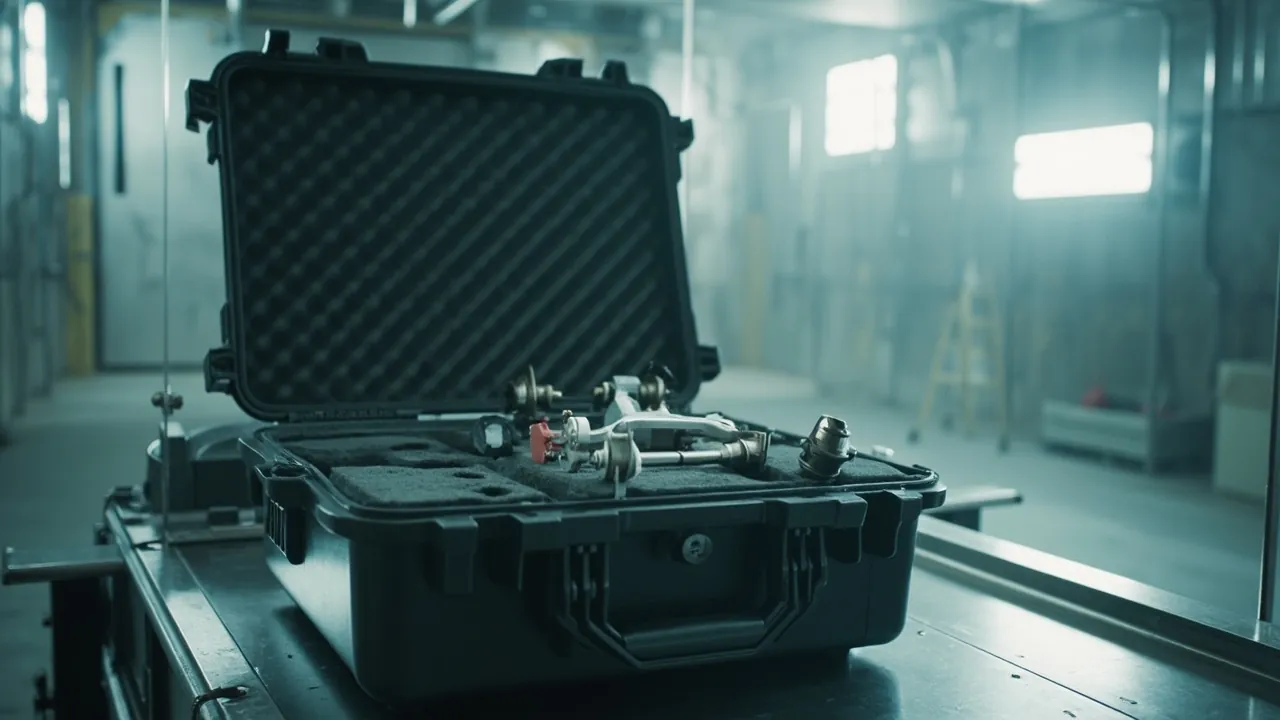
The short answer: there is no single number. The duration of a salt spray test follows from three things — the corrosivity of the target environment, the surface treatment of the metal parts, and the acceptance criteria. As empirical bands for neutral salt spray (NSS): 24–48 hours is usually enough for dry inland or indoor urban use; 96–168 hours for general outdoor and humid industrial locations; 240–480 hours for outdoor use within one to five kilometres of the coast; and 480–720 hours, sometimes up to 1,000 hours, for direct marine exposure, ship decks or offshore platforms, ideally combined with a cyclic corrosion test. The essential point is this: the failure points in a protective case are almost never in the plastic shell. They are in the latch, hinge pin, screws, inserts and pressure relief valve. Most engineering plastics resist salt spray well; what determines coastal service life is the material and plating of the hardware. This article sets out the full basis for duration banding, the operating parameters of ISO 9227 and ASTM B117, the mapping to ISO 12944 corrosivity categories, the assessment methods, and a report checklist for tender evaluation.
A common misconception is that a larger number of hours is always better. In reality, a duration only means something once the method, the acceptance criteria and the test objects are fixed. Four hundred and eighty hours under neutral salt spray and 480 hours under copper-accelerated acetic acid salt spray are not comparable. A 240-hour report that permits light white rust and a 240-hour report that forbids any red rust differ in severity by several times. And two 480-hour specimens whose hardware carries 6 µm and 12 µm of plating will end very differently. So before asking how many hours, procurement and engineering staff should ask three questions: which salt spray method is this, what is the acceptance criterion, and which components are being assessed?
This guide is written for procurement, structural and quality staff working with protective cases, tool cases, military-spec cases and waterproof junction boxes. It breaks down the method families, the basis for duration banding, the selection logic for metal parts and surface treatments, how to apply the framework to coastal and sea freight scenarios, and how to read a salt spray report. All figures are given as typical or empirical values, and the binding conditions are those in the released standards and the agreed test plan.
Contents
- What a salt spray test measures: three variables and one pass line
- The standards: ISO 9227, ASTM B117 and GB/T 10125
- Three salt spray methods: NSS, AASS and CASS
- Duration bands: what 24, 48, 96, 240, 480 and 720 hours mean
- Why salt spray hours cannot be converted into service years
- ISO 12944 corrosivity categories: C1 to C5 and durability
- Which parts of a protective case suffer most
- Material and surface treatment: 304, 316, zinc plating, powder coating, anodising
- Choosing hours by scenario: inland, coastal, sea freight and offshore
- Assessment methods: ISO 4628, ASTM D1654 and ASTM D610
- Cyclic corrosion testing: closer to reality than neutral salt spray
- How salt spray, IP ratings and sea freight protection fit together
- Common misunderstandings and traps
- Frequently Asked Questions
- Conclusion and Related Reading
What a salt spray test measures: three variables and one pass line
The salt spray test is an accelerated corrosion test: a specimen is placed in a sealed chamber, a salt solution of specified concentration is sprayed continuously, the chamber is held at a specified temperature for a specified duration, and the corrosion is then assessed. The aim is to reproduce months or years of natural atmospheric corrosion within days or weeks. Three variables govern the result:
- The chemistry of the fog. Is it neutral salt spray, or has acetic acid or copper salt been added? This fixes both the acceleration factor and the applicable objects.
- Chamber temperature and spray rate. Higher temperature and greater spray volume accelerate corrosion, and both must be held within narrow limits or the result cannot be reproduced.
- Test duration. From 24 hours to over 1,000 hours. Duration sets the total exposure, but it can only be compared across tests when the method, temperature and acceptance criteria match.
The pass line has two parts: the type of corrosion (is light white rust permitted, or is red rust forbidden entirely) and the degree of corrosion (spot count, area fraction, creep distance from a scribe). The same number of hours means very different levels of severity under different acceptance criteria. This is where salt spray reports are easiest to make look impressive: if the acceptance threshold is written loosely, any duration can be reported as a pass.
| Variable | Typical value | Effect | Common mistake |
|---|---|---|---|
| --- | --- | --- | --- |
| Salt spray type | NSS / AASS / CASS | Acceleration factor and applicable objects | Comparing CASS results with NSS results |
| Solution concentration | About 50 g/L sodium chloride (about 5%) | Corrosion rate | Poor concentration control |
| Collection rate | About 1–2 mL/h per 80 cm² | Whether the spray rate is adequate | No collection rate recorded |
| Chamber temperature | About 35 °C for NSS and AASS; about 50 °C for CASS | Corrosion rate | Excessive temperature fluctuation |
| pH | About 6.5–7.2 for NSS; about 3.1–3.3 for AASS and CASS | Corrosion mechanism | pH not measured |
| Duration | 24 h to over 1,000 h | Total exposure | Stating duration without method or criteria |
One-line principle: a duration without method, temperature, collection rate and acceptance criteria is not a meaningful technical specification.
The standards: ISO 9227, ASTM B117 and GB/T 10125
Three families of standards govern salt spray testing. They are highly similar but expressed differently.
| Standard | Title and scope | Methods covered | Typical pairing |
|---|---|---|---|
| --- | --- | --- | --- |
| ISO 9227 | Corrosion tests in artificial atmospheres — salt spray tests | NSS, AASS, CASS | ISO 4628 series assessment |
| ASTM B117 | Operating salt spray (fog) apparatus | Neutral salt spray | ASTM D1654, D610 assessment |
| GB/T 10125 | Corrosion tests in artificial atmospheres — salt spray tests | NSS, AASS, CASS | GB/T 6461 assessment |
| IEC 60068-2-11 / -52 | Salt mist tests for electronic products | Constant salt mist / cyclic salt mist | Environmental testing of electronics |
| ASTM G85 | Modified salt spray (fog) testing | Acidified, cyclic, SWAAT and others | Aluminium alloys, automotive parts |
| ISO 14993 | Cyclic corrosion tests (salt spray, dry, wet) | Cyclic | Closer to natural environments |
ISO 9227 and GB/T 10125 mirror each other in structure, both covering neutral salt spray (NSS), acetic acid salt spray (AASS) and copper-accelerated acetic acid salt spray (CASS), and they are the two most frequently cited in Chinese projects. ASTM B117 covers neutral salt spray only and is the most widely used operating practice for salt spray apparatus in the North American system, normally paired with ASTM D1654 for corrosion creep from a scribe or ASTM D610 for degree of rusting. So a report stating "480 hours to ASTM B117" and one stating "480 hours NSS to ISO 9227" describe similar but not identical conditions, particularly in the wording of collection rate and solution pH. Where a test crosses standards, the revision cited should be stated.
For military and premium equipment programmes, MIL-STD-810H Method 509 salt fog may also appear. It is likewise based on neutral salt spray, but the conditions are set by tailoring and are often combined with temperature, humidity and vibration into a complete environmental profile; the division of labour is set out in how cases comply with MIL-STD-810.
Three salt spray methods: NSS, AASS and CASS

The difference between the three methods is best described as progressively increasing corrosivity.
| Method | Full name | Solution | Temperature | Acceleration | Typical use |
|---|---|---|---|---|---|
| --- | --- | --- | --- | --- | --- |
| NSS | Neutral salt spray | About 50 g/L NaCl, pH 6.5–7.2 | About 35 °C | Baseline | General metals and plating |
| AASS | Acetic acid salt spray | Acidified with acetic acid to pH about 3.1–3.3 | About 35 °C | Higher than NSS | Decorative plating such as Cu-Ni-Cr |
| CASS | Copper-accelerated acetic acid salt spray | Acetic acid plus copper salt, pH about 3.1–3.3 | About 50 °C | Highest | Rapid evaluation of decorative plating |
The selection rule is simple: general verification of a protective case uses NSS. The metal parts of a protective case are typically stainless steel, zinc-plated steel or powder-coated components, and NSS already exposes their corrosion weaknesses effectively. AASS and CASS are aimed mainly at decorative electroplated layers such as sanitary ware and appearance hardware, where they assess porosity and defects over a short period; they are not commonly used for structural parts of a protective case. Using short-duration CASS results to claim salt spray resistance, or comparing NSS results with CASS results, is a method mismatch and the conclusion does not stand.
One practical note: spray direction, specimen angle (usually 15°–30° from vertical) and shadowing all affect the result. Specimens must not shield one another, and salt solution must not pool on surfaces for long periods. The report should record how specimens were positioned and where in the chamber they sat.
Duration bands: what 24, 48, 96, 240, 480 and 720 hours mean
This is the core section. The bands below assume neutral salt spray (NSS) and assume that the objects assessed are the hardware and surface-treated parts of a protective case.
| Duration (NSS) | Exposure intensity (empirical) | Typical scenario | Note |
|---|---|---|---|
| --- | --- | --- | --- |
| 24 h | Basic screening | Dry inland, indoor storage | Quick comparison only, not a coastal claim |
| 48 h | Light protection | Indoor urban, protected transport | Common for incoming plating checks |
| 96 h | Moderate protection | General outdoor, humid industrial | Entry level for most general-purpose cases |
| 168 h (7 days) | Moderate to strong | Long outdoor exposure, industrial atmosphere | Frequently used as a general export requirement |
| 240 h (10 days) | Strong | Coastal outdoor within 1–5 km | Common starting point for coastal projects |
| 480 h (20 days) | Strong plus | Coastal outdoor, sea freight export | Common requirement for coastal and marine export |
| 720 h (30 days) | Very strong | Direct marine exposure, shipboard equipment | Often combined with cyclic corrosion testing |
| 1,000 h and above | Extreme | Offshore platforms, special equipment | Needs clear criteria or the value is limited |
How should this table be used? In three steps.
Step one: establish the environmental corrosivity category. Inland, coastal and offshore environments differ enormously in corrosion intensity, and the ISO 12944 classification in the next section is a useful reference.
Step two: establish the protective capability of the hardware. At the same duration, 304 stainless steel, 316 stainless steel, zinc-plated steel and powder-coated parts behave very differently. Select the material first, then fix the duration — not the other way round.
Step three: establish the acceptance criteria. Whether the criterion is "no red rust" or "no corrosion of any kind", "creep from the scribe no more than 2 mm" or "no more than 5 mm", decides whether the duration is sufficient. Duration and criteria must appear as a pair, otherwise severity cannot be assessed.
Why salt spray hours cannot be converted into service years
This is the point most likely to mislead. There is no general conversion between neutral salt spray hours and years of natural exposure. Three reasons apply.
First, salt spray is a constant single stress, while nature is a cyclic multi-stress environment. The natural environment combines wet and dry alternation, sunlight and ultraviolet, temperature cycling, rain washing and pollutant deposition; these act together in a way that constant spraying does not. Coastal failure of a protective case is typically the result of a cycle of daytime ultraviolet ageing, nighttime condensation and salt deposition — and there is no ultraviolet or dry stage in the salt spray chamber.
Second, the acceleration factor differs between material systems. For some coating systems a few hundred hours of neutral salt spray corresponds roughly to several years of coastal exposure; for others the same duration corresponds to less than a year. The factor depends on coating type, thickness, substrate and pretreatment, and cannot be transferred between systems.
Third, environments themselves vary enormously. Two locations both described as "coastal", one 0.5 km and one 5 km from the sea, can differ several-fold in salt deposition and humidity; windward and leeward faces differ too. A single formula of "hours equals years" must therefore distort.
| Dimension | Neutral salt spray | Natural coastal exposure |
|---|---|---|
| --- | --- | --- |
| Stress type | Constant salt fog | Salt fog plus UV, wet-dry and thermal cycling |
| Time scale | Tens to thousands of hours | Years to decades |
| Reproducibility | High | Low, varying by site and year |
| Primary use | Material and process screening, batch comparison | True service life evaluation |
The correct use is therefore to treat salt spray testing as a screening and comparison tool, not a life-conversion tool. Its value lies in comparing materials, platings and suppliers, and in verifying batch consistency — not in claiming that "480 hours equals ten coastal years". Where true service life must be assessed, cyclic corrosion testing combined with outdoor exposure data is the appropriate route.
ISO 12944 corrosivity categories: C1 to C5 and durability

Since direct conversion is impossible, the industry uses a different approach: define the protective scheme from the corrosivity category of the environment. ISO 12944 for protective paint systems on steel structures provides the most widely used environmental classification, and protective case projects commonly borrow it to define coastal selection criteria.
| Category | Environment | Typical location | Suggested salt spray duration (empirical) |
|---|---|---|---|
| --- | --- | --- | --- |
| C1 | Very low | Heated, clean interiors | 24–48 h |
| C2 | Low | Low-pollution rural, unheated interiors | 48–96 h |
| C3 | Medium | Urban and general industrial atmosphere, low-salinity coastal | 96–240 h |
| C4 | High | Industrial areas, moderate-salinity coastal | 240–480 h |
| C5 | Very high | Highly humid aggressive industrial, high-salinity coastal | 480–720 h |
| CX (some revisions) | Extreme | Offshore platforms, tropical high-salinity zones | Above 720 h with cyclic testing |
ISO 12944 also bands durability in terms of protective life using common categories of low, medium, high and very high, corresponding to different year ranges. For a protective case the most practical approach is this: fix the target corrosivity category first (C3, C4 or C5), then define a matched combination of hardware material, plating thickness and salt spray duration — rather than debating hours in isolation. A model aimed at a C5 coastal market, for example, should combine 316 stainless steel or thick plating with 480–720 hours of NSS and clearly stated acceptance criteria. Raising the duration from 240 to 480 hours while keeping thin zinc-plated hardware will still fail.
Which parts of a protective case suffer most
This is the section most often skipped. Corrosion failure in a protective case almost never occurs in the plastic shell; it concentrates in metal and surface-treated parts.
| Component | Common material | Main corrosion risk | Mitigation |
|---|---|---|---|
| --- | --- | --- | --- |
| Latch | Zinc-plated steel, stainless spring steel | Spring corrosion, jamming, fracture | 316 stainless or thicker plating |
| Hinge pin | Stainless steel, zinc-plated steel | Pin corrosion, seizure | 316 stainless with passivation |
| Screws and bolts | Zinc-plated steel, stainless steel | Corrosion, galling, fracture | Stainless fasteners with anti-galling treatment |
| Inserts | Brass, zinc-plated steel, stainless steel | Interfacial corrosion with plastic, loosening | 316 stainless or surface treatment |
| Handle | Metal frame with overmoulded grip | Frame corrosion, grip delamination | Anodised aluminium or stainless steel |
| Pressure relief valve | Spring, diaphragm, metal body | Spring corrosion, valve seizure | Stainless spring with corrosion-resistant body |
| Nameplates and labels | Aluminium, polyester film | Fading, peeling, substrate corrosion | Anodising with weather-resistant adhesive |
| Wheels and bearings | Steel balls, plated axle | Corrosion and seizure | Stainless bearings or sealed design |
The most valuable engineering conclusion is that a salt spray report must list the components assessed. A report stating only "complete case passed 480 hours of salt spray", without saying whether the latches, hinges and screws were on the specimen and included in the assessment, cannot establish what that pass covers. The test plan should therefore specify a critical hardware list, and the report should give a corrosion assessment and photographs for each item.
Material and surface treatment: 304, 316, zinc plating, powder coating, anodising
Material selection is the decisive factor in salt spray resistance, and it matters more than duration. The table below compares common options.
| Option | Salt spray resistance (empirical) | Advantages | Limitations |
|---|---|---|---|
| --- | --- | --- | --- |
| 304 stainless steel | Moderate; pitting in chloride environments | Reasonable cost, generally good | Pitting and rust staining in long coastal exposure |
| 316 stainless steel | Good | Molybdenum addition, strong chloride pitting resistance | Higher cost |
| Zinc-plated steel (trivalent passivation) | Depends on coating thickness | Low cost, sacrificial anode protection | Rapid corrosion once plating is breached |
| Powder coating | Good, depending on system and thickness | Wide colour and appearance choice | Poor edge coverage, creep at scratches |
| Anodised aluminium | Moderate to good | Light, attractive | Corrosion resistance depends on sealing quality |
| Untreated carbon steel | Poor | Lowest cost | Unsuitable for any outdoor scenario |
Three selection points:
- Prefer 316 stainless steel for coastal and sea freight applications. 304 is prone to pitting in chloride environments; it may pass a short salt spray test but still show rust staining after long coastal exposure. Where cost is sensitive, 304 can be retained with added passivation and drainage-aware structural design.
- Plating thickness matters more than plating type. For zinc plating, 6 µm and 12 µm can differ several-fold in salt spray endurance. The report should record the measured plating thickness, not merely state "zinc plated".
- The weak points of powder coating are edges and scratches. Coated parts usually begin to corrode at cut edges, sharp corners and scratches, so salt spray specimens should retain production edges rather than being polished, which would give an optimistic result.
The selection logic for the plastic shell itself, covering toughness, weathering and chemical resistance, is in how to select protective case plastics, and the long-term effects of ultraviolet exposure are in UV ageing testing for cases.
Choosing hours by scenario: inland, coastal, sea freight and offshore

Consolidating the logic into actionable scenario guidance.
| Scenario | Environmental characteristics | Suggested duration (NSS, empirical) | Key requirement |
|---|---|---|---|
| --- | --- | --- | --- |
| Dry inland storage | Dry, no salt | 24–48 h | Routine sampling is sufficient |
| Urban and general outdoor | Light pollution, occasional rain | 96–168 h | Focus on plating thickness |
| Coastal outdoor, 1–5 km | Moderate salt deposition, high humidity | 240–480 h | 316 stainless hardware recommended |
| Coastal within 1 km or direct sea wind | High salt deposition | 480–720 h | 316 stainless with drainage design |
| Sea freight export (in container) | High temperature and humidity plus sea salt | 240–480 h | Combine with moisture barrier packaging and desiccant |
| Ship deck or offshore platform | Continuous salt spray and spray wash | Above 720 h, cyclic test recommended | All-stainless scheme with periodic maintenance |
Sea freight deserves a specific note. The corrosion mechanism inside a container is high temperature and humidity plus condensation driven by diurnal temperature swings plus residual sea salt, and the dominant cause is often internal condensation rather than external salt fog ingress. Sea freight protection is therefore two things at once: corrosion resistance of the hardware and moisture control inside the packaging. The former determines whether the hardware survives coastal storage; the latter determines whether the equipment arrives intact. The full protection strategy for sea freight is set out in what to watch for in sea freight and waterproof design for outdoor cases.
Assessment methods: ISO 4628, ASTM D1654 and ASTM D610
Once the exposure is complete, how to assess matters more than is commonly recognised. Four methods dominate.
| Method | What it assesses | Output form | Typical pairing |
|---|---|---|---|
| --- | --- | --- | --- |
| ISO 4628 series | Blistering, rusting, cracking, flaking | Ratings such as rust grade Ri 0–5 | ISO 9227 |
| ASTM D610 | Degree of rusting on painted steel | Grade 0–10 by area fraction | ASTM B117 |
| ASTM D1654 | Corrosion creep from a scribe | Grade 0–10 or creep width in mm | ASTM B117 |
| ASTM B117 visual check | Location and count of rust spots, white rust, red rust | Descriptive record | Internal sampling |
Two practical recommendations.
First, assess white rust and red rust separately. On zinc-plated parts, surface white rust is a normal product of sacrificial anode protection and does not mean the substrate has failed; red rust indicates that the plating has been penetrated and the substrate is corroding. A criterion that says only "no corrosion" is too crude; the common formulation is "light white rust permitted, no red rust".
Second, require scribe test results. The weakest points of a coated part are cut edges and scratches, and ASTM D1654 creep assessment from a scribe exposes them effectively. A salt spray report without a scribe assessment can show that the surface remained intact, but not that the coating system provides effective protection.
An acceptable salt spray report should contain photographs of the specimen before, during and after the test, an item-by-item assessment of critical hardware, the assessment standards and grades used, a description of corrosion locations, and a clear correspondence between the acceptance criteria and the conclusion. For how to check a report's accreditation, see how to read a CNAS or CMA test report.
Cyclic corrosion testing: closer to reality than neutral salt spray
The greatest limitation of neutral salt spray is that it applies a single constant stress. To approach real conditions more closely, the industry increasingly uses cyclic corrosion testing, in which a single cycle passes through salt spray, drying, wetting (condensation) and sometimes a low-temperature stage, reproducing daily and weather variation.
| Test type | Main standard | Cycle composition | Suitability |
|---|---|---|---|
| --- | --- | --- | --- |
| Constant neutral salt spray | ISO 9227 NSS / ASTM B117 | Continuous spraying | Screening and batch comparison |
| Cyclic salt mist | IEC 60068-2-52, ISO 14993 | Spray, dry, wet | Electronics and structural parts |
| Modified salt spray | ASTM G85 | Acidified, cyclic, SWAAT and others | Aluminium alloys, automotive parts |
| Military salt fog | MIL-STD-810H Method 509 | Set by tailoring, may be cyclic | Environmental adaptability of defence equipment |
The selection logic is: neutral salt spray for routine acceptance, cyclic corrosion where a more realistic evaluation is wanted. Note that cyclic test hours and neutral salt spray hours are not directly convertible; a 24-hour cycle usually imposes more complex stresses than 24 hours of continuous spraying. When citing a cyclic test, state the cycle composition and the duration of each stage rather than only the total duration.
For protective cases, where the target market is high-salinity coastal or offshore, adding a cyclic test to the NSS baseline is recommended, because real failure modes — creep after coating damage, crevice corrosion on hardware, and internal rust driven by condensation — do not fully appear under constant salt spray.
How salt spray, IP ratings and sea freight protection fit together
The three are often conflated. Their division of labour is clear.
| System | Question answered | Standard | Purpose for a protective case |
|---|---|---|---|
| --- | --- | --- | --- |
| IP rating | To what level dust and water are excluded | IEC 60529 / GB/T 4208 | Declaration of dust and water protection |
| Salt spray test | How long material and plating resist corrosion | ISO 9227 / ASTM B117 / GB/T 10125 | Coastal and marine corrosion resistance |
| Sea freight protection | Whether a whole consignment arrives intact | Packaging and moisture control | Comprehensive protection during logistics |
An IP rating and a salt spray test are two different things: IP governs whether water gets in, salt spray governs whether what is exposed will rust. A case that passes IP67 may still have latches and hinges that rust during long coastal use. Conversely, a case with all-stainless hardware may still let sea water in if the seal fails. For coastal and marine products, both verifications should therefore be required together: IP67 or IP68 to demonstrate ingress protection and salt spray testing to demonstrate hardware corrosion resistance, reported separately. The definition and verification route for IP ratings are in IP67 protective case design and verification and what an IP67 rating actually means, and the practical sealing design is in how to select case seal materials.
Common misunderstandings and traps
Trap one: more hours is always better. Duration is only total exposure; the method and the acceptance criteria determine severity. Four hundred and eighty hours of CASS and 480 hours of NSS are not comparable in harshness.
Trap two: substituting CASS or AASS results for NSS. The three methods have different acceleration factors and applicability, and cannot be compared across methods.
Trap three: stating "passed 480 hours of salt spray" without the criteria. A duration without a threshold cannot be assessed or reproduced.
Trap four: assessing only the case body and not the hardware. Corrosion failure in a protective case is almost entirely in metal parts, so a report that omits critical hardware has incomplete coverage.
Trap five: no scribe assessment. The weakest points of a coated part are cut edges and scratches, and visual inspection of intact surfaces alone overestimates protection.
Trap six: equating white rust with failure. White rust on zinc-plated parts is normal sacrificial protection, and the assessment must distinguish it from red rust.
Trap seven: treating salt spray hours as a life conversion. No general conversion exists; the acceleration factor depends on material system and environment.
Trap eight: using polished specimens. Polishing removes production edges and burrs and biases the result towards optimism.
Trap nine: ignoring post-test cleaning and assessment timing. Specimens should be cleaned to the standard and assessed promptly after removal; leaving them to stand allows corrosion to continue and distorts the verdict.
Frequently Asked Questions
Q: How many hours of salt spray testing should a protective case have? A: There is no single number, but empirical bands can be given by target environment. For dry inland or indoor storage, 24–48 hours of neutral salt spray is sufficient for rapid sampling. For general outdoor and humid industrial locations, use 96–168 hours. For outdoor use within one to five kilometres of the coast, 240–480 hours is recommended. For direct marine exposure, ship decks and offshore platforms, 480–720 hours is usual, with some projects reaching 1,000 hours and a cyclic corrosion test added. One qualification is essential: the duration must be fixed together with the method, hardware material, plating thickness and acceptance criteria. The same 480 hours may pass with 316 stainless hardware and fail with thin zinc plating. The procurement agreement is best written as a complete condition — for example, "480 hours NSS to ISO 9227, no red rust on critical hardware, creep from a scribe no more than 2 mm" — rather than a bare number.
Q: What is the difference between NSS, AASS and CASS? A: The three form a progression of increasing corrosivity. NSS (neutral salt spray) uses about 50 g/L sodium chloride at pH about 6.5–7.2 and a chamber temperature of about 35 °C, and is the most basic and general method, suited to stainless steel, zinc-plated and coated parts. AASS (acetic acid salt spray) adds acetic acid to the same solution, lowering pH to about 3.1–3.3, which markedly increases corrosivity, and is used mainly for decorative electroplating. CASS (copper-accelerated acetic acid salt spray) further adds copper salt and raises the temperature to about 50 °C, giving the highest corrosivity, and is used to assess plating porosity and defects within very short periods. General verification of a protective case uses NSS, because its hardware is mostly stainless, zinc-plated or powder-coated and NSS already exposes the weaknesses. Note in particular that results from the three methods cannot be converted or compared with one another; citing across methods is a technical error.
Q: How many salt spray hours equal a certain number of coastal years? A: There is no general relationship. The question is common but technically unsound, for three reasons. First, a salt spray test applies a single constant stress with continuous spraying, whereas the natural coastal environment combines salt fog, ultraviolet, wet-dry alternation and thermal cycling, so the failure mechanisms differ. Second, the acceleration factor varies between material systems: a few hundred hours may correspond to several coastal years for some coating systems and to less than a year for others, depending on coating type, thickness, substrate and pretreatment, and cannot be transferred between systems. Third, coastal environments themselves vary widely: locations 0.5 km and 5 km from the sea can differ several-fold in salt deposition. The correct use is to treat salt spray testing as a screening and comparison tool — comparing materials, platings and suppliers, and verifying batch consistency. Where true service life must be assessed, use cyclic corrosion testing with outdoor exposure data, or use the ISO 12944 corrosivity and durability framework to define the protective scheme.
Q: Where does corrosion failure normally appear on a protective case? A: Almost entirely on metal and surface-treated parts, not in the plastic shell. Most engineering plastics such as PC, PP and ABS resist salt spray well, and its effect on them is mainly a long-term surface change rather than structural corrosion. What genuinely corrodes is the latch, whose spring can corrode, jam or fracture; the hinge pin, which can seize after corrosion; the screws and bolts, which can corrode, gall or break; the inserts, where interfacial corrosion with the plastic can cause loosening; the handle frame; the spring and body of the pressure relief valve; the wheel bearings on wheeled cases; and the nameplate. A salt spray test plan should therefore include a critical hardware list, and the report should assess each item. A report describing only the appearance of the shell and omitting the hardware has incomplete coverage and cannot answer how long the case will last on the coast.
Q: Is salt spray testing the same as IP67 waterproof testing? A: No. They answer entirely different questions and cannot substitute for each other. An IP rating under IEC 60529 or GB/T 4208 answers to what level dust and water are excluded, assessing the enclosure's ability to keep solid foreign objects and water out; IP67 corresponds to a short-term immersion condition. A salt spray test answers how long material and plating resist corrosion in a saline environment, assessing electrochemical corrosion irrespective of whether water enters. A case that passes IP67 may still have latches and hinges that rust during long coastal use; conversely, a case with all-stainless hardware may still admit sea water if the seal ages and fails. For products aimed at coastal and sea freight markets, both verifications are recommended: IP67 or IP68 for ingress protection and salt spray for hardware corrosion resistance, reported separately and never conflated.
Q: For sea freight export, how many hours of salt spray are needed? A: Two different questions need separating. The first is protecting the goods inside the container, where the dominant cause of corrosion is usually not external salt fog ingress but internal condensation driven by high temperature and humidity plus diurnal temperature swings, together with residual sea salt; the emphasis is therefore moisture barrier packaging, desiccant and sensible stacking, with 240–480 hours of salt spray typically taken as the requirement for coastal storage resistance. The second is the product's own coastal durability, which depends on the final service environment: for long outdoor use in coastal areas, 480 hours or more and 316 stainless hardware are recommended, while 240–480 hours is usually sufficient where the case is stored in a coastal warehouse and then used inland. Express sea freight logistics requirements and the target market corrosivity category separately in the procurement agreement, mapping them to the moisture control scheme and the salt spray duration respectively, rather than using one number to cover two entirely different failure mechanisms. For the full sea freight picture see what to watch for in sea freight.
Q: Why does a salt spray test need a scribe? Is an unscribed specimen not more complete? A: An unscribed test measures the performance of an intact surface, but coated parts will certainly be scratched in real use. The protective mechanism of powder coating, anodising and plating is a barrier: a continuous dense layer separating the substrate from the corrosive medium. Once a scratch, cut edge or sharp corner appears, the barrier is broken, corrosion begins at that point and spreads sideways. A scribe test, usually assessed to ASTM D1654, is precisely what measures how fast corrosion creeps once the coating is damaged, and it is a key indicator of coating system quality. Testing intact surfaces only, even with no rust after 720 hours, says nothing about behaviour after damage and can produce an overly optimistic conclusion. When issuing a salt spray report, provide results for both intact and scribed specimens, and state the scribe width, the test method and the creep rating.
Q: Once the salt spray test is done, how is a pass determined? A: The criteria must be written into the test plan before the test; deciding afterwards removes objectivity. Four elements are commonly used. First, the type of corrosion: distinguish white rust from red rust, with the usual criterion being "light white rust permitted, no red rust". Second, the degree of corrosion: assess using ISO 4628 rust grades or ASTM D610 area-fraction grades, for example requiring the rust grade not to exceed a stated level. Third, scribe creep: assess corrosion creep width from the scribe to ASTM D1654, for example requiring no more than 2 mm. Fourth, retained function: beyond appearance, check that latches open and close, hinges rotate and screws can be removed, because seizure and galling caused by corrosion are failures too. Specimens should also be cleaned to the standard and assessed promptly after removal, since leaving them allows corrosion to continue and distorts the conclusion. An acceptable report gives before and after photographs, item-by-item assessments, the assessment standards and grades used, and a clear mapping between criteria and conclusion.
Q: My supplier provided only a one-page "passed 480 hours of salt spray" conclusion. What should I do? A: Request four categories of information before deciding whether to accept it. First, method and standard: is it ISO 9227 NSS, ASTM B117 or GB/T 10125, and what were the solution concentration, pH, chamber temperature and collection rate? Second, acceptance criteria: what exactly is the threshold, does it distinguish white rust from red rust, and was a scribe assessment performed? Third, tested objects: which components were on the specimen, were the critical hardware items — latch, hinge, screws, inserts, pressure relief valve — present and individually assessed, and do the model, material and hardware configuration in the report match production? Fourth, raw records: photographs before, during and after the test, descriptions of corrosion locations, and records of the test conditions. A report lacking these four cannot support the conclusion "salt spray resistant"; it can only show that a test was run once. Write these elements directly into the procurement agreement as acceptance clauses. For checking report accreditation see how to read a CNAS or CMA test report.
Conclusion and Related Reading
Back to the question in the title: the duration of a protective case salt spray test follows from the target environmental corrosivity category, the surface treatment of the metal parts and the acceptance criteria. Using empirical neutral salt spray bands: 24–48 hours for inland and indoor, 96–168 hours for general outdoor, 240–480 hours for coastal locations within one to five kilometres, and 480–720 hours or more for direct marine exposure and offshore platforms, combined with cyclic corrosion testing. Three points matter more than the number itself. First, there is no general conversion between salt spray hours and natural years — it is a screening and comparison tool, not a life-conversion tool. Second, failure points are almost entirely in the latch, hinge, screws, inserts and pressure relief valve, which makes material and plating selection more decisive than duration. Third, duration must be paired with acceptance criteria that separate white rust from red rust and include a scribe assessment, otherwise severity cannot be judged.
Three actions that can be taken immediately: first, write the salt spray requirement as a complete condition rather than a bare number — for example, ISO 9227 NSS, 480 hours, no red rust on critical hardware, scribe creep no more than 2 mm. Second, attach a critical hardware list to the test plan and require the report to assess each item with photographs, avoiding the vague conclusion of "the complete case passed". Third, require both IP verification and salt spray verification for coastal and sea freight projects — IP67 or IP68 for ingress protection and salt spray for hardware corrosion resistance, since the two divide the work and neither is dispensable.
JUNZHJIA, manufactured by KeXin New Materials (Guangdong) Co., Ltd., covers protective cases, tool cases, military-spec storage boxes and waterproof junction boxes for wholesale, distribution, OEM/ODM and global supply. The company can specify 316 stainless hardware and plating options for coastal and sea freight markets, help define salt spray durations and acceptance criteria, and supply structural documentation, material data and test files.
Related Reading