

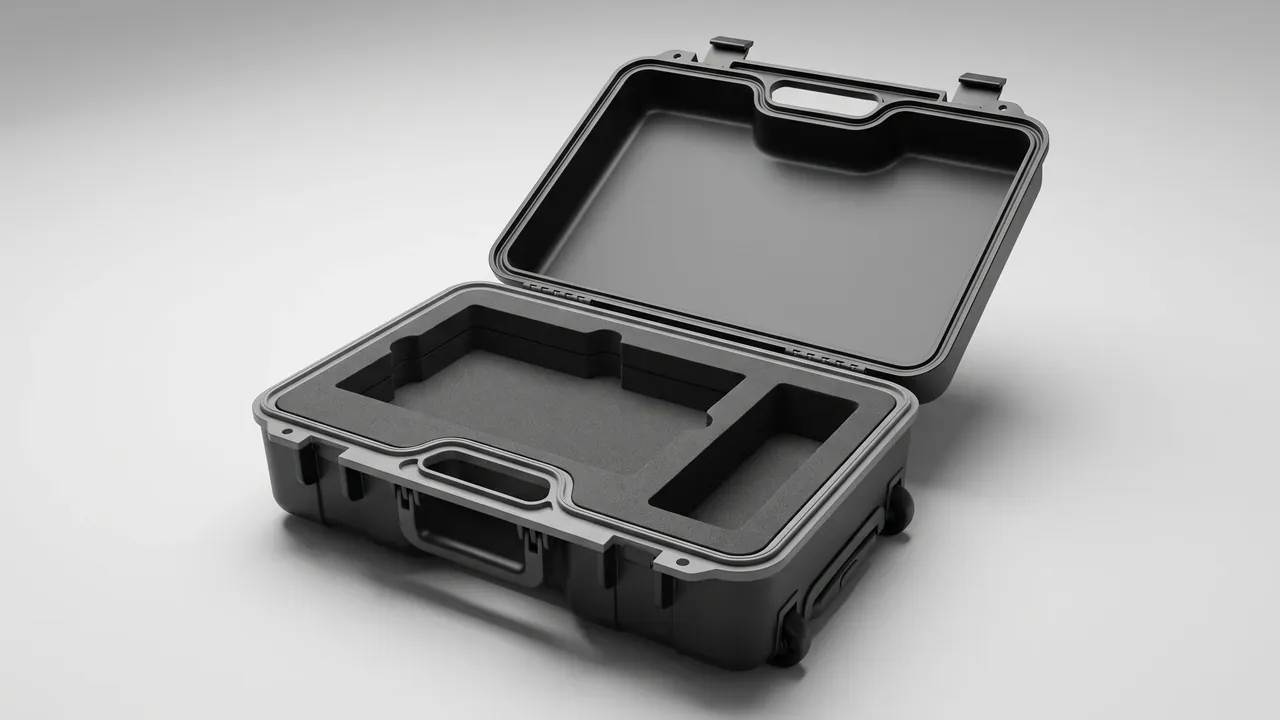
Quick answer: Buy a portable case PC by working backwards from the shipping conditions: cavity from the machine footprint, cushion from the worst drop height, an ESD lining with a stated surface resistance and a bleed path, then the handle and wheels, then gasket and valve.
Table of contents
- Portable Case PC Selection: Order of Five Criteria
- Cavity Size: Machine Footprint Sets the Case Class
- Cushion Thickness: Working Back from Drop Height
- ESD Lining: Surface Resistance and a Bleed Path
- Handle, Latches and Sealing: Carrying Posture Sets Structure
- FAQ
1. Portable Case PC Selection: Order of Five Criteria
You can shortlist whatever cavity looks good in a catalogue, or lay the machine and the shipping route on the table first.
| Criterion | Locks down | A wrong call shows up as |
|---|---|---|
| Cavity clearance | Case class | Will not fit, or slides |
| Cushion thickness | Foam build, height | Corners fail first |
| ESD lining | Material, grounding | Faults after arrival |
| Handle, wheels | Carrying posture | Boss tears out |
| Gasket, valve | Air freight | Lid jams like a suction cup |
Order matters: change the cavity and the foam and outer height move with it.
2. Cavity Size: Machine Footprint Sets the Case Class
A mid-tower desktop measures around 450 by 210 by 450 mm, a 24-inch monitor with stand near 560 by 340 by 60 mm.
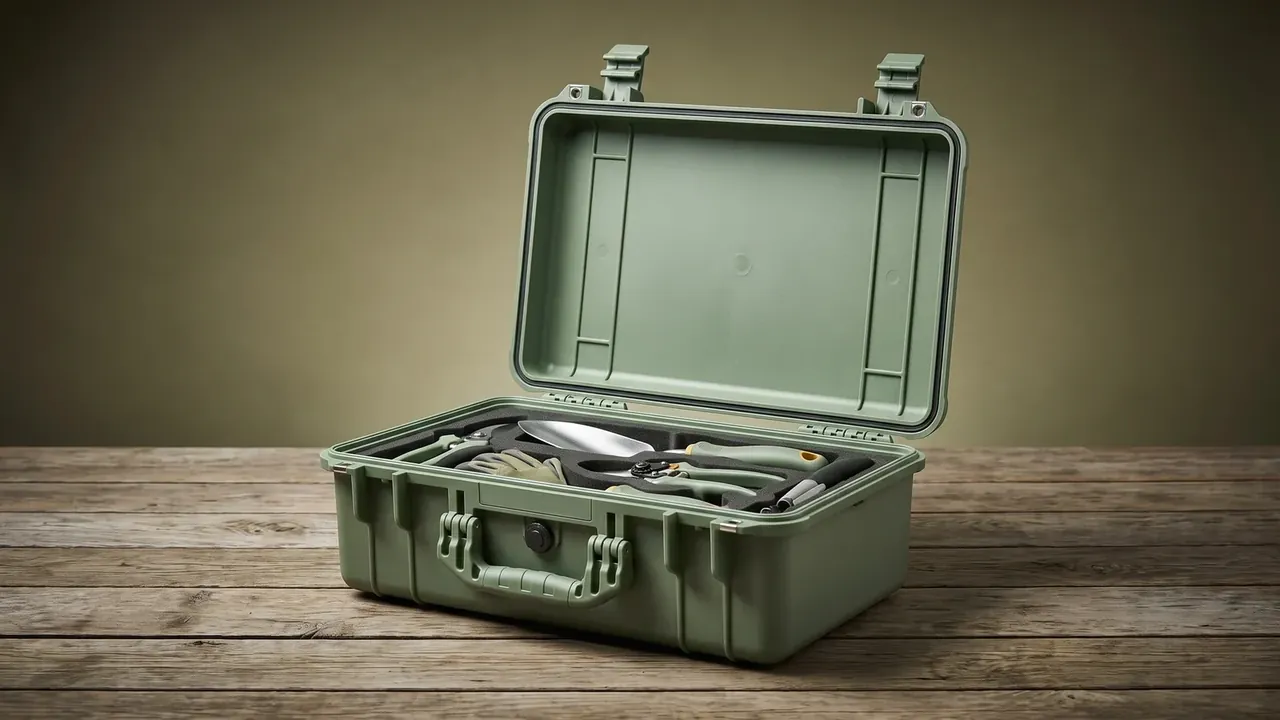
For a portable case PC, add 15 to 20 mm per side: past 30 mm the machine slides, below 10 mm the foam is crushed against a hard wall. Then allow 8 mm corner pads and 5 mm for ribs.
3. Cushion Thickness: Working Back from Drop Height
Air freight handling produces corner drops near 1.2 m, parcel sorting around 0.9 m, hand carrying 0.6 m. For a 500 mm cavity that is 40 mm of foam against 15 mm.
Thicker is not better: every millimetre adds height, weight and freight cost. Judge cushion by peak acceleration on a portable case PC, held under 40 G in a 1.2 m corner drop. PE at 30 kg per cubic metre survives repeated drops; EVA at 45 holds a crisp face.
| Route | Drop height | Total foam | Build |
|---|---|---|---|
| Carried by hand | 0.6 m | 15 mm | Single PE layer |
| Single parcel | 0.9 m | 25 mm | PE with EVA facing |
| Air freight | 1.2 m | 40 mm | Double PE plus divider |
Cut the pocket 2 to 3 mm shallower than the machine so the lid foam presses down and nothing drops out when inverted.
4. ESD Lining: Surface Resistance and a Bleed Path
Static protection is skipped because it shows up nowhere at goods-in. Mainboards tolerate discharges in the low hundreds of volts; two steps on a dry carpet build several thousand.

Surface resistance should sit between ten to the sixth and ten to the ninth ohm: below that band the lining dumps the charge on contact, above it the charge sits there. Because PP and ABS are insulators, static needs a route out through metal latches or a moulded stud, under one ohm to the lining. Below 30 percent relative humidity ordinary foam climbs an order of magnitude.
5. Handle, Latches and Sealing: Carrying Posture Sets Structure
The fixing beats the shape: a through-bolted boss with a backing plate lasts longest, a self-tapping screw into a pocket comes second.
Up to 8 kg one moulded handle is enough, 8 to 15 kg needs a ribbed boss, above 15 kg the handle is secondary. Test at three times loaded weight, 30 kg for an hour.
| Loaded weight | Posture | Structure |
|---|---|---|
| Under 8 kg | One hand | Moulded handle |
| 8 to 15 kg | Hand plus strap | Ribbed boss, wheel option |
| Over 15 kg | Trolley | Twin wheels, handle secondary |
Gasket and valve go together: an O-ring lid on a portable case PC jams on big temperature swings, so a valve cracks near 0.2 bar. Write minus 20 to 60 degrees Celsius into the order and prove it with a four-hour cold soak.
Conclusion
Specify cavity, cushion, static control, handle and sealing in that order, because each sets the next. Put those five numbers on the drawing and the sample approves in one round. Get the sequence right and a portable case PC stops being a guess.
This article discusses only the container (case body) side of specifications and design intent, and does not cover any handling, loading or use of the contents.
Related Reading
- Cavity and lining design for electronic equipment cases
- How to zone a camera equipment case
- Reading case size classes and cavity dimensions
- Cushion layers and what peak acceleration means
Related Products
- 8 Series — Gun Cases; Military Equipment Cases; Camera Equipment Cases; Drone Cases; Watch Cases; Knife Cases; First Aid Cases; Electronics Equipment Cases
- WL8-2812 PP Gun Case — model WL8-2812
- All protective cases and toolboxes: 7 series, 158 models