

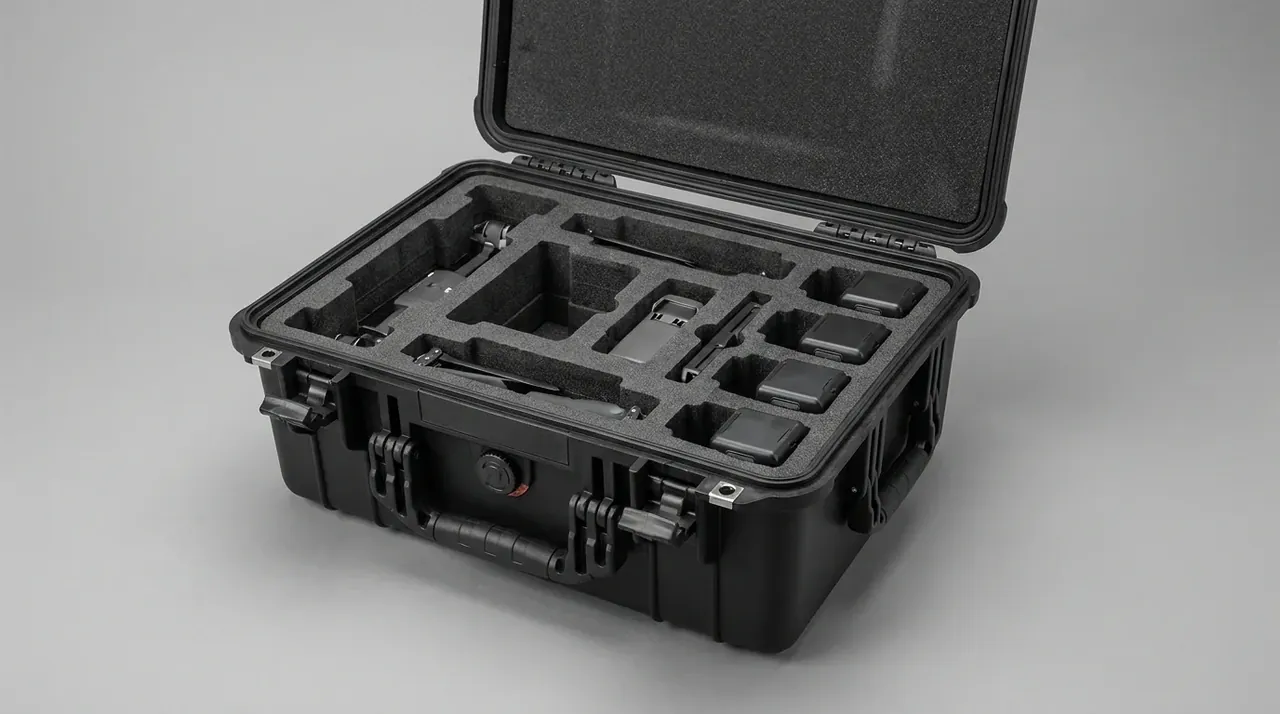
Quick answer: A Portable outdoor gas canister & power storage box splits a 480×320×220 mm cavity into three bays around an 8 mm through divider, holds the 25 mm air gap at a 14 °C face-to-face difference, and sinks only 2 mm at the base under five stacked units totalling 120 kg.
Table of contents
- Bay layout of the Portable outdoor gas canister & power storage box
- Divider cavity and thermal separation
- Vent area and the offset between ports
- Stack load and base ribs
- Seals and handle across the temperature range
- FAQ
1. Bay layout of the Portable outdoor gas canister & power storage box
The cavity splits into three bays at 6:4:2 on a 480×320×220 mm envelope, with the middle divider running through from the base to 12 mm below the mouth, 8 mm thick and open at the top. Running it through leaves no gap for heat to sneak around the mouth from one bay into the other. The largest bay holds 18 L and the smallest 6 L, the small one sitting on a step 15 mm above the base. The three-bay split costs one more moulded part and pushes an empty unit from 4.2 kg to 4.9 kg, which buys separation that a two-bay layout cannot give.
The divider is inserted and welded rather than moulded in one piece, with three weld beads 4 mm wide. Insertion lets the divider position shift per batch, but a cold weld joins two bays at the base, so each unit is pressure-tested on one side at 200 mm of water column and must hold 30 s without a drop.
| Bay | Volume and height | Separation |
|---|---|---|
| Large | 18 L / 220 mm | Through divider, 8 mm |
| Middle | 12 L / 220 mm | Through divider, 8 mm |
| Small | 6 L / 205 mm | Base stepped 15 mm |
2. Divider cavity and thermal separation
The divider is double-walled with a 25 mm cavity between the skins and a 3 mm relief slit at each end, filled with nothing at all. That air layer breaks direct conduction between the two faces, and its resistance runs an order of magnitude above solid material of the same thickness. The test heats one outer face to 55 °C and reads a thermocouple on the other after 60 min: at 25 mm the drop settles near 14 °C and the heated face rises under 8 °C. Going to 40 mm adds about 2 °C and 15 mm of width, which does not pay.
Leaving the cavity empty also keeps moisture out of it: packed with insulation, the space traps vapour that condenses on the inner skin in the cold and tracks along the weld into a bay.
| Cavity | Face difference | Width cost |
|---|---|---|
| 15 mm | About 9 °C | Baseline |
| 25 mm | About 14 °C | +8 mm |
| 40 mm | About 16 °C | +15 mm |
3. Vent area and the offset between ports
Each side carries one port with 18 cm² of free area, set one high and one low with a 120 mm vertical offset so air enters low and leaves high along a diagonal path through the body. Louvres outside sit at 45°, a 1.2 mm stainless mesh inside can be taken out for cleaning, and the blades face down so rain runs off the outside. Measured flow is 8 L/min per port at 20 Pa, 16 L/min for the pair, enough to dilute accumulated vapour below the safe band within 10 min.
No port goes in the lid, deliberately: the lid faces up, carries the stack, and a port there would be blocked the moment a second unit is set on top. Ports low in the side wall use the ground clearance formed by the base ribs so intake is not smothered by the floor.
4. Stack load and base ribs
The base is ribbed in a 5 mm high, 70 mm square grid with one 12 mm foot at each corner, same material as the ribs, leaving 12 mm of clearance under the body. Five units stacked at 120 kg are held 24 h, and base sink is capped at 2 mm, read as the largest gap under a straight edge at each of the four sides. Each foot presents 900 mm², so the bottom unit carries 60 kg per foot, about 0.67 MPa, inside the long-term creep allowance for PP.
Ribs and feet stay separate parts so an impact bends the ribs first and lets the feet pass load to the ground, two jobs that one moulded block cannot do.
| Stack item | Setting | Verdict |
|---|---|---|
| Layers and load | 5 / 120 kg | Held 24 h |
| Base sink | Largest gap, four sides | ≤2 mm |
| Feet | 4 at 900 mm² | 60 kg each |
| Ground clearance | 12 mm | Ribs clear of floor |
5. Seals and handle across the temperature range
The lid seal is a 40 Shore A silicone cord, 6×8 mm, in a 2.4 mm groove at 30% squeeze. After 4 h at -20 °C opening force climbs from 45 N to 70 N, and silicone still rebounds at that temperature where EPDM would reach 95 N. After 4 h at 55 °C the cord softens and squeeze falls to 25%, so the unit is sprayed for 3 min against an IP65 benchmark and the inner wall checked for tracking. The handle takes 30 kg static for 10 min, and a mount gap past 0.6 mm is read as creep.
Six hinge pins of 4 mm diameter are used, and opening torque at -20 °C must stay under 3 N·m; anything higher means the pin bore shrinks too far in the cold and needs 0.05 mm more clearance.
Conclusion
The Portable outdoor gas canister & power storage box holds a 480×320×220 mm three-bay layout, a 25 mm divider cavity with a 14 °C face difference, two 18 cm² ports offset 120 mm, a 2 mm base sink under 120 kg across five units and stable sealing at both -20 °C and 55 °C as one case-side design chain. The five readings sit on the bay bench, the thermal rig, the flow rig, the stack rig and the chamber, and none replaces another. The shop keeps the 8 mm divider, 30% squeeze, 12 mm clearance and 0.67 MPa foot pressure on one parameter sheet. All of it covers structure and load paths only.
This article discusses the case side of the specification only and does not cover handling, loading or use of anything carried inside.
Related Reading
- Choosing between dividers and foam
- Selecting and fitting case accessories
- Comparing foam materials for cases
- What decides a custom insert
Related Products
- 8 Series — Gun Cases; Military Equipment Cases; Camera Equipment Cases; Drone Cases; Watch Cases; Knife Cases; First Aid Cases; Electronics Equipment Cases
- WL8-2812 PP Gun Case — model WL8-2812
- All protective cases and toolboxes: 7 series, 158 models