

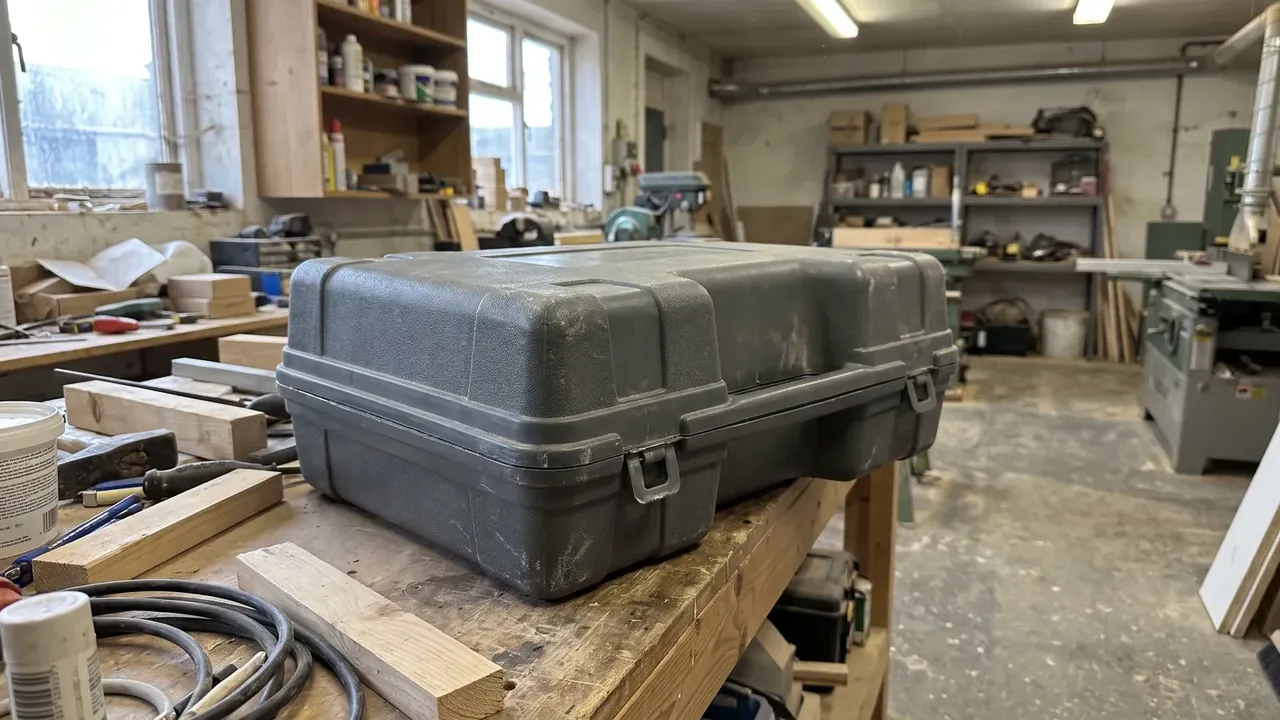
Quick answer: A Portable Respiratory Equipment Case holds two 16 mm tubes at a 45 mm bend radius in a 420×310×165 mm cavity, closing over an 8 mm channel at 180 N.
Table of contents
- Why a Portable Respiratory Equipment Case Starts With the Tube Path
- Port Position and Minimum Bend Radius
- How Coil Count Loads the Tube Wall
- Lid Closure and the Relief Channel
- Handover Checks on the Tube Path
- FAQ
1. Why a Portable Respiratory Equipment Case Starts With the Tube Path
A tube folded once never returns to its bore. The wall thins along the fold and no air pressure pushes it back.
On the shell side of a Portable Respiratory Equipment Case, the rest follows. The cavity must let the tube coil without force, and the lid must close without pinching the coil. An outside size of 460 × 350 × 200 mm and a 4.2 mm wall leave a 420 × 310 × 165 mm cavity with just over 120 mm of clear height.
Tubing is thin-wall silicone or TPU at 2.5 mm, 16 mm outside diameter typical. Two failures dominate: sideways pull at the port, or a coil radius squeezed until the section ovals.
Space is tight: a three-turn coil already touches the wall. A bigger case helps, but the 500 mm class pushes the unit past 6.4 kg and spoils the one-hand carry. An upright coil borrows side-wall height, but its outer turn wears one spot.
Below about 120 mm of clear height, a Portable Respiratory Equipment Case takes only two and a half turns, and the free end lifts into the liner.
2. Port Position and Minimum Bend Radius
2 ports of 16 mm sit in the lower half of the short wall, with an R3 fillet in the bore and a 45° lead-in outside. Position sets the straight run before the turn.
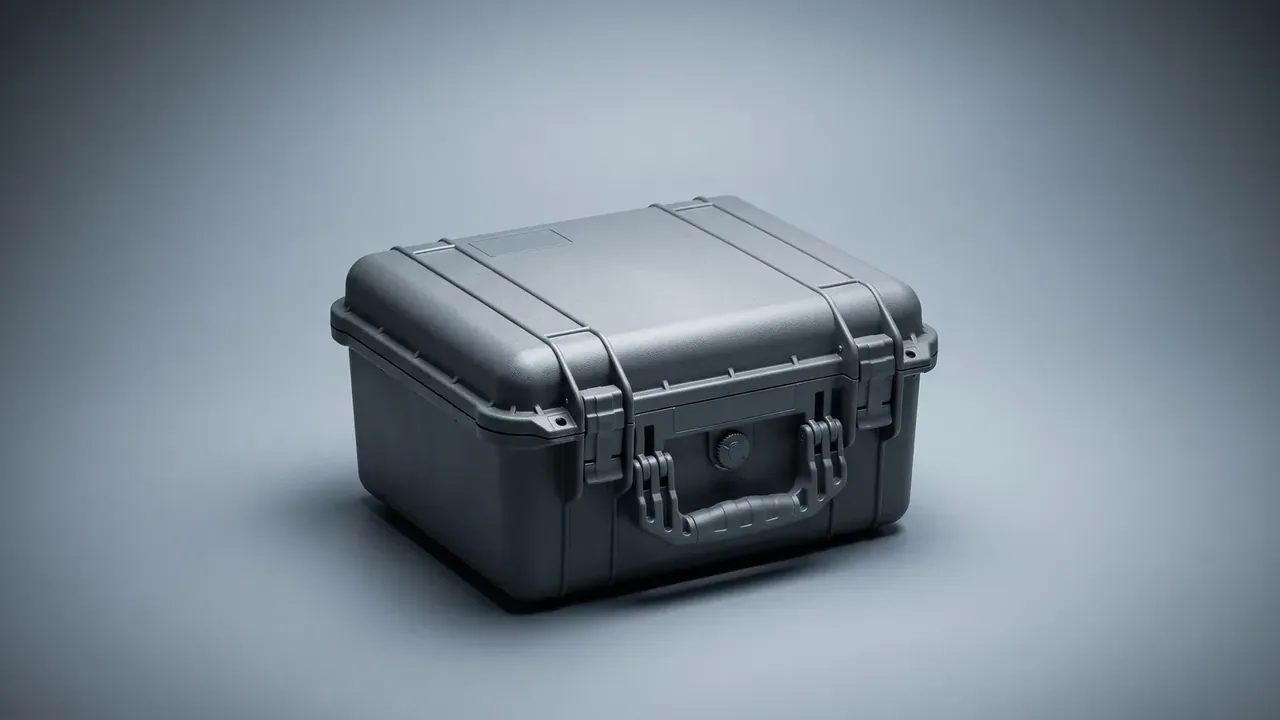
The design value on a Portable Respiratory Equipment Case is 45 mm. Smooth-bore silicone is rated near six times bore, roughly 96 mm at 16 mm. Reaching 45 mm depends on the corrugated wall and the moulded guide fillet.
| Port position | Opening location | Tube outside diameter | Design bend radius |
|---|---|---|---|
| Lower side wall | lower third of the short wall | 16 mm | 45 mm |
| Lid-side upper | recess in the lid liner | 16 mm | 55 mm |
| Divider centre | notch in the movable divider | 16 mm | 60 mm |
On a Portable Respiratory Equipment Case, the lower side wall is hardest, since the tube turns into the cavity as it leaves the bore. Lid-side ports keep the tube straight while shut but leave a length hanging at each opening.
Height matters for sealing. A top port catches water off the lid seam; set lower, water must travel the wall, and that distance is the buffer.
3. How Coil Count Loads the Tube Wall
Three turns is the ceiling for a 16 mm tube in a 420 × 310 mm cavity. A fourth runs out of room and inner turns flatten first.
| Coil radius | Coil count | Wall ovality | Crease risk |
|---|---|---|---|
| 45 mm | 3 | under 8% | low |
| 38 mm | 4 | 12% to 15% | medium |
| 30 mm | 5 | above 20% | high |
Ovality is read with a caliper across one section, difference over major axis. Under 8% the tube springs back; past 12% a night under load leaves a flat.
Ovality reverses; a crease does not. A crease is a hard line where the wall is drawn thin, and a creased tube blown round still measures under its bore. A Portable Respiratory Equipment Case running 2 ports of 16 mm at 45 mm has to come off a three-turn coil without one.
4. Lid Closure and the Relief Channel
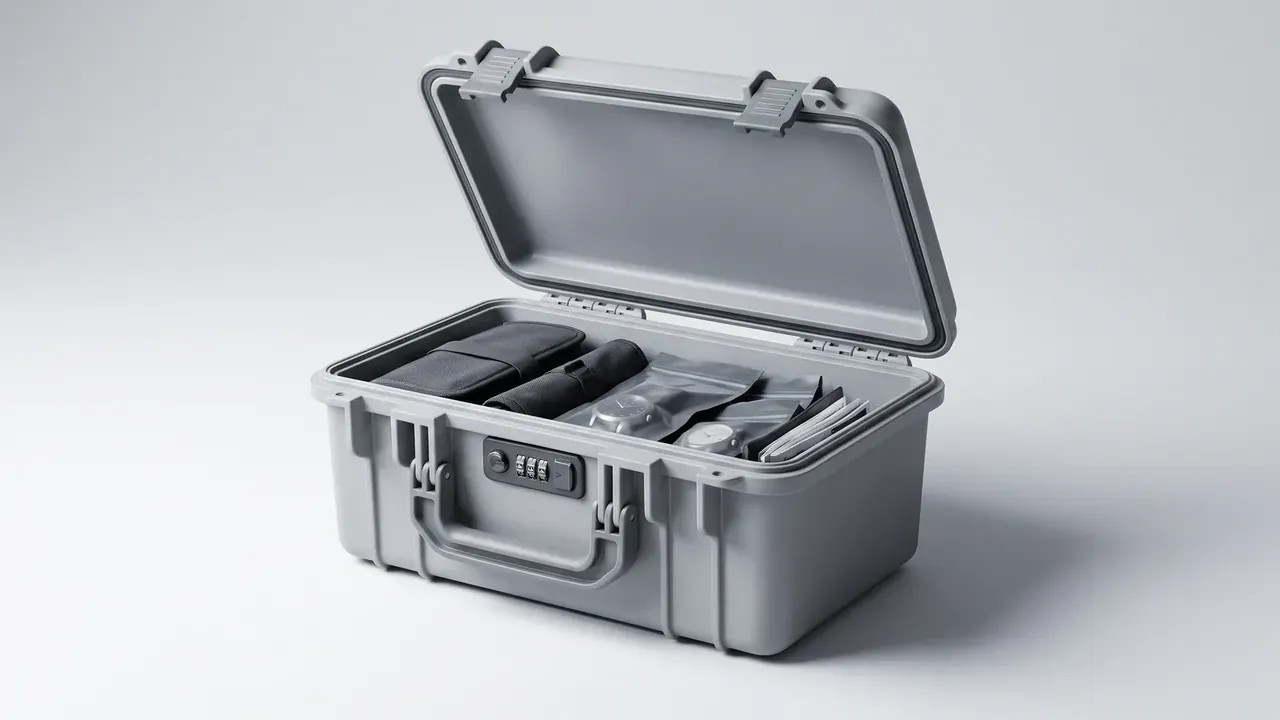
The channel on a Portable Respiratory Equipment Case is 20 mm wide and 8 mm deep, cut into the lid liner above the ports. With the tube seated, 180 N closes the lid for 2 latches rated 300 N.
| Relief channel | Channel depth | Closing force | Residual flattening |
|---|---|---|---|
| Tube centred | 8 mm | 180 N | under 5% |
| Tube 4 mm off centre | 8 mm | 260 N | 10% to 15% |
| No channel | 0 | above 340 N | above 25% |
The depth is sized around a 2.5 mm wall. A 16 mm tube sits 2 mm into the channel and fills fourteen millimetres of height.
Read 180 N with a push-pull gauge, latched but unlocked, head square on the lid centre. A scatter beyond 40 N means the channel sits off the port axis.
The liner is EVA at 30 mm; at 8 mm deep the remaining 22 mm still supports the tube on both flanks.
5. Handover Checks on the Tube Path
Three items, all on the shell: whitening in the port bore, coil count still at 3, fresh marks inside the lid.
A white line at the fillet means sideways pull has worn the R3. A coil that gained a turn means the tube was folded double, and one fold leaves a crease. Marks on the channel edge mean the liner is off axis.
Before dispatch the vacuum check runs at −20 kPa for 5 min, accepting a rise of 0.5 kPa. That is not the IP66 claim: IP66 is a 12.5 mm nozzle at 100 kPa and 100 L/min for at least 3 min, answering whether a jet gets in, while the vacuum check answers whether the shell has a through defect. A Portable Respiratory Equipment Case passing both can be stacked 4 high and stored from −20 °C to +55 °C.
Conclusion
Two ports, one channel, one radius decide the outcome: 2 ports of 16 mm, a 45 mm minimum bend radius, three turns with no crease, and an 8 mm channel matched to 180 N. A Portable Respiratory Equipment Case built to those four numbers survives closure and a rough road, and a 6.4 kg unit on IP66 margin still presses its gasket evenly at 4 high.
Related Reading
- The Usable-Volume Calculation
- Plastic Case versus Wooden Crate
- Surface Treatment for Disinfected Medical Cases
Related Products
- 8 Series — Gun Cases; Military Equipment Cases; Camera Equipment Cases; Drone Cases; Watch Cases; Knife Cases; First Aid Cases; Electronics Equipment Cases
- WL8-2812 PP Gun Case — model WL8-2812
- All protective cases and toolboxes: 7 series, 158 models