

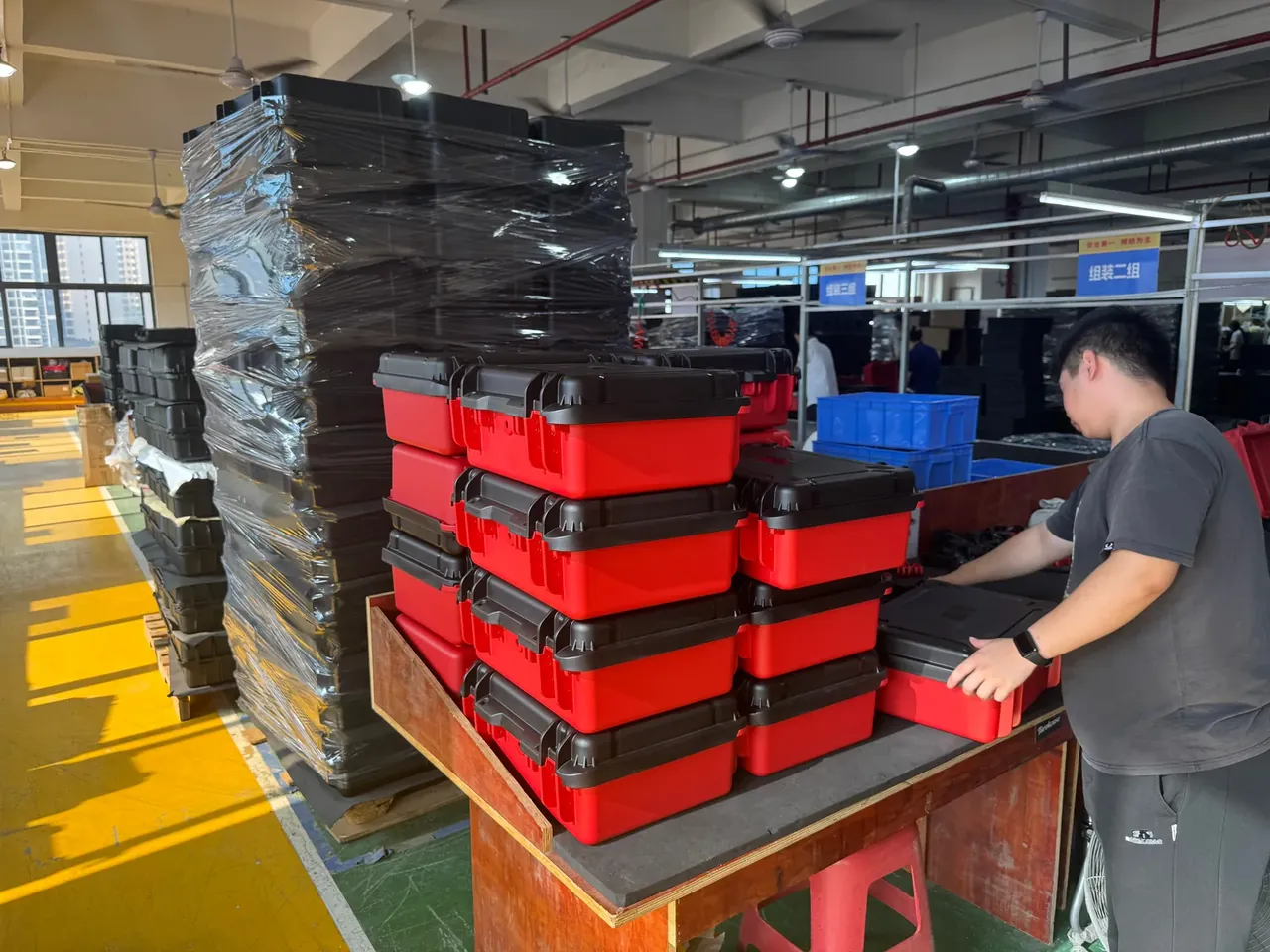
Quick answer: A Portable sound level meter small plastic protective box fixes an 8 mm lid frame and 0.3 mm post clearance, holding drift to 0.4 mm after a 1.5 m drop.
Table of contents
- Lid press-frame height of a Portable sound level meter small plastic protective box
- Fit clearance of the four base locating posts
- Post displacement readings after six-face drops
- Frame sink on the open-close cycle rig
- Clearance reject line for small-box batches
- FAQ
1. Lid press-frame height of a Portable sound level meter small plastic protective box
Once the outer 250 x 180 x 80 mm and inner 222 x 152 x 55 mm sizes are set, a Portable sound level meter small plastic protective box locks its lid press-frame at 8 mm before anything else in the dimension chain. The shell wall is 2.5 mm and the empty box weighs 0.75 kg, so the part is small, yet that frame alone carries the vertical restraint once the lid shuts. Press-frame height governs up and down only.
2. Fit clearance of the four base locating posts
Four 6 mm locating posts rise from the base insert, and their fit into the post holes is held at 0.3 mm across the set. A Portable sound level meter small plastic protective box uses these posts to pin the insert in the horizontal plane: open the gap to 0.6 mm and side play at impact pushes the post reading past 0.4 mm; close it too far and uneven mould shrinkage jams the posts so the insert will not drop into the shell.
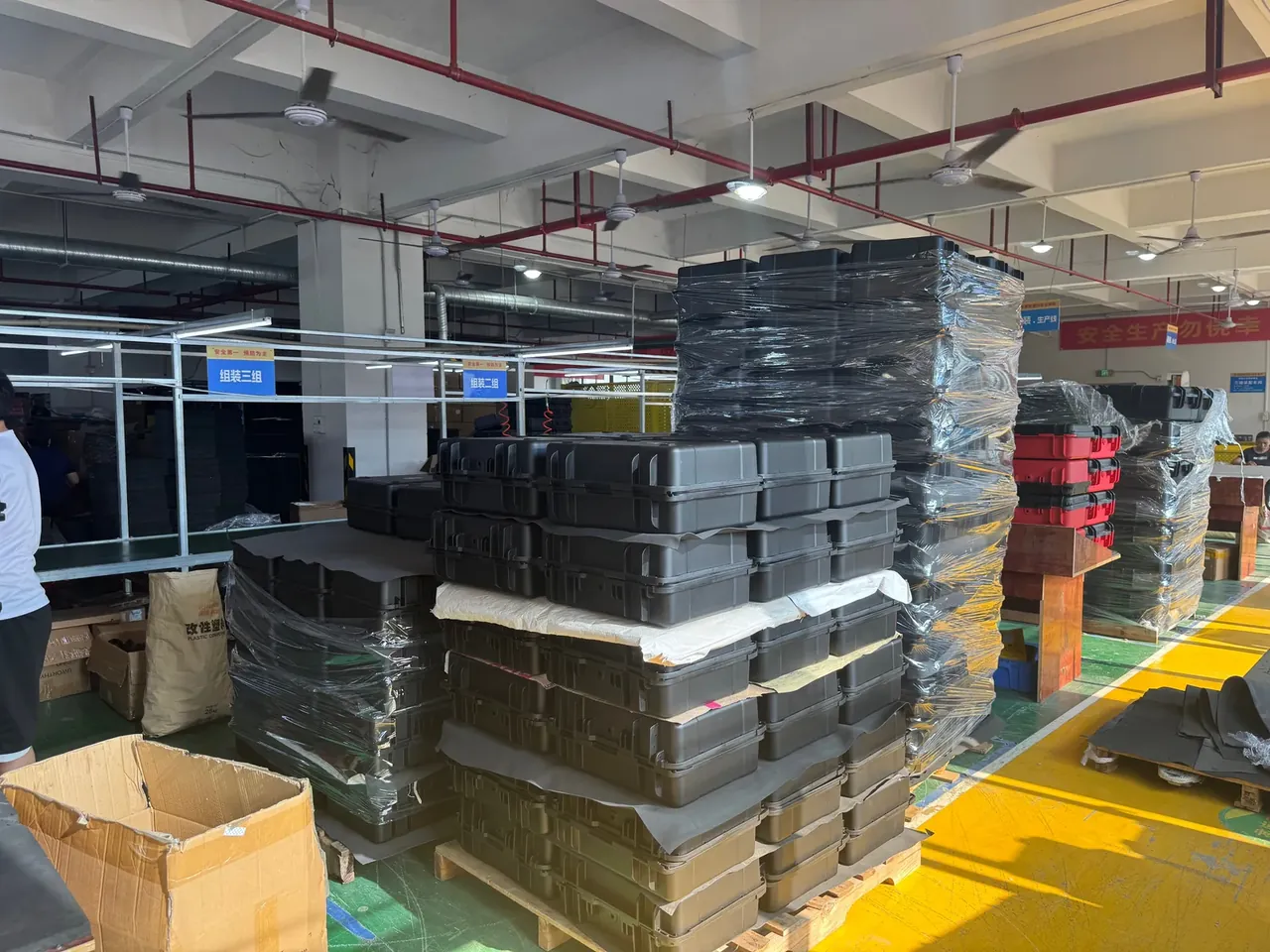
The four posts pair across the diagonals, and clearance has to be even within one shell rather than loose here and tight there. The table logs each post by number with its clearance and frame position, all read at 20 C.
| Post number | Fit clearance | Frame position |
|---|---|---|
| Post 1, front left | 0.3 mm | Frame front-left corner |
| Post 2, front right | 0.3 mm | Frame front-right corner |
| Post 3, rear left | 0.3 mm | Frame rear-left corner |
| Post 4, rear right | 0.3 mm | Frame rear-right corner |
3. Post displacement readings after six-face drops
Drops run at 1.5 m on six faces: bottom, top, two long sides and two short sides, one each. A Portable sound level meter small plastic protective box is loaded with 1.5 kg, the catch with a one-hand opening force of no more than 26 N is shut, and post shift against a scribed floor datum is read after each drop. The acceptance line is 0.4 mm on every orientation.
The six readings are gathered below; one face over the line sends that post-hole batch back for recheck.
| Drop orientation | Drop height | Post drift |
|---|---|---|
| Bottom down | 1.5 m | <=0.4 mm |
| Top down | 1.5 m | <=0.4 mm |
| Long side A down | 1.5 m | <=0.4 mm |
| Long side B down | 1.5 m | <=0.4 mm |
| Short side A down | 1.5 m | <=0.4 mm |
| Short side B down | 1.5 m | <=0.4 mm |
The 0.4 mm line exists so the 0.3 mm fit and the 8 mm frame keep reserve after impact. The box returns to room temperature for a second reading, confirming foam rebound has not nudged a post. One sample from each end of the working range acts as control: the hot end sits 4 h before post diameter is read, the cold end 4 h before hole clearance is read. Both pairs are logged beside the room-temperature piece in one sheet. Sealing is benchmarked to the IP65 method, with no certificate number claimed. Any pair diverging past 0.1 mm returns for an insert-bond recheck.
4. Frame sink on the open-close cycle rig
A Portable sound level meter small plastic protective box runs 4000 open-close cycles at a fixed lid angle on the rig, with frame clearance read every 500 cycles. One judgement applies: frame sink after 4000 cycles must stay within 0.3 mm. Sink here does not mean a collapsed frame; it asks whether the 8 mm height still keeps the retained margin near its original place at end of life.

Sink is banded in the table, and any piece past the boundary leaves the sampling flow.
| Drift reading | Cycle count | Frame state |
|---|---|---|
| 0.1 mm | 4000 cycles | No sink |
| 0.2 mm | 4000 cycles | No sink |
| 0.3 mm | 4000 cycles | Boundary |
| 0.4 mm | 4000 cycles | Recheck |
| 0.5 mm | 4000 cycles | Reject |
5. Clearance reject line for small-box batches
A Portable sound level meter small plastic protective box has all four posts per shot checked at 0.3 mm. Reject sits on the spread across the four posts of one shell, not on a single post: a spread past 0.1 mm sends the tool back, since uneven mould shrinkage splits impact loads between posts. Batch rejection looks at one whole shell, not at the tidiest piece.
Conclusion
A Portable sound level meter small plastic protective box builds its dimension chain from the 0.3 mm fit of four 6 mm base posts, closes it through an 8 mm lid frame, and lands on <=0.4 mm post drift after a 1.5 m six-face drop. A 4000-cycle rig adds the 0.3 mm frame-sink recheck, while a 26 N one-hand opening force and sealing benchmarked to IP65 keep one set of readings and one closing feel across the shell. Batch sampling puts reject on the spread of the four post clearances, so uneven shrinkage stops before assembly.
Related Reading
- Electrician meter case latch selection
- Portable gas detector box sealing
- Waterproof mini plastic box wall specs
- Lab instrument case locating inserts
Related Products
- 8 Series — Gun Cases; Military Equipment Cases; Camera Equipment Cases; Drone Cases; Watch Cases; Knife Cases; First Aid Cases; Electronics Equipment Cases
- WL8-2812 PP Gun Case — model WL8-2812
- All protective cases and toolboxes: 7 series, 158 models