

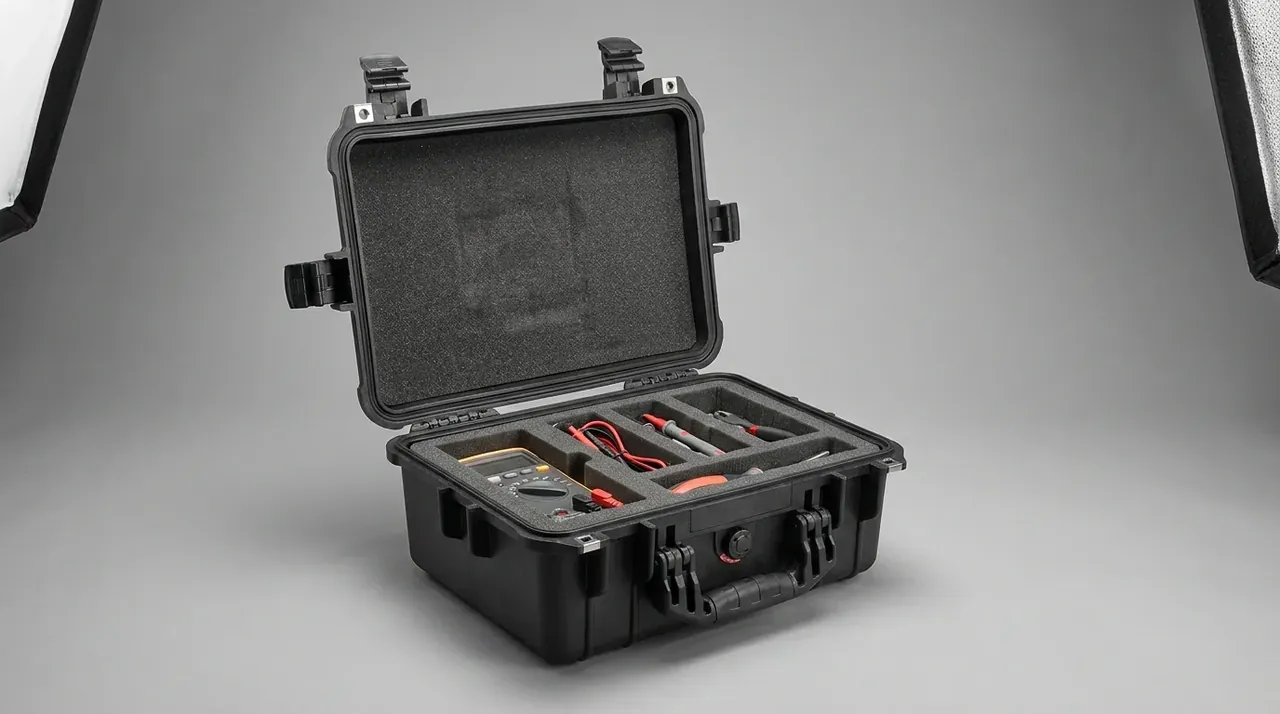
Quick answer: Laboratory analytical instrument portable safety box: 600×460×320 mm shell, 21 kg loaded, five ribs, ≤1.2 mm floor deflection, 450 N per handle.
Table of contents
- The laboratory analytical instrument portable safety box shifts from protection to carrying
- A 21 kg load shared by five floor ribs
- Four corners take the first landing shock
- A 450 N handle and 480 N latches split the load
- Rechecking after a 1.0 m drop and three-high stacking
- FAQ
1. The laboratory analytical instrument portable safety box shifts from protection to carrying
A bench instrument once sat on a table, its load carried by the bench. As a Laboratory analytical instrument portable safety box that bench is gone: 14 kg of payload plus a 7.0 kg shell becomes 21 kg, all of it passing through the floor and handles. The job shifts from shielding to carrying.
The Laboratory analytical instrument portable safety box measures 600×460×320 mm outside, 540×400×265 mm inside, with a 4.5 mm wall. The 7.0 kg empty weight plus 14 kg of payload gives 21 kg; thickening the wall would only raise that empty weight. Five floor ribs do the work.
Acceptance changes with the job. A fixed unit is judged by a panel stopping a knock; the Laboratory analytical instrument portable safety box is judged by floor deflection at 21 kg held to ≤1.2 mm and a single handle rated 450 N. Only then do sealing and stacking matter.
2. A 21 kg load shared by five floor ribs
Twenty-one kilograms on a 540×400 mm floor will bow a flat panel and tilt the instrument base. Five ribs along the long edge cut one wide span into short ones, so with 14 kg aboard a centre gauge must read ≤1.2 mm. That is why the Laboratory analytical instrument portable safety box puts its ribs in the floor, not the lid.
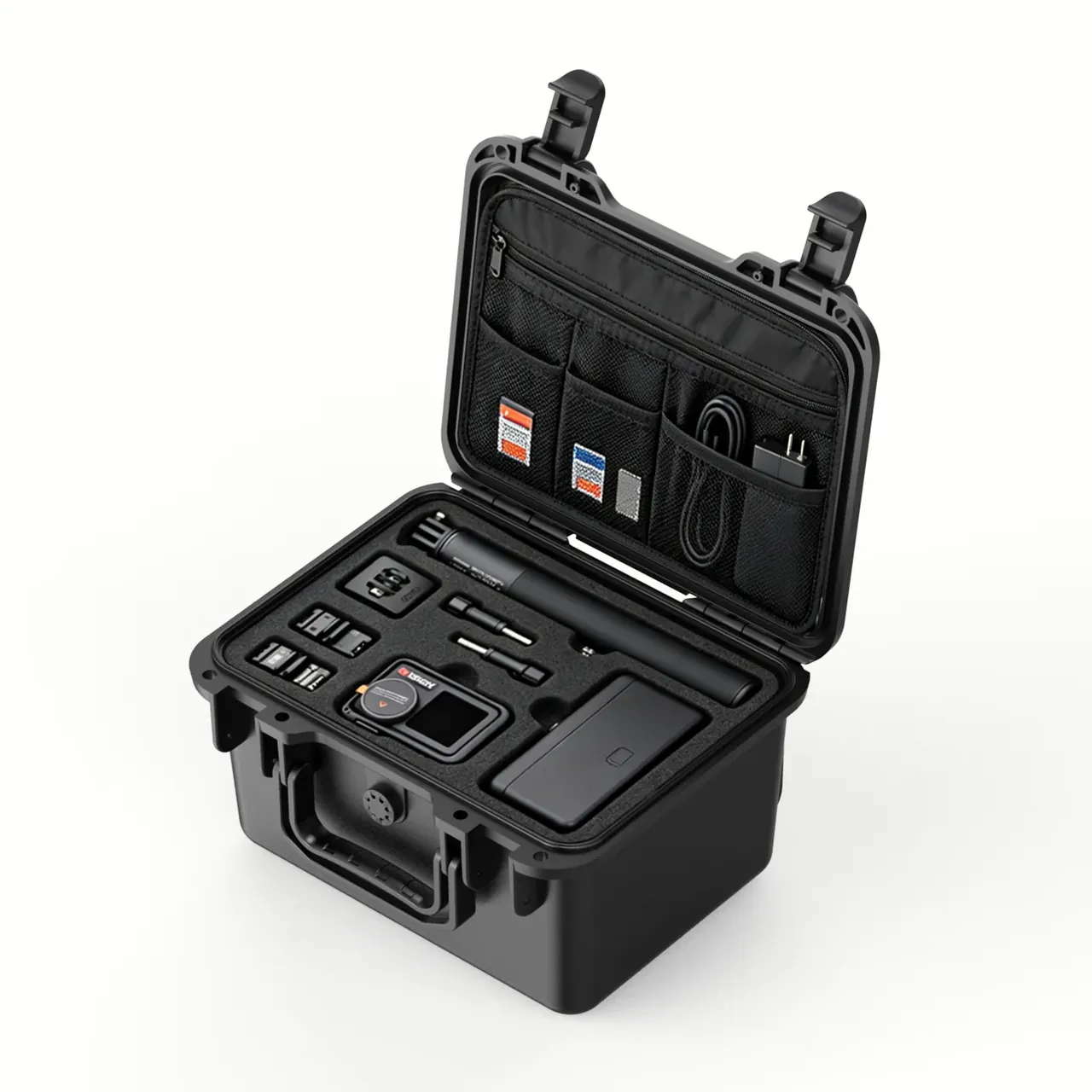
State the conditions before quoting a reading: box flat on a rigid platen, 14 kg spread over the inner floor, probe at the long-edge midpoint before and after loading. The same Laboratory analytical instrument portable safety box reads high on a soft bench or with corners hanging free, so the setup has to be fixed first.
| Handling method | Load path | Floor reading |
|---|---|---|
| Grip carry | Two handles, 450 N each | Midpoint ≤1.2 mm |
| Hands under base | Palms under five ribs | Deflection back to zero |
| Corner landing | Four guards first | Local compression only |
Two handles at 450 N each are sized for 21 kg: one person per handle carries roughly half, and 450 N covers the jolt of lifting, not a static load.
3. Four corners take the first landing shock
When a Laboratory analytical instrument portable safety box is set down, first contact is one corner, not the whole floor. Four thick guards absorb the first hit of a 1.0 m drop and pass it inward along the ribs, so the wall and sealing rim feel the load a moment later.
A 1.0 m drop is checked at the full 21 kg, looking for corner cracks, sprung latches and detached guards, never a device reading. Four latches at 480 N each hold the rim down so the lid cannot flip and leave a guard taking twist alone.
| Load location | Event | Carrying part |
|---|---|---|
| Long-edge midpoint | 14 kg at rest | Five floor ribs |
| Four corner guards | 1.0 m drop | Four guards |
| Handle root | One at 450 N | Boss and rib ends |
4. A 450 N handle and 480 N latches split the load
Handles lift and latches close; on the Laboratory analytical instrument portable safety box they share no load path. Two handles at 450 N cover the 21 kg lift, four latches at 480 N clamp the rim, and 480 N sits above 450 N because the latch also absorbs gasket rebound.
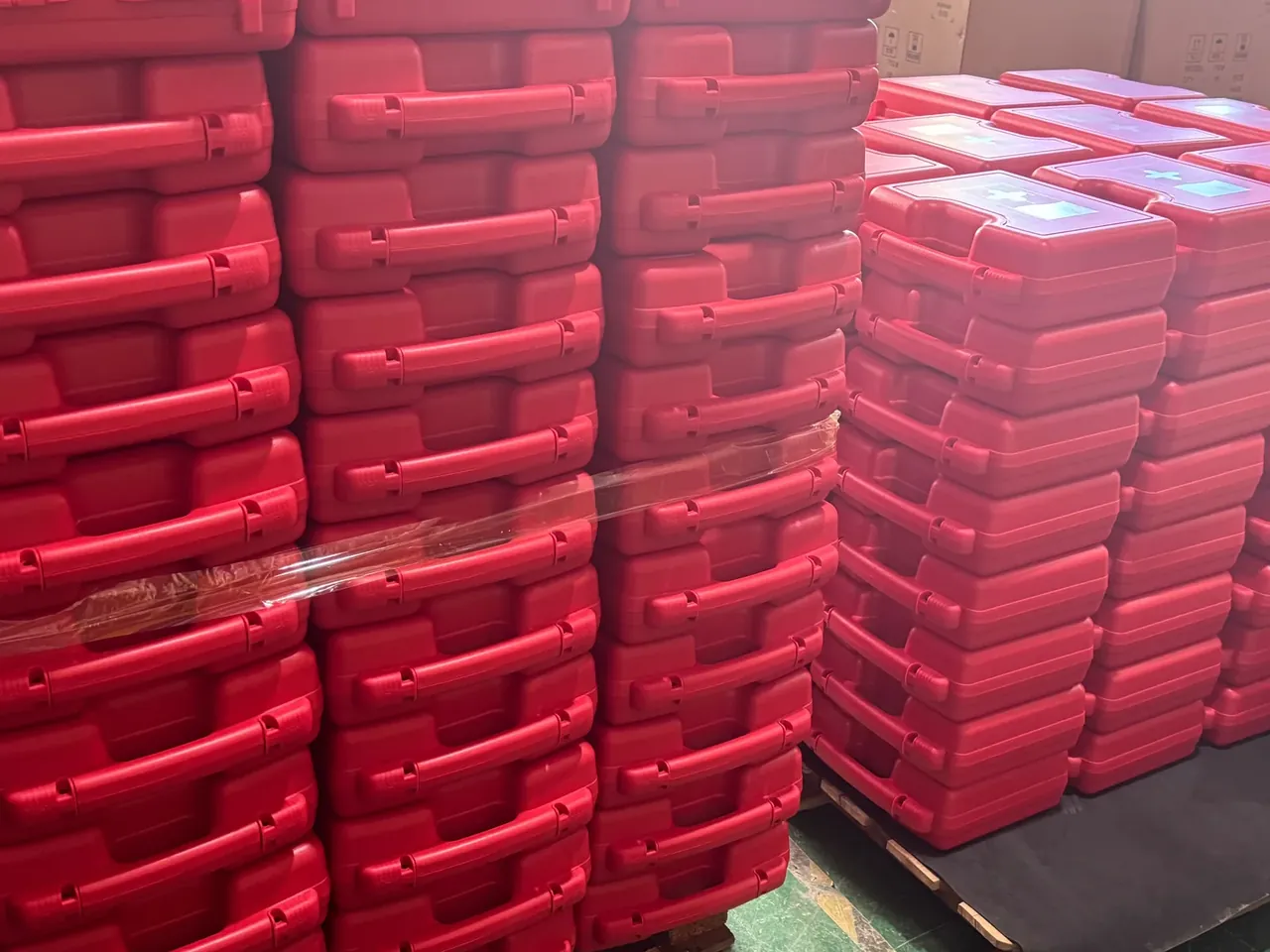
Sealing is verified to the IP65 method, a continuous gasket pressed at the rebate by four latches along the long edges. The −15 °C to 55 °C range belongs to shell and gasket together: cold stiffens the gasket and needs latch reserve, while heat raises pressure that the round valve bleeds off.
The two forces are labelled apart, so one never stands in for the other.
5. Rechecking after a 1.0 m drop and three-high stacking
Rechecking the Laboratory analytical instrument portable safety box reads box-side state only. After a 1.0 m drop, corners, latches and the rim rebate are examined; after three-high stacking the lower lid is checked for permanent set. Both follow one method: checked against the 1.0 m drop and three-high static methods, with no certification claimed.
| Design value | Measurement | Pass |
|---|---|---|
| Deflection ≤1.2 mm | 14 kg on platen | Within limit |
| Handle 450 N | Static pull | No root crack |
| Latch 480 N | Closed and pulled | No spring open |
The 7.0 kg shell and 14 kg payload add to 21 kg, feeding both drop and stack. IP65 and −15 °C to 55 °C are the environmental edges: check cracks after the drop, then a gasket out of its groove, in that order. The 4.5 mm wall, 540×400×265 mm cavity and 600×460×320 mm envelope are the shared base, so changing any one forces the five-rib span and the deflection to be recalculated.
Conclusion
The Laboratory analytical instrument portable safety box turns shielding into carrying. A 600×460×320 mm envelope, 540×400×265 mm cavity, 4.5 mm wall and 7.0 kg empty weight are the base; 14 kg of payload taking the box to 21 kg is the real condition. Five ribs hold deflection to ≤1.2 mm, four guards take the first hit of a 1.0 m landing, two 450 N handles and four 480 N latches keep separate paths, and three-high stacking with IP65 closes the edge.
Related Reading
- Laboratory instrument case handling and post-calibration checks
- How optical instrument cases divide internal protection
- Portable test meter safety case manufacturer specifications
- Musical instrument protective case liners and shells
Related Products
- 8 Series — Gun Cases; Military Equipment Cases; Camera Equipment Cases; Drone Cases; Watch Cases; Knife Cases; First Aid Cases; Electronics Equipment Cases
- WL8-2812 PP Gun Case — model WL8-2812
- All protective cases and toolboxes: 7 series, 158 models