

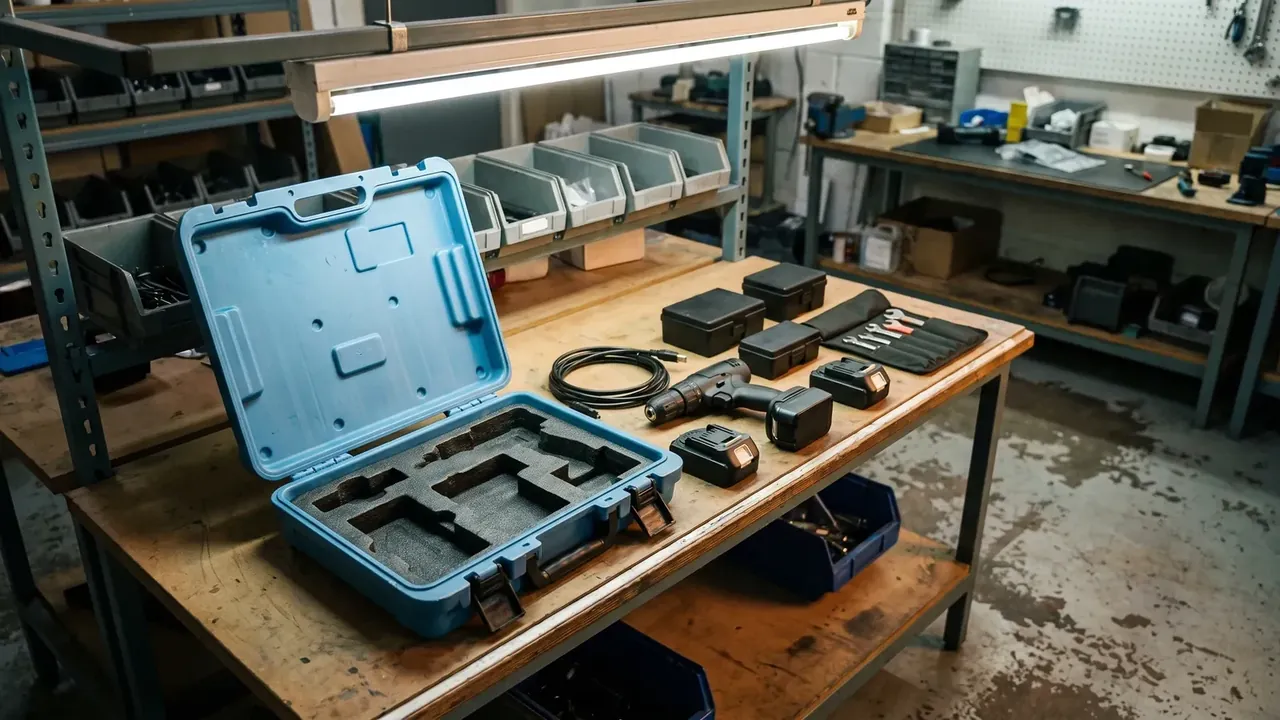
Quick answer: Servicing a Portable Tool Box means reading six numbers on a schedule: handle set, boss torque, latch preload, hinge play, tray warpage, gasket set. Each has a pass line and a replacement limit.
Table of contents
- How Often a Portable Tool Box Should Be Inspected
- Handle and Strap Load Decay
- Latches, Hinge Play and Tray Detachment
- Wall Cracks and Gasket Ageing
- Cleaning, Rust Control and Scrap Limits
- FAQ
1. How Often a Portable Tool Box Should Be Inspected
Interval runs on working hours, not months, because a shutdown week produces no wear. Tier A at 40 hours covers handle, boss and latches; tier B at 120 covers hinges, trays and gasket; tier C twice a year runs a static load test. Record readings, never the word normal.
| Item | Interval | Pass | Replace |
|---|---|---|---|
| Handle set, residual | 40 h | ≤2 mm | >4 mm |
| Boss screw torque | 40 h | 1.2 N·m | stripped, or <0.6 N·m |
| Latch preload | 40 h | ≥120 N | <90 N |
| Hinge pin play | 120 h | ≤0.15 mm | >0.35 mm |
| Tray warpage | 120 h | ≤3 mm | >6 mm |
2. Handle and Strap Load Decay
Test at four times the rated load: on a 20 kg rating, hang 80 kg for five minutes, unload, wait thirty minutes, then measure handle crown to rim. A new Portable Tool Box returns to about 1.2 mm; past 2 mm the wall around the boss has yielded, past 4 mm the lid goes.
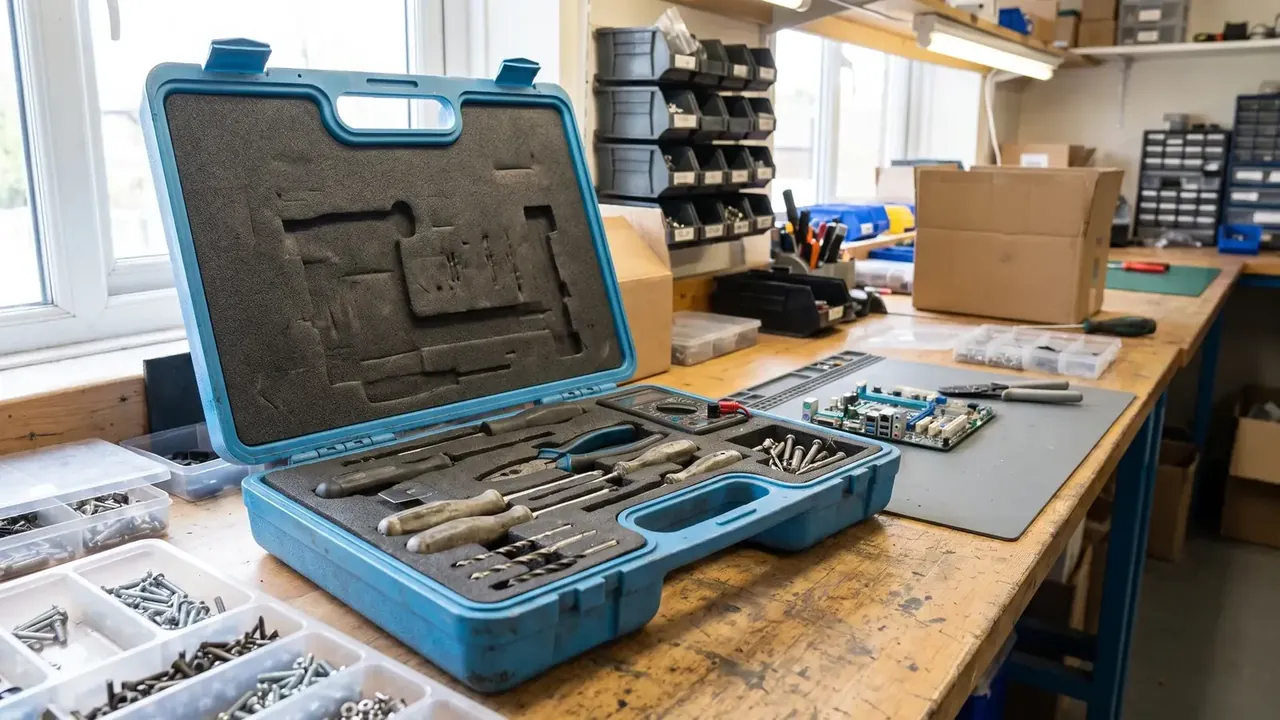
The boss fails first. Four M5 screws into PA66 columns take 1.2 N·m; at 0.6 N·m the case rattles on lift. Re-torque once: a second pass strips the column.
At twelve months the case reads 2.4 mm, 1.0 N·m and 152 N; by twenty-four months 4.8 mm, 0.6 N·m and 96 N, the end of its working life. Strap inspection is webbing and stitching: a 38 mm strap at 20 kg carries 200 N per side, and once the third warp yarn shows through, strength is down forty percent.
3. Latches, Hinge Play and Tray Detachment
Latch preload is read with a force gauge wedged between claw and seat. New is 180 N; under 120 N, shim the seat 0.5 mm to recover about 25 N; under 90 N, replace, because the gasket is already unseated. Claw wear past 1.5 mm also retires the latch.
A 3 mm stainless pin in a PA66 hole tolerates 0.15 mm of play; at 0.35 mm the lid rocks and shears the gasket. Pins are replaceable; an ovalised hole is not.
Tray detachment means the clip slips off its wall hook, and a pull force below 25 N counts as failed. Warpage reads against a 1 m edge: 3 mm binds, 6 mm retires the tray.
4. Wall Cracks and Gasket Ageing
Cracks start where stress whitening appears: boss corners, latch seat roots, hinge ears. Past 15 mm, or past 60% of wall, the case is scrap. Load-bearing faces are never welded; elsewhere a 235 °C hot-air weld is allowed twice.
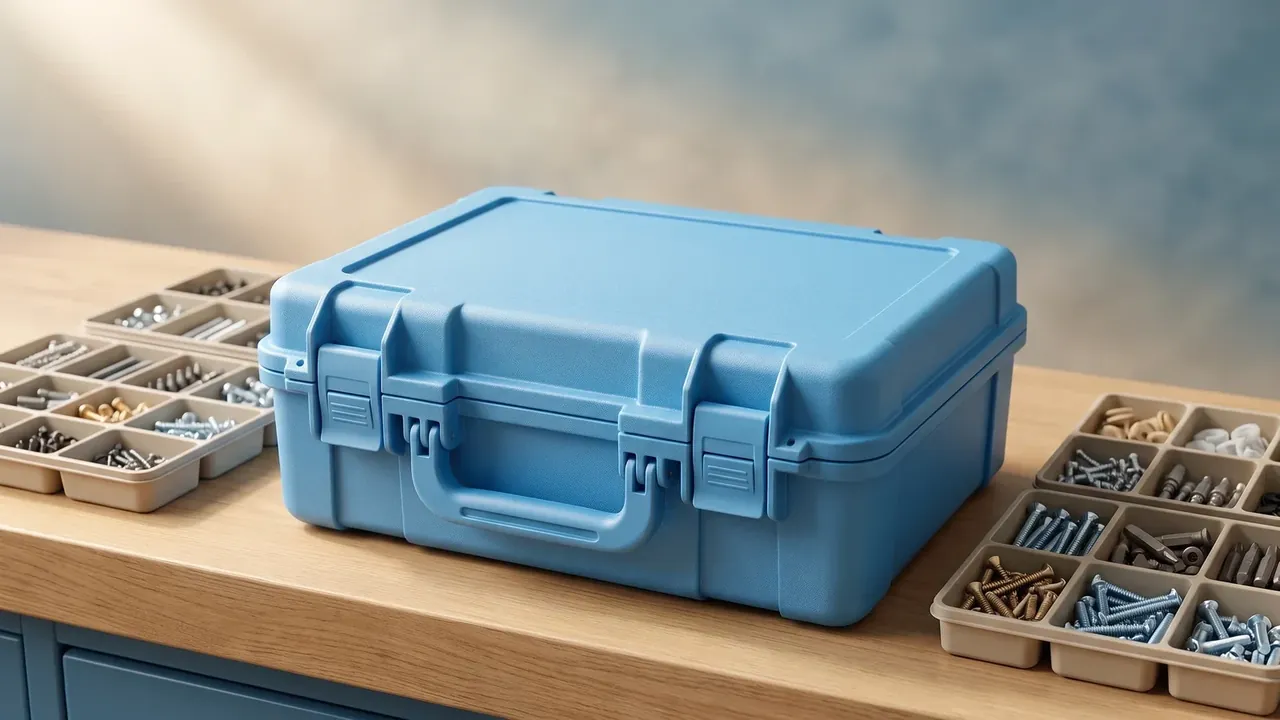
Gasket ageing is compression set plus hardness. Compress a 100 mm sample to half thickness for 24 hours, release for 30, and a loss above 25% means replacement; a 70 Shore A strip below 60 no longer seals. Polypropylene loses forty percent of its impact at minus 20 °C.
5. Cleaning, Rust Control and Scrap Limits
Wash every 40 working hours at sanding stations, 120 in assembly. Use neutral cleaner at pH 6 to 8 below 40 °C and dry open; acetone and xylene stress-crack polypropylene.
Only three metal parts exist: the handle, the latch spring plates and the hinge pins. A 72-hour salt spray with no red rust passes. A Portable Tool Box is scrapped on combinations: any grade A item over the line, or two grade B items together.
| Scrap condition | Limit | Grade |
|---|---|---|
| Handle set | >4 mm | A |
| Latch preload | <90 N | A |
| Wall crack | >15 mm or >60% wall | A |
| Whole-case set | >6 mm | A |
| Hot-air welds | more than 2 | A |
Conclusion
Maintenance comes down to six readings and two lines: 2 mm, 120 N and 0.35 mm pass, 4 mm, 90 N and 15 mm replace. Numbers beat feel, and a Portable Tool Box that keeps its own record decays visibly before it fails.
This article discusses only the container (case body) side of specifications and design intent, and does not cover any handling, loading or use of the contents.
Related Reading
- Maintenance points for steel tool chests
- Common Portable Tool Box problems and fixes
- Lid latch problems and how to handle them
- Routine maintenance for case moulds
Related Products
- 8 Series — Gun Cases; Military Equipment Cases; Camera Equipment Cases; Drone Cases; Watch Cases; Knife Cases; First Aid Cases; Electronics Equipment Cases
- WL8-2812 PP Gun Case — model WL8-2812
- All protective cases and toolboxes: 7 series, 158 models