

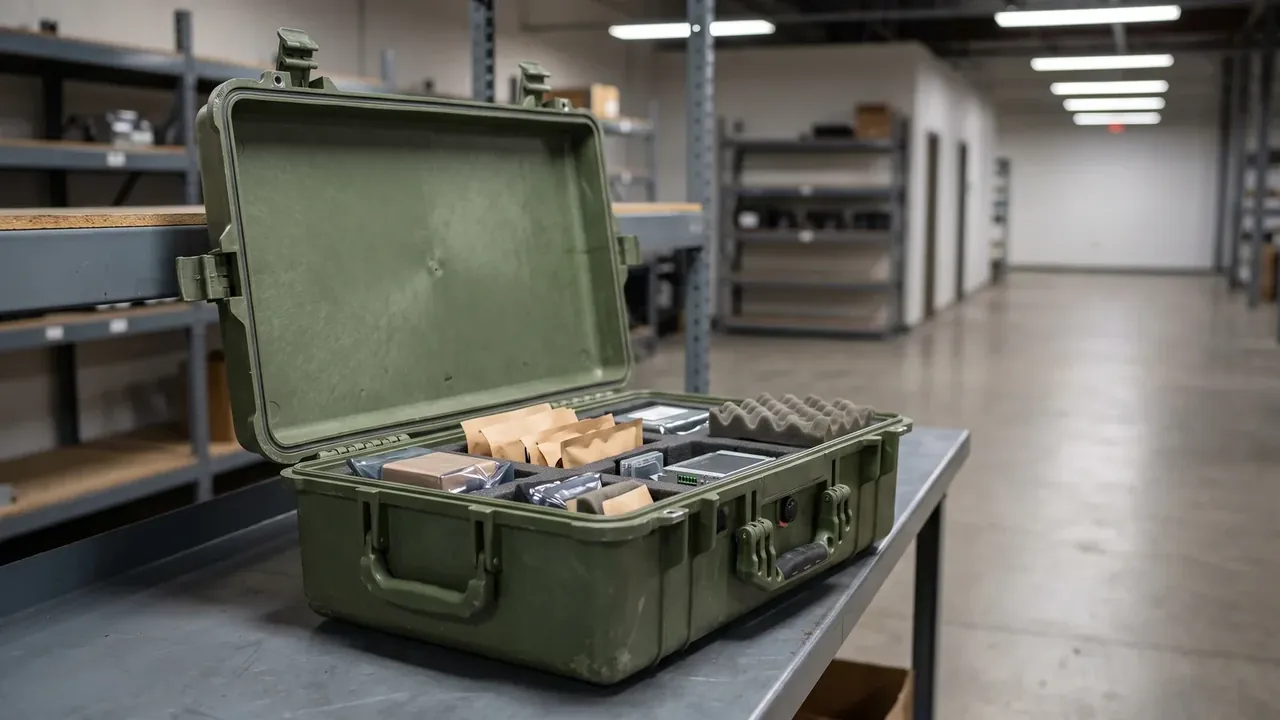
Quick answer: Over 750 trips a PP Plastic Case costs 3.2 cents per trip against 90 cents for a corrugated carton. That gap collapses below minus 40 °C, under diesel immersion, or where shielding is required — and rotomolded PE, HDPE and aluminum take over.
Table of contents
- The life-cycle bill: where the money goes
- Against ABS: finish and cold-weather trade
- Against rotomolded PE: wall thickness buys weight
- Against aluminum and steel: shielding and dents
- When a PP Plastic Case is the wrong buy
- Tooling amortization: why small runs switch
- FAQ
1. The life-cycle bill: where the money goes
A 1.2 m case leaves the factory at 24 USD. Resin takes 9.5 kg at 1.45 USD/kg, or 13.80; molding adds 4.40; latches, pins and gasket 2.50; packing 2.10. Resin is 58% of the price, so a 140 USD/t resin move shifts the unit by 1.30 USD.
Amortization runs on trips, not years. At 150 trips a year for five years the case books 750 trips at 3.2 cents. A 90-cent carton used once costs 90 cents a trip, a factor of 28, before return freight and repair kits are counted.
Lose the volume and the case loses. Thirty trips a year over five years is 150 trips, or 16 cents each, against 22 cents for a single-use crate, before return freight.
| Cost element | USD | Share |
|---|---|---|
| Polypropylene | 13.80 | 58% |
| Molding | 4.40 | 18% |
| Hardware, gasket | 2.50 | 10% |
| Packing, freight | 2.10 | 9% |
2. Against ABS: finish and cold-weather trade
ABS runs 1.05 g/cm³ against 0.91, so the same cavity weighs 15% more — 11 kg instead of 9.5. Resin at 1,750 USD/t lifts the unit to 35 USD, or 4.7 cents a trip. The extra 1.5 cents buys surface and dimensional control.
That control is real. ABS shrinks 0.4% to 0.7% against 1.2% to 1.8%, so lid fit holds inside 0.2 mm and a gloss face takes paint without a primer. On branded cases, rework falls 3 points.
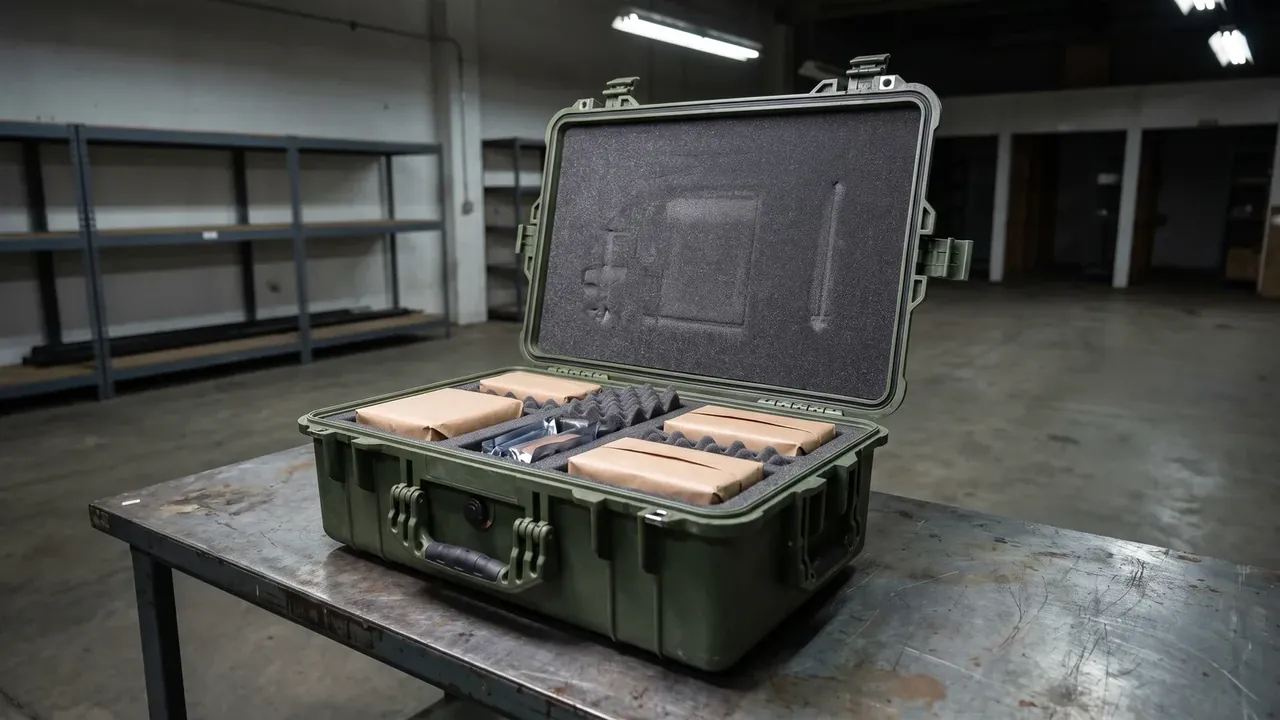
Cold is where ABS gives it back. At minus 20 °C its notched impact falls from 20 to 9 kJ/m² and corners whiten, while 24 hours in gasoline adds 2% weight. A northern winter yard retires ABS before PP.
| Metric | PP | ABS |
|---|---|---|
| Density | 0.91 | 1.05 |
| Resin | 1,450 USD/t | 1,750 USD/t |
| Shrinkage | 1.2–1.8% | 0.4–0.7% |
| Impact at −20 °C | 7 kJ/m² | 9 kJ/m² |
3. Against rotomolded PE: wall thickness buys weight
Rotomolding lays down 4 to 6 mm of wall and yields a 14 kg case, half again the molded part. The weight buys cold toughness: a 2 m ball drop at minus 40 °C leaves the shell intact, which is why cold stores specify it. Polyethylene also shrugs off detergents that stress-crack PP, though 14 kg of shell takes two people to lift when loaded.
Cycle time is the price. A rotomold takes 25 minutes against 165 seconds, a 9× gap, while tooling inverts: about 4,200 USD against 62,000 for a 1.2 m injection tool. Under 3,000 units, rotomolding usually lands 20% cheaper.
Tolerance is the soft spot. On that wall, dimensions hold to ±1.5 mm and rim flatness cannot beat 0.8 mm, so sealing needs a 35% squeeze. Cases that locate instruments should not be rotomolded.
4. Against aluminum and steel: shielding and dents
A 2 mm aluminum shell, folded and riveted, weighs 6.5 kg — 3 kg less than the PP part — and sells near 125 USD, 5.2× the molded case. It buys shielding: conductive anodizing plus finger stock reaches 40 to 60 dB, which no plastic matches.
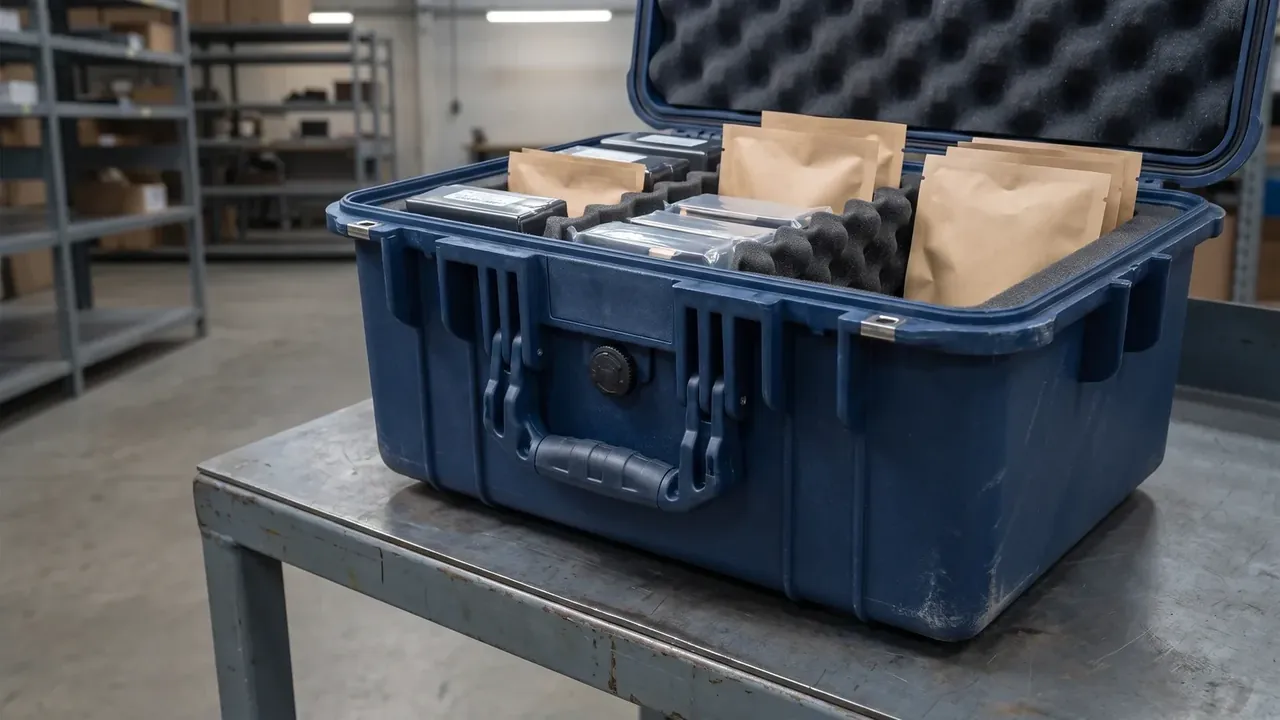
Dents are the tax. A 1 kg hammer from 1 m leaves an 8 mm dent that no panel beating removes, while PP dents 12 mm and springs back 8. Aluminum also conducts heat, so walls frost over on a minus 30 °C apron.
Steel is heavier: 1.2 mm cold-rolled sheet welds into an 18 kg case at 55 USD and beats everything on puncture, yet seams and hinge bosses rust after 48 hours of salt spray. Fixed installations take steel; anyone carrying a case up a ladder will not.
5. When a PP Plastic Case is the wrong buy
Cold comes first. Below minus 25 °C, homopolymer impact falls to 3 kJ/m² and corners crack on the first drop, so rotomolded PE or a polyurethane shell is correct.
Chemicals come second. Diesel, gasoline and ketones swell PP past 1% in 24 hours and the dimensions follow, so fuel cases belong in HDPE or a stainless liner.
Oversized low-volume parts come third. Past 1.8 m the press needs 3,200 t and the tool runs 120,000 USD, which is 3,000 USD per unit on a 300-piece order. Cosmetic parts come fourth: gloss and paint mean ABS. Every one of these switches costs more per unit and less per failure.
6. Tooling amortization: why small runs switch
Spread 62,000 USD across the order and the arithmetic argues: 3,000 units carry 20.70 each, 30,000 carry 2.10, 300,000 carry 0.21. Same part, a 100× spread, all of it in the denominator.
Under 3,000 units a catalog case wins. At 30 USD against 24 plus 20.70 of tooling, it is 33% cheaper and ships in 7 days instead of 45.
Ownership needs a clause. Write the tool title into the contract or the second order repeats the 62,000 USD; that line is the one most often skipped.
Conclusion
The dividing line is trip count and service condition, not unit price: at 750 trips in dry, room-temperature duty a PP Plastic Case at 3.2 cents has no rival; at 150 trips, or under minus 40 °C, diesel soak or a shielding spec, rotomolded PE, HDPE and aluminum each take a share. Check those premises before arguing about the price of a PP Plastic Case.
This article discusses only the container (case body) side of specifications and design intent, and does not cover any handling, loading or use of the contents.
Related Reading
- How PP and ABS shells differ in service
- Fitting out small plastic cases
- Sizing PP wall thickness from load
- What industries demand from a case shell
- Four shell materials for firearm cases
Related Products
- 8 Series — Gun Cases; Military Equipment Cases; Camera Equipment Cases; Drone Cases; Watch Cases; Knife Cases; First Aid Cases; Electronics Equipment Cases
- WL8-2812 PP Gun Case — model WL8-2812
- All protective cases and toolboxes: 7 series, 158 models