

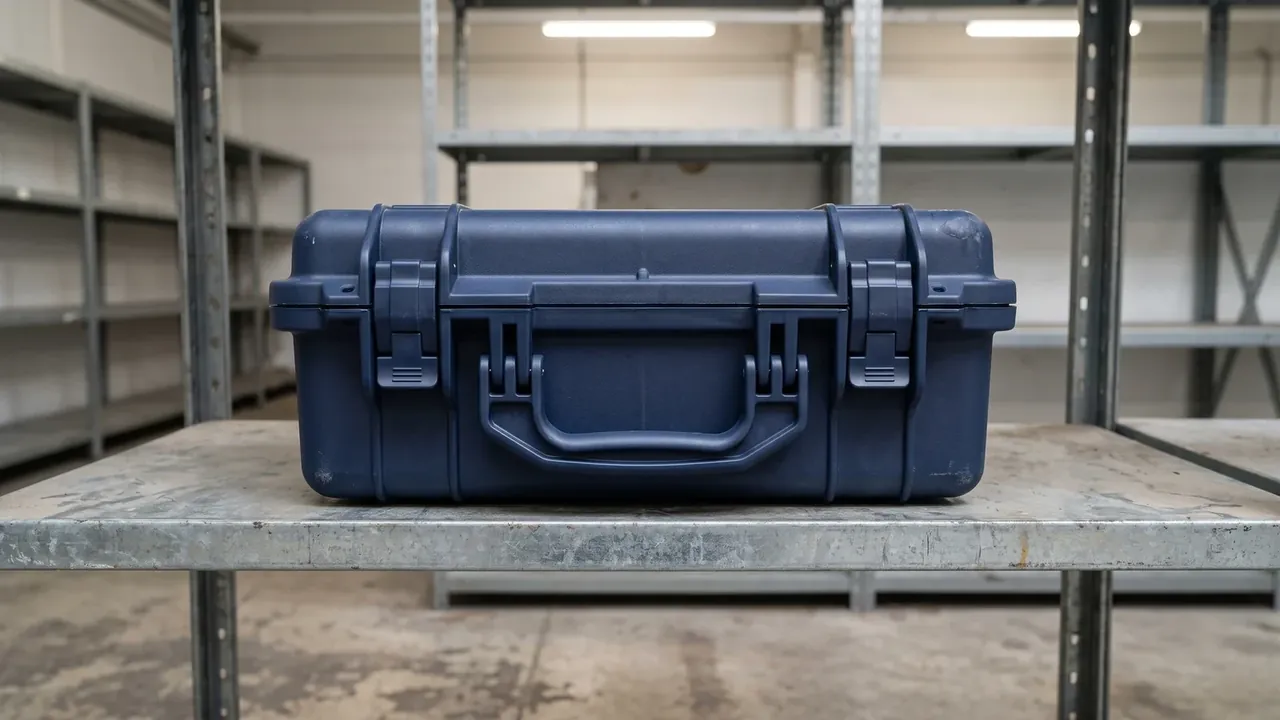
Quick answer: Specify a PP Plastic Case backwards from acceptance. A 1.2 m drop at 42 kg into a 560 mm cavity puts the 380 mm span at 3.2 mm of wall and a 90 mm rib pitch.
Table of contents
- Working Backwards from One Line in the Test Report
- Cavity Size Sets Projected Area and Clamp Force
- Rib Pitch and Height Fill the Stiffness Gap
- How Latches and Hinges Load the Wall
- Turning the Chain into Inspectable Callouts
- FAQ
1. Working Backwards from One Line in the Test Report
A test report carries one line: full load, 1.2 m, one drop on six faces, three edges and one corner, no rupture, no latch release. That line must become deflection before a wall is named, since on a PP Plastic Case the wall is an output.
A PP Plastic Case cavity of 560 by 380 by 210 mm sets the rest. At 42 kg the base spans 380 mm, homopolymer bends near 1500 MPa, a drop triples the load to 126 kg on 0.213 m2, and 2 mm of deflection returns 3.2 mm.
| Load | Cavity length | Base span | Wall | Rib pitch |
|---|---|---|---|---|
| 30 kg | 460 mm | 320 mm | 2.8 mm | 105 mm |
| 42 kg | 560 mm | 380 mm | 3.2 mm | 90 mm |
| 60 kg | 640 mm | 440 mm | 3.6 mm | 80 mm |
2. Cavity Size Sets Projected Area and Clamp Force
Fix the cavity and projected area follows: 560 by 380 mm with 3.2 mm of wall and 1.5 percent shrinkage projects 0.233 m2. At 35 MPa the clamp needs 815 tonnes, so this PP Plastic Case is moulded in the 1000 tonne band.
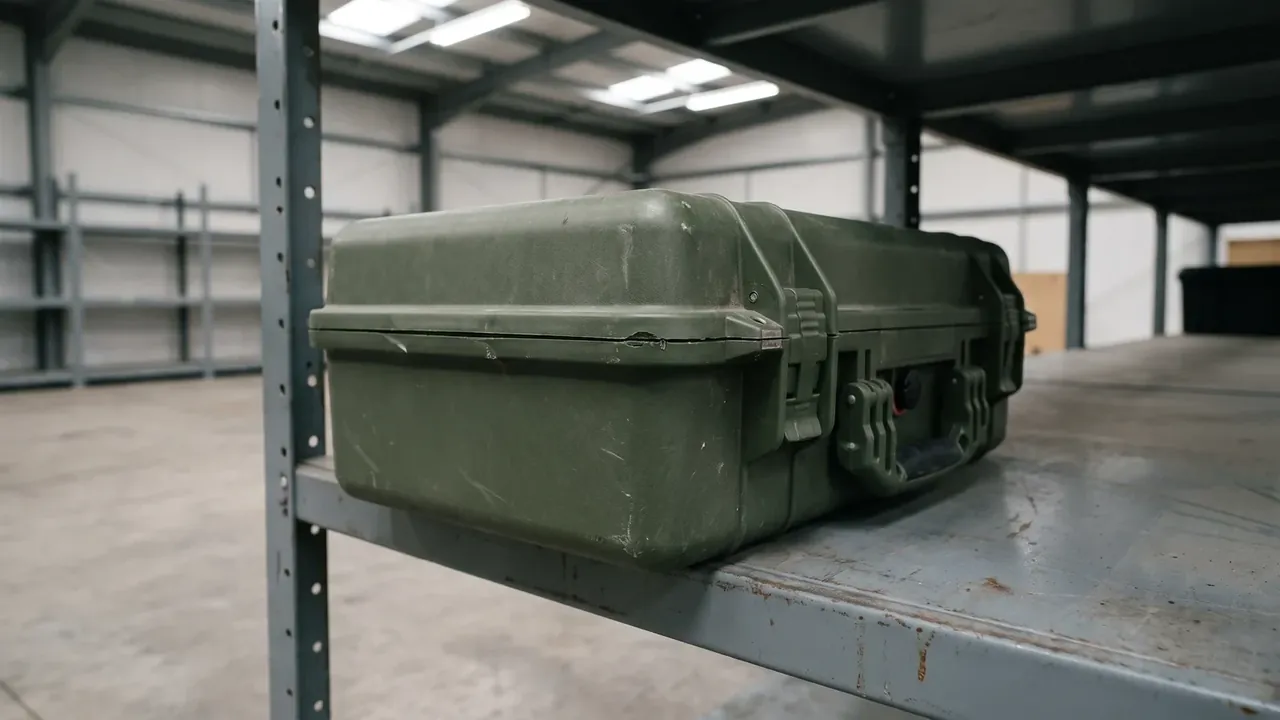
Melt flow enters only here: flow ratio is longest path over wall, so a short-edge gate puts 470 mm at the far end, giving 147 and calling for 10 to 14 g/10 min. Tie bars 820 mm apart cap the PP Plastic Case mould at 780 mm, and a starved clamp leaves 0.3 mm of flash.
3. Rib Pitch and Height Fill the Stiffness Gap
Ribs bridge the gap between calculated wall and surviving wall: across 380 mm at 3.2 mm a bare panel sags 5 mm under 42 kg, and 4 ribs cut that to 1.6 mm.
Three numbers set geometry: rib thickness at 0.6 of wall, 1.9 mm; height under 3 times thickness, 5.7 mm; draft from 0.5 to 1 degree. A root fillet of R0.5 mm pulls stress concentration from 2.4 to 1.6; without it a PP Plastic Case cracks by the second drop.
| Location | Wall | Rib thickness | Rib height | Draft |
|---|---|---|---|---|
| Base, longitudinal | 3.2 mm | 1.9 mm | 5.7 mm | 0.5 deg |
| Side wall, transverse | 3.2 mm | 1.9 mm | 5.0 mm | 0.8 deg |
| Lid stiffeners | 2.8 mm | 1.7 mm | 4.6 mm | 0.5 deg |
A 90 mm pitch rests on that plate model: 1.4 mm of sag at 42 kg against 2.8 mm at 120 mm, past the 2 mm limit.
4. How Latches and Hinges Load the Wall
A latch is the only route by which lid load returns to the body. With 42 kg aboard, 2 latches and one pin, each pulls about 210 N in a drop, so wall under 2.6 mm at the seat tears, and on a PP Plastic Case the seat is thickened to 3.6 mm.
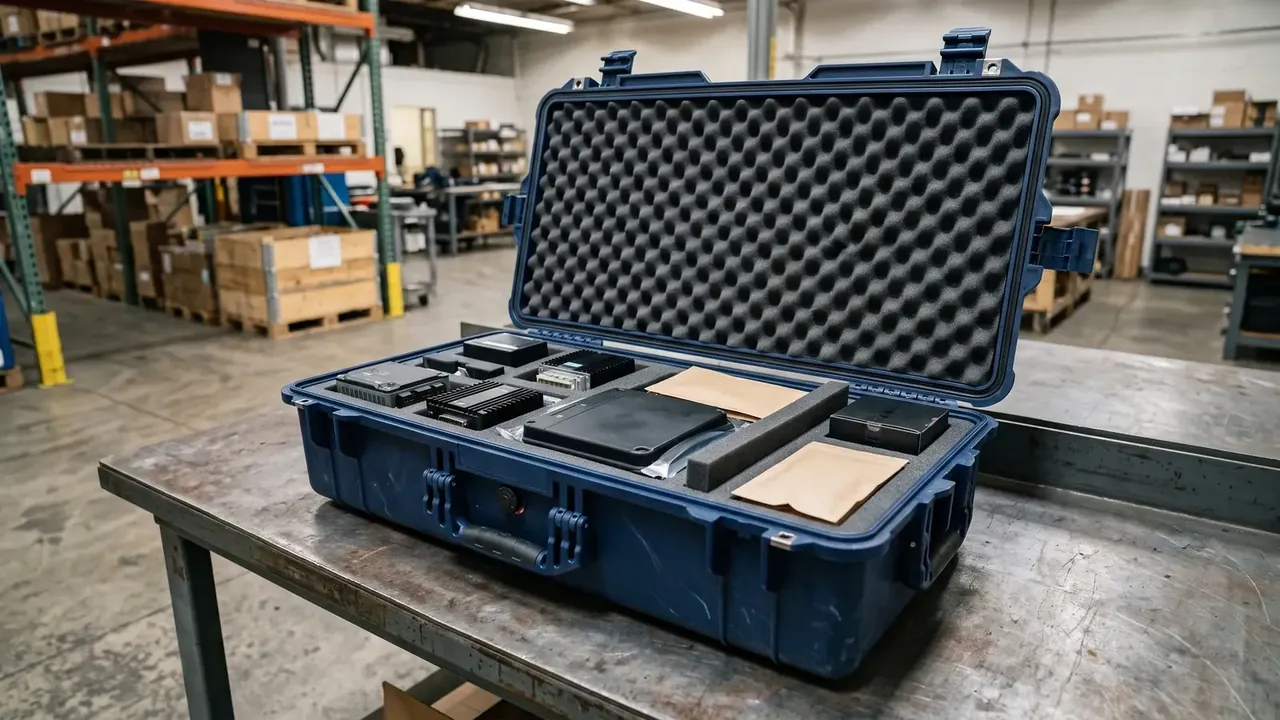
The pin is 5 mm of 304 stainless in a 4 mm bore with 0.15 mm clearance; at 0.3 mm the lid sags 1.2 mm after 5000 cycles. A PP Plastic Case seals on the same chain: a 6 by 4 mm groove holds a 5.5 mm cord at 27 percent compression, and at 18 percent IP65 leaks in 3 minutes.
| Part | Key dimension | Load | Typical failure |
|---|---|---|---|
| Latch seat | 3.6 mm local wall | 210 N | Tear at the root |
| Hinge pin | 5 mm diameter | 180 N | Bore wear |
| Gasket groove | 6 mm wide, 4 mm deep | 27 percent squeeze | Leak at the seal |
5. Turning the Chain into Inspectable Callouts
Four callouts go on the drawing of a PP Plastic Case: wall 3.2 mm plus or minus 0.15 mm, flatness 0.4 mm, weight 2.4 kg plus or minus 3 percent, latch force 60 N plus or minus 10 N.
At plus or minus 0.08 mm the cycle stretches from 55 s to 68 s and costs 1.9 CNY more; at plus or minus 0.25 mm the seat misses by 0.4 mm. Sampling runs 5 parts per batch at 9 points in 210 s on patrol.
Conclusion
One 1.2 m drop line yields a wall, a rib pitch, a latch count and a tolerance set: load, cavity, wall, hardware. With four callouts on the drawing the shop can reproduce the calculation, and a PP Plastic Case closes cleanly after 3 drops.
This article discusses only the container (case body) side of specifications and design intent, and does not cover any handling, loading or use of the contents.
Related Reading
- Setting drop test conditions
- Cavity and panel dimension chains for instrument cases
- PP against ABS on the same thickness chain
Related Products
- 8 Series — Gun Cases; Military Equipment Cases; Camera Equipment Cases; Drone Cases; Watch Cases; Knife Cases; First Aid Cases; Electronics Equipment Cases
- WL8-2812 PP Gun Case — model WL8-2812
- All protective cases and toolboxes: 7 series, 158 models