

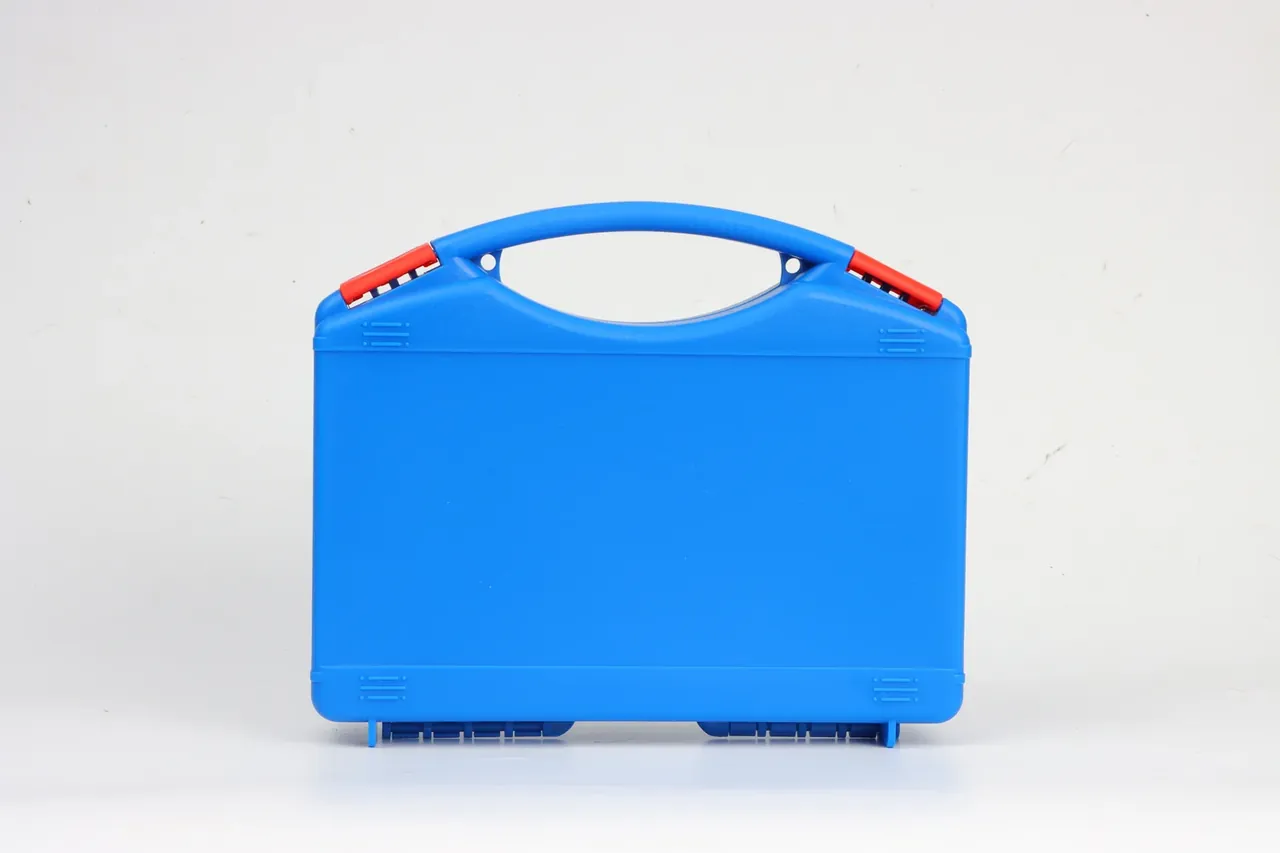
Quick answer: The inspection came down to four moves: pull 80 units, measure cavity and wall, gauge latches, run five thousand open-close cycles, drop from 1.2 metres on six faces. Every limit was printed before the trucks arrived.
Table of contents
- Day of arrival: 800 units, two trucks, one checklist
- First-article check: five tools, three limits
- Latches and hinges on a 5000-cycle rig
- Drop and stack: how two lots were failed
- Class A rejection, Class B concession, Class C rework
- FAQ
1. Day of arrival: 800 units, two trucks, one checklist
Two trucks reached the bay at nine with eight hundred PP Plastic Case units of 590 by 390 by 220 millimetres on four pallets. We had one morning.
Sample size follows lot size: eight hundred units fall under code letter K at general inspection level II, so 80 pieces, zero-accept-one-reject on critical, AQL 1.0 on major.
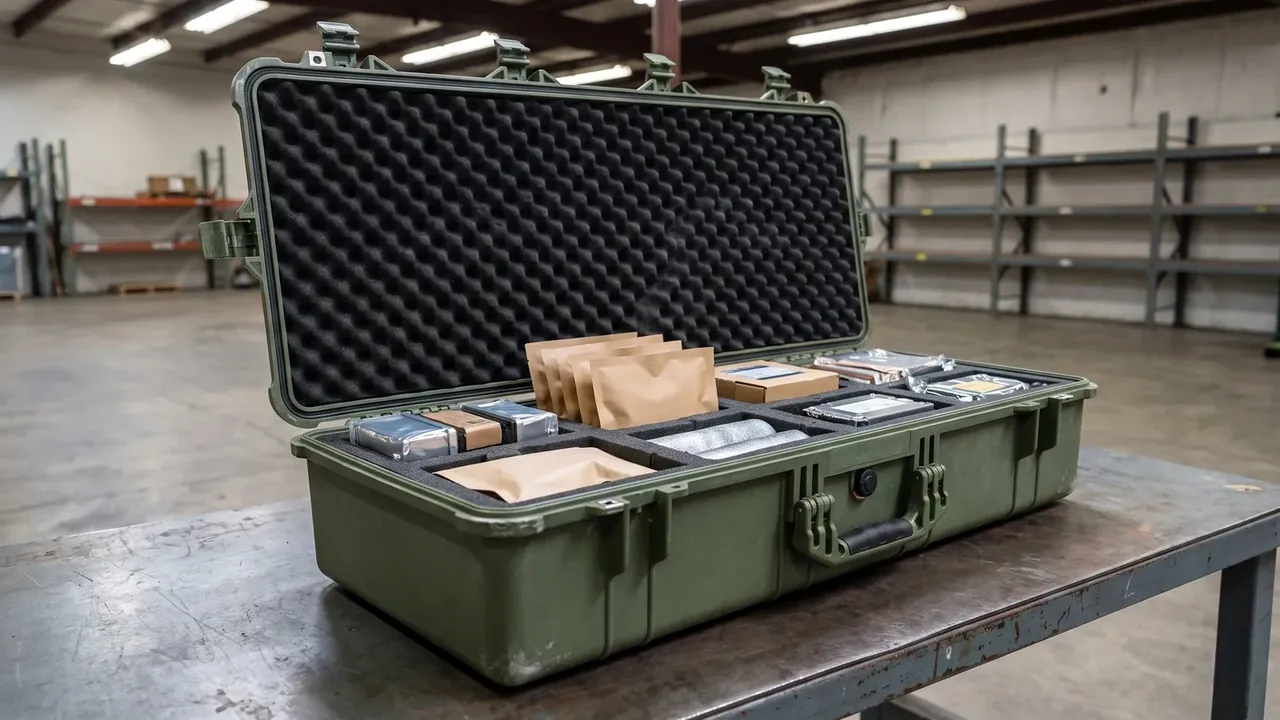
The first look is the seam: an even gap along the long edge means latches and gasket groove line up, a wedge means the rim has distorted. Three units took a 0.35 millimetre feeler at the corner. Cavity readings ran 589.2 to 590.8 against plus or minus 0.6, wall 2.66 to 2.91 against a nominal 2.8.
| Item | Basis | Limit |
|---|---|---|
| Cavity size | Plus or minus 0.6 mm | Out of band is Class B |
| Wall | 2.8 mm nominal, 5% loss | Below 2.66 is Class B |
| Latch force | Cold first reading | 55 to 95 N |
| Drop | 1.2 m, three per face | No through crack |
2. First-article check: five tools, three limits
One PP Plastic Case on the bench, worked top to bottom in forty-five minutes.
- Vernier caliper, 0.02 millimetre, for cavity depth;
- Ultrasonic gauge, 10 millimetre probe, five points clear of ribs;
- Force gauge, 500 newton range, on the latch lip;
- Feeler set, 0.05 to 1.0 millimetre, for the closed-lid gap;
- Colour card under D65 light, against Delta E 2.
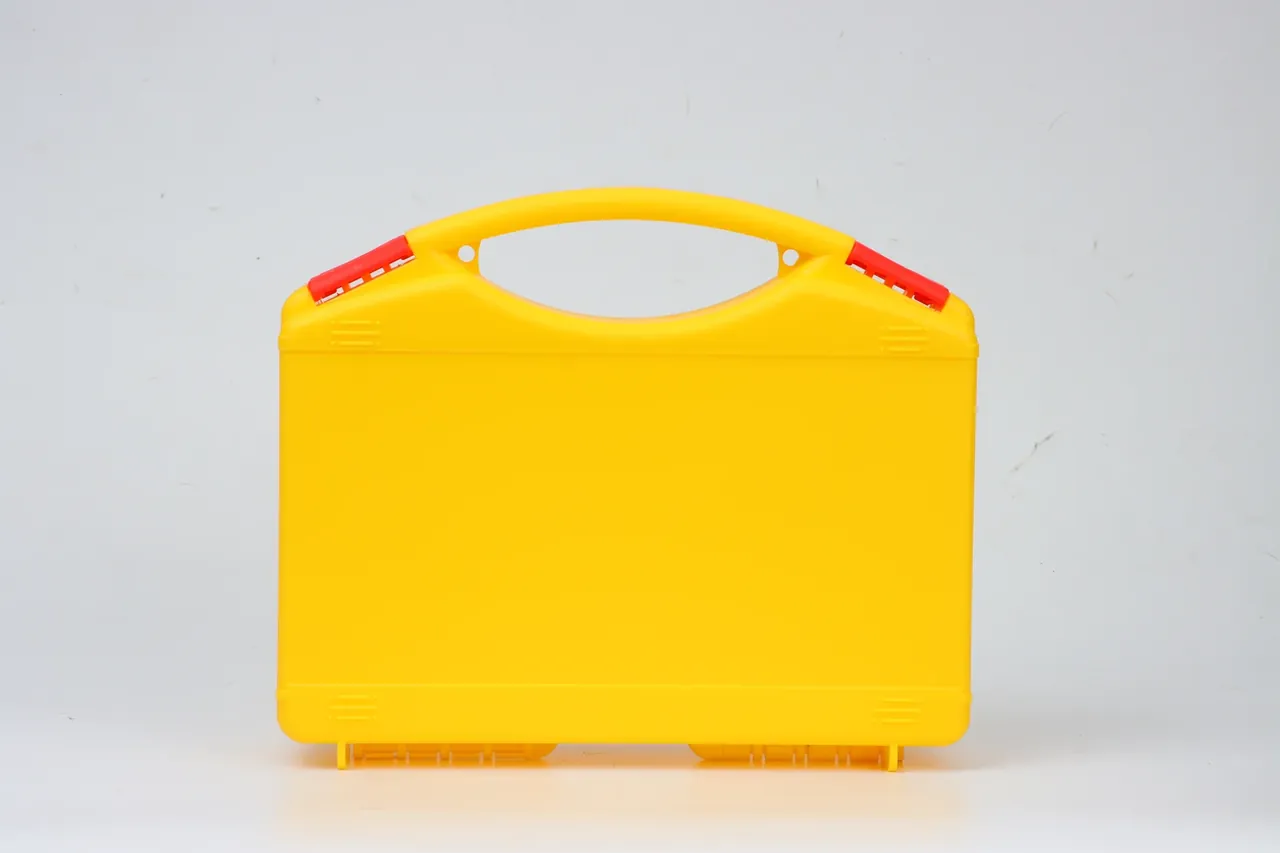
Appearance is usually an opinion, so we cut it to 300 millimetres and 500 lux: a sink mark visible only closer is not a defect. White weld lines signal low melt temperature.
Tools first, limits after.
3. Latches and hinges on a 5000-cycle rig
The rig loops every 3 seconds on a PP Plastic Case, pushing the latch, lifting the lid to 100 degrees and closing; the full run takes 4 hours 10 minutes, reading every 500 cycles.
| Cycles | Latch force | Hinge end play |
|---|---|---|
| 0 | 68 N | 0.2 mm |
| 500 | 66 N | 0.3 mm |
| 2000 | 63 N | 0.5 mm |
| 5000 | 57 N | 0.8 mm |
A rig turns feel into numbers: hand readings scatter by 6 newtons, and a rig stopping at 500 cycles misses the knee past 2000.
This lot graded Class B: 57 newtons clears the 55 newton floor, yet a 16% loss crosses the 15% internal line. The fix was a thicker rib at the latch root, 1.2 to 1.8 millimetres. Hinge play past 1.0 millimetre lets the lid shift and drops the dust rating.
4. Drop and stack: how two lots were failed
Drops run from 1.2 metres, once per face and once on an edge. This lot sat at minus 18 degrees Celsius for four hours and had to be dropped within 30 seconds of leaving the freezer. Two PP Plastic Case units cracked 12 millimetres at the lower corners, both opposite a latch. The crack did not go through, and the limit graded it Class A.
Stacking: five high, 72 hours, 25 degrees Celsius, the bottom unit carrying four cases plus weights. This lot read 3.1 millimetres against a 2.5 limit.
Both failures pointed at one place: at minus 18 degrees the wall of a PP Plastic Case stiffens, so impact energy crowds into the corner radius and stacking doubles the load there. Two diagonal ribs and a radius opened from R8 to R12 fixed it; the second lot read 1.9 millimetres clean.
5. Class A rejection, Class B concession, Class C rework
Of the 80 sampled, two graded Class A, nine Class B, fourteen Class C.
- Class A, corner crack or latch popping open: reject the lot or screen every unit.
- Class B, latch force below line or Delta E 3.2: concession at 6% to 8% off, indoors only.
- Class C, flash, skewed label, misaligned insert: supplier rework the same day, no credit.
The fourteen Class C units were cleared in forty minutes on a separate pallet. Class A defects require an 8D in seven days, and the next lot is sampled at 125 until two lots run clean. After three rounds, arguments about a PP Plastic Case shipment stay technical.
Conclusion
One checklist, one rig, five tools, four limits. Set sampling and AQL first, then method and instrument, then grading, and acceptance of a PP Plastic Case stops being an argument about feel.
This article discusses only the container (case body) side of specifications and design intent, and does not cover any handling, loading or use of the contents.
Related Reading
- Airdrop case acceptance: drop and stack limits
- Mould storage checks and rust prevention
- Pallet marking items at goods-in
- Inspection gates in a moulding SOP
Related Products
- 8 Series — Gun Cases; Military Equipment Cases; Camera Equipment Cases; Drone Cases; Watch Cases; Knife Cases; First Aid Cases; Electronics Equipment Cases
- WL8-2812 PP Gun Case — model WL8-2812
- All protective cases and toolboxes: 7 series, 158 models