

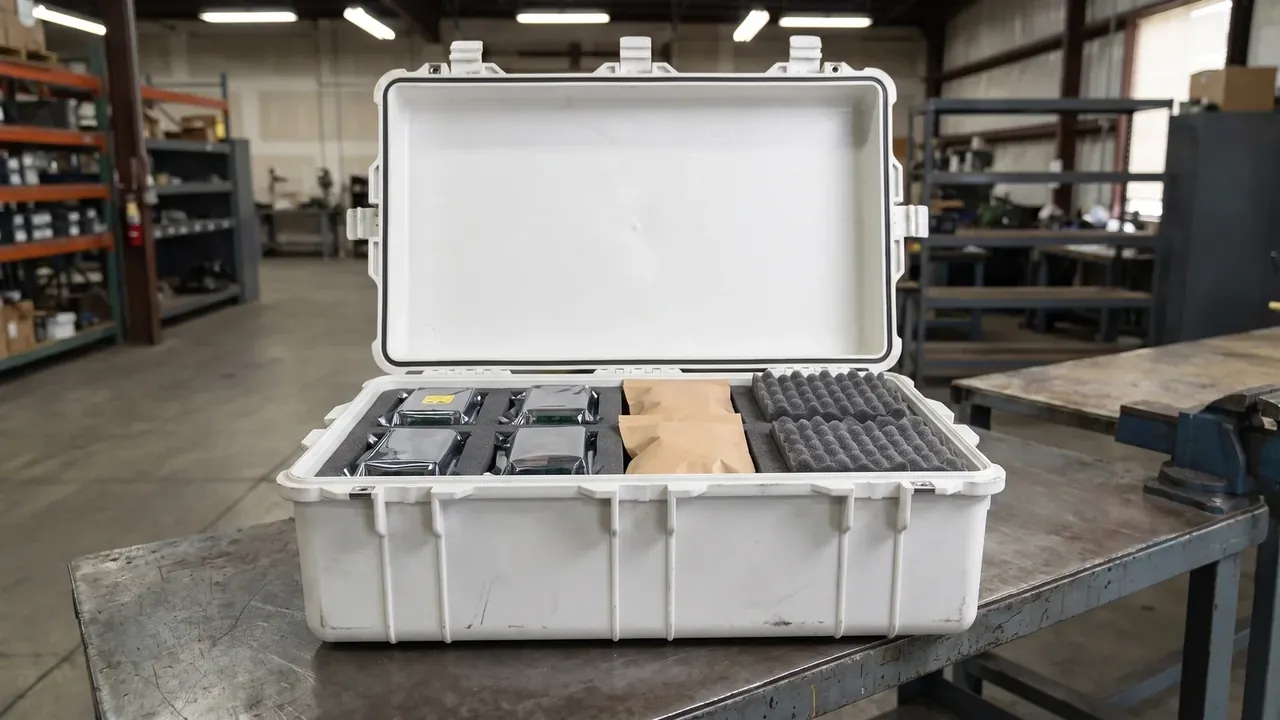
Quick answer: Two lines decide a PP plastic protective case: grade sets low-temperature toughness, process sets wall and batch. Below minus 20 degrees Celsius use block copolymer; 6 to 10 mm walls at 30 to 300 pieces favour rotomolding, 3 mm walls with tight latches favour injection.
Table of contents
- PP Plastic Protective Case: Grade and Molding Lines
- Homopolymer Versus Copolymer: Brittleness Sets the Limit
- Melt Index and Process: Injection and Rotomolding
- Chemical Resistance and Water Uptake
- Wall Thickness, Ribs and Case Stiffness
- FAQ
1. PP Plastic Protective Case: Grade and Molding Lines
A PP plastic protective case is not chosen by colour. Two lines decide it: grade, which governs whether a corner cracks in the cold, and process, which fixes wall, ribs and batch.
Grade has three variables: ethylene distribution, melt index and tensile yield. Process has two: injection or rotomolding, and a wall of 3 mm or 8 mm.
| Grade | Melt index (g/10 min) | Tensile yield (MPa) | Brittleness | Process |
|---|---|---|---|---|
| Homopolymer PP-H | 8 to 20 | 33 to 35 | 0 to -10 C | injection |
| Random copolymer PP-R | 10 to 25 | 28 to 30 | -10 C | clear parts |
| Block copolymer PP-B | 8 to 20 | 25 to 28 | -25 C | injection, rotomold |
| Rotomolding powder | 3 to 6 | 24 to 27 | -30 C | rotomold |
2. Homopolymer Versus Copolymer: Brittleness Sets the Limit
Homopolymer PP is highly crystalline, yields at 33 to 35 MPa, and is hard, cheap and chemically inert. Its brittleness sits between 0 and minus 10 degrees Celsius, so a winter drop splits corners.
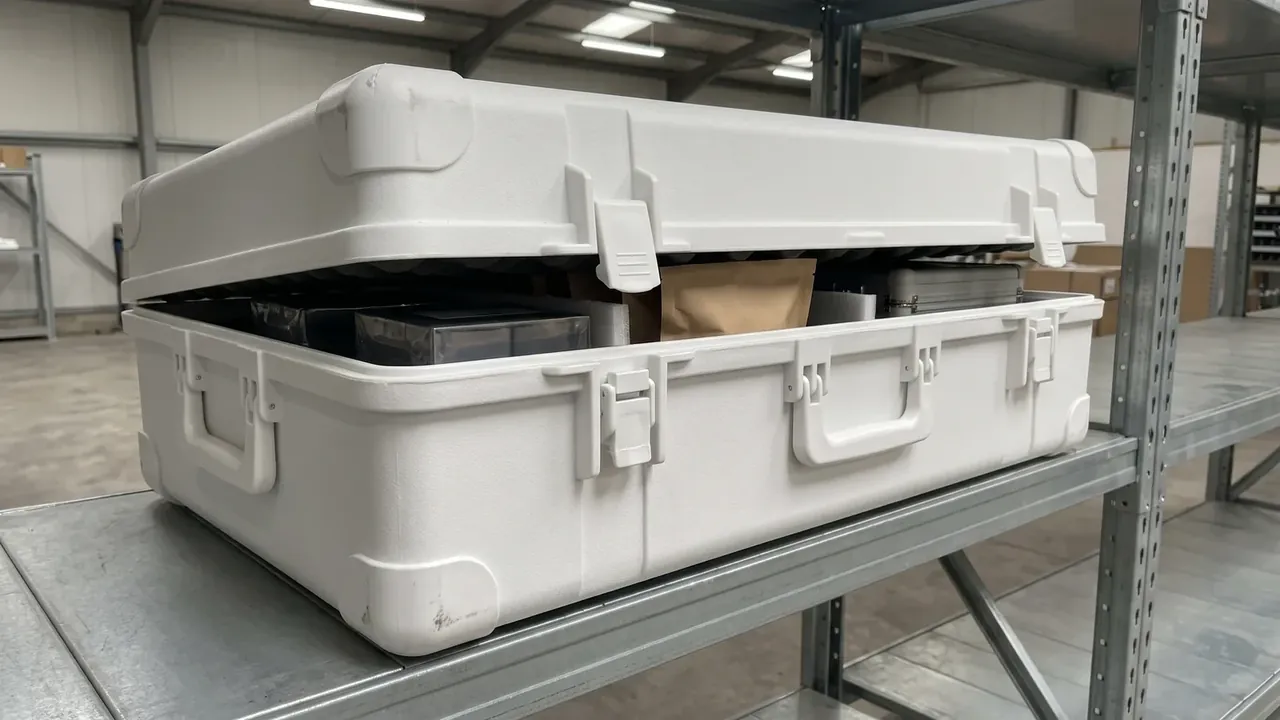
Random copolymer gains clarity and little toughness, with brittleness near minus 10 degrees Celsius. It suits clear covers, not a load-bearing PP plastic protective case.
Block copolymer disperses ethylene-propylene rubber as separate domains and pushes brittleness to minus 25 degrees Celsius, with high-rubber grades at minus 40. The price is a hazy surface and 0.2 mm of extra wall.
Write the condition, not the phrase: a 2 kg drop from 1 m at minus 20 with ten samples uncracked is a testable clause.
3. Melt Index and Process: Injection and Rotomolding
Melt index governs flow distance. Injection runs 8 to 20 g/10 min, the top for thin deep cavities; rotomolding uses 3 to 6, ground to 35 mesh.
Injection fills a steel tool at 2.5 to 4 mm wall, 60 to 90 seconds a cycle, economic from 3000 pieces. Latches, hinges and gasket grooves mould in one shot, ribs reach 4 mm, tolerance holds to 0.2 mm.
Rotomolding bakes a 3 mm aluminium mould at 280 degrees Celsius for 18 to 25 minutes, building a 6 to 10 mm wall at 30 to 300 pieces. No gate means low residual stress, but ribs stop at 2 mm.
| Item | Injection | Rotomolding |
|---|---|---|
| Wall (mm) | 2.5 to 4 | 6 to 10 |
| Rib depth | 4 mm | about 2 mm |
| Tolerance (mm) | plus or minus 0.2 | plus or minus 0.8 |
4. Chemical Resistance and Water Uptake
PP tolerates acids, bases and salts across pH 2 to 12. Thirty days in 60 percent sulfuric acid moves mass 0.3 percent and 40 percent sodium hydroxide 0.5 percent.
Organics differ: gasoline swells the wall 8 percent in thirty days and leaves it soft; toluene blisters it.
Water uptake is 0.01 to 0.02 percent in 24 hours, so dimensions barely move with humidity. Condensation is a seal and dew point problem.
5. Wall Thickness, Ribs and Case Stiffness
Rib thickness is 0.6 times the main wall: 1.8 mm of rib on a 3 mm wall. Thicker and sink marks appear where the gasket seals.
Ribs sit 80 to 120 mm apart with a 1 degree draft and an R0.5 root. Injection cuts a 4 mm rib; rotomolding manages 2 mm.
Check stiffness loaded: fill to rating, press 30 kg on the lid centre for an hour, hold residual deflection under 2 mm, then drop a corner at minus 20 without a crack. Only then is the wall of the PP plastic protective case fixed.
Service range: minus 20 to 80 degrees Celsius continuous, 100 short term. Above 80 degrees PP creeps and lid preload is gone.
Conclusion
Four numbers carry a PP plastic protective case: melt index, tensile yield, brittleness temperature and wall thickness. Grade sets toughness, process sets wall and batch, medium decides whether the resin belongs. Specified this way, a PP plastic protective case holds at the cold end and the chemical end.
This article discusses only the container (case body) side of specifications and design intent, and does not cover any handling, loading or use of the contents.
Related Reading
- PP case grades and shrinkage
- PP case versus ABS case
- How an injection moulded case is formed
- What rotational moulding does to a case
Related Products
- 8 Series — Gun Cases; Military Equipment Cases; Camera Equipment Cases; Drone Cases; Watch Cases; Knife Cases; First Aid Cases; Electronics Equipment Cases
- WL8-2812 PP Gun Case — model WL8-2812
- All protective cases and toolboxes: 7 series, 158 models