

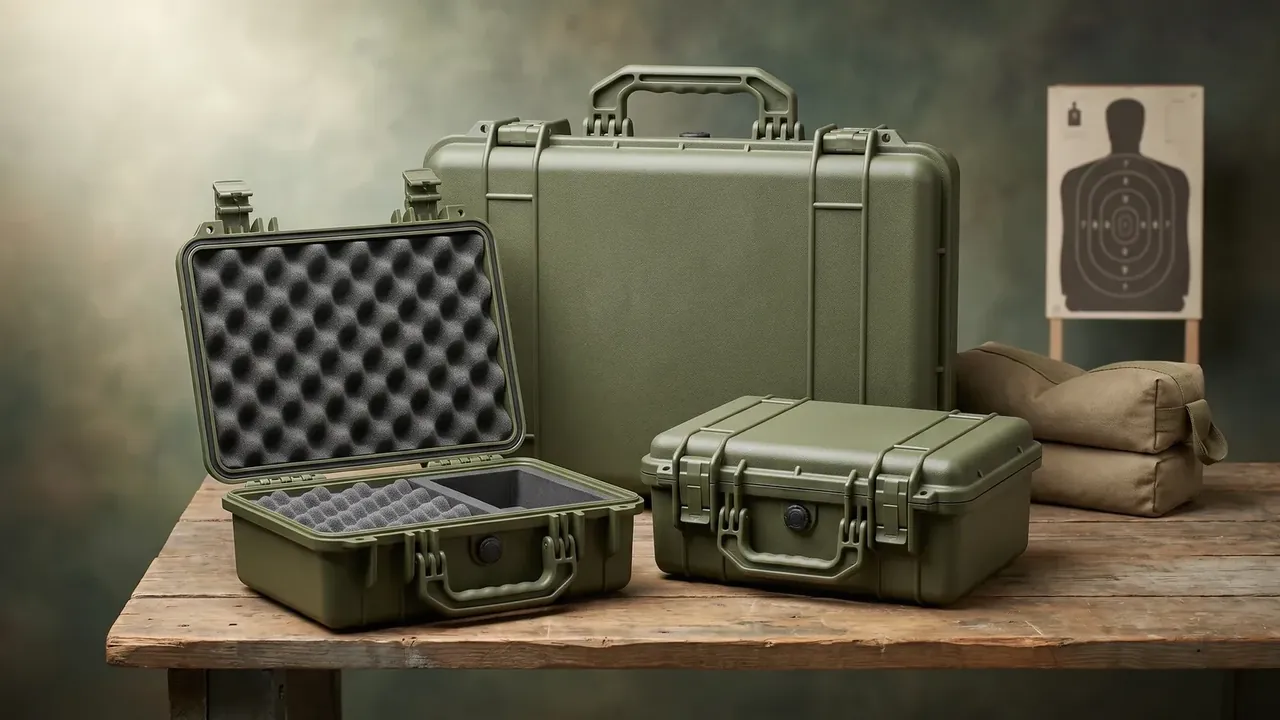
Quick answer: A prop charge container is sized backwards from the load. Four 14.5 kg units set the cavity, a 1.2 m corner drop sets the 3.5 mm wall, a 1 640 mm seal perimeter settles on four latches.
Table of contents
- Starting From the Load Case
- Where 3.5 mm Comes From
- Latches and the Sealing Face
- Stacking and Drop Verification
- FAQ
1. Starting From the Load Case
The chain starts with diameter, length and unit mass. A 152 mm by 480 mm unit at 14.5 kg, four to a case, gives a 58 kg payload designed to 60 kg; stacked four high, the bottom lid of a prop charge container carries 180 kg.
| Design input | Value | Effect on the specification |
|---|---|---|
| Unit diameter | 152 mm | Cavity 156 mm, 2 mm per side |
| Unit length | 480 mm | Cavity 486 mm, 3 mm each end |
| Unit mass | 14.5 kg | Cradle rated 15 kg |
| Units per case | 4 | 58 kg payload, 60 kg design |
| Stack height | 4 cases | 180 kg on the bottom lid |
Clearance is not a case of more being better: at 5 mm a side the units slide in transit and impact lands on the end faces; under 1 mm the seal scuffs.
Centre ribs take 30 kg each at 6 mm thick, lighter than one 10 mm slab. The cavity of a prop charge container comes from the real part plus 2 mm.
2. Where 3.5 mm Comes From
Treat the body as a thin cylinder: a 160 mm cavity under 0.02 MPa gives pD over two t, about 0.46 MPa at 3.5 mm. Modified PP shrugs that off, so stacking is not the governing case.
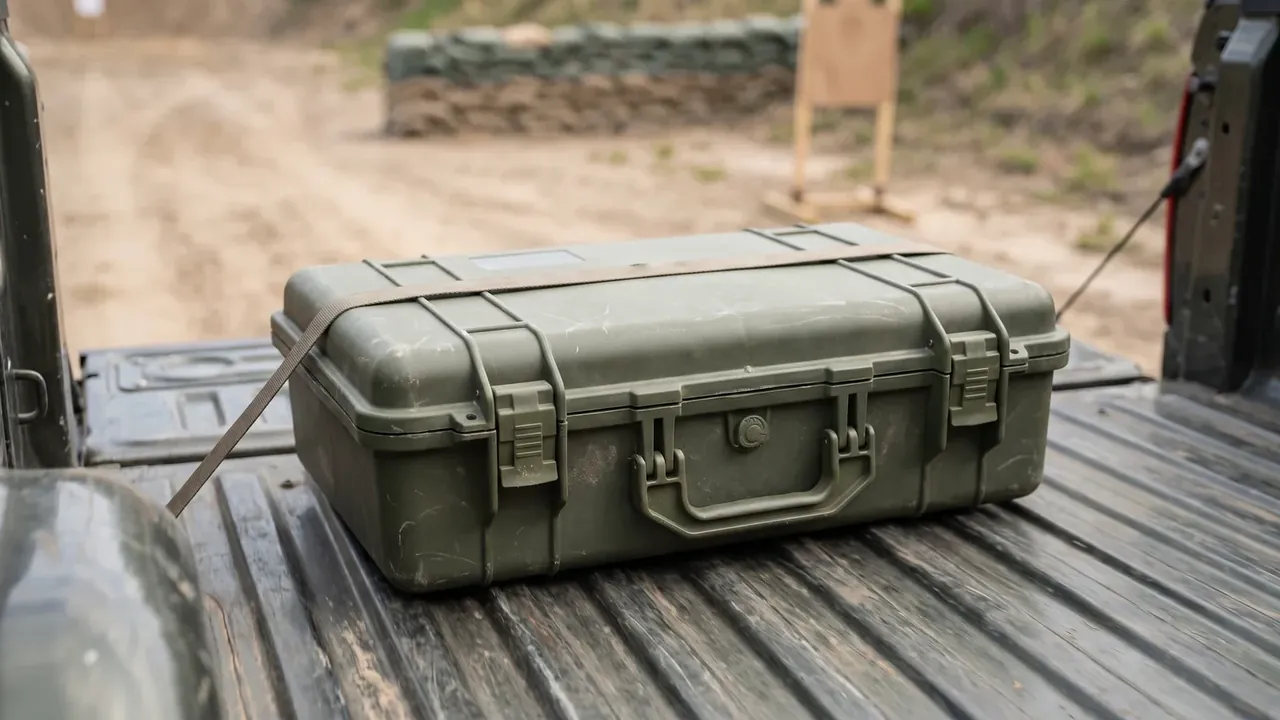
The drop is. A 1.2 m corner fall at 60 g with a concentration factor of 3 needs 3.2 to 3.5 mm to keep set under 2 mm: side 3.5, base 5, lid 4.
Three thicknesses bring their own problem. The lid freezes while the base contracts, and the body warps until one lid gap reaches 1.5 mm. Taper the transition, add a relief step inside the base, gate at its centre; the tool then holds a 0.6 mm gap.
Ribs make 3.5 mm work. A plain panel deflects 4 mm at mid-span under 180 kg; two ribs at 180 mm centres bring it under 1.2 mm, and spacing below 120 mm pulls sink marks through.
3. Latches and the Sealing Face
A latch compresses the gasket rather than clamping the lid, so spacing by perimeter beats spacing by count.
- Seal perimeter 1 640 mm, gasket compression 25 percent, pressure points spread evenly
- Four latches leave neighbours 410 mm apart, with 0.8 mm of rebound at mid-span
- Six latches cut spacing to 270 mm but stretch opening from 12 to 20 seconds
- Latch bases run 1 mm thicker than the wall, or they deflect first
- Groove 6 by 4 mm takes a 5 mm square cord and fills exactly
- No latch on the hinge side, where two 3 mm ribs keep the pin straight
At that arrangement a prop charge container holds 60 seconds at 0.03 MPa with under 1 kPa decay. Extra latches add two leak paths.
4. Stacking and Drop Verification
Stack four cases at 60 kg for 30 days, then read set on the bottom lid: 3 mm limit, recovery to 1 mm in 24 hours. Drop 1.2 m onto corner, edge and face on fresh cases.
| Test | Condition | Pass criterion |
|---|---|---|
| Stack | 4 cases, 30 days | Set 3 mm or less |
| Corner drop | 1.2 m | No through crack |
| Seal | 0.03 MPa, 60 s | Decay 1 kPa or less |
| Rib deflection | 180 kg | Under 1.2 mm |
Creep couples the two: a case loaded for 30 days cracks about 30 percent longer in a drop, so stack first and drop second.
The chain closes at 620 by 340 by 300 mm and 9.8 kg empty. Move one link and everything downstream is recalculated.
Conclusion
Sizing a prop charge container is arithmetic rather than selection: the load fixes the cavity, the cavity the envelope, stress and drop the walls, the seal perimeter the latches. Keep 18 kg, 3.5 mm, four latches and 1.2 m in mind, and any deviation in a prop charge container shows at a glance.
This article discusses only the container (case body) side of specifications and design intent, and does not cover any handling, loading or use of the contents.
Related Reading
- How a prop charge container is put together
- Material choices for prop charge containers
- Reading the spec sheet of a stackable container
Related Products
- 8 Series — Gun Cases; Military Equipment Cases; Camera Equipment Cases; Drone Cases; Watch Cases; Knife Cases; First Aid Cases; Electronics Equipment Cases
- WL8-2812 PP Gun Case — model WL8-2812
- All protective cases and toolboxes: 7 series, 158 models