

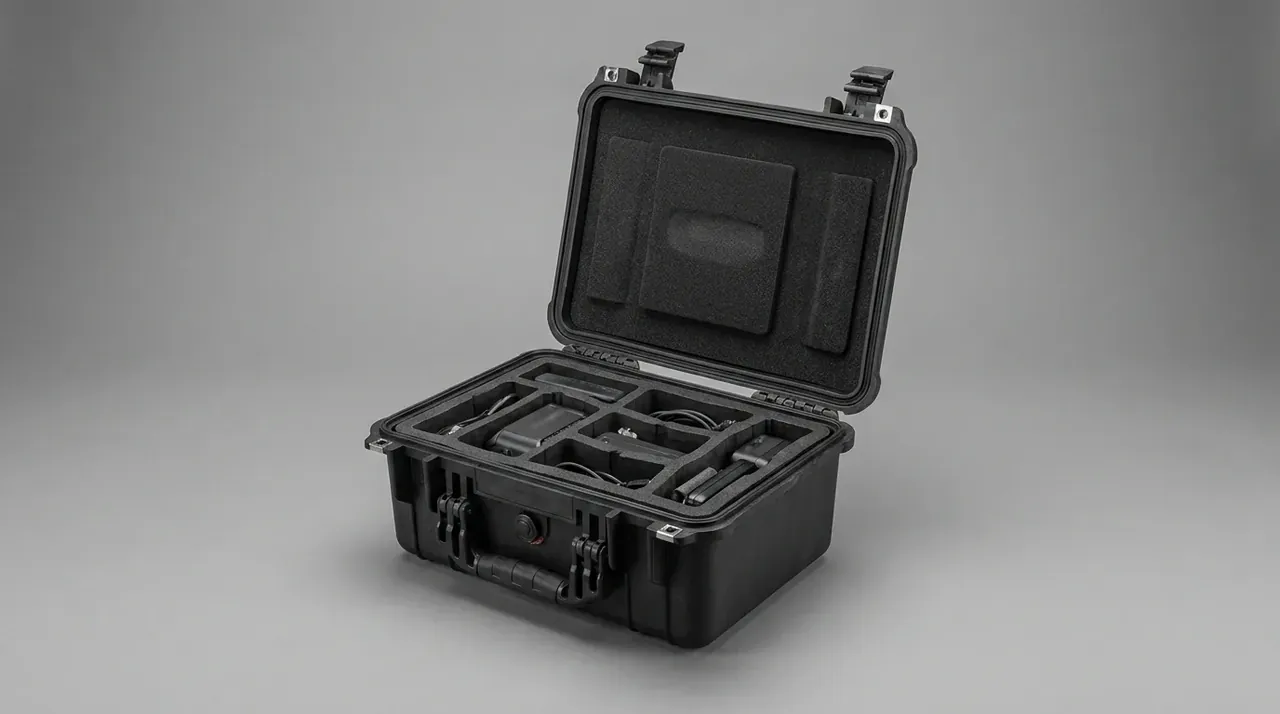
Quick answer: A case quarterly service visit is 12 checks in under 20 minutes, and it catches gasket compression below 25% and latch pull under 45 N before either shows up as a leak.
Table of contents
- Setting the 90-day interval
- Gasket compression and latch pull
- Wheels, hinges and handle
- Shell, squareness and lining
- Pressure valve and three dispositions
- FAQ
1. Setting the 90-day interval
Ninety days is not arbitrary. A gasket under clamp load takes a permanent set, and about 40% of the annual set happens in the first 90 days.
Interval follows duty: a warehouse case opened fewer than 10 times a month runs 90 days, a truck-loaded case 60, coastal plants and open yards 30. The 12 checks never change, only frequency.
Twelve checks split across five items: seals 2 in 4 minutes, latches 2 in 3, running gear 3 in 5, shell with lining 3 in 5, valve 2 in 3. That totals 20 minutes, with records and dispositions outside the 12.
| Item | Checks | Time | Tools | Most-skipped check |
|---|---|---|---|---|
| Seals | 2 | 4 min | caliper | fewer than 8 compression points |
| Latches | 2 | 3 min | spring gauge, 0.3 mm feeler | mating face offset |
| Running gear | 3 | 5 min | 0.5 mm feeler, caliper | handle return time |
| Shell and lining | 3 | 5 min | 10× loupe, tape | lining collapse area |
| Valve | 2 | 3 min | 20 mL syringe | cap return |
| Total | 12 | 20 min | — | — |
Two records settle the interval. With two items in one area sitting in the warning band, say 26%–30% compression or 38–45 N latch pull, a case quarterly service interval is too long and drops by 30 days.
2. Gasket compression and latch pull
Gasket condition is judged by compression, not by feel. A 10 mm solid silicone cord standing 7.5 mm above the groove with the lid closed is at 25%; read groove depth and cord height with a caliper, subtract, divide by the original section, and record the lowest of eight points.
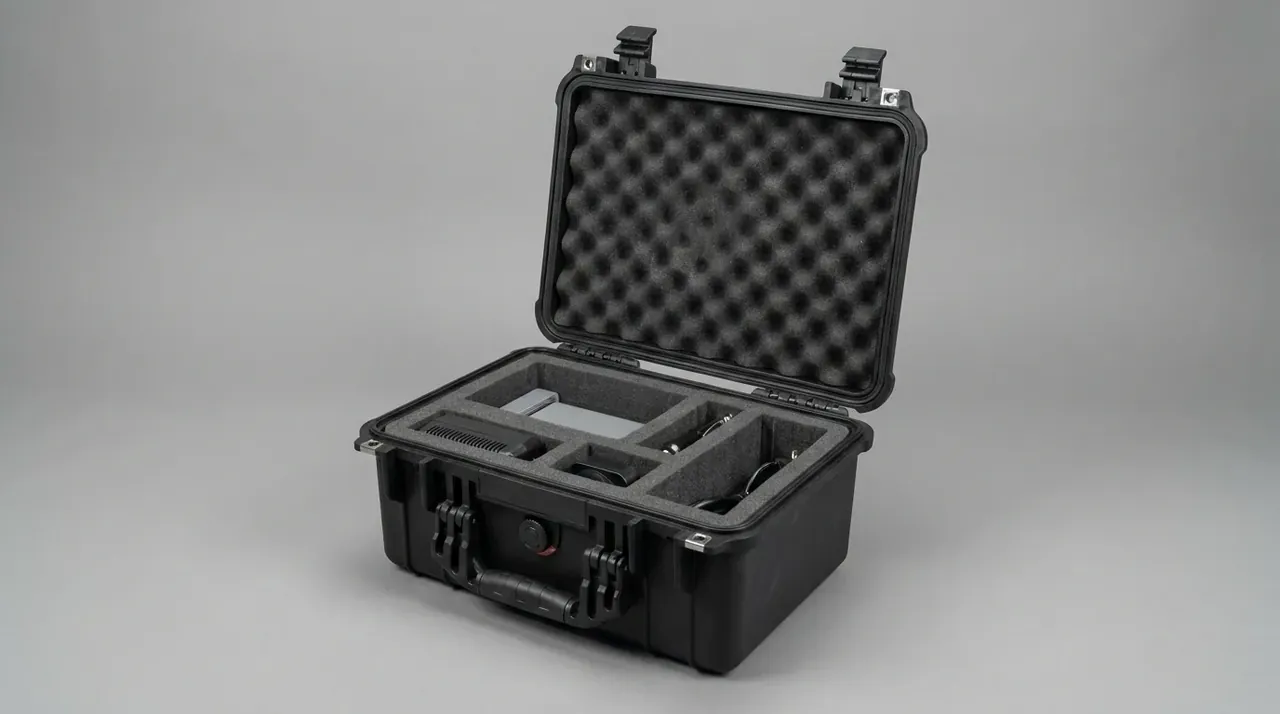
Latch pull of 45 N is the factory figure. Hook a spring gauge on the latch body, pull square to the mating face and average three pulls: under 40 N it closes loosely and rain finds the latch line, over 60 N the hook is misaligned and forcing it whitens the PP root.
Recovery says more about ageing than any visual check: press and release, 3 s is normal, slower than 5 s means plasticiser has migrated and the cord barely compresses at −20 ℃ although the lid still latches.
The fourth is mating face offset. Run a 0.3 mm feeler around the closure line; past 10% of the perimeter, check the hinge pin and rim flatness instead of winding the latches tighter. Case quarterly service skips this one most often, because it never changes how the lid feels.
| Check | Tool | Pass line | Action if out |
|---|---|---|---|
| Gasket compression | caliper | ≥20%, target 25% | under 20%: downgrade |
| Latch pull | spring gauge | 40–60 N, nominal 45 N | under 40 N: adjust catch |
| Gasket recovery | finger press | back to thickness in 3 s | slower than 5 s: replace |
| Mating face offset | 0.3 mm feeler | ≤10% of perimeter | check hinge pin |
3. Wheels, hinges and handle
The number that matters at the wheel is 0.5 mm of axial play. Lay the case on its side and push the wheel along the axle: a 0.5 mm feeler should enter without the wheel rocking. Past 1.0 mm the hub and axle have worn apart.
Hinge pins are measured, not eyeballed. A nominal 6 mm pin worn to 5.6 mm lets the lid rock 2 mm at 90° open, and corner compression falls 5 percentage points.
The handle gets two actions: extend all three stages and check side play at 3 mm or less, then press the release and time the return at 1 s or less.
If any one of the three is condemned the case stays in the building, because a single new wheel loads the frame unevenly and the next case quarterly service finds the other side out.
4. Shell, squareness and lining
Cracks start at corners, not on flats. Walk a 10× loupe along four vertical ribs and eight corners: a crack longer than 5 mm that has gone through the wall is a replacement. Surface marks up to 3 mm can stay if marked for the next round.
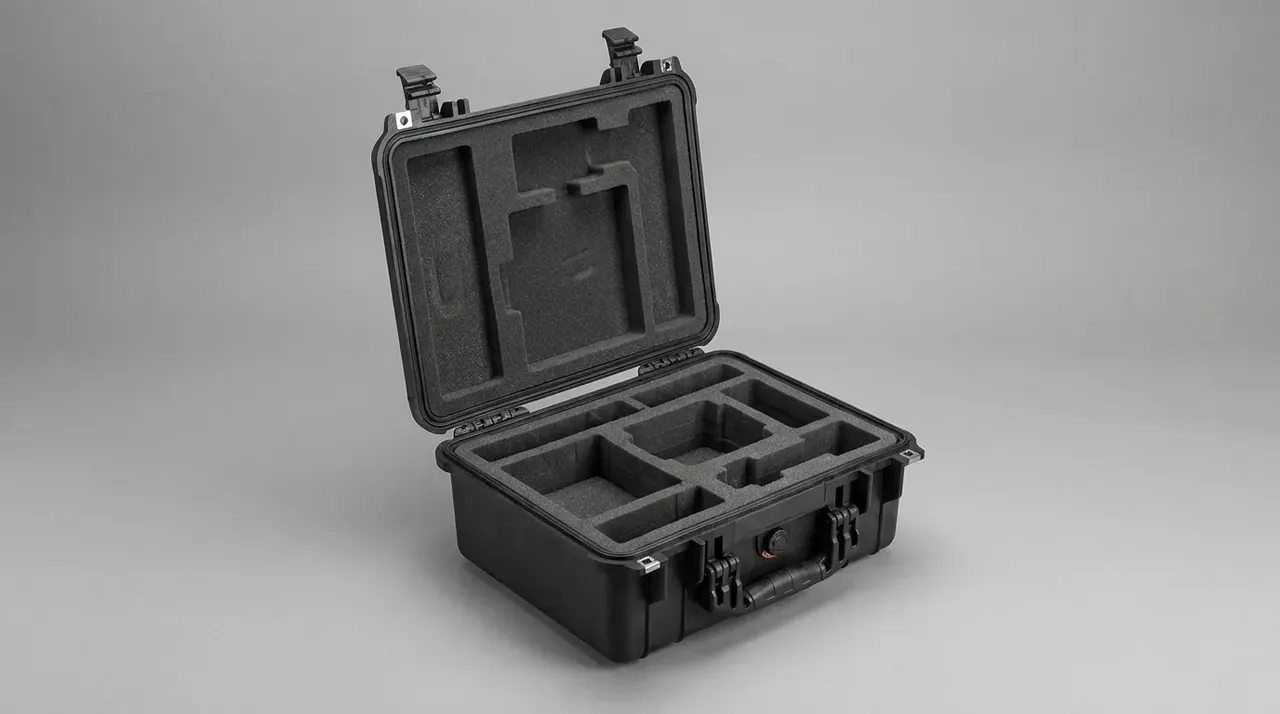
Squareness is the diagonal difference. Close the empty case and measure both rim diagonals; more than 3 mm apart means the rim is out of square, the gasket crushed on one side and barely touching on the other. Such a case can move inside a warehouse only.
The lining is reduced to two numbers, collapse depth and collapse area: depth over 5 mm and area over 20 cm² go on the record sheet, while whether to replace it outright is a separate judgement. Measure at 20 ℃, because a −20 ℃ store reads 3 percentage points low on compression and 1 mm wide on the diagonal.
5. Pressure valve and three dispositions
The valve is the item most often skipped and least safe to skip. Fit a hose from a 20 mL syringe over it and push 10 mL of air through; free passage returns within 5 s, a blocked membrane takes over 20 s or will not move. A blocked valve lets differential pressure lift the gasket on air freight, and the case takes water with nothing visible outside. The second valve item is cap return: press and release, and it should spring back within 2 s.
The record sheet has six fixed columns: date, case number, check item, measured value, disposition, next due date. Twelve rows, one per check, and the value must be a number rather than the word normal. Two rows per case, ten cases to a page, so the paperwork for case quarterly service stays small.
| Disposition | Trigger | Action | Re-check |
|---|---|---|---|
| Keep in service | all 12 items inside limits | no change of use | 90 days |
| Downgrade | 1–2 items in warning band, e.g. 20%–24% compression or 0.6–1.0 mm wheel play | warehouse moves only, no truck | 30 days |
| Replace | any through-wall failure, e.g. crack over 5 mm or latch under 30 N | stop use, repair or scrap | not applicable |
A downgraded case narrows its duty instead of getting a quick fix: 38 N latch pull and 0.8 mm wheel play means warehouse moves only, and one more band of loss sends it to repair or scrap.
Trend beats any single reading. Four rounds at 25%, 22%, 20% and 18% compression tell you how many quarters that case has left.
Conclusion
The practical form of case quarterly service is a six-column sheet with twelve measured rows. Fix the interval at 90 days and the visit at 20 minutes, and 25% compression, 45 N latch pull and 0.5 mm wheel play become numbers you can compare. Four flat rounds hold the interval; two sliding rounds cut it to 30 days. Put the three dispositions in the last column, then book the next date before the case goes back on the shelf.
This article discusses container-side specifications and design implications only, and does not cover any handling, loading or use of the contents.
Related Reading
- Case repair and spare parts
- Case maintenance during warehouse storage
- Routine care for weapon storage cabinets
- How a case pressure relief valve works
Related Products
- 8 Series — Gun Cases; Military Equipment Cases; Camera Equipment Cases; Drone Cases; Watch Cases; Knife Cases; First Aid Cases; Electronics Equipment Cases
- WL8-2812 PP Gun Case — model WL8-2812
- All protective cases and toolboxes: 7 series, 158 models