

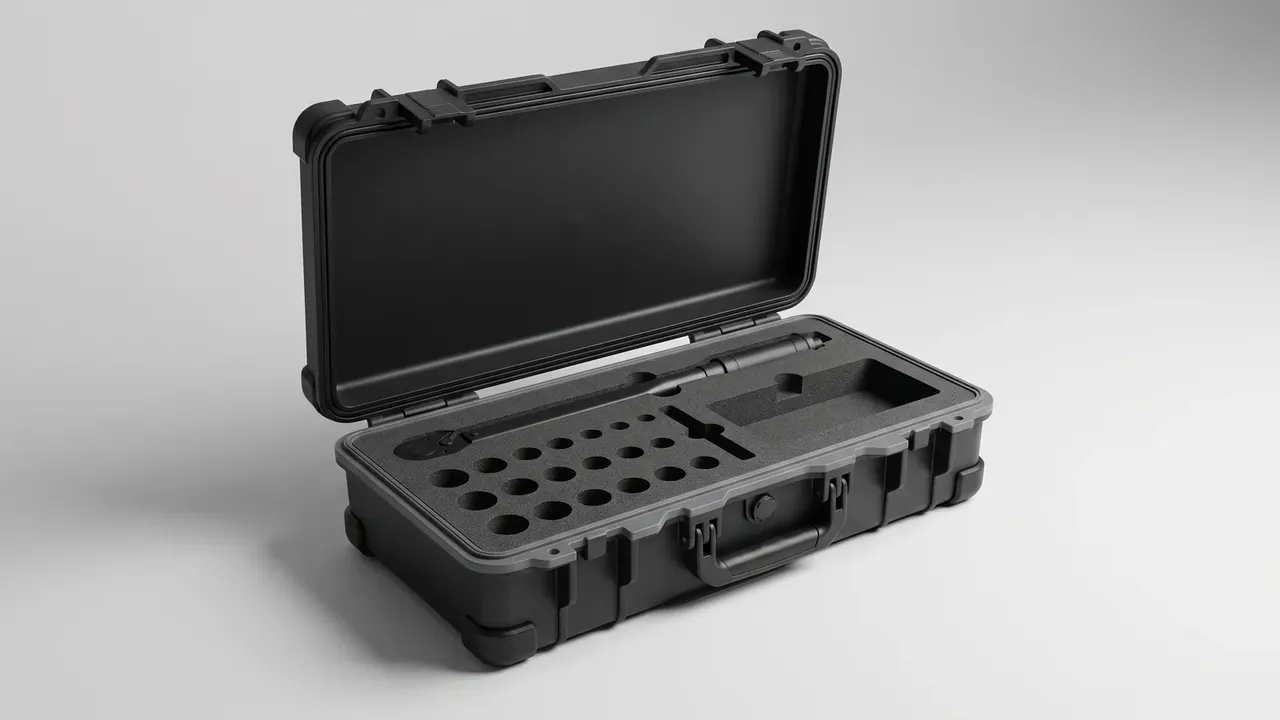
Quick answer: A rail maintenance tool case is laid out around a 120-minute possession, not around a tool list: every cutout holds one item, the case weighs about 9.5 kg empty and stays under 32 kg loaded, so two technicians can carry it across the ballast and still close the count in 15 minutes.
Table of contents
- Layout for a 120-minute possession window
- Shadow board logic inside the case
- Carrying, structure gauge and stacking loads
- Lost-tool recovery and night marking
- FAQ
1. Layout for a 120-minute possession window
An urban rail possession runs 120 minutes from registration to hand-back, and a rail maintenance tool case gets under 20 of them. The layout follows the peak demand of one job: 4 people on track, 2 torque wrenches and 1 track gauge shared, foam cut to that count.
Work back from 120 minutes and the tool loop gets 20: three to pick, fifteen to count, two for anything missing. Common items therefore sit on one level; a two-tier lid costs 40 seconds a lift, and nobody has that at 04:00.
| Zone | Cavity size | Positions |
|---|---|---|
| Hand tools | 380 × 260 mm | 12 |
| Torque and gauges | 300 × 180 mm | 4 |
| Fasteners | 240 × 160 mm | 6 |
| Spares | 200 × 150 mm | 2 |
Empty weight is 9.5 kg and the loaded limit 32 kg, so two people carry it 15 m to the cess without swapping hands. Above 35 kg it belongs on a trolley: lifting by the handle cracks the moulded ribs first.
2. Shadow board logic inside the case
Inside a rail maintenance tool case, a shadow board works only when one cavity holds one item, with 1 to 2 mm of clearance. Too much and the item jumps its seat, so a torch beam reads an empty slot. Too little and a gloved hand forces it into the next cavity.
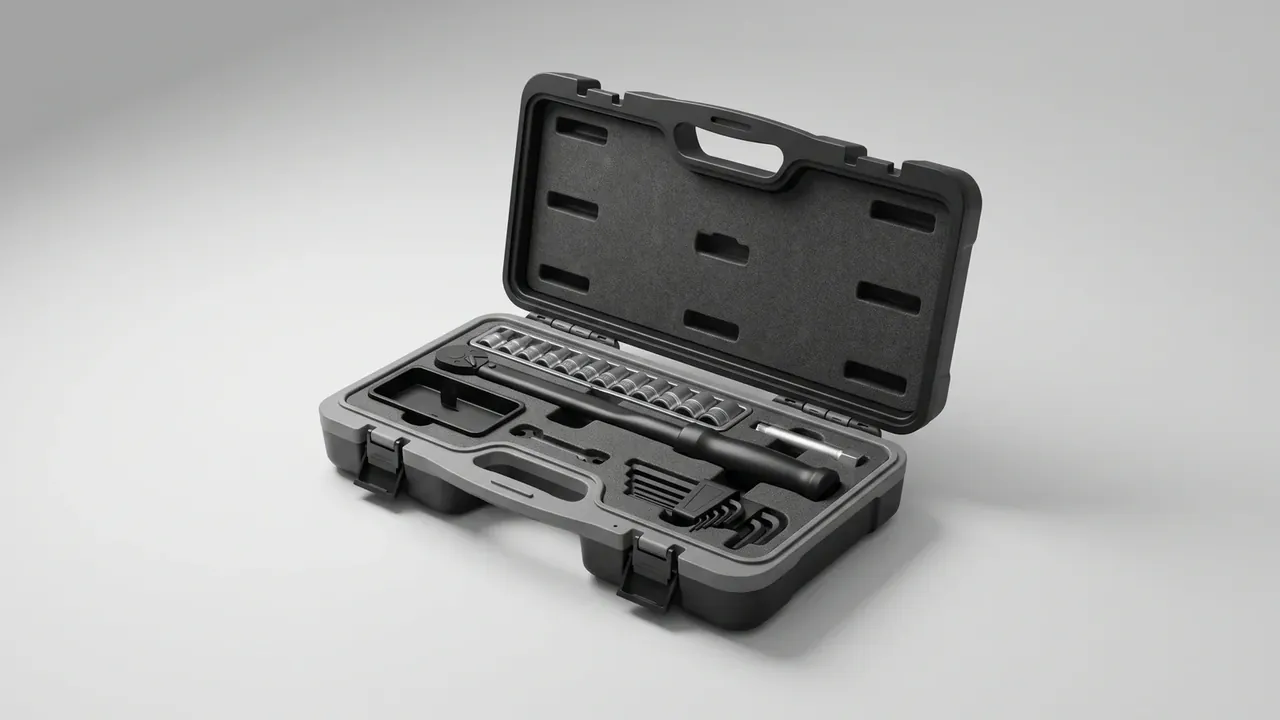
The EVA board is 30 mm in two layers: 20 mm carries the outline, 10 mm backs it. Cut depth stops at half the tool thickness so a fingertip can pinch the edge. CNC routing holds edge squareness within 0.2 mm; past that the walls fuzz in three months.
Colour does more than numbering. Cavity floors come in three tones: dark grey for daily tools, light grey for measuring items, black for job-specific pieces. A count scans for exposed backing first, then confirms position by position. Bare foam means a missing item, and one pass of a head torch covers 24 positions without reading a label.
| Board property | Value | Acceptance |
|---|---|---|
| Thickness | 30 mm (20 + 10) | Local compression ≤2 mm |
| Cavity clearance | 1 to 2 mm | No shift after 10 inverted shakes |
| Edge squareness | ≤0.2 mm | No visible fuzz |
| Label wear | 500 wipes | Still legible |
3. Carrying, structure gauge and stacking loads
The first constraint beside the track is the structure gauge: with the case at the ballast edge, its outer face stays 2 m or more from the track centre line. In a narrow section it goes against the wall, handle inboard and latches out, cutting the area exposed to train-induced pressure.
The base of the rail maintenance tool case is rated for 25 kg distributed, each of four feet taking 8 kg. Stacking is specified at 3 high, so the bottom case carries 64 kg; a 2.5 mm PP wall at 40 °C for 72 hours creeps under 0.6 mm. A fourth layer needs a pallet.
Latches fail before walls do. Each closes at 120 N and the pair is opposed, so a drop makes the latch yield first and the gasket load second, keeping lid distortion out of the seal channel.
| Item | Value | Acceptance |
|---|---|---|
| Loaded weight | 32 kg | Handle deflection ≤0.5 mm |
| Stack height | 3 cases | Bottom case at 64 kg |
| Wall thickness | 2.5 mm | Creep ≤0.6 mm at 40 °C, 72 h |
| Latch force | 120 N | ≤15% loss after 500 cycles |
In a vehicle the case is tied at 2 points with 25 mm webbing, since cord leaves a crease that becomes a crack starter. A van reaches 55 °C, so it sits 20 mm off the wall; a gasket held 8 hours at 55 °C takes a set of up to 8%.
Feet are 8 mm crowned pads, so ballast, trough covers and platform edges take the base squarely instead of tipping it. Trough covers leave a 3 mm gap, and a foot dropping in levers the handle outward. A platform edge is a 1.2 m fall to rail level, with shock between 60 g and 90 g; seats break first, so the seat root is thickened 4 mm.
4. Lost-tool recovery and night marking
Recovery depends on three markings: an asset number on the lid, a seal slot beside the latch, and the exposed cavity that shows a gap in the board. The number is laser-etched to survive a scuff, and the slot is a 6 mm recess so a cable tie sits flush.
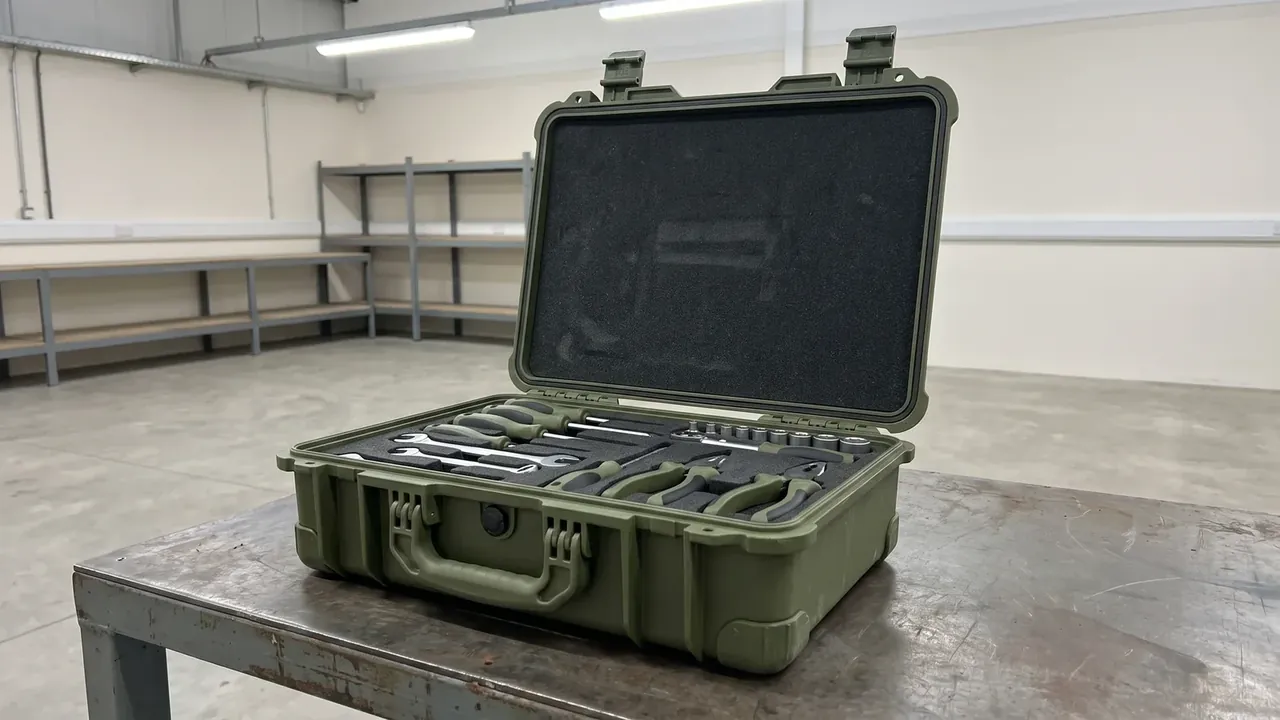
Reflective marking on the rail maintenance tool case goes on all four corners, in 50 mm strips readable at 30 m in headlights. A fully reflective panel turns into a white smear in rain at night; four corner strips keep the outline legible.
Recovery runs as a 24-hour loop. A gap at the count puts a red marker in the cavity, the tool room is told within 2 hours, and the section is walked within 24. While the marker is in place, the rail maintenance tool case stays in the store.
Conclusion
The value of a rail maintenance tool case comes down to two measurable numbers: three minutes to pick, fifteen to count, and 9.5 kg empty against 32 kg loaded. The first rests on one cavity per item and three floor tones, the second on a 2.5 mm wall with four feet sharing the load. Put both in the acceptance sheet rather than comparing layer counts.
This article discusses only the container (case body) side of specifications and design intent, and does not cover any handling, loading or use of the contents.
Related Reading
- Compartment layout for railway maintenance cases
- Choosing cases for transit maintenance work
- Fixing a distorted lid that will not close
Related Products
- 8 Series — Gun Cases; Military Equipment Cases; Camera Equipment Cases; Drone Cases; Watch Cases; Knife Cases; First Aid Cases; Electronics Equipment Cases
- WL8-2812 PP Gun Case — model WL8-2812
- All protective cases and toolboxes: 7 series, 158 models