

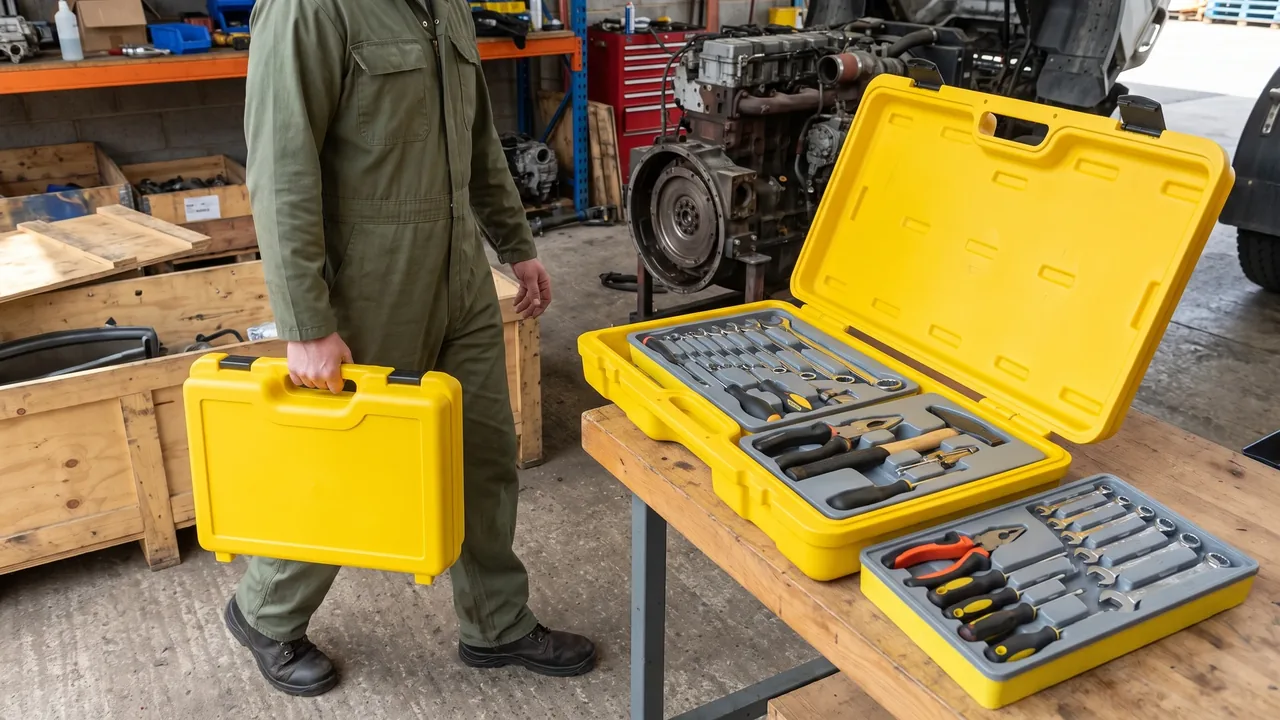
Railway track maintenance crews, urban metro operation teams, and line engineering workshops move heavy wrenches, track gauges, rail thermometers, measuring instruments, and assorted fastening tools between work sites on a daily basis. The core value of a railway maintenance tool case lies in its rotomolded shell carrying dozens of kilograms of heavy tools while delivering integrated dustproof, waterproof, shock-resistant, and orderly storage protection in harsh outdoor, humid, dusty, and vibration-prone field environments. A properly specified heavy-duty case reduces tool loss and impact damage while shortening the tool-check time at the start and end of each shift, making it a foundational piece of standardized line-maintenance equipment that no procurement plan should overlook.
1. Application Scenarios and Core Value of the Railway Maintenance Tool Case
The railway maintenance tool case primarily serves conventional railway engineering sections, high-speed line workshops, urban rail transit operation zones, and maintenance teams on dedicated industrial sidings. Typical use cases include routine track patrol and maintenance, re-tightening work after manual tamping in turnout areas, geometric re-check after rail grinding or welding, equipment inspection at bridge and tunnel portals, and the centralized transport of disassembly tools and gauges during night-time possession windows. In these scenarios, tools are transferred repeatedly between emergency vehicles, track work cars, and manual carrying, so the case must absorb knocks from frequent handling while resisting rain, dust ingress, and internal movement caused by road shock.
From a value perspective, the case first resolves the problem of tool storage order. Line work involves many tool types: long rail gauges and track rules, smaller torque-wrench heads, feeler gauges, and marking supplies, plus fragile glass levels and electronic measuring modules. Without dedicated dividers and restraints, tools collide during transport, causing gauges to lose calibration and cutting edges to chip. Second, the sealed structure isolates the interior from external rain, snow, and dust, giving moisture-sensitive devices such as electronic rail thermometers and digital track rules basic protection. Third, standardized case dimensions simplify stacking and fixing inside work vehicles, enabling rapid loading and unloading together with wheels and stacking features. For purchasers, selecting a structurally reliable heavy-duty case is essentially buying long-term insurance for both operational efficiency and tool-asset safety.
As line-maintenance standardization advances, more engineering sections include tool cases in team fixed-location management lists, requiring tools to be zoned by work flow with a checklist and responsible-person label on the lid interior. This management approach depends on the case itself offering customization capacity and durable structure, turning the maintenance case from a mere storage vessel into a visualized carrier of team work standards. Related guidance on heavy-duty cases and rail transit cases helps procurement compare enclosure families before specifying dimensions.
2. Rotational Molding Material and Structural Strength
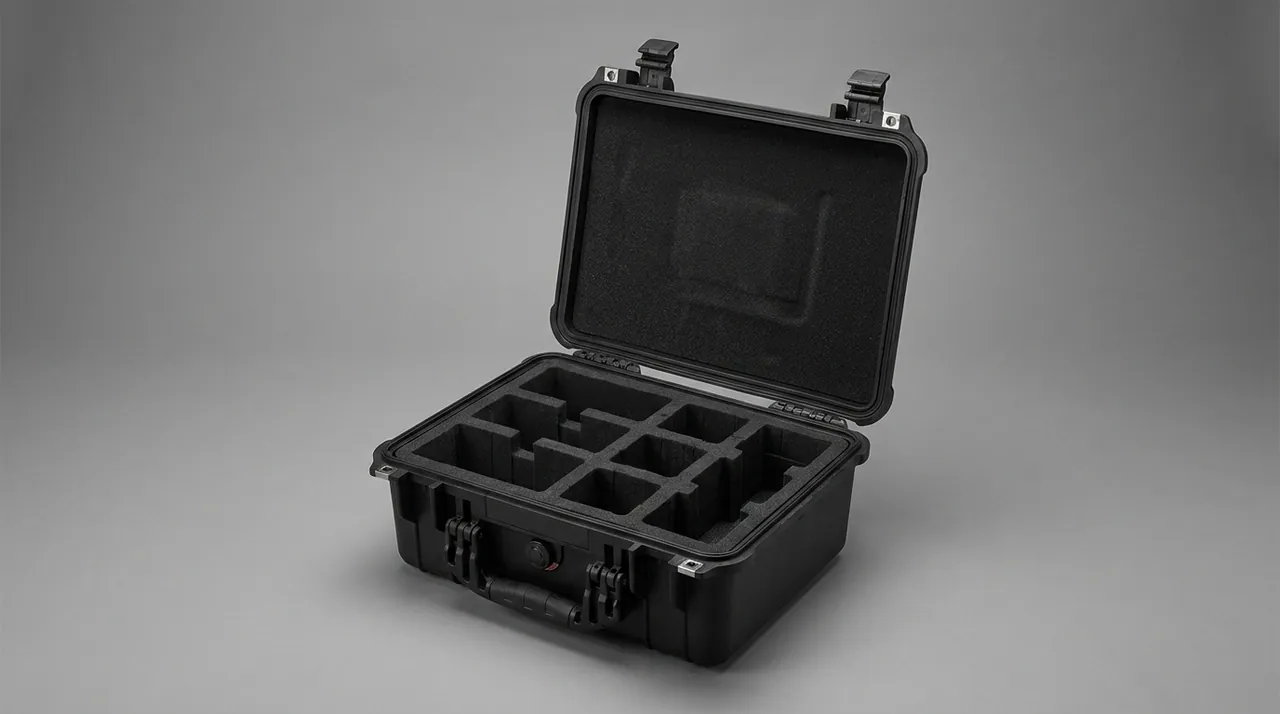
The outer shell of a railway maintenance tool case is commonly produced by rotational molding, also called rotomolding, using linear low-density polyethylene. The process loads plastic powder into a mold, then rotates it biaxially while heating so the material adheres evenly to the cavity wall and forms a seamless, integral shell after cooling. Compared with injection molding, a rotomolded shell allows wall thickness flexibility between roughly three and six millimeters and avoids stress concentration at corners and edges, suiting the high strength and drop resistance required for heavy-tool storage and transport.
The environmental stress-crack resistance of the shell material is a key selection metric. Line work exposes cases to ultraviolet light, day-night temperature swings, and oil contact, so the resin needs good low-temperature toughness and anti-aging behavior. In practice, carbon black masterbatch and UV stabilizers are added to the polyethylene base to slow embrittlement during long outdoor service. For base-plate zones carrying torque wrenches and sledgehammers, manufacturers often locally thicken the wall and add reinforcement ribs to raise bending stiffness and prevent permanent deformation under full load.
Structural strength also depends on wall-thickness distribution. A major advantage of rotomolding is controllable, uniform thickness with a smooth interior, avoiding the weak weld lines of metal welded boxes. At the junctions of sidewalls and lid, properly rounded transitions spread impact energy during opening, closing, and drops. During procurement, buyers can request wall-thickness maps and typical empirical data from suppliers, then estimate safety margin at expected drop heights combined with full load weight. For long-term stacked storage, lid deflection under uniform load should also be considered and verified by layered load testing where necessary.
3. Reinforced Corners and Rib Design
The most vulnerable areas of a heavy tool case in the field are corners and regions around latches. Railway maintenance cases typically use embedded metal corner guards or thickened plastic corners to protect the eight outer corners. Metal guards are usually stamped from aluminum alloy or stainless steel and fixed to the shell by riveting or embedding, taking the impact first when the case contacts the ground and protecting the sealing face and appearance. Plastic corners are integrated or clipped onto the shell, providing lightweight, rust-free protection.
Reinforcement ribs are another means to raise overall rigidity. Horizontal and vertical ribs on the inner sidewalls and baseplate improve bending and torsion resistance without large weight increases, keeping the loaded case stable in shape during handling and stacking. Rib design must leave room for liner installation so protrusions do not compress tool space. Mature engineering uses topology thinking supported by finite-element analysis, placing material along load paths to balance light weight and strength.
Corner and rib coordination also appears in local reinforcement around latch and hinge zones. Frequently opened areas can crack under repeated force, so the shell there is locally thickened and forms an integral load structure with the latch mounting plate. When inspecting goods, buyers should check that transitions between guards and shell are smooth, rivet points are complete, and rib roots show no visible sink marks, because these details decide long-term reliability.
4. IP67 Sealing Structure and Dustproof Waterproof Rating
The sealing performance of a railway maintenance tool case is usually expressed by an ingress protection rating, with IP67 a common target for outdoor work. The IP code follows IEC 60529 and the national equivalent GB/T 4208: the first digit indicates dust protection, the second indicates water protection. Digit 6 means total dust exclusion, digit 7 means short-time immersion under specified pressure and time without water entry. For cases used in rain, standing water, and mud, reaching IP67 protects internal tools and gauges from water damage in most field conditions.
Achieving IP67 depends on the elastic gasket between lid and body plus a reliable compression mechanism. Gaskets commonly use EPDM rubber or silicone for ozone resistance, aging resistance, and stable compression recovery. When the lid closes, latches press the lid evenly against the body flange, compressing the gasket to form a continuous waterproof line. Long-term sealing validity depends on gasket compression and aging state, so cases should pass typical immersion and spray verification before shipment, with recommended inspection intervals stated in the manual.
Pressure equalization is another essential part of sealing design. When a case moves from plain elevation to tunnels, bridges, or high-altitude sections, internal-external pressure differences can make the lid hard to open or abnormally suck the gasket. Mature cases integrate manual or automatic pressure-equalization valves in the sidewall to slowly balance pressure, protecting gasket life and allowing smooth opening under large temperature differences. When JUNZHIJIA matches gaskets by model, the hardness and cross-section are selected according to case volume and expected temperature range so a continuous seal line forms after closure.
5. Custom Liners and Tool Partition Layout
Whether a tool case truly improves efficiency largely depends on internal layout. Liners for railway maintenance cases typically use foamed polyethylene, cross-linked foam, or die-cut sponge, formed by CNC routing, thermoforming, or die cutting into cavities matching each tool profile. For long rail gauges and track rules, the liner reserves through-length slots with elastic straps; for torque wrenches, ratchets, and sockets, it uses zoned trays and adjustable dividers so different sizes each have a place.
The core of a custom liner is "one tool, one position." When teams work in night possession windows or bad weather, operators can pick the right tool by feel without lighting, and quickly verify completeness when packing. To achieve this, the tool list is measured and documented before customization, recording dimensions, weight, and fragile points, then engineers plan liner zones and buffer thickness. JUNZHIJIA, when undertaking maintenance-case liner customization, usually provides a three-dimensional layout proposal first, then proceeds to tooling and pilot production after section confirmation, keeping cavity error within an acceptable range against real tools.
Beyond foam liners, divider trays and adjustable partitions are also common. Dividers reconfigure flexibly as the tool list changes, suiting mobile teams with frequently adjusted tools; foam offers higher locating precision and cushioning but is harder to alter after cutting, suiting fixed standard configurations. In practice, teams can choose based on tool stability, or adopt a hybrid "foam base plus adjustable upper layer" to balance precision and flexibility. Guidance on toolbox internal foam selection and custom foam lining gives further comparison of liner materials.
6. Vibration Damping and Impact Resistance
During transport, maintenance cases experience vehicle bumps, rail shocks, and manual drops, so damping and impact resistance are central design goals. The cushioning coefficient of liner material decides the peak force on tools during impact; cross-linked polyethylene foam generally absorbs energy well, spreading shock over larger area and longer time to lower damage risk to gauges and electronic modules. For cases containing digital track rules or rail thermometers, double-layer buffering and suspended fixation around critical parts keep core devices isolated from the shell.
Impact resistance is often verified by drop and shock procedures in MIL-STD-810H and the vibration and drop requirements of the ISTA series. These standards, built on typical duty profiles, specify drop heights, orientations, and vibration spectra by weight class. Note that specific test numbers vary with case size, loaded weight, and conditions; values here are industry typical or empirical and actual acceptance should follow the test plan agreed by both parties. Buyers can request corresponding test reports or summaries as reference for batch acceptance.
In daily use, damping depends on liner integrity and tool fixing. If cavities collapse or straps loosen from long-term handling, tools shift inside and cushioning weakens. Teams should establish periodic open-case checks, replacing collapsed liners, aged gaskets, or failed straps promptly so protection stays within design expectation. For a broader view, protective case maintenance guidance covers routine inspection routines applicable to railway cases.
7. Stacking Structure and Wheeled Mobility Design
Engineering-section storerooms and emergency-vehicle cabins have limited space, so stacking ability directly affects storage and transport efficiency. Mature cases have interlocking stacking locators on lid and base so upper and lower cases do not slide horizontally, while perimeter ribs carry upper load. Stacking height should combine case load capacity with base deflection; heavy cases can stably stack several layers under specified stacking, but the exact limit should follow the manufacturer's typical load parameters to avoid permanent deformation of the bottom case.
For cases too heavy for one person after loading, wheel sets and telescopic handles improve mobility. Wheels use impact-resistant engineering-plastic or rubber-coated types, rolling on platforms, ballast surfaces, and cabin floors; handles need sufficient strength and reliable locking in both rolling and stowed states. Wheel sets are wear parts, so they should be removable with spare axles and instructions supplied for quick field recovery.
Stacking and mobility must also consider secure fixing. During emergency-vehicle transport, cases should connect to the cabin floor by straps or locators to prevent overturning during braking and cornering. When selecting, check whether the case reserves lashing holes or side fixing lugs; though small, these details relate to tool safety in long-distance transfer. JUNZHIJIA, when supplying heavy cases, gives stacking and fixing advice based on the customer's vehicle space and supplies matching locator accessories. See also case stacking structure and wheels and trolley handles for design specifics.
8. Latch and Pressure-Equalization Valve Configuration
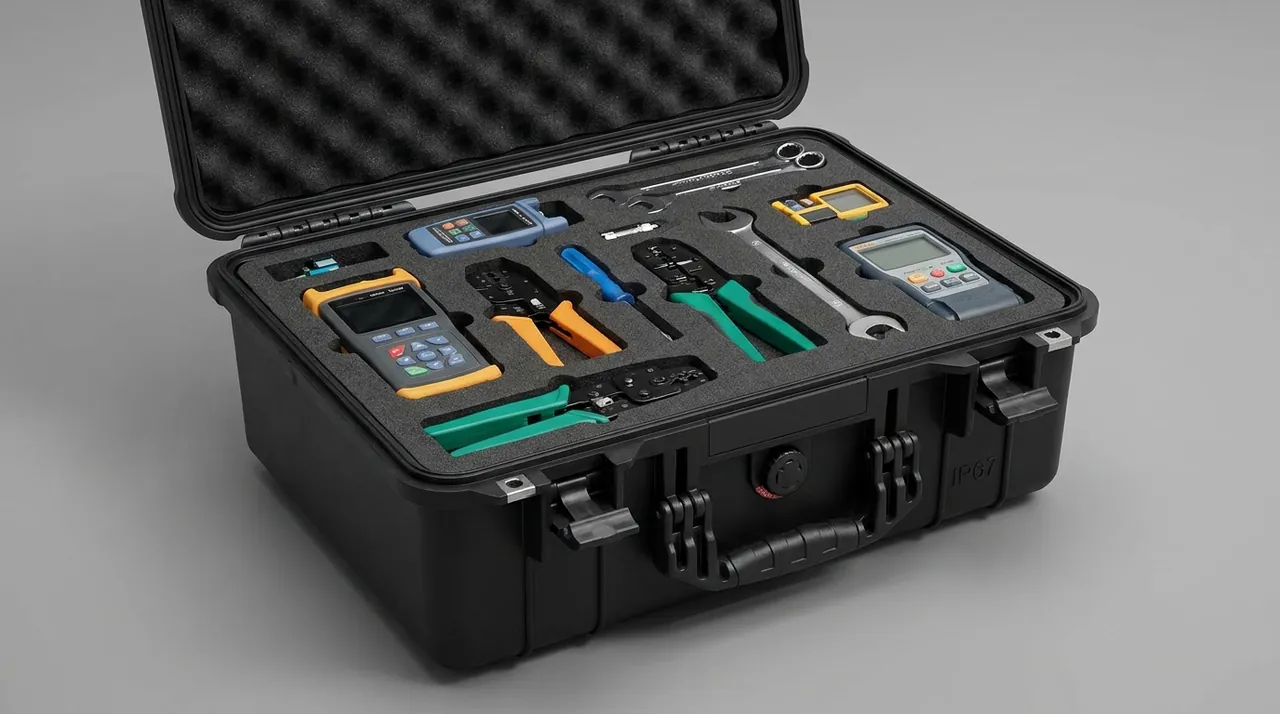
Latches directly reflect the security of a railway maintenance tool case. Common types include single-press locks, two-point linked locks, and lockable butterfly latches; high-security scenes may add combination or electronic locks. Latch materials are mainly stainless steel and reinforced engineering plastic, requiring corrosion resistance, impact resistance, and long cycle life. For cases storing dedicated gauges or valuable test modules, lockable latch points are recommended to provide physical theft resistance during transfer and temporary storage while supporting responsibility division in team management.
Latch compression uniformity affects sealing. Two-point or multi-point linked locks distribute lid pressure evenly along the flange, avoiding local gaps that leak. The latch mounting zone usually has metal or reinforced inserts to bear repeated opening force without cracking the shell. When inspecting, buyers can perform latch cycle tests, observing looseness, misalignment, or jamming, and request typical cycle-life statements from suppliers where needed.
The pressure-equalization valve, mentioned in section four, together with latches forms the case "opening-security system." After severe elevation or temperature change, operators should release pressure through the valve before unlocking to avoid tearing the gasket under sudden force. The valve itself needs dustproof and waterproof ability and reliable closure under long-term vibration. A rational latch and valve combination markedly reduces maintenance frequency of the maintenance case in complex environments.
9. Certification Standards and Test Documentation
Although railway maintenance cases are not mandatory-certified products, citing authoritative standards in batch procurement and engineering acceptance improves technical communication between buyer and supplier. For protection rating, IP67 judgment follows IEC 60529 and its domestic equivalent GB/T 4208; buyers can require third-party or self-test dust and water records. Material flame behavior can reference the UL94 vertical burning rating, which is meaningful for cases storing battery-equipped test devices.
For environmental adaptability, MIL-STD-810H provides temperature, humidity, drop, and vibration procedures to assess reliability under harsh transport and duty conditions; the ISTA series focuses on overall transport-packaging performance and can serve as pre-shipment verification. These standards guide method, and pass or fail depends on selected severity and acceptance criteria, so acceptance documents should state the procedure number and limit rather than loosely claim "compliant with a standard."
Test documentation standardization also matters. A complete report covers sample information, test conditions, process, and result interpretation, with photos and raw data where necessary. JUNZHIJIA can, on request, provide test summaries or self-inspection records corresponding to cited standards so engineering sections can file the case into material acceptance archives. All numeric values here are industry typical or empirical and do not guarantee any specific batch; actual parameters follow drawings and contracts confirmed by both parties. See MIL-STD-810H case compliance and ISTA test guidance for method context.
10. Customization Capability and OEM/ODM Service
Because line-maintenance tools differ by vehicle, section, and task, cases need differentiated dimensions, liners, and accessories, making customization capability an important supplier criterion. Mature manufacturers offer one-stop OEM/ODM service from dimension customization, liner tooling, screen-printed identification, to latch and wheel selection. In OEM mode, the section provides the tool list and functional needs, and the supplier completes structural design and prototype; in ODM mode, the supplier can also join function definition and propose better layout and material plans.
The customization process usually has five stages: requirement research, three-dimensional proposal, prototype review, pilot production, and batch delivery. Requirement research measures tool dimensions and clarifies the use environment; the proposal stage outputs liner layout and structural points; the prototype stage lets the team actually load tools to verify access convenience; pilot production checks consistency and process stability; batch delivery moves to supplier evaluation and incoming inspection. JUNZHIJIA emphasizes deriving liner design from the team's real work flow in customization projects, avoiding redundant cavities or wasted space from "customization for its own sake."
Beyond structure and liner, customization extends to identification and asset management. The case surface can screen-print section, zone, number, and responsible person; some scenes integrate QR-nameplates so each case enters the unit's asset ledger and inspection system. Combining the physical container with digital management is becoming a direction of railway maintenance equipment upgrade and provides a data basis for later spare supply and life tracking. Further reading on maintenance toolbox guidance complements this section.
11. Selection Parameters and Procurement Points
Selecting a railway maintenance tool case should address four questions: what to load, where to go, how to transport, and how long to use. What to load decides inner dimensions and liner form, requiring total tool volume and maximum single weight; where to go decides protection rating and environmental adaptability, with rainy dusty sections preferring IP67 or above and attention to gasket material; how to transport decides whether wheels, handles, and stacking are needed, with long vehicle trips focusing on fixing; how long to use decides material grade and warranty terms, with high-frequency use preferring maintainable, replaceable design.
When procuring, prepare an inquiry file with dimensions, load, protection rating, liner plan, accessory list, and acceptance standard, and obtain comparable proposals from several suppliers. Incoming inspection should cover appearance defects, latch flexibility, seal continuity, and liner fit, with samples drop- or immersion-tested by agreed standards where necessary. Supplier evaluation beyond price should examine tooling capability, batch consistency, and after-sales spare supply, the last directly affecting whole-life use cost.
For cases under fixed-asset management, the contract should clarify the spare-parts list and supply cycle, such as gaskets, latch tongues, wheel axles, and liner modules, so later maintenance is orderly. Connecting selection, acceptance, and maintenance ensures the railway maintenance tool case keeps delivering storage and protection value over years rather than being a one-time consumable. The IP67 protective case reference helps confirm rating expectations during specification.
12. Daily Maintenance and Lifecycle Management
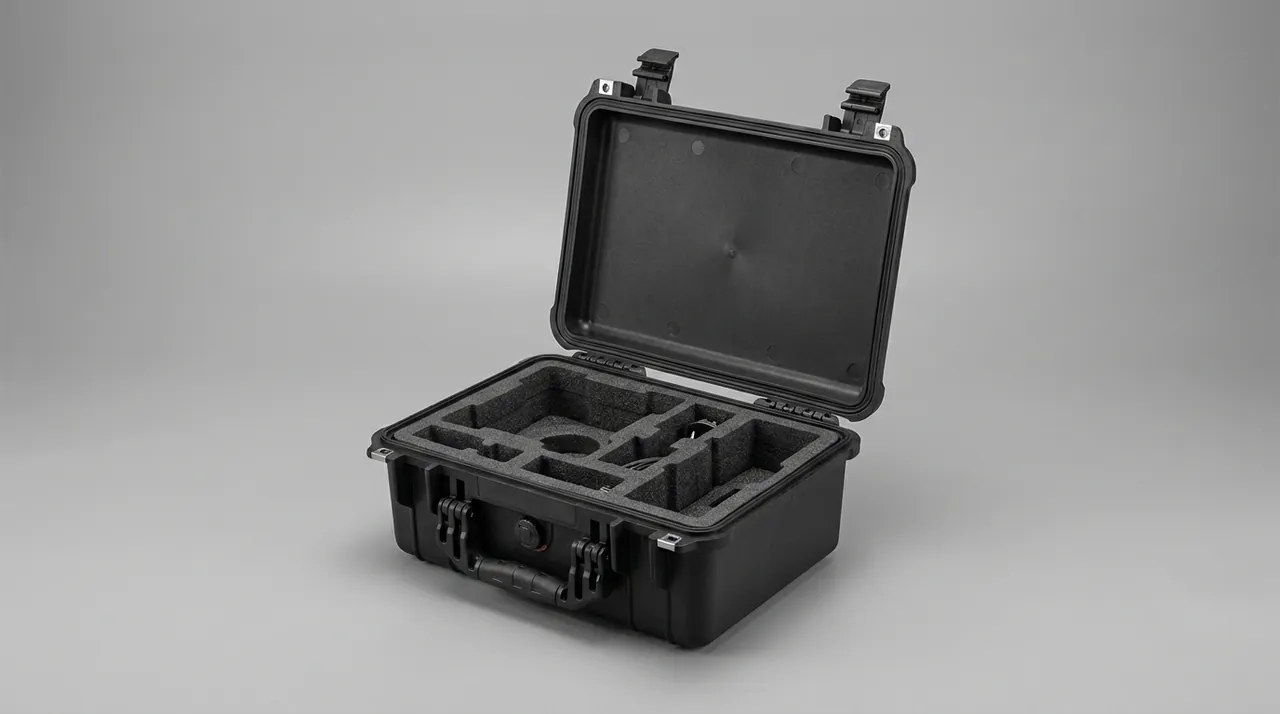
The life of a railway maintenance tool case closely relates to maintenance habits. The first maintenance step is cleaning: after work, wipe mud and oil from the shell with a soft cloth to avoid hard particles scratching the sealing face during opening and closing. Gaskets should be checked periodically for hardening, cracking, or permanent compression marks, and replaced with same-spec parts when aging appears to maintain IP67 protection. If liner modules collapse or cavities enlarge, re-fit or re-cut them to prevent tools from loosening inside.
Storage environment also affects life. Long-idle cases should rest in a cool, dry place, avoiding direct sunlight and heat that accelerate shell and gasket aging; stacked storage should control layers and avoid sharp heavy objects on top. For wheeled cases, periodically check axle tightness and rolling smoothness, cleaning or replacing on jamming. A "one case, one card" maintenance file recording inspection dates, replaced parts, and responsible persons helps intervene before hazards appear.
When a case reaches design service life or suffers severe drop damage, repair value should be evaluated. Cracks in weldable materials can be locally repaired, but field repair strength of rotomolded polyethylene is limited, usually suggesting replacement; latches and wheels can be replaced separately. Through preventive maintenance and reasonable scrap judgment, engineering sections maximize the service cycle of tool cases, controlling equipment renewal cost while safeguarding operational efficiency.
FAQ
Q: What is the main difference between a railway maintenance tool case and a household toolbox? A: A railway maintenance tool case and a household toolbox differ fundamentally in load target and use environment. Household toolboxes serve indoor or minor repair scenes with small capacity and low protection, unable to protect tools against rain, dust, and bumping. Railway maintenance cases target line-work sites, carrying heavy and precise tools such as torque wrenches, rail gauges, and track rules within a rotomolded shell, and provide IP67-class dustproof and waterproof ability. Their structure commonly includes reinforcement ribs and metal corner guards, liners custom-cut to tool profiles, and sometimes wheels, handles, and pressure-equalization valves to suit emergency-vehicle transfer, track work, and outdoor storage. Selection should focus on full-load weight, protection rating, and liner fit rather than appearance and price alone. For engineering sections, the heavy case is part of team fixed-location management, carrying both tool-asset safety and operational-efficiency missions that a household box cannot fulfill. In practice, the heavier the tool set and the harsher the site, the larger the gap between a purpose-built case and a general toolbox, so the specification should be driven by duty profile rather than catalog appearance, and the selected case should be validated against the real tool list before purchase.
Q: How can I verify that a maintenance case truly reaches IP67? A: Verifying IP67 cannot rely on a label alone; it needs standards and test evidence together. The IP code follows IEC 60529 and GB/T 4208, where IP67 means total dust exclusion and short-time immersion without water entry. Buyers can require suppliers to provide test records under those standards, checking whether dust and immersion verification used specified pressure and duration, and whether the sample has a continuous elastic gasket and evenly compressed latches. After arrival, self-check by closing latches on an empty case to see if the seal line is complete, or conduct short spray checks where permitted. Remember that sealing declines as the gasket ages, so even factory-qualified cases need periodic gasket replacement. Combining standards, test documents, and daily maintenance ensures the rating stays valid long term, and procurement should write acceptance criteria into the technical agreement rather than trusting marketing text. Recording the verified rating in the acceptance file also helps later audits and spare-part planning, because the gasket that delivers the rating is a consumable that must be tracked across the case service life to avoid silent loss of protection.
Q: What liner forms exist for maintenance cases, and which scenes suit each? A: Maintenance-case liners mainly include foam cavity liners, divider trays, and adjustable partitions. Foam cavity liners are routed or die-cut to match tool contours, offering high locating precision and good cushioning, suiting fixed-standard teams that emphasize one-tool-one-position, such as a workshop serving a fixed section. Divider trays and adjustable partitions are more flexible, reconfiguring as the tool list changes, suiting mobile teams with frequently adjusted tasks. Some cases adopt a hybrid of foam base and adjustable upper layer to balance precision and flexibility. Selection should first count tool dimensions and replacement frequency, then decide liner form and reserve some redundancy for temporarily added gauges and consumables, because over-tight cavities cause tool jamming while over-loose ones fail to protect. A useful rule is to prototype the liner with the actual tools present, because paper dimensions often miss handles, guards, and accessory bags that change the real footprint inside the case and that only become visible during a live loading test.
Q: How should a fully loaded maintenance case be secured in an emergency vehicle? A: Securing a fully loaded maintenance case in an emergency vehicle aims to prevent sliding, overturning, and mutual collision during transport. First use the interlocking stacking locators on base and lid to align multiple cases so layers resist horizontal shift; then connect the bottom case to the vehicle floor with straps or locators, passing webbing through reserved fixing lugs and tightening. Wheeled cases should have wheels inward or locked during transport to stop rolling under braking. Before long trips, re-check that stacking layers do not exceed the manufacturer's typical load limit and add anti-collision pads inside the cabin to reduce bump shock. Proper fixing protects the case, the crew, and other equipment, and is an indispensable part of line-work safety management that procurement and drivers should both enforce. Documenting the securing method in the team's transport checklist turns a one-time good practice into a repeatable standard that survives crew changes and different vehicle types, and it also simplifies post-trip inspection when cases are unloaded at the next work site.
Q: How often should the case gasket be replaced? A: Gasket replacement interval depends on usage frequency, environmental severity, and material performance, so no single timeline fits all. In outdoor high-frequency use with long sun, rain, and temperature cycling, EPDM or silicone gaskets may harden, surface-crack, or show permanent compression set after several years and should then be replaced to keep IP67. Teams can include gasket checks in pre-departure routine inspection, replacing on deep imprints, insufficient rebound, or local cracks. Replacement should use gaskets matching the original cross-section and hardness, installed continuously without breaks. JUNZHIJIA emphasizes specification consistency when matching gaskets by model, precisely to avoid interrupted seal lines and leakage from mixed parts, and buyers should keep spare gaskets in stock for planned maintenance. Tracking replacement dates in the maintenance card prevents the common failure of discovering leakage only after the next heavy rain, when tools are already at risk and the possession window is too short to react.
Q: What steps does customizing a section-specific maintenance case usually involve? A: Customizing a section-specific maintenance case usually goes through five stages: requirement research, three-dimensional proposal, prototype review, pilot production, and batch delivery. Requirement research measures all tools' dimensions, weights, and fragile points and clarifies the use environment; the proposal stage outputs liner layout and structural points for section confirmation; the prototype stage lets the team load tools to verify access convenience and cavity fit; pilot production checks process consistency and incoming quality; batch delivery enters supplier evaluation and spare management. Throughout, deriving liner design from the real work flow is most critical to avoid wasted space. JUNZHIJIA applies this process in OEM/ODM projects and adds asset labels and QR nameplates for digital management, helping sections track each case through its service life with auditable records. Closing the loop with a short field trial before full batch order reduces the risk that a theoretically good design proves awkward in the real possession window, where lighting is poor and time pressure is high.
Q: Can a case with a cracked shell still be used? A: Whether a case with a cracked shell can continue depends on crack location, length, and stress condition. If the crack sits in a non-load zone and is short, temporary sealing and downgraded use for lighter tools may be acceptable, but never for carrying heavy tools or long-distance transfer. Field welding repair of rotomolded polyethylene usually has limited strength and rarely restores original integral performance, so full replacement is often advised. By contrast, latches, axles, and liners are separately replaceable at lower cost. To reduce sudden damage, teams should establish periodic open-case checks to find shell anomalies before cracks extend, and use preventive maintenance to lengthen the overall service cycle, treating the case as managed equipment rather than disposable packaging. A practical threshold is to compare repair cost and downtime against a new case price, and to retire shells that have lost structural integrity even if cosmetically intact, because a hidden crack can fail at the worst moment.
Q: Beyond price, which supplier capabilities matter most when procuring cases? A: Beyond price, procurement should focus on four supplier capabilities: tooling capability, batch consistency, customization response, and after-sales spare supply. Tooling capability decides dimensional precision and structural stability; batch consistency concerns whether every arrived case matches the prototype; customization response shows whether the supplier can complete liner and accessory design per the section's tool list; after-sales spare supply directly affects replacement timing of gaskets, latches, and axles. It is advisable to clarify the spare-parts list and supply cycle in the contract and write incoming-inspection standards into the technical agreement. Suppliers with complete OEM/ODM service and test-document provision better support the case's continuous protection value over years, turning a one-time purchase into a managed, long-life asset for the maintenance organization. Requesting a sample evaluation against the written specification before committing the full order protects the buyer from inconsistent batches and gives the section a measured baseline for future tenders, which is especially useful when several workshops share one procurement framework.