

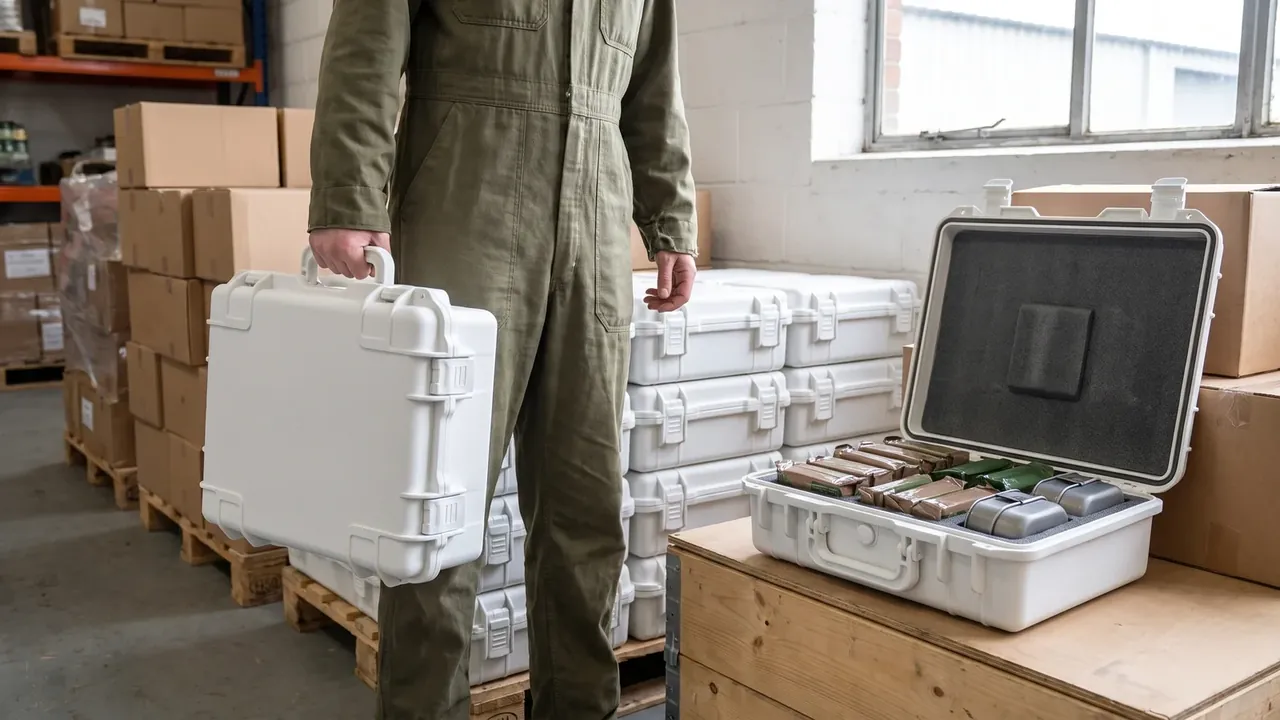
Quick answer: A ration box serves five settings: field cooking, individual issue, hospital diets, first-day relief feeding and cold-chain shuttles. What changes is portions per case, temperature band, and whether anyone can wash it afterwards.
Table of contents
- Five scenarios and how each configures the box
- Field cooking: from the kitchen to the serving point
- Individual ration issue: cases per head, counting by cell
- Field hospitals and aid posts: three diet grades
- Disaster relief and cold-chain shuttles
- FAQ
1. Five scenarios and how each configures the box
The setting decides the configuration: hot food at temperature after 40 minutes, one case per platoon meal, three grades that never mix cells, a case that circulates with no wash line, a 3 °C rise in 25 minutes.
| Setting | Per case | Scale | Constraint |
|---|---|---|---|
| Field cooking | 20 portions | 8 per meal | 65 °C out, 40 min |
| Individual issue | 12 portions | 27 for 3 days | Platoon, day marked |
| Field hospital | 9 cells | 7 for 60 portions | Three colours |
| Disaster relief | 30 portions | 50 on day one | Sealed after 1.2 m drop |
| Cold shuttle | 18 portions | 6 per run | Under 3 °C rise |
The variable most often missed is washing. With a wash line, a ration box is a returnable utensil washed twice a day; without one, the same case is single-use packaging and reuse drops to zero.
2. Field cooking: from the kitchen to the serving point
Sizing a ration box runs backwards from headcount: 150 people, three dishes and a soup, 20 portions per case, eight cases per meal. Over 1.5 km, one flatbed run plus two people unloading fits inside 40 minutes.

Food leaves the range at 65 °C, enters a preheated case, and reads 55 °C on arrival, above the 50 °C floor. Three habits hold it: ten minutes of hot-water preheat, filling to eight-tenths, no reopening to count.
The lid needs a wipeable panel for meal and kitchen number, since labels do not stick to grease; cells are fixed by dish.
3. Individual ration issue: cases per head, counting by cell
Issue is headcount times days: 324 portions for a company of 108 over three days, 27 cases at 12 each, nine to a platoon.
| Level | Unit | Cases |
|---|---|---|
| Company | 108 people, 3 days | 27 |
| Platoon | 36 people, 3 days | 9 |
| Squad | 12 people, 1 day | 1 |
Counting runs by cell: an empty cell is a missing portion, and 27 cases clear in four minutes. Returns land near 96%, so 26 come back; the gap is replaced by the 12-portion case.
4. Field hospitals and aid posts: three diet grades
A hospital configures by diet grade: a 20-bed aid post runs regular, semi-liquid and liquid at 60 portions a day; nine cells to a case gives seven cases, each grade colour-coded to the diet order.
Liquid diets run at 2–6 °C beside the treatment trolley; two 400 g ice packs hold them there for three hours. A ration box never enters the sterile zone — it hands over in the buffer, wiped with 75% alcohol.
5. Disaster relief and cold-chain shuttles
Relief is driven by day one: 1,500 portions for 500 people is 50 cases at 30 each. For air drop the case must survive a 1.2 m fall without cracking or springing open; the seal is checked first.
Sites rarely have washing, so the liner becomes disposable: bagged meals, tied off, the case carrying shape and stackability only. Reuse drops to zero and the shell goes back to a wash line.
Cold shuttles: eight kilometres, 25 minutes at -18 °C, cases precooled to -15 °C with 2 kg of dry ice, still below -15 °C on arrival and holding six hours. Keep a 30 mm air gap.
| Setting | Configuration | Scale | Reuse |
|---|---|---|---|
| Relief day one | 30 portions, liner | 50 cases | None |
| Air drop | Seals, buffers | 12 per lift | After inspection |
| Cold shuttle | -15 °C, dry ice | 6 per run | Washed at the store |
| Road cut off | Hand relay, 20 kg | 300 a day | Daily |
Conclusion
Three variables sit behind every setting: portions per trip, the temperature band to hold, and whether anyone can wash the case on return. Written into a configuration table, they let one ration box cover all five settings.
This article discusses only the container (case body) side of specifications and design intent, and does not cover any handling, loading or use of the contents.
Related Reading
- What a ration box is: unit packaging requirements
- Ration box versus insulated carrier
- Configuring emergency supply cases by scenario
- How medical cases work before and inside the ward
Related Products
- 8 Series — Gun Cases; Military Equipment Cases; Camera Equipment Cases; Drone Cases; Watch Cases; Knife Cases; First Aid Cases; Electronics Equipment Cases
- WL8-2812 PP Gun Case — model WL8-2812
- All protective cases and toolboxes: 7 series, 158 models