


Quick answer: Upkeep of a ration box runs on four tiers, three readings and three scrap lines: 30 seconds before a shift, 6 minutes weekly, 18 minutes monthly, 45 minutes quarterly, with gasket compression, latch retention and crack length deciding repair or replacement.
Table of contents
- How to Set Four Inspection Tiers
- Gasket: Compression, Feeler Gauge and Hardness
- Latches and Hinges: Measure Wear, Do Not Eyeball It
- Liner Cracks: What Can Be Repaired
- Scrap Lines: Three Red Lines and the Evidence Trail
- FAQ
1. How to Set Four Inspection Tiers
Inspection fails when it becomes a signature. Four tiers with a fixed item count and time budget tell a crew what those thirty seconds are for.
| Tier | Frequency | Time per case | Items | Who signs |
|---|---|---|---|---|
| Pre-shift | Once per shift | 30 seconds | 5 | Operator |
| Weekly | Once a week | 6 minutes | 8 | Safety officer |
| Monthly | Once a month | 18 minutes | 14 | Technician |
| Quarterly | Once a quarter | 45 minutes | 21, plus 10 percent torn down | Supervisor |
Pre-shift asks whether the case can go out today, weekly whether it seals, monthly whether the structure is hurt, quarterly how long it will last. One hundred cases at eighteen minutes is thirty man-hours a month, so the round runs across four shifts.
2. Gasket: Compression, Feeler Gauge and Hardness
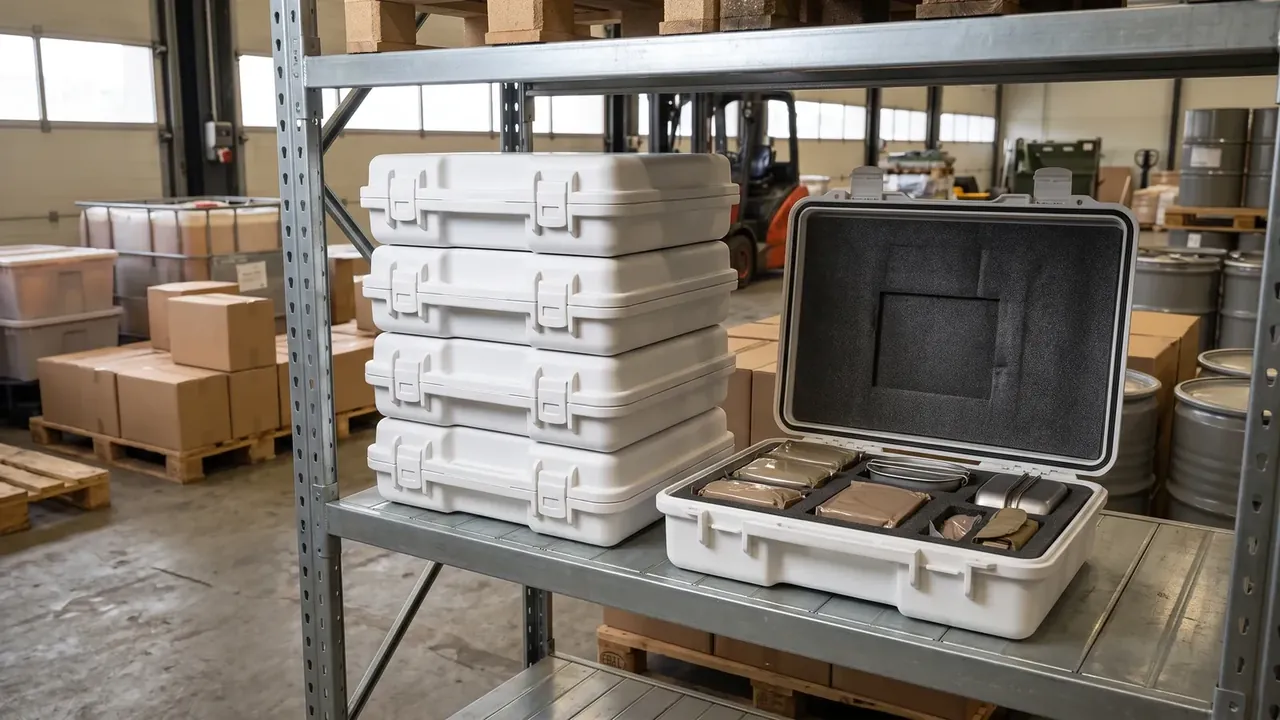
The gasket fails first, judged on three readings: height under compression, whether a 0.5 mm feeler enters, and how far Shore A hardness has moved.
| State | Height when latched | 0.5 mm feeler | Shore A | Action |
|---|---|---|---|---|
| Good | 7.0–7.3 mm | Will not enter | Around 55 | Keep in service |
| Under-compressed | Above 7.6 mm | Enters 20 mm | 55–60 | Adjust groove or replace |
| Ageing | 7.4–7.8 mm | Enters locally | 61–67 | Replace this quarter |
| Aged | Any | Enters in several places | 68 and above | Replace now |
A new strip is 8 × 10 mm with a 10 mm free height and sits at 7.0–7.3 mm when latched, 27 to 30 percent. Above 7.6 mm it carries no load, and a feeler entering 20 mm condemns the whole strip, since a local collapse draws vapour along it. Replace at 24 months or 600 closures, not at the first leak.
3. Latches and Hinges: Measure Wear, Do Not Eyeball It
Latch trouble is retention force, not looks. A new latch holds 180 N and is condemned below 120 N, because the lid loses preload and gasket compression drops a grade.
Pins are measured, not felt: 5.0 mm new, 4.6 mm condemned. A worn pin passes over centre, so closing feels lighter while nothing is preloaded; a hinge-seat crack over 8 mm stops the case, since welding there only anneals the PP. Spares run at 5 percent, changed as a set of four.
4. Liner Cracks: What Can Be Repaired
Sort cracks first: white stress marks, through-wall splits, radial cracks around bosses. The first is logged; the other two are welded or replaced.
Weld only at 30 mm or less, 20 mm clear of a boss and away from the radius: 3 mm PP rod at 235–245 °C, 80 mm a minute, one pass per face, then a 30-minute water test at two-thirds of case depth. Adhesive is not an option: it bonds poorly to PP, goes brittle in the cold, and the patch starts the next crack.
5. Scrap Lines: Three Red Lines and the Evidence Trail
Scrap is any one of three lines, each with a threshold others can measure again.
| Item | Threshold | Action |
|---|---|---|
| Through-crack | Any length | Scrap at once |
| Sealing face flatness | Deviation over 1.5 mm | Scrap |
| Repair history | 3 repairs, or a second at one spot | Scrap |
| Hinge seat crack | Over 8 mm | Stop and assess |
A through-crack comes first, then flatness past 1.5 mm, then a third repair. Photograph the crack, log the feeler reading, mark the inner wall, and drill the scrapped case on the spot, or it drifts back into the pool.
Conclusion
Maintenance replaces sight with measurement: four tiers that fix the time, three gasket readings that fix the change point, newtons for preload, millimetres for cracks, three lines for scrap. The service life of a ration box depends on whether each decision landed on the line, not on age.
This article discusses only the container (case body) side of specifications and design intent, and does not cover any handling, loading or use of the contents.
Related Reading
- How supply cases are inspected and accepted
- Maintenance cycles for reusable storage cases
- Care points for rotationally moulded case bodies
- Preservation and upkeep of war reserve cases
Related Products
- 8 Series — Gun Cases; Military Equipment Cases; Camera Equipment Cases; Drone Cases; Watch Cases; Knife Cases; First Aid Cases; Electronics Equipment Cases
- WL8-2812 PP Gun Case — model WL8-2812
- All protective cases and toolboxes: 7 series, 158 models