

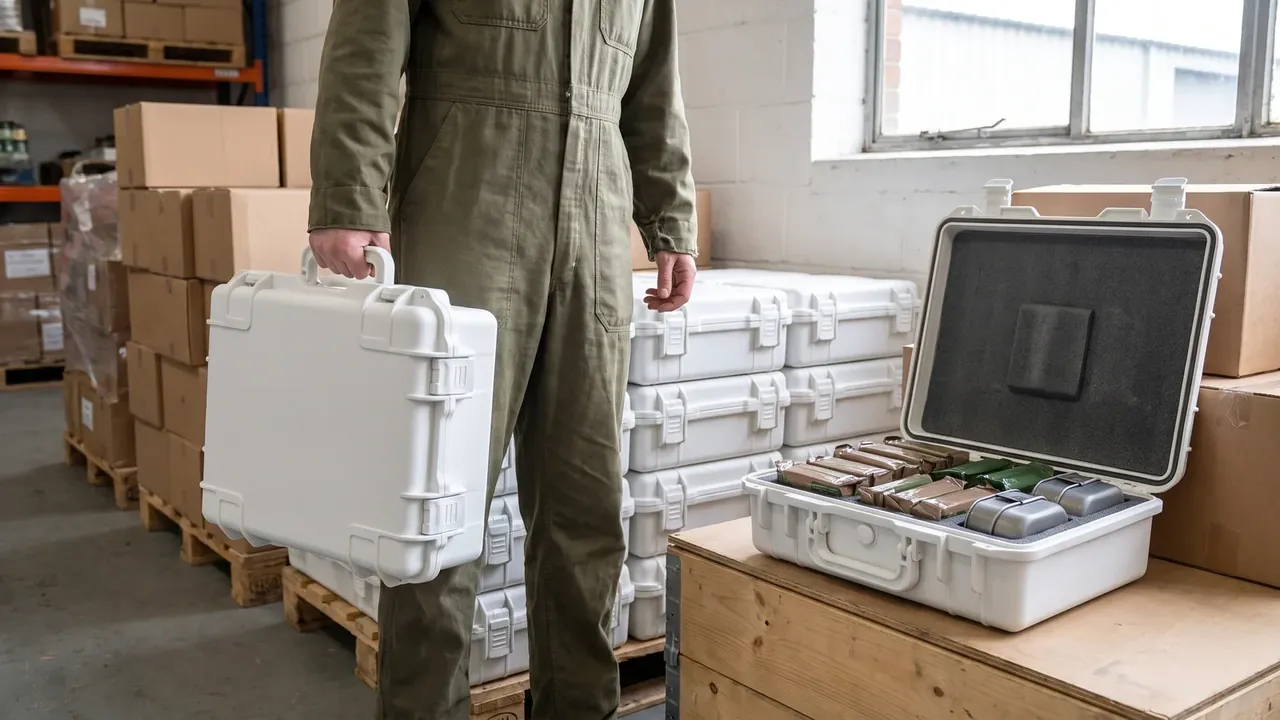
Quick answer: A ration box quote becomes comparable only when split into six blocks: shell material, labour, hardware, insert, finishing, and packing with testing overhead. Quantity moves in tiers near 300, 1,000 and 5,000 pieces; lead time runs in five stages closed by three inspection gates.
Table of contents
- What the Six Cost Blocks of a Ration Box Quote Are
- Tooling Amortisation and Sample Fees
- MOQ Tiers and the Price Steps Between Them
- Scheduling Samples and Mass Production
- Inspection Gates, Payment Milestones and Claims
- FAQ
1. What the Six Cost Blocks of a Ration Box Quote Are
Most first-round comparisons of a ration box collapse into one unit price. Two factories quoting the same external dimension can sit 20 percent apart, and the gap is rarely margin.
| Cost block | Share of unit price | What to pin down |
|---|---|---|
| Shell material | 30–38% | Resin grade or fabric denier, coating weight, regrind content |
| Moulding or sewing labour | 18–24% | Minutes per unit, press tonnage, first-pass yield |
| Hardware | 12–18% | Latch and handle alloy, pull-off force, salt-spray hours |
| Insert and dividers | 10–15% | Foam density, cutting method, separate tray tooling |
| Finishing and marking | 5–8% | Print method, colour count, accepted colour shift |
| Packing, testing, overhead | 8–12% | Export carton grade, sampling ratio |
The six blocks add up to slightly less than the quote; the rest is tooling amortisation, freight and a currency buffer. Ask for those as separate lines.
2. Tooling Amortisation and Sample Fees
Tooling on a ration box is invoiced once or amortised into the price. Charged once, repeat orders pay nothing again; amortised, the first payment is lighter. Either way the contract states the base, for instance a write-off across 50,000 pieces.
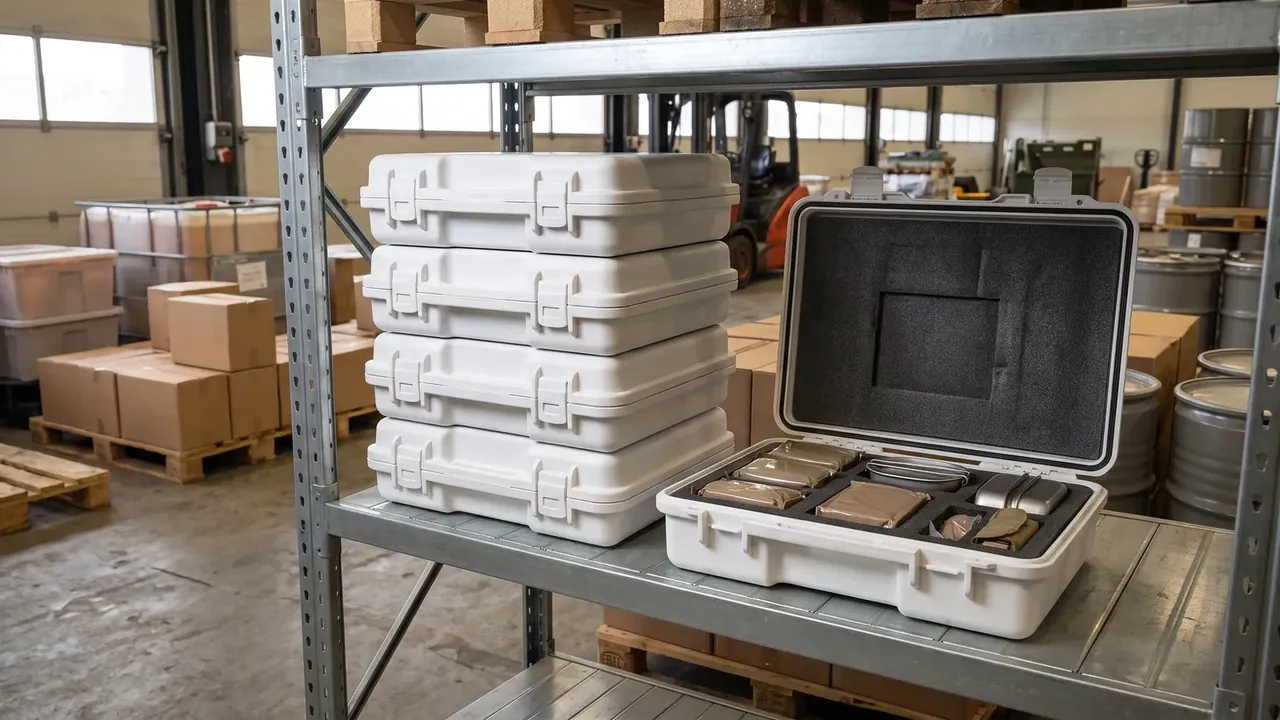
The base decides the gap: over 1,000 pieces each unit carries one thousandth of the tooling cost, over 20,000 one twenty-thousandth.
Samples come as two lines: handmade, five to seven working days; tooled, covering trial shots and first-article inspection, usually two rounds with a third billed by press hour.
3. MOQ Tiers and the Price Steps Between Them
Minimum order quantity follows from three process limits, not sales policy: the smallest pigment batch, the plate count on printing, and changeover time. The batch is hardest, since dyed fabric runs by the drum, typically 800 to 1,500 metres.
| Tier | Quantity | Price against base | Typical use |
|---|---|---|---|
| Trial | 300–500 pcs | plus 18–25% | Colour or insert validation |
| Standard | 1,000–2,000 pcs | base | Quarterly replenishment |
| Framework | 5,000 pcs and up | minus 8–12% | Annual frame, called off in lots |
Most of the step between tiers is changeover: a mould swap takes three to four hours, and a sewn model needs rebalanced stations plus half a day for first-article approval. A 300-piece order at the 1,000-piece price depends on shared material.
4. Scheduling Samples and Mass Production
A single delivery date is not a plan. Five stages sit between an approved drawing and a loaded container, each with its own duration and start trigger.
| Stage | Working days | Clock starts when |
|---|---|---|
| Handmade sample | 5–7 | Drawing and dimension sheet approved |
| Tooling | 12–15 | Tooling payment received, structure signed |
| Trial shot and first article | 5–7 | Mould arrives, sample shipped |
| Mass production | 25–30 | First article signed, material on site |
| Inspection and export packing | 3–5 | Production completed |
The chain starts on the latest of three events, not the signature date: drawing approval, deposit received, material on site. Artwork revision alone can eat half the schedule. Compressing a ration box schedule usually means a split run.
5. Inspection Gates, Payment Milestones and Claims
Three gates catch more than one final inspection: the first article after tooling, a mid-run check at 30 percent, and a final gate before packing sampled at level II with an AQL of 2.5.
Payment interlocks: 30 percent deposit, 40 percent after first-article approval, 30 percent against the bill of lading copy. Claims split by defect type, batch replacement for a latch below its pull-off force, a proportional credit capped near 15 percent for shade shift, with a 30-day window extended to 90 for latent defects. Leave those clauses vague and every shipment reopens the argument.
Conclusion
Procurement of a ration box is decided on the quotation sheet. Six blocks show where the money sits, and the tiers show whether material can be shared. The right price is not the lowest number but the one that holds once lead time, inspection and claims are attached, the only defensible basis for buying a ration box.
This article discusses only the container (case body) side of specifications and design intent, and does not cover any handling, loading or use of the contents.
Related Reading
- What a ration box is and how its body is specified
- How to answer a protective case enquiry
- How supplier qualification is audited
- Inspection items for military supply cases
Related Products
- 8 Series — Gun Cases; Military Equipment Cases; Camera Equipment Cases; Drone Cases; Watch Cases; Knife Cases; First Aid Cases; Electronics Equipment Cases
- WL8-2812 PP Gun Case — model WL8-2812
- All protective cases and toolboxes: 7 series, 158 models