

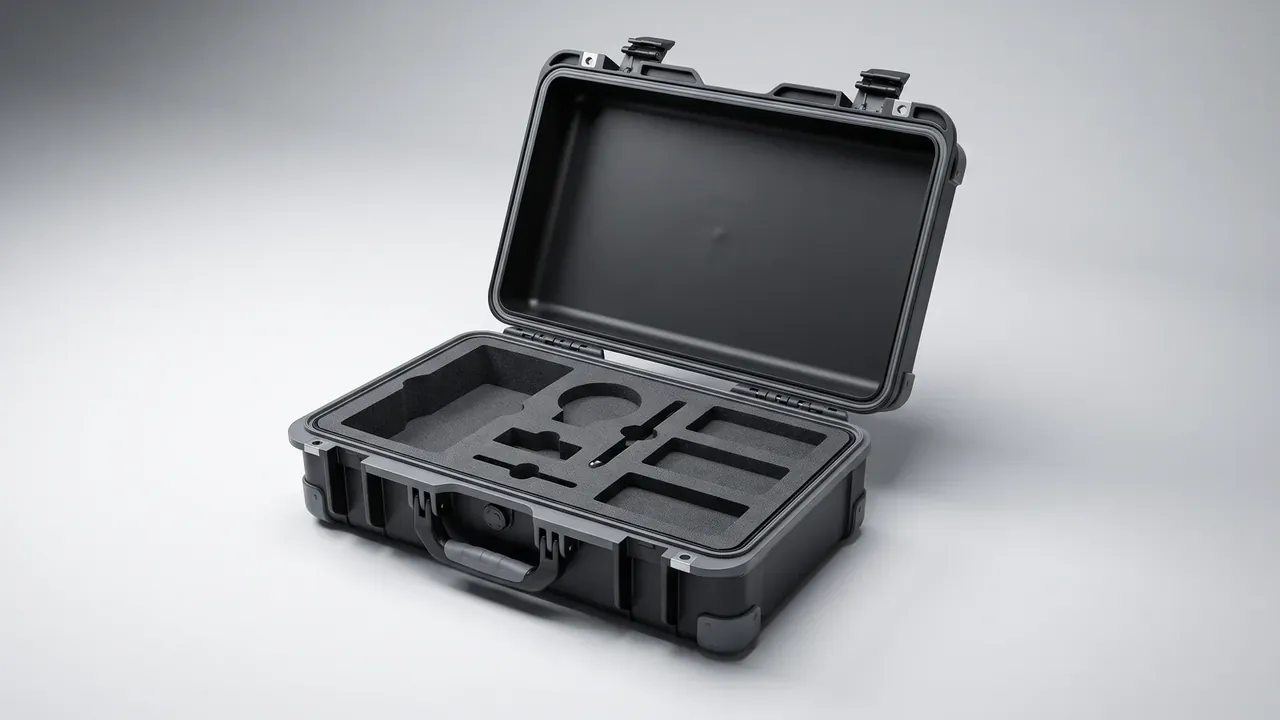
Quick answer: A refinery inspection case entering Zone 1 must pass three checks: a dissipative shell, no bare aluminium hardware, and the IP65 seal.
Table of contents
- Three Hard Limits Ex-Zones Put on the Case Body
- Dissipative Shells and Non-Sparking Hardware
- The Tool Admission Table: In, Out, Never
- Marking and Plant Coding on the Case
- Grounding, Discharge and Lid Discipline
- FAQ
1. Three Hard Limits Ex-Zones Put on the Case Body
A refinery inspection case is specified by the zone it will enter, not the tools it will hold. IEC 60079-10-1 splits a plant into Zone 0, where gas sits for long periods; Zone 1, where it is likely in normal operation; and Zone 2, where it appears under fault conditions. A box on a shoulder strap crosses all three in a shift, and at 10–20 lid cycles the gasket wears about three times faster than on a sealed case.
The first limit is surface resistance. Ordinary PP sits at 10¹⁴–10¹⁶ Ω, an insulator: a 20 L case rubbed twice on a leatherette seat reaches 8–12 kV and takes minutes to bleed. Ex-zones want the dissipative band, 10⁶–10⁹ Ω, where most of the charge leaves within 1 s.
The second limit is exposed metal. Aluminium against rusted carbon steel or concrete can heat an oxide layer past ignition, and the parts usually missed are hinge pins, latch strikers, corner screws and feet.
The third is the seal once the lid is shut. IP65 means dust-tight plus protection against water jets. Opening a case inside a tank farm exchanges about 60% of its internal volume, and a gasket that does not close that path lets gas in with every day-night swing.
2. Dissipative Shells and Non-Sparking Hardware
Static control in a refinery inspection case comes from the compound, not a coating. Carbon black or conductive masterbatch in PP or HDPE pulls surface resistance from 10¹⁵ Ω to about 10⁷ Ω, at the cost of a colour range that stops at dark grey and 8–12% off falling-dart strength.
The measurement has to be pinned down. Under IEC 61340-4-1 the electrode weighs 2.5 kg over 25 cm²; below 10⁹ Ω the voltage is 100 V, read 15 s after energising. Test at 50% and 12% relative humidity — readings more than a decade apart disqualify the compound.
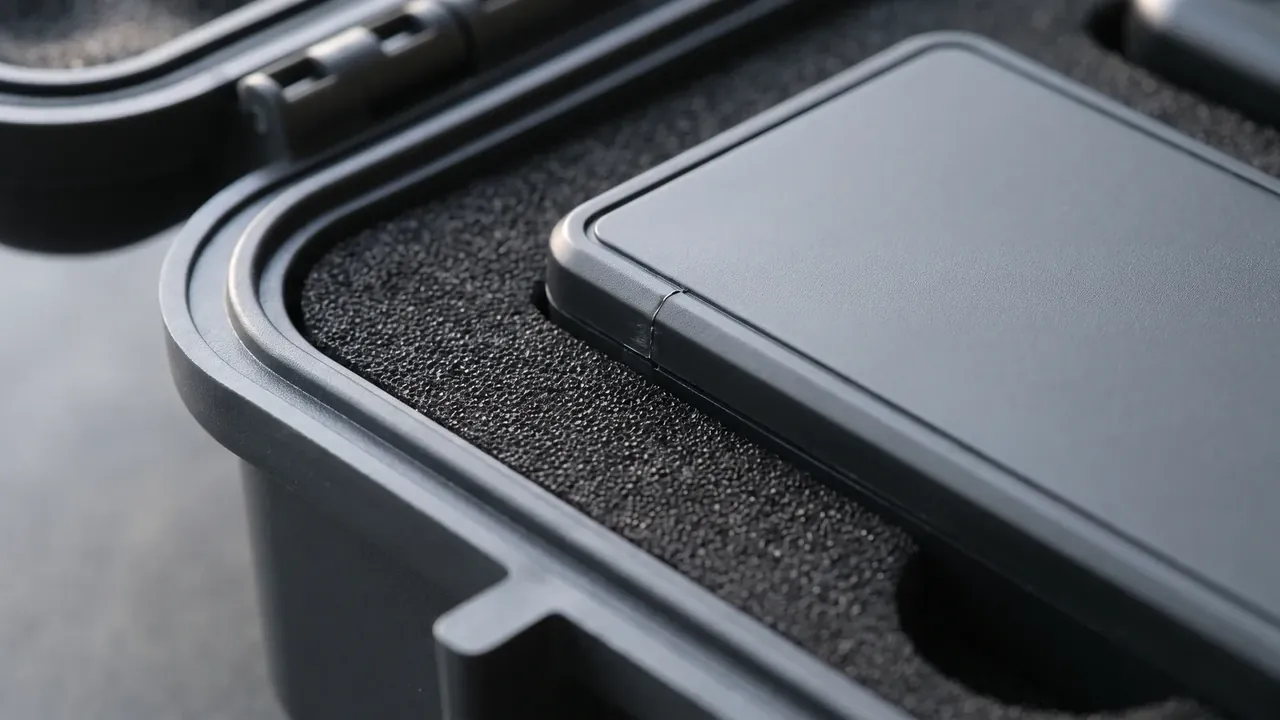
Non-sparking parts go where contact happens. Copper-beryllium runs at HRC 38–42 and aluminium bronze at HB 160–190; neither throws an incendiary spark against steel. Inserts at the striker, hinge pin and corner screws add 120–200 g.
Bare aluminium has to go. An aluminium frame used for stiffness needs hard anodising at 25 μm or more, plus EPDM trim over every face that could touch a grating.
3. The Tool Admission Table: In, Out, Never
A refinery inspection case sorts tools into three groups: into Zone 1, left in the workshop, never shipped. Two questions decide — spark or hot surface, and power.
| Tool | Into Zone 1 | Left outside | Basis |
|---|---|---|---|
| CuBe wrench, aluminium bronze scraper | Yes | — | Non-sparking, HRC 38–42 |
| Carbon steel wrench, socket, steel tape | No | Yes | Rubbing, tape retraction |
| IS multimeter (Ex ia IIC T4) | Yes | — | Energy-limited circuit |
| Standard multimeter, standard radio | No | Yes | Range switching, battery arcs |
| IS torch, 2×AA, IP67 | Yes | — | Surface stays under T4 |
Read the table by its basis column. The same wrench changes status with the zone: carbon steel is refused in Zone 1 yet may be carried briefly into Zone 2 after gas testing, and that difference belongs on the case, not on a paper list in an office.
4. Marking and Plant Coding on the Case
A refinery inspection case carries two layers of marking: the Ex plate for what sits inside, and the plant code for the asset. They change on different schedules and should not share a label.
The Ex plate is needed only when electrical equipment is inside. With an intrinsically safe gas detector in the foam, it follows the GB 3836.1 layout: Ex ia IIC T4 Ga, ambient -20 ℃ to +55 ℃, then the certificate number and plant asset number on separate lines. The certificate number is filled from the paperwork shipped with the instrument, never pre-printed.
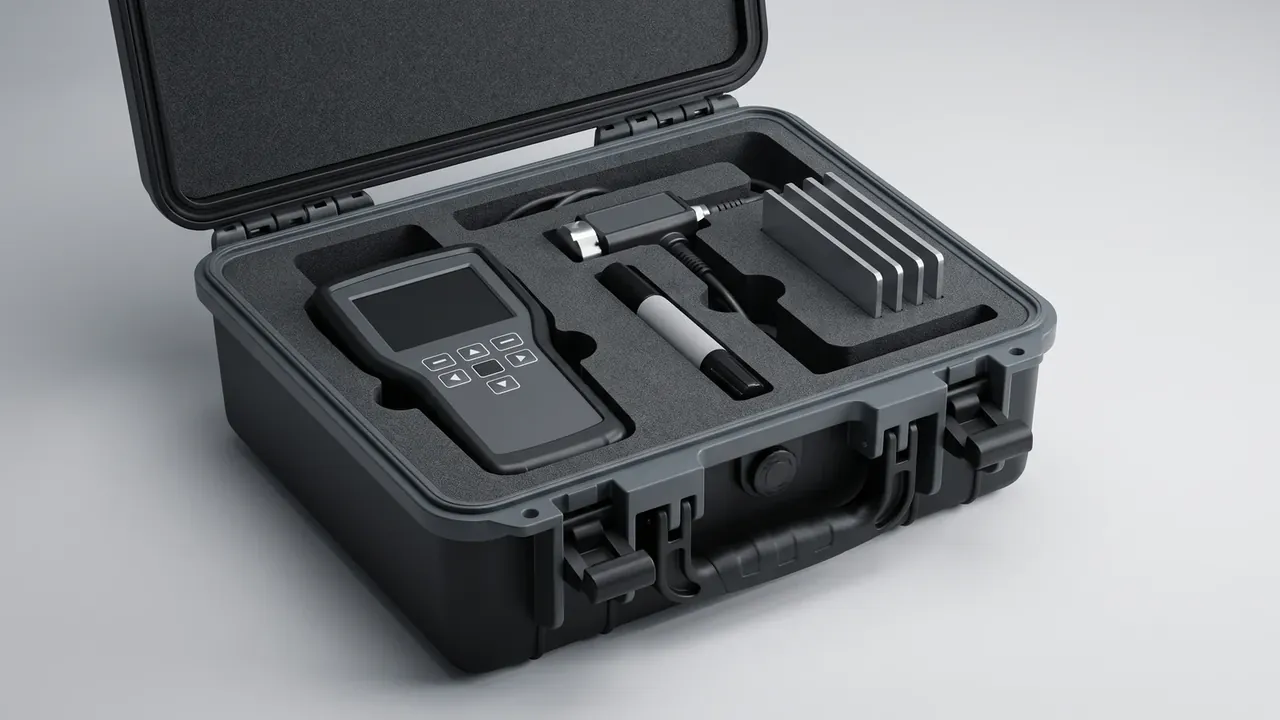
The plant code runs four fields: area, crew, serial, next inspection date. Twelve characters cover it. The first six are laser-marked inside the lid, the last six sit on a replaceable label.
| Line | Content | Position | Durability |
|---|---|---|---|
| Ex marking | Ex ia IIC T4 Ga | Plate, line 1 | Laser, 0.2 mm deep |
| Ambient range | -20 ℃ to +55 ℃ | Plate, line 2 | As above |
| Area code | Unit number + Zone 1 | Inside lid | 500 rub cycles |
| Crew and serial | 3-digit crew, 2-digit serial | Front label | 50 wipes |
| Inspection date | Year and month, 6 digits | Lower edge | 500 h UV |
Crews wipe cases with 75% ethanol; a polyester label smears after roughly 30 passes, an anodised plate is still legible at 200.
5. Grounding, Discharge and Lid Discipline
The grounding tab is the last line on a refinery inspection case and the first item dropped: a 6 mm copper braid tail at the rear of the base, clamped with an M5 stainless bolt, bonded at 0.1 Ω or less.
On the 1000 V to 100 V decay yardstick a shell at 10⁸ Ω bleeds in about 0.3 s, one at 10¹¹ Ω needs over 30 s. The habit before opening: palm on the stud, hold 1–2 s, then release the latches.
Lid discipline runs on cycles and season. Latches are rated for 5000 closures; at 15 per shift and 3750 a year, each of the two sees under 2000. Below -15 ℃ the opening force on a PP latch climbs from 60 N to 95 N, so the lid comes up two-handed.
Conclusion
A refinery inspection case is settled by four numbers: 10⁶–10⁹ Ω against 10¹⁴ Ω and 8–12 kV for stock PP; 120–200 g of copper alloy at the contact points; IP65 against a 60% volume exchange; and 5000 latch cycles against 95 N at -15 ℃. Tools pass on two questions — spark, or power.
This article covers the case body only: material, sealing, hardware and marking. Nothing here addresses the handling, loading or use of anything carried inside.
Related Reading
- Explosion-proof case certification and marking
- How an explosion-proof tool box is built
- Valve cases on refinery sites
Related Products
- 8 Series — Gun Cases; Military Equipment Cases; Camera Equipment Cases; Drone Cases; Watch Cases; Knife Cases; First Aid Cases; Electronics Equipment Cases
- WL8-2812 PP Gun Case — model WL8-2812
- All protective cases and toolboxes: 7 series, 158 models