

Quick answer: The cost of accepting an explosion-proof case sits in rework, not in inspection fees. Four judgement lines on the acceptance sheet, covering wall, joint, latch holding and stacking, cut the rework rate on a batch of three hundred from one in five to under three percent.
Table of contents
- Where Rework Cost Lands
- Six Minutes at Goods In
- Seal and Vent Face Three Moves
- Stacking and Cold Sampling
- Six Fields on the Record
- Disposition Concess Repair Return
- FAQ
1. Where Rework Cost Lands
Rework never costs the price of one case. A rejected unit drags freight both ways, unpacking, re-inspection, a fresh production slot and a late penalty onto the whole batch, so the unit price looks unchanged while the margin is gone.
Break rework into actions and the account opens up. Full replacement eats a production slot, re-taping seals is cheapest but means opening three hundred cases, and swapping latches sits in between.
| Failed item | Rework action | Added cost per unit | Schedule impact |
|---|---|---|---|
| Wall below limit by 0.8 mm | batch replacement | 42 CNY | 7 days |
| 0.3 mm feeler enters joint | re-tape seals | 9 CNY | 2 days |
| Latch holding under 220 N | add latches | 6 CNY | 1 day |
| Flat face past 3 mm | internal bracing | 15 CNY | 3 days |
Only the first row pushes cost past thirty percent; the rest are priced for dock labour.
2. Six Minutes at Goods In
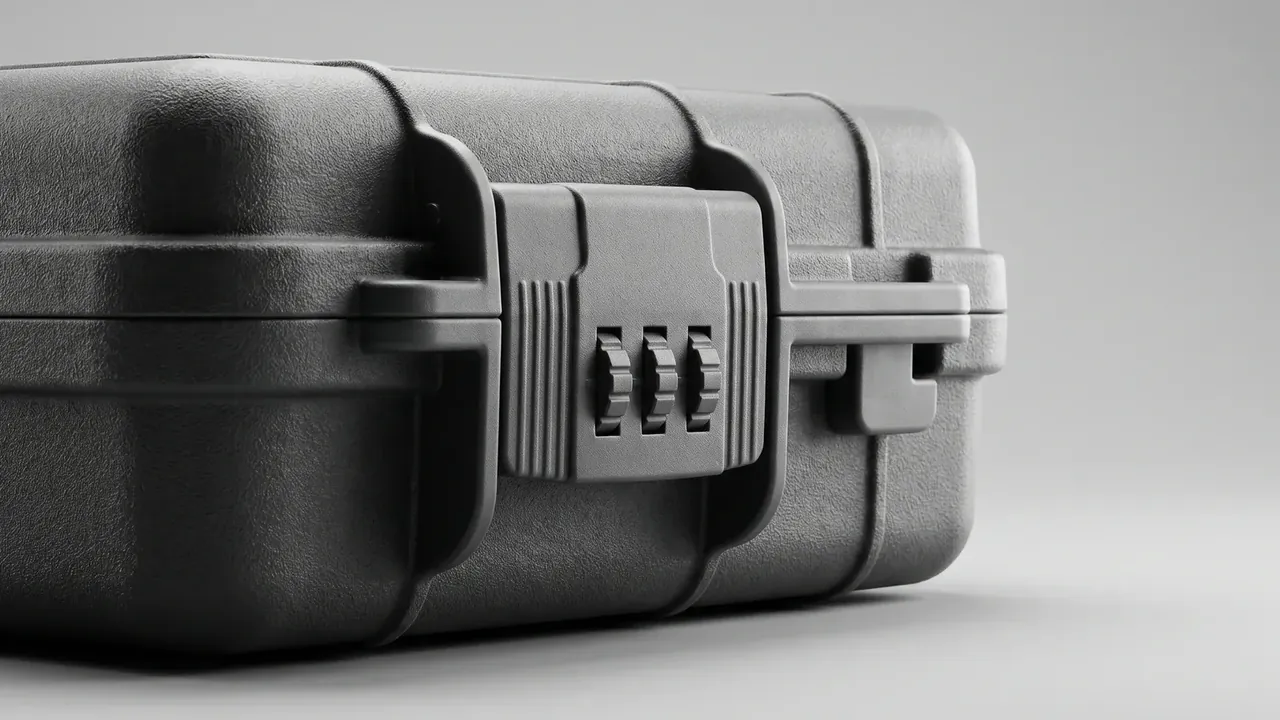
Six minutes per explosion-proof case, held by four judgement lines.
| Check | Instrument | Judgement line | Sampling |
|---|---|---|---|
| Side wall | caliper | 5.8 mm minimum | 3 cases, 4 points each |
| Lid joint | 0.3 mm feeler | feeler must not enter | every case |
| Cavity | tape | within 2 mm of drawing | 3 cases per batch |
| Latch holding | pull gauge | 220 N minimum | 3 cases, 2 latches each |
Read wall at the middle of a flat face, never at the rim, the thickest part of a rotomoulded part, which biases every reading upward. Walk the feeler round the joint. Watch the 30 mm either side of the hinge. Take cavity length, width and depth, keeping the tape off the base ribs. Load each latch slowly before reading at hold. A case that overruns six minutes means an uncalibrated instrument or an unreadable drawing.
3. Seal and Vent Face Three Moves
Three moves settle seal and vent face.
- Run a 0.3 mm feeler along the closed joint; 10 mm of penetration fails the case.
- Take the vent face at 18 percent of side area, press the centre, require rebound within 1 second.
- Hold seal compression at 25 to 30 percent; more kills rebound, less seals nothing.
- Keep 100 mm clear in front of the vent face, with no liner, strap or nameplate.
The fourth item is usually treated as decoration: liners are fitted later, by people who do not know it has a job.
4. Stacking and Cold Sampling
Stacking is sampled, not performed on every unit: a 500 kg platform load on the closed case for 24 hours, with flat-face deformation above 3 mm failing it.
The cold item is simpler: minus 25 C for 2 hours, then a corner-first drop from 0.9 m inside 90 seconds. No corner crack, no latch springing open. A platform scale with weights is the load, a chest freezer is the chamber, so the difficulty is sampling: cavities of one mould can differ by 0.4 mm of wall, and one case proves nothing.
5. Six Fields on the Record
The acceptance sheet is not for signing but for arguing later; drop one field and the judgement cannot stand.
- Batch and cavity numbers, naming the cavities sampled.
- Instrument ID and calibration date.
- Measured values, not the words pass or fail.
- Source of the judgement line, by drawing or clause.
- Disposition, one of concession, repair or return.
- Re-check date and signature, mandatory for repaired units.
Fill all six and a rework dispute has something to stand on.
6. Disposition Concess Repair Return
Three routes. Concession suits deviations with no structural meaning, such as shade; repair suits replaceable parts, such as latches and seals; return suits mould-level deviation in wall or cavity.
Concession needs a ceiling: past twenty percent of a batch, process capability is already short. Return needs a freight clause, since a full batch going back costs close to ten percent of goods value.
Conclusion
Acceptance earns its money by stopping rework at the dock rather than at the customer site. Four judgement lines, six minutes per case and six record fields are not complicated; doing them every time is. Put the lines in the contract, sample across cavities and route failures into three dispositions, and rework falls from one in five to under three percent. The more an explosion-proof case acceptance reads like a procedure, the more predictable its unit cost.
This article discusses only the container (case body) side of specifications and design intent, and does not cover any handling, loading or use of the contents.
Related Reading
- Waterproof hard case checks and judgement lines
- What an explosion-proof case is: relief, containment, strength
- How an explosion-proof case differs from alternatives
- Airdrop case drop and stacking acceptance
- Artillery shell box batch inspection records
Related Products
- 8 Series — Gun Cases; Military Equipment Cases; Camera Equipment Cases; Drone Cases; Watch Cases; Knife Cases; First Aid Cases; Electronics Equipment Cases
- WL8-2812 PP Gun Case — model WL8-2812
- All protective cases and toolboxes: 7 series, 158 models