

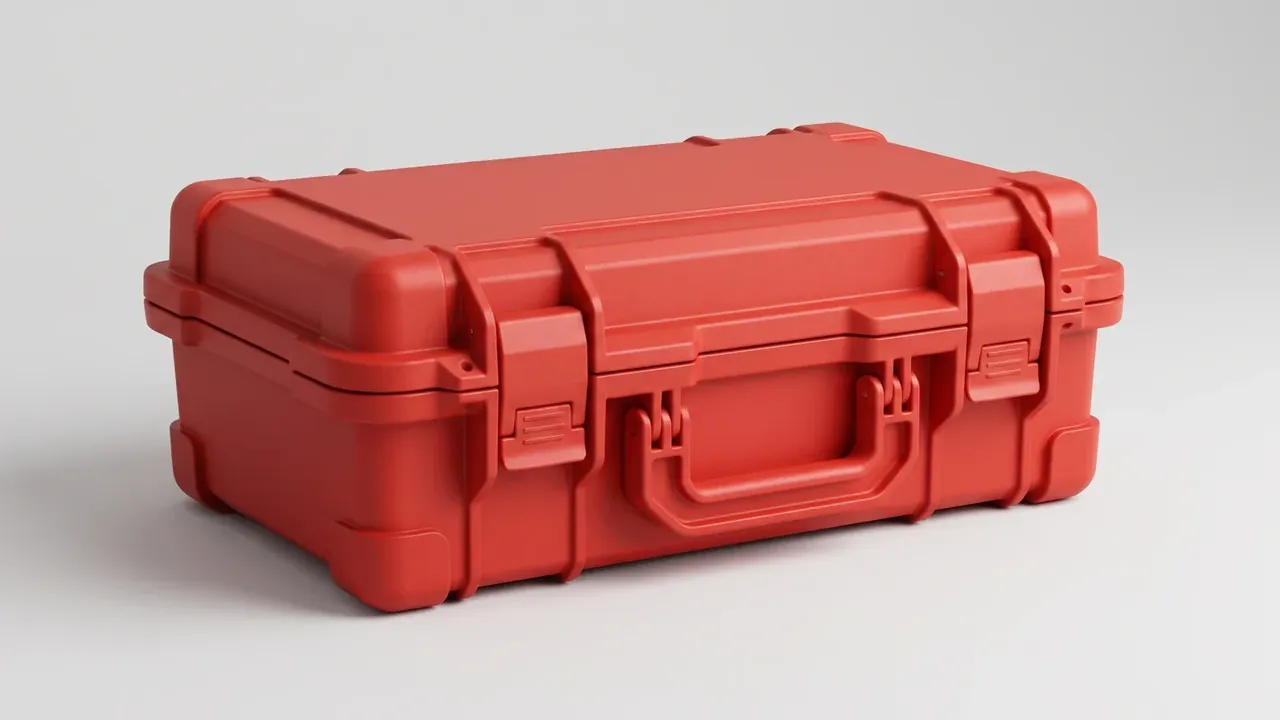
Quick answer: An explosion proof tool box follows the zone and the surface resistance: conductive PP or a bonded metal body below 10^6 ohms in Zone 1, up to 10^9 in Zone 2, with an earth stud carrying static away before the lid opens.
Table of contents
- Material Limits in Zone 1 and Zone 2
- Conductive PP Below One Megaohm
- Static: Box, Body and Earth
- Separating Copper Beryllium Tools
- Five Places That Must Not Spark
- Cleaning and Re-testing
- FAQ
1. Material Limits in Zone 1 and Zone 2
Zone 1 covers an area where a flammable atmosphere may appear for roughly 10 to 1,000 hours a year; Zone 2 covers the case where it appears only briefly, under 10 hours. For an explosion proof tool box the difference turns on one word: static. A shell that carries several kilovolts discharges the moment a latch is lifted.
| Material | Surface resistance | Decay | Spark risk | Zone |
|---|---|---|---|---|
| Conductive PP | 10^4 to 10^6 ohms | Under 2 s | Low | 1 and 2 |
| 304 stainless | Below 10^2 ohms | Immediate | Impact only | 1, bonded |
| Plain ABS | Above 10^14 ohms | Hours | High | Not for use |
Conductive PP sits between 10^4 and 10^6 ohms and sheds charge in seconds. Stainless is lower but only helps once bonded into the plant earth; plain ABS, above 10^14 ohms, is an insulator and stays out of Zone 1.
2. Conductive PP Below One Megaohm
An explosion proof tool box in conductive PP carries carbon black at 15 to 20 percent by weight, which takes the resin to a volume resistivity of 10^3 to 10^5 ohm centimetres. The trade is mechanical: tensile strength falls from 28 to 23 MPa and notched impact from 8 to 5 kJ per square metre, which is why the wall is moulded at 3.5 mm rather than 2.5 mm.
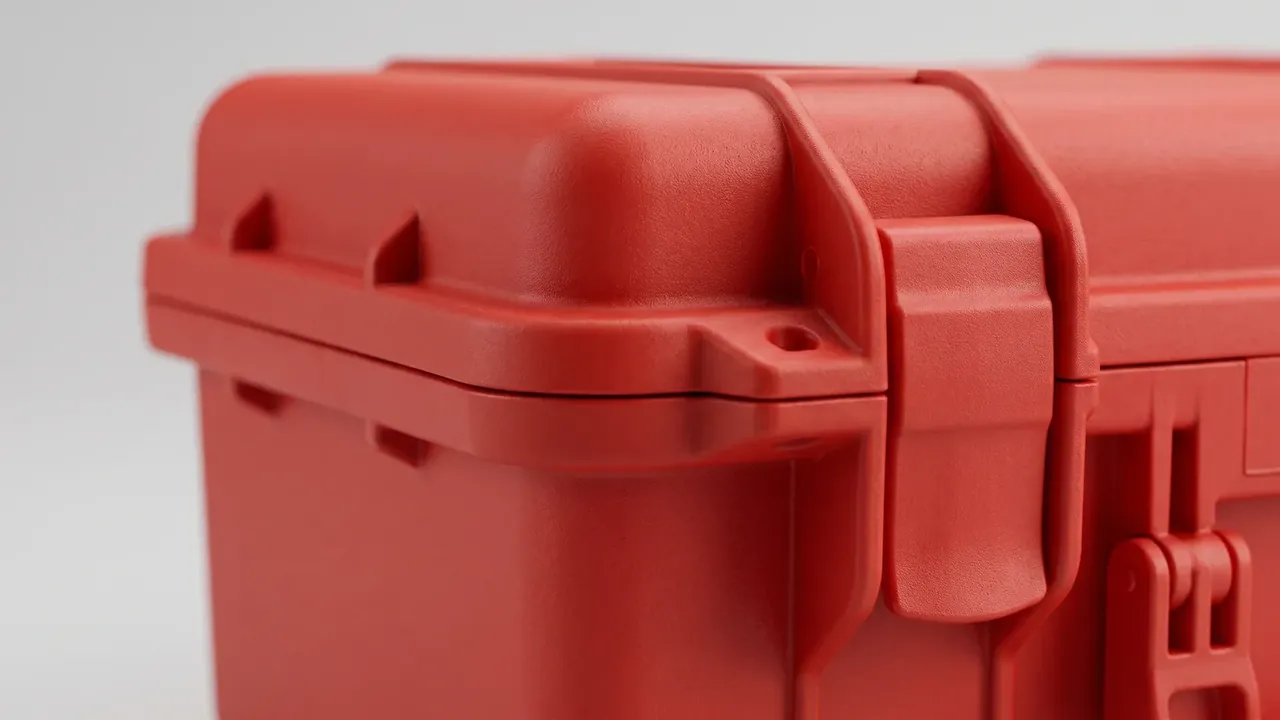
The test method must be fixed. Parallel electrodes 100 mm apart, 500 V DC, reading at 60 seconds, in air at 23 C and 50 percent humidity. Raise humidity to 80 percent and the reading drops a full decade; leave an oil film on the surface and it climbs tenfold.
3. Static: Box, Body and Earth
Walking 20 m across a plant floor lifts a person to about 5 kV, and pulling off a synthetic jacket can reach 12 kV. With 100 pF of body capacitance, 10 kV stores 5 mJ, while methane needs only 0.28 mJ to ignite, a margin of more than fifteen times.
An explosion proof tool box therefore has to conduct, not insulate. An M6 stainless stud moulded into the base takes a 4 square millimetre braided strap, and the resistance from box to earth is held under 100 ohms. Bond first, open second, and conductive PP drops 5 kV below 100 V within 2 seconds along that path.
4. Separating Copper Beryllium Tools
Wrenches in these areas are usually copper beryllium or aluminium bronze, 35 to 42 HRC, chosen so a strike does not spark. Two such tools hitting each other still shed metal, so the interior of an explosion proof tool box uses one pocket per tool, 20 mm of foam between pockets.
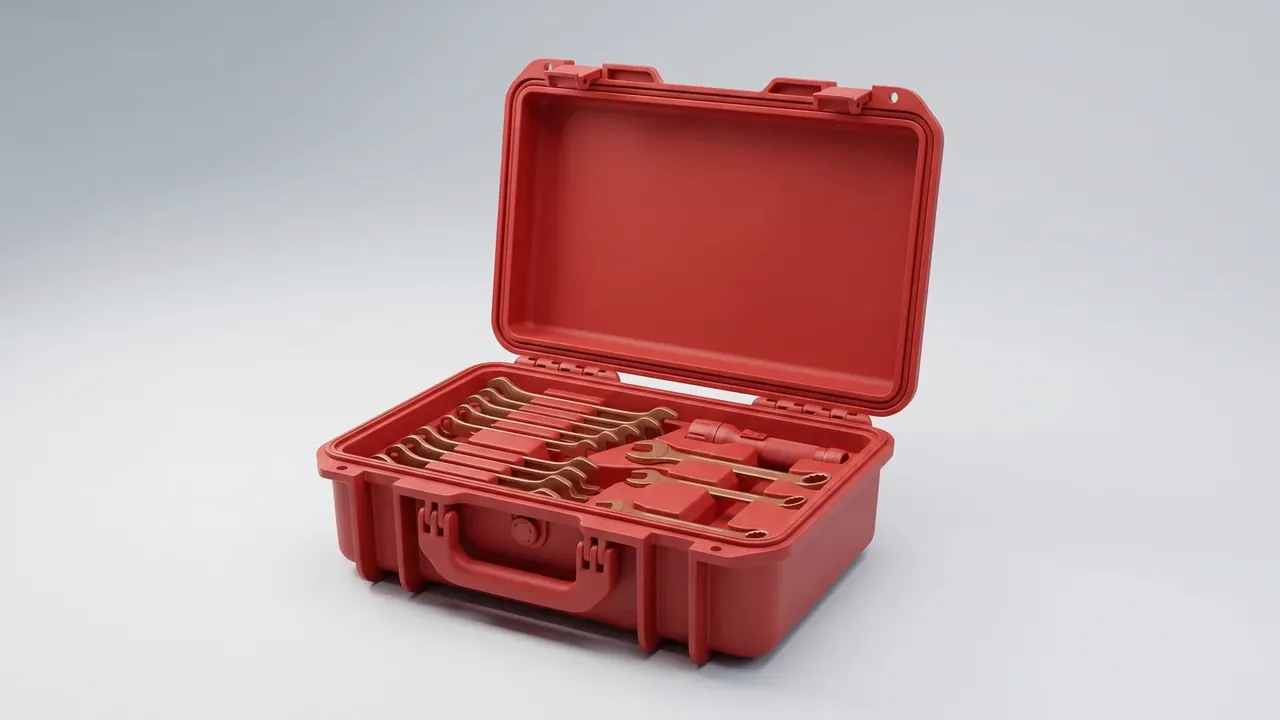
The foam is 70 kg/m³ EVA, 0.18 MPa at 25 percent compression, so a wrench beds in without sinking. Clearance is 0.5 mm a side: under 0.2 mm the tool has to be pried out, over 1 mm it slides 4 mm across a 3 km trolley run and the handles peen each other.
5. Five Places That Must Not Spark
The latch body comes first. A POM moulding has no steel spring, closing at 120 N and losing under 15 percent over 5,000 cycles. Where a metal latch is specified, 316 stainless gets a 0.5 mm nylon liner so steel never bites steel.
The hinge pin comes second, POM or 316 with 0.2 mm of clearance so movement happens between polymer faces. The handle pin, the metal mesh in the breather and the rivets behind the nameplate finish the list. Those five are the only moving and metal parts on the shell, and each one dealt with removes a spark source.
6. Cleaning and Re-testing
The shell of an explosion proof tool box carries its conductivity in the carbon black network near the surface, and solvents attack it. One wipe with acetone strips the resin, carries the carbon away, and lifts surface resistance from 10^5 to 10^8 ohms, which retires a perfectly good box.
Clean with a neutral surfactant and water, rinse, and let it dry for 30 minutes in air.
Re-test every 6 months and log three numbers: surface resistance at two points on lid and base, earth resistance at the stud, latch force at mid-span.
| Item | Pass band | Interval | If out of band |
|---|---|---|---|
| Surface resistance | 10^4 to 10^6 ohms | 6 months | Clean, re-test, retire |
| Earth resistance | Under 100 ohms | 6 months | New strap, clean stud |
| Latch force | Above 100 N | 12 months | Replace latch |
Conclusion
Choosing an explosion proof tool box for a petrochemical site comes down to three numbers: hours per year that decide Zone 1 or Zone 2, a surface resistance of 10^6 ohms that decides whether it may enter, and 100 ohms to earth that decides whether it is safe once inside. Conductive PP buys a 2 second decay with 15 to 20 percent carbon black; a metal body buys solvent resistance through bonding. Both work if the stud, latches and hinge get the same care. Inside a hazardous area the question is not strength but whether static has a path out.
This article discusses only the container (case body) side of specifications and design intent, and does not cover any handling, loading or use of the contents.
Related Reading
- How industrial tool boxes are used on site
- Specifications and inspection standards for hardware tool boxes
- Choosing case latches and their closing force
- How to judge a gasket sealed protective case
Related Products
- 8 Series — Gun Cases; Military Equipment Cases; Camera Equipment Cases; Drone Cases; Watch Cases; Knife Cases; First Aid Cases; Electronics Equipment Cases
- WL8-2812 PP Gun Case — model WL8-2812
- All protective cases and toolboxes: 7 series, 158 models