

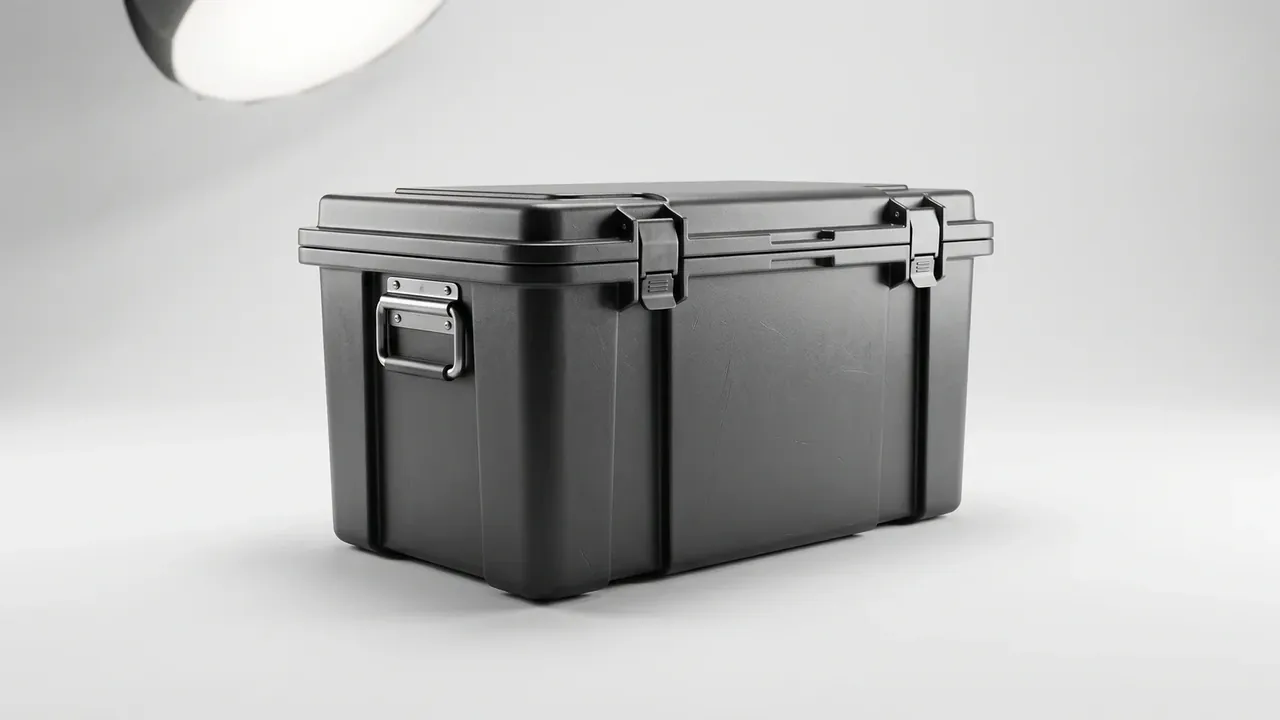
Quick answer: Follow the load, not the wall thickness. In a reinforced protective case, stack height sets rib spacing, the way a corner lands sets cap thickness, the long-edge span sets hinge count, and weight per litre shows whether mass is structural or filler.
Table of contents
- Load path of a reinforced protective case
- Ribs: spacing sets stiffness
- Corners and hinges: where stress collects
- Wall thickness and weight per litre
- Acceptance and the quotation
- FAQ
1. Load path of a reinforced protective case
A reinforced protective case is only as strong as its load path. Under a stack, force lands on the lid, crosses the lid ribs into the side walls, drops through vertical posts and leaves at four corners. Break one link and extra material buys nothing.
So work backwards: stack height and unit weight first, corner impact second, thickness last. Reverse it and thick walls with thin corners split on the first drop.
| Decision | Ask first | Number to hold |
|---|---|---|
| Load path | Stack height, unit weight | Five high, 32 kg maximum |
| Ribs | Spacing and height | 90–120 mm, height 2.5× wall |
| Corner caps | Wraps three faces or one | 2.0 mm cap, 45 mm cover |
| Hinges | Long-edge span | Three above 600 mm |
| Weight ratio | Mass per litre | 0.14–0.18 kg |
Three mistakes dominate: reinforcement read as uniform thickening, hoops with no posts, caps screwed flat.
2. Ribs: spacing sets stiffness
Spacing is the first parameter, not height. Tightening pitch from 150 mm to 100 mm adds stiffness faster than growing rib height from 6 mm to 10 mm, for about ten percent more weight. At 90–120 mm a reinforced protective case is well braced; past 200 mm the panel dishes.
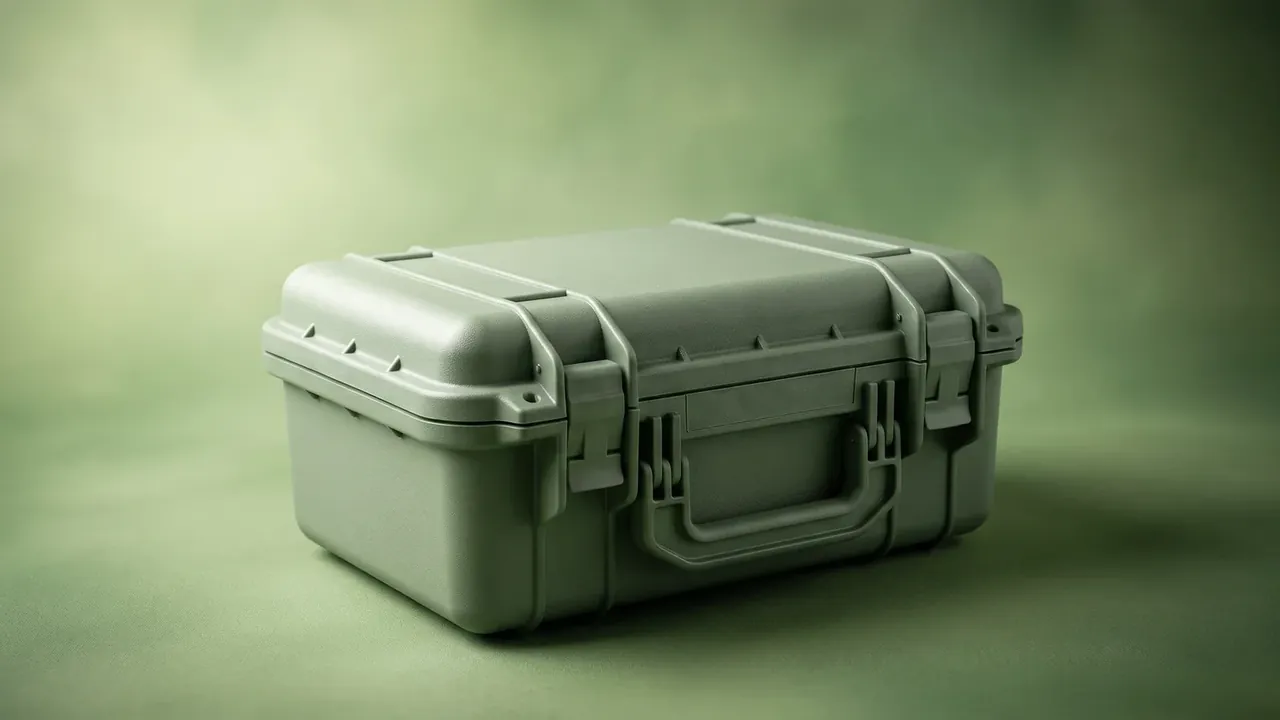
Keep height near 2.5 times wall, root radius R1.5, draft 1.5 degrees. Taller ribs fight the mould and steeper ones sink the outer face. Squares over 120 mm across do little.
Vertical ribs carry stack load, horizontal ribs only stop bulge. One-directional ribs push drop energy to an end face, which is where cracks start.
3. Corners and hinges: where stress collects
Corners take the highest stress in a reinforced protective case. A proper cap wraps top, side and end face, covers 45 mm per leg, measures 2.0 mm, and is moulded in modified PP, sometimes with a TPE outer layer. A flat cap without a lip shears its screws on the first drop.
M5 screws into metal inserts, torqued to 2.5 N·m, hold better than screws driven into plastic and do not wallow out. Pull each cap at 300 N for a minute.
Hinges set service life. Two below 600 mm, three above, no span over 300 mm, or the lid centre lifts. Use a 4 mm stainless pin and expect misalignment under 1.0 mm after 5000 cycles.
4. Wall thickness and weight per litre
Thickness follows structure. A mainstream reinforced protective case runs 3.2 mm on the walls, 4.5 mm where load concentrates, and the lid 0.3 mm thicker because it carries the stack. Taking the whole shell to 5 mm adds mass while ribs stay wrong.
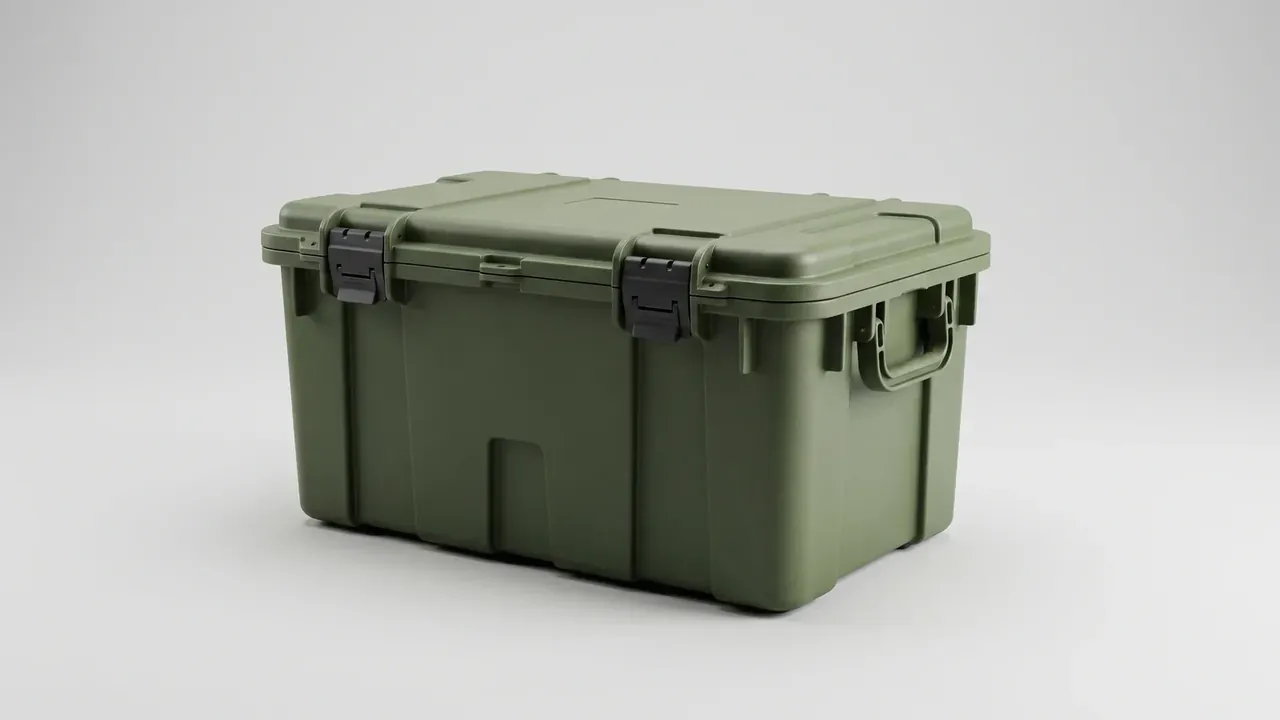
Weight per litre is the cheapest check: empty mass over internal volume, 0.14–0.18 kg. Below 0.12 the ribs are sparse; above 0.20 bulk replaces design. A 45 L case at 7.0 kg reads 0.156.
5. Acceptance and the quotation
Structure is settled at acceptance for a reinforced protective case. Measure rib pitch at three points per wall; 10 mm off drawing is a process problem. Pull caps at 300 N, cycle hinges 5000 times, then drop a loaded case 1.2 m onto six faces and look for cracks through a corner.
Stack testing earns its own run: five loaded cases, 24 hours on the bottom unit, deflection read an hour after unloading, 3 mm the limit. It exposes rib spacing that drops never touch.
| Check | Method | Pass |
|---|---|---|
| Rib pitch | Three points per wall | Within 10 mm |
| Cap pull-out | 300 N for 1 min | No movement |
| Hinge life | 5000 cycles | Under 1.0 mm |
| Stack | Five high, 24 h | Under 3 mm |
| Drop | 1.2 m, six faces | No through-crack |
Write the quotation the same way: resin grade, wall thickness per face, rib layout, cap material, hinge spec and count. A quote that says only reinforced cannot be inspected.
Conclusion
Five numbers carry the decision: rib pitch, rib height against wall, cap coverage, hinge span, weight per litre. Align them and prices become comparable; compare thickness alone and you buy mass instead of strength. Put all five on the enquiry sheet, and a reinforced protective case stops being a matter of opinion.
This article discusses only the container (case body) side of specifications and design intent, and does not cover any handling, loading or use of the contents.
Related Reading
- How to read a heavy-duty protective case spec sheet
- How an injection-moulded case body is built
- Rotomoulding and what it does to wall thickness
- What a case factory checks before shipment
Related Products
- 8 Series — Gun Cases; Military Equipment Cases; Camera Equipment Cases; Drone Cases; Watch Cases; Knife Cases; First Aid Cases; Electronics Equipment Cases
- WL8-2812 PP Gun Case — model WL8-2812
- All protective cases and toolboxes: 7 series, 158 models