

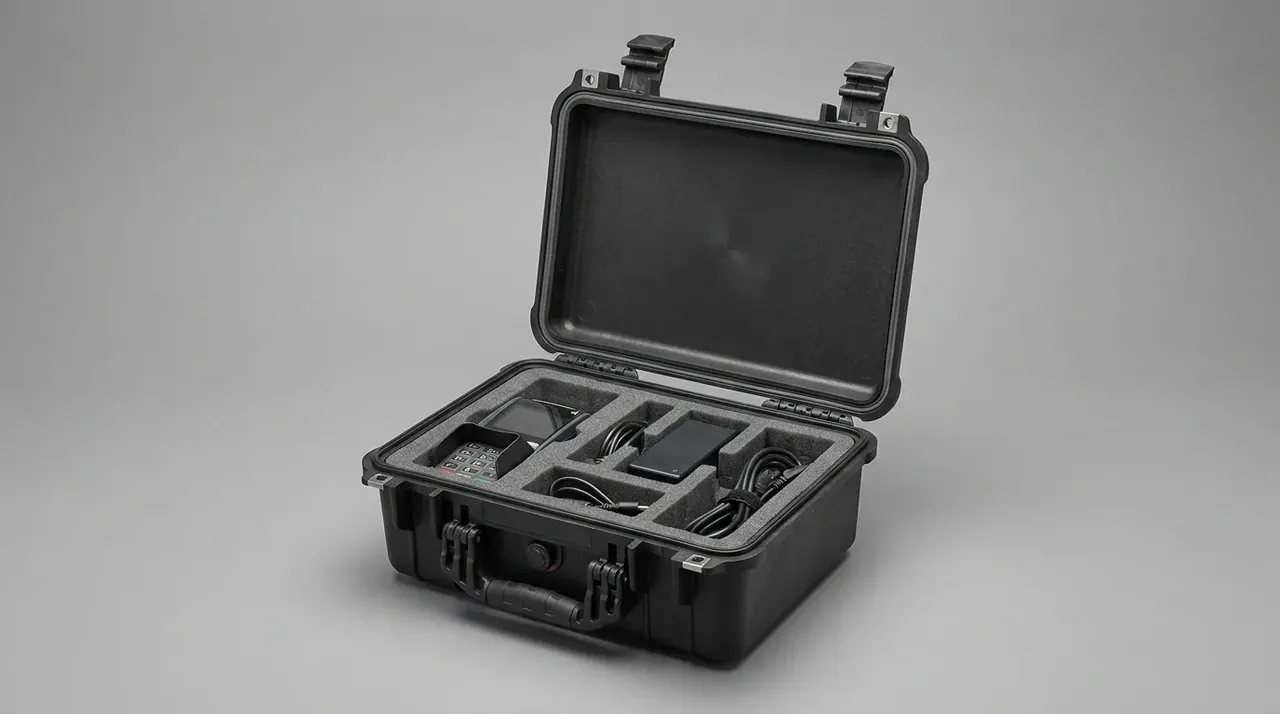
Quick answer: Case resin price pass-through is one multiplication: PP from 8.6 to 9.4 CNY/kg adds 1.68 CNY to a 2.1 kg case, under 3% of the selling price.
Table of contents
- The pass-through formula
- The ±5% threshold and the monthly average
- 90-day quote validity and price locks
- Three responses: recipe, wall, terms
- FAQ
1. The pass-through formula
Resin up 0.8 CNY a kilogram puts 1.68 CNY on a case that uses 2.1 kg. The arithmetic has one shape: 2.1 × (9.4 − 8.6) = 1.68. Polypropylene moved from 8.6 to 9.4 CNY/kg, a 9.3% rise, and divided by one case it becomes 1.68 CNY.
That looks small until it meets volume: 300,000 cases a year carry 504,000 CNY. Case resin price talks break down because the buyer measures a percentage of the whole case and the supplier measures an absolute on the resin line.
Three variables sit in the formula: weight per case, the gap between base and current average, and loss rate. Weight follows volume and wall thickness, with 2.1 kg matching a 420 mm × 320 mm × 180 mm case. Loss is taken at 3%, covering sprue, runner and trial shots.
| Weight per case (kg) | At 8.6 CNY/kg | At 9.4 CNY/kg | Increase per case |
|---|---|---|---|
| 1.8 | 15.48 | 16.92 | 1.44 |
| 2.1 | 18.06 | 19.74 | 1.68 |
| 2.4 | 20.64 | 22.56 | 1.92 |
With the 3% loss the 1.68 CNY becomes 1.73. That 0.05 CNY is not a rounding detail: over 300,000 cases it is 15,000 CNY, the cost of a small mould change.
Pass-through covers resin only. Labour, power, packaging and freight do not follow the pellet price, and multiplying them by the resin rise hands the supplier a second gain. Resin moves on the formula; everything else is negotiated once a year.
At 1.68 CNY on a 60 CNY ex-works case the rise is 2.8%. Under 3%, most buyers absorb it, and only above 5% does the adjustment process start.
2. The ±5% threshold and the monthly average
The threshold sits at ±5%, so no adjustment is discussed until the average pellet price moves further. The line does not save money, it saves paperwork: resin moves 3% inside a week, and a letter for every move would bury both sides.
Most case resin price disputes stick on the reference, not the threshold. The reference belongs in the contract: 26th of the previous month to the 25th of the current month, five working days of mainstream quotes, highest and lowest dropped, the rest averaged. The window crosses the month so finance can check and invoice.
A single day cannot carry an adjustment. A 12% jump inside one day is common, usually a trader clearing stock or a typing error, and pricing on it means repricing next month.
Once triggered, the clock runs: a written notice within 5 working days of the average being published, a confirmation within 5 working days, and the new price from the 1st of the following month. Miss the window and the difference folds into next month's base, with no backdating.
The base price must be frozen for 12 months. A base that floats destroys the reference: the rise is measured against a low base and the fall against a high one, which eats a quarter of every review meeting.
The case resin price threshold also accumulates. Three months at 2% each never cross the line alone but add to 6%, so the fourth month triggers.
3. 90-day quote validity and price locks
Quote validity is 90 days from the date the quotation is issued, not from the order date. The case resin price window usually hides inside those 90 days: a quote issued on 1 March holds until 1 June, whatever the pellet market does.
Ninety days is a compromise. At 30 the supplier cannot buy ahead; at 180 the supplier refuses. Ninety covers buying through first shipment.
Locks come in two shapes. A time lock holds a quarter and reopens at the average; a volume lock holds 6 months above 2000 pieces per batch. Neither suits a month of violent swings.
A lock is never unconditional. The usual exception splits whatever exceeds a 10% monthly rise, which kept suppliers from cutting specification to absorb cost.
Fifteen days before expiry, a case resin price review should ask for a fresh weight breakdown, not a new unit price. The breakdown shows whether part weight moved and whether the regrind ratio changed, and either one kills comparability.
4. Three responses: recipe, wall, terms
When a case resin price rise lands, only three levers move: recipe, wall and payment terms. They differ in speed and cost, so the order matters.
The recipe is fastest. Blending 15% regrind, which runs 3.2 CNY/kg below virgin, saves 1.0 CNY a case and covers about 60% of the 1.68 CNY rise. Impact strength drops roughly 8%, so the drop margin at minus 20 ℃ thins.
The wall is the most complete change and the slowest. From 3.0 mm to 2.8 mm cuts weight 6.7%, from 2.1 kg to 1.96 kg, saving 1.32 CNY at 9.4 CNY/kg. The tool has to change, the ribs at the latch and hinge seats need recalculating, and drop and stack tests run again, which takes 8 weeks.
Terms are the lever people forget. Settlement from 90 days to 30 lowers the supplier's working capital, and 0.3 to 0.5 CNY per case comes out of the quote; a monthly settlement with a 10% cap shifts the risk into the annual budget.
The three should not run at once. Take the recipe first, since it covers 60% in 2 weeks; move to the wall only if that fails, because it touches tooling and certification; keep terms last, as a bargaining chip.
One check comes first: confirm the weight per case. The same tool on different presses runs 2% apart, and 2% of 2.1 kg is 42 g, worth 0.4 CNY at 9.4 CNY/kg.
Conclusion
Case resin price pass-through has to end as a formula anyone can recompute: increase per case equals weight times the price difference times the loss factor, and 2.1 kg at 0.8 CNY/kg with 3% loss gives 1.73 CNY. Pair that formula with the threshold table and every rise becomes a calculation instead of an argument. Check the monthly average against ±5%, check whether the 90-day quote has expired, then pick one of recipe, wall or terms. If none closes the gap, spread the unit change over annual volume and requote, where 300,000 cases carry 519,000 CNY, enough for a formal review.
| Monthly average move | Trigger | Adjustment | Effective |
|---|---|---|---|
| under ±3% | no | none | not applicable |
| ±3% to ±5% | watch | none, carried forward | not applicable |
| above ±5% | yes | actual less 5% | 1st of next month |
| above ±10% | yes, renegotiate | excess split 50/50 | 1st of next month |
This article discusses container-side specifications and design implications only, and does not cover any handling, loading or use of the contents.
Related Reading
- PP against ABS in protective cases
- Case resin grades and where they fit
- Comparing case materials side by side
- PP and ABS tool boxes compared
Related Products
- 8 Series — Gun Cases; Military Equipment Cases; Camera Equipment Cases; Drone Cases; Watch Cases; Knife Cases; First Aid Cases; Electronics Equipment Cases
- WL8-2812 PP Gun Case — model WL8-2812
- All protective cases and toolboxes: 7 series, 158 models