


Quick answer: A rifle case is not an oversized storage box. It is a shell, a seal and a latch system working as one, and its performance comes down to three numbers: wall thickness, rib pitch and gasket groove depth. This walk-through follows the build order, from pellets to shell to the five checks at the end of the line.
Table of contents
- What a Rifle Case Actually Is: Shell, Seal, Latch
- From Pellets to Shell: Injection or Rotomoulding
- Three Numbers That Decide Performance
- Assembly and Testing: The Last Stretch
- FAQ
1. What a Rifle Case Actually Is: Shell, Seal, Latch
A rifle case solves one problem on the drawing: it holds a long, fragile, damp-sensitive object inside a space that does not move, and lets that space be carried, driven and dropped without coming apart. It is not an oversized storage box. It is a rigid shell, a seal and a latch system doing three jobs at once.
Each part carries one job. The shell gives stiffness, the seal keeps water and dust out, the latch supplies preload. Lose one and the other two are wasted: a thick shell with a latch that never compresses the gasket still leaks, and a good gasket on a thin lid lifts at the first press.
| Part | Job | Criterion |
|---|---|---|
| Shell | Survive drop and stacking | Six-face drop from 1.2 m without cracking, five-tier stack without collapse |
| Seal | Block water and dust | Held at 0.3 bar for 60 seconds with no drop |
| Latch | Preload the gasket | About 60 N per latch, four spread evenly |
The order is fixed: shell stiffness first, groove depth second, latch travel last.
2. From Pellets to Shell: Injection or Rotomoulding
A rifle case shell comes off one of two routes, injection moulding or rotomoulding. Size and volume pick the route, not price.
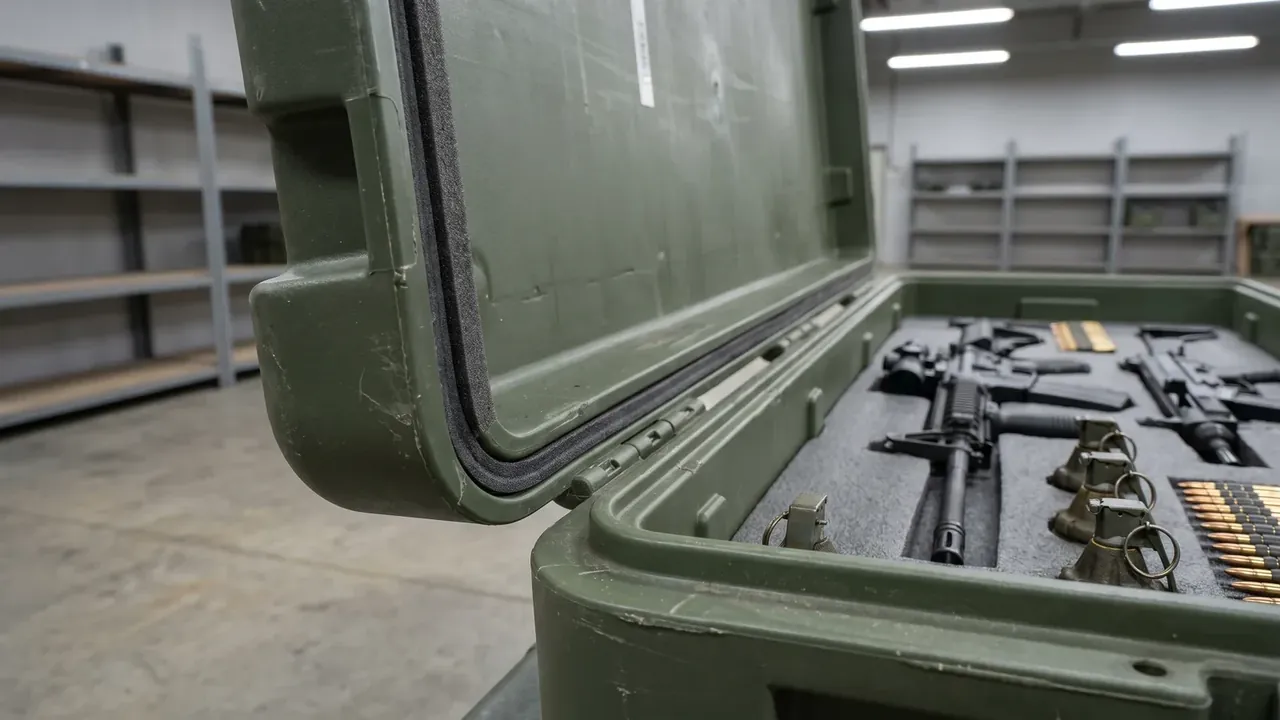
Injection runs on a short cycle measured in seconds:
- Dry pellets at 80°C for four hours, down to 0.2 percent moisture
- Melt at 230°C, mould at 40°C, inject at 90 MPa
- Hold 8 seconds, cool 25 seconds, eject
- Trim, fit inserts, hand to assembly
Rotomoulding takes the other path: powder in the mould, two-axis rotation with heat, walls from 6 mm up, twenty minutes a cycle. It cannot hold a 1 mm rib, but it piles material into corners, which pays off on drops.
Length 1.2 m is the divide. Below it, injection; above it, rotomoulding; in between, volume decides.
3. Three Numbers That Decide Performance
A rifle case drawing carries dozens of dimensions. Three of them set performance.
| Parameter | Typical value | What drift costs |
|---|---|---|
| Wall | 3.5 mm moulded, 6 mm rotational | 0.5 mm thin and corners whiten on impact |
| Rib pitch | 80 mm apart, 4 mm deep | Wider pitch and the wall bulges under vacuum |
| Gasket groove | 8 mm wide, 6 mm deep | Deeper will not compress, shallower will not close |
Gasket squeeze is designed at 25 percent. A 6 mm groove with an 8 mm cord closes to 6 mm, which lands inside the window. Too little squeeze and water seeps; too much and the cord loses rebound in three years.
Thicker is not better. Add wall and the shrinkage difference grows, so flat faces dish. Moulded rifle case faces are usually held to 1.5 mm flatness, with ribs doing the stiffening rather than thickness.
4. Assembly and Testing: The Last Stretch
Every rifle case leaving the line runs five checks before packing. This is the stretch most often shortened, and the one that fails first.
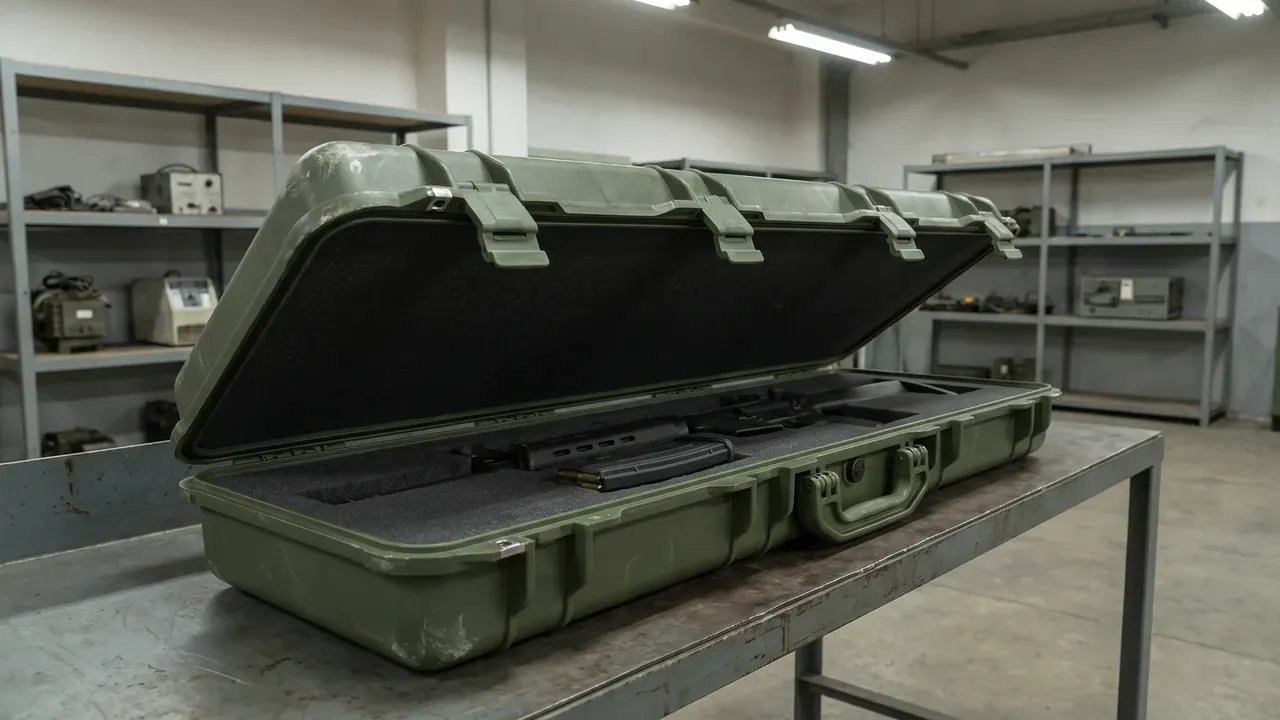
- Air: 0.3 bar held 60 seconds, drop no more than 0.02 bar
- Drop: 1.2 m, six faces and three corners, ballasted to rated load
- Hinge life: 50,000 cycles, torque loss under 20 percent
- Climate: four hours at -30°C and at 70°C, three rounds
- Salt spray: 240 hours, no red rust on hinge or latch
Hinge life is the check people skip. Fifty thousand cycles sounds generous, and at four openings a day it works out to thirty-four years, but a line audit runs only five hundred, so the rest rests on design.
Records have to follow the shell. Housings, gaskets and latches in one batch come from different suppliers, and a batch number alone will not tell you which roll of cord went in.
Conclusion
The threshold for a rifle case is not its finish but three numbers: wall, rib pitch, gasket groove. Fix those and stiffness, sealing and service life follow, with latches, hinges and foam arranged around them. Read the three first, and any talk about what a rifle case should cost starts from something solid.
This article discusses only the container (case body) side of specifications and design intent, and does not cover any handling, loading or use of the contents.
Related Reading
- Inside the shell of a tool box
- Foam inserts and dividers for gear cases
- Bodies and wheel sets on road cases
Related Products
- 8 Series — Gun Cases; Military Equipment Cases; Camera Equipment Cases; Drone Cases; Watch Cases; Knife Cases; First Aid Cases; Electronics Equipment Cases
- WL8-2812 PP Gun Case — model WL8-2812
- All protective cases and toolboxes: 7 series, 158 models