

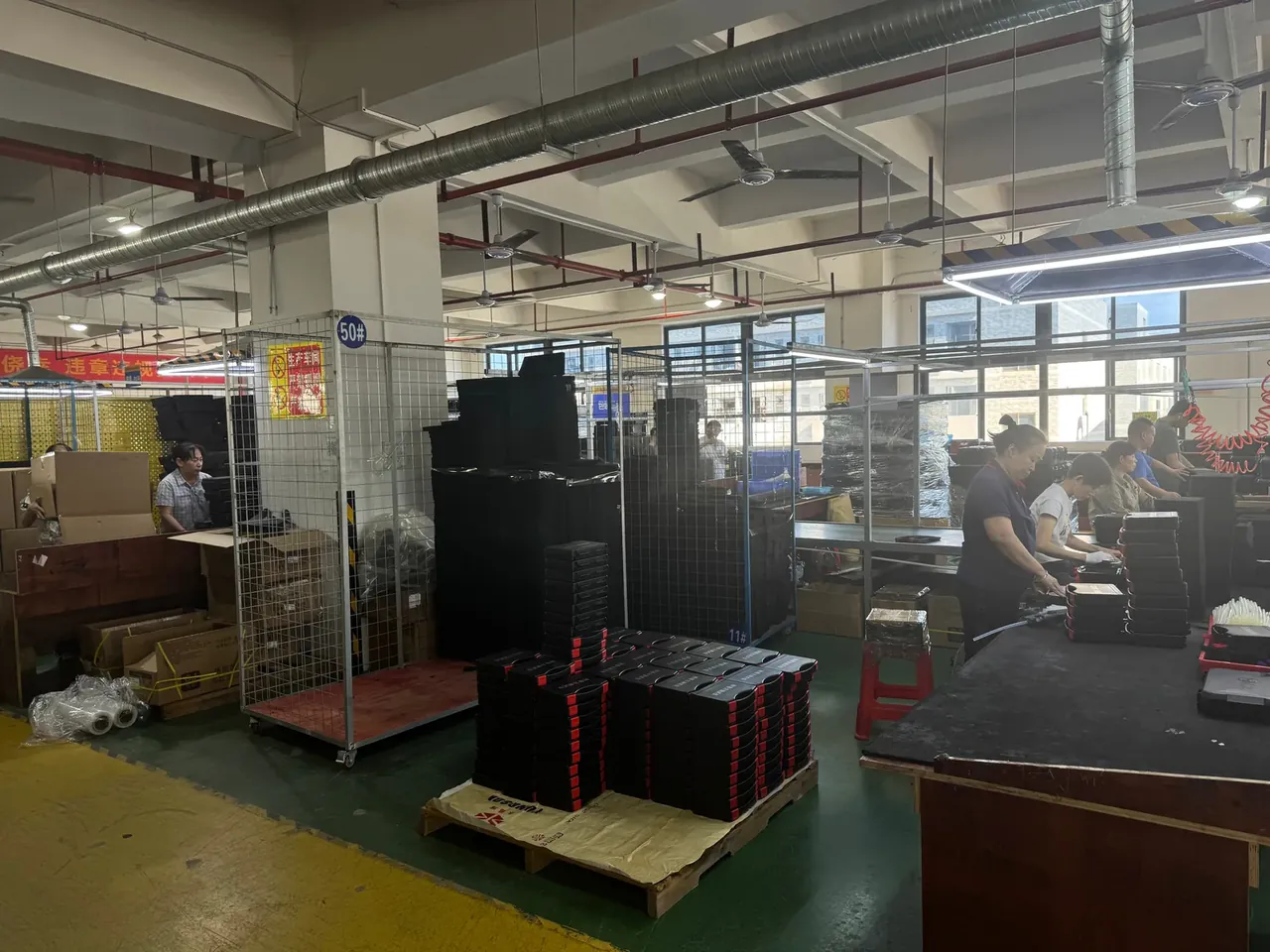
Quick answer: A Road Inspection Equipment Case of 520×360×220 mm, 4.5 mm wall, four φ10 mm tie points and Shore A25 pads turns a 0.8 g stop into 33 N.
Table of contents
- Fixing a Road Inspection Equipment Case in the Van
- Pad Hardness Against the Road Spectrum
- Tie Points and the Load of a Sudden Stop
- How the Lid Stays Shut Over Rough Ground
- The Pre-Departure Check
- FAQ
1. Fixing a Road Inspection Equipment Case in the Van
Only four corners of the shell touch the van floor. Fixing a Road Inspection Equipment Case means handing load along a chain: floor to pad, pad to base, base to wall, wall to boss, boss through strap to the anchor rail. Leave a gap anywhere and a stop lets the body slide before anything holds it. Where the force enters matters more than strap width. A strap over the lid loads the cover first, so cover stiffness becomes the bottleneck. Four corner lashings feed load straight into the bosses, and a pallet with chocks stops movement, leaving the strap to hold nothing but lift.
| Fixing method | Hardware | Body weight | Movement under a stop |
|---|---|---|---|
| Over-the-lid strap | 2 webbing straps, 25 mm | Under 15 kg | 3–5 mm |
| Four-corner lashing | 4 φ10 mm bosses and hooks | Under 30 kg | Within 1 mm |
| Pallet and chocks | Timber pallet, four chocks | Above 40 kg | Within 0.5 mm |
2. Pad Hardness Against the Road Spectrum
Hardness follows from the road. A survey car on paved surfaces puts its energy low in the band, and a typical road spectrum covers 5–200 Hz; 2 h at 1.5 g RMS is the window anything inside must survive. Method 514 of MIL-STD-810 gives a framework, not a fixed profile.
A Shore A25 EVA pad reads about 120 kPa at 25 percent compression, and that sets how far the body settles. Too soft and the pad is already densified at rest; too firm and it barely deflects, which equals bare steel. Density shifts the curve: 20 kg/m³ of difference is another pad.
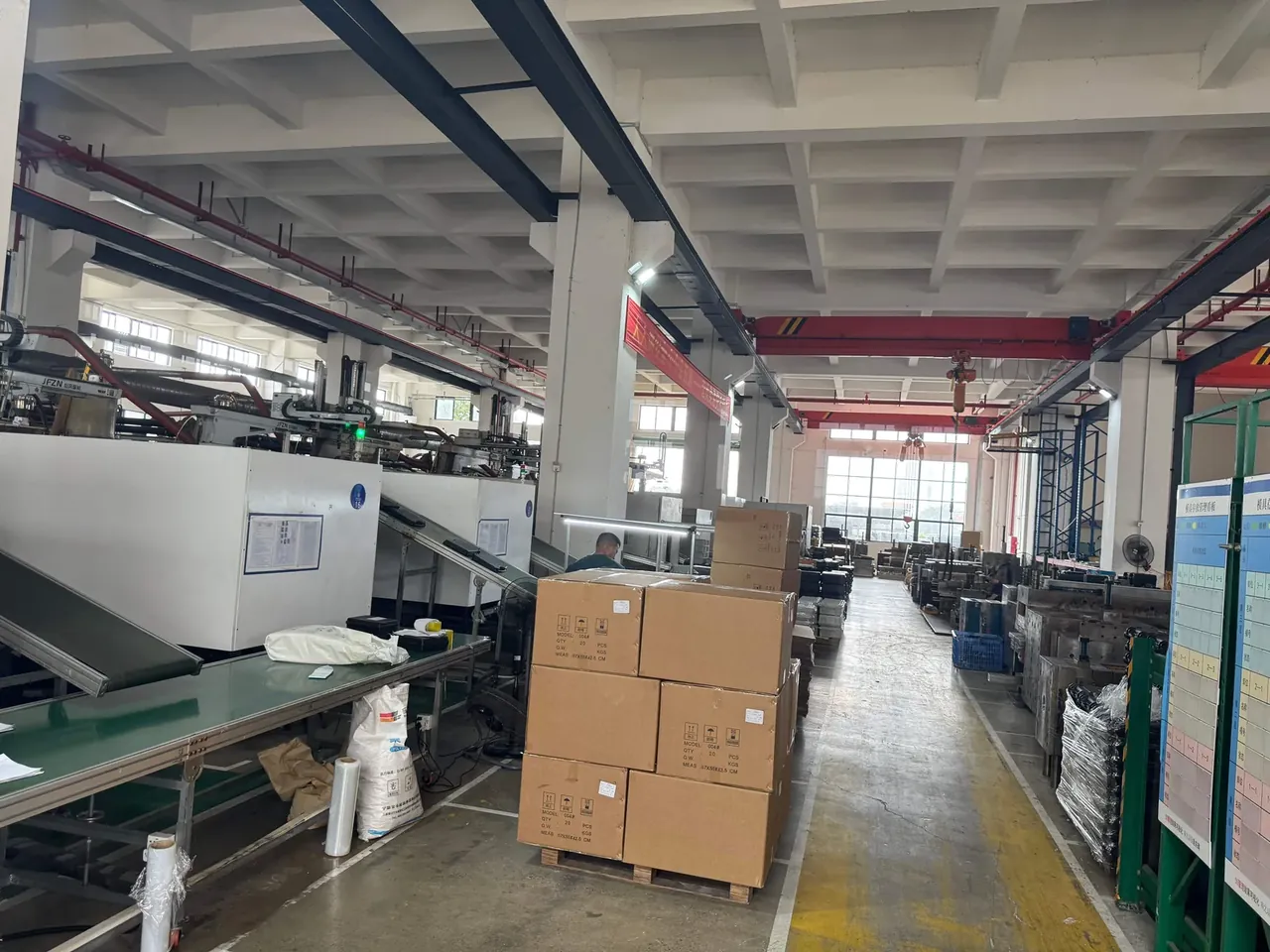
Thickness travels with hardness: a 30 mm A25 pad gives about 7 mm of travel, the same compound at 15 mm leaves just over 3 mm and bottoms out on the first 1.5 g event. Past four tenths of pad thickness, cushioning ends.
| Vibration level | Frequency band | RMS level | Cavity movement |
|---|---|---|---|
| City asphalt | 5–80 Hz | 0.5 g | Within 0.2 mm |
| Trunk road and gravel | 20–150 Hz | 1.0 g | Within 0.4 mm |
| Unmade track | 5–200 Hz | 1.5 g | Within 0.5 mm |
Take the level where cavity movement stays under 0.5 mm after 2 h of random vibration; anything softer is a short-haul sample only.
3. Tie Points and the Load of a Sudden Stop
Road cargo practice sizes the forward case at 0.8 g, sideways and rearward at 0.5 g. A 4.1 kg body at 0.8 g produces about 33 N, which four tie points share at under 9 N each, trivial on paper. The wear lives in repetition: twenty stops a day loosen and tighten the straps, and the hook grinds each eye.
Bosses sit above the corner radius rather than mid-panel, so a strap on a Road Inspection Equipment Case runs nearly parallel to the wall and sheds less sideways load. A 10 mm bore suits a 25 mm strap hook; smaller and the hook will not pass, larger and the webbing rattles. A 30 mm backing plate spreads the point load.
More bosses is not better, because every bore is a hole in a pressure shell and stress climbs with the count. Up to 20 kg, four bosses and two straps are enough; beyond that, add bearing area under the base before drilling again.
4. How the Lid Stays Shut Over Rough Ground
A lid rarely flies open; it micro-moves. A fraction of a millimetre per cycle becomes tens of thousands across 2 h, polishing the catch faces until holding force drops.
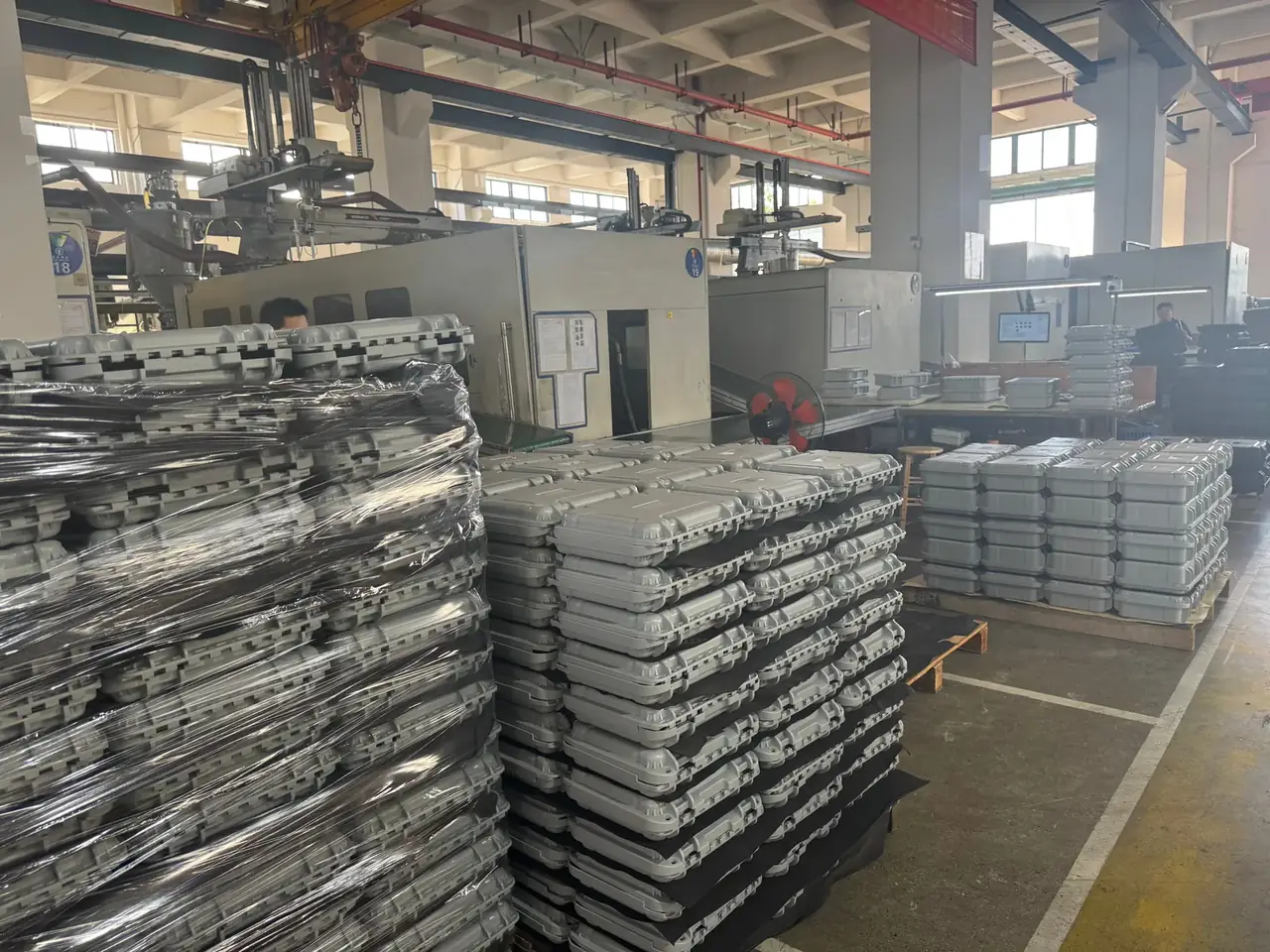
Holding force on a Road Inspection Equipment Case sits at 120 N, between staying shut and being openable. Below 80 N the lid can release itself under 1.5 g; above 180 N a gloved hand reaches for a tool and the tongue breaks first. Two catches placed symmetrically keep rim clamp even, since load on one side lifts the other by about 1 mm.
The hinge side needs its own look. The 8000-cycle figure assumes ten openings a day over two years, and pin-to-bush clearance changes fastest in the first two thousand cycles.
5. The Pre-Departure Check
A minute before departure decides the whole run. The check ignores appearance and reads four things a hand can feel: bolt torque at the tie points, strap tension, pad compression, and the gap along the closed lid.
| Check item | Where to look | Pass criterion | Interval |
|---|---|---|---|
| Tie point torque | 4 boss bolts | No slack, no rust | Every trip |
| Strap tension | 2 webbing straps | Under 10 mm deflection by hand | Every trip |
| Pad compression | Four base corners | 15–25 percent compressed | Weekly |
| Lid holding force | 2 catch tongues | Crisp reset, gap within 0.5 mm | Every trip |
The -20 to 70 ℃ range covers a van parked in summer sun. A gasket softens at 70 ℃ and takes a permanent set, so the IP66 seal outlives no shell and belongs on a replacement schedule.
The last gate on the assembly line of a Road Inspection Equipment Case is a catch-force sample. Shrinkage moves each seat by a fraction of a millimetre and tongue flex absorbs it. Sampling reads the range across ten from one batch; a spread above 0.3 mm points at unstable mould temperature.
Conclusion
Fixing a Road Inspection Equipment Case in a moving van reduces to four numbers a person can check by hand: boss torque, strap tension, pad compression and catch holding force. Hold those and the body behaves as one rigid part of the vehicle; let any drift and the walls absorb travel they were never designed for. Pinning the three tables into the departure routine outlasts another pair of ribs.
Related Reading
Related Products
- 8 Series — Gun Cases; Military Equipment Cases; Camera Equipment Cases; Drone Cases; Watch Cases; Knife Cases; First Aid Cases; Electronics Equipment Cases
- WL8-2812 PP Gun Case — model WL8-2812
- All protective cases and toolboxes: 7 series, 158 models