

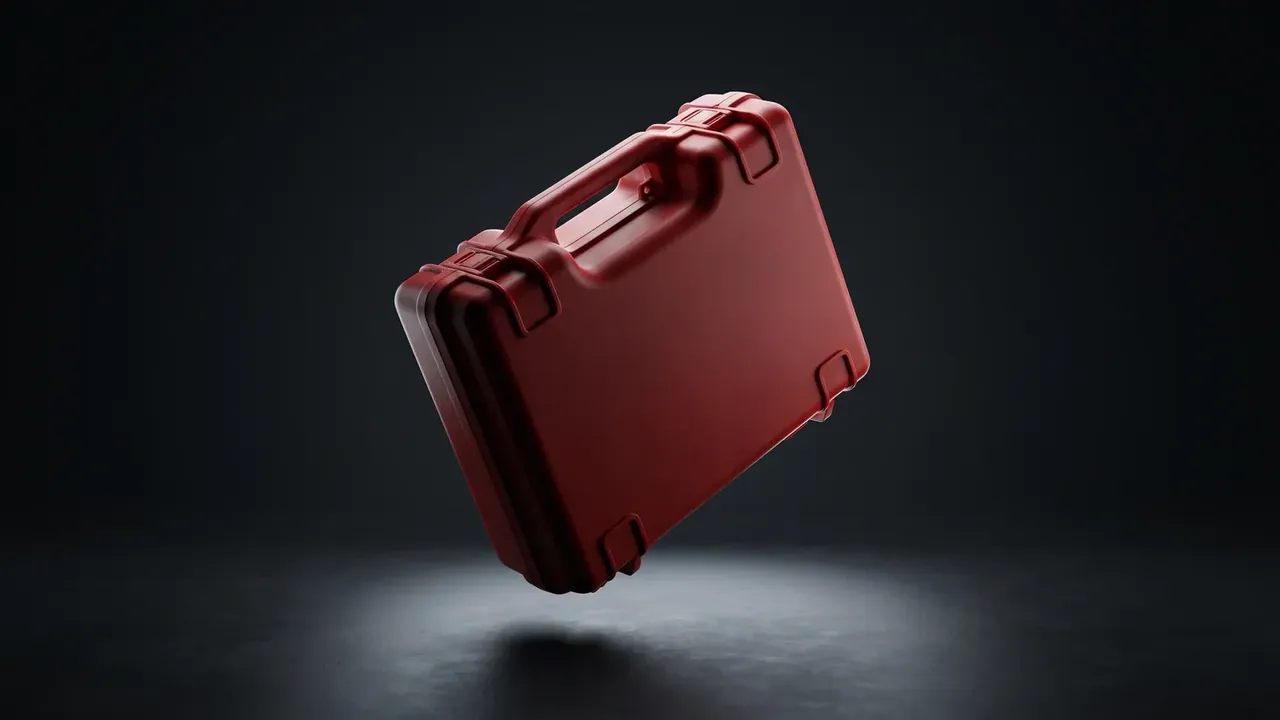
Quick answer: Wheels pay off only when the load is heavy, the walk long and the floor flat. Climb stairs, cross gravel or turn in a narrow bay and the extra 2.4 kg works against you. Here are the three switch lines and the criteria behind them.
Table of contents
- Three jobs where a rolling tool case loses
- Against a hand box: where the extra weight sits
- Against a tool chest: capacity traded for retrieval time
- Against a tool bag: the line between soft and hard
- When a rolling tool case still wins
- FAQ
1. Three jobs where a rolling tool case loses
Put wheels on a case and everyone assumes it beats a hand box. In three jobs that assumption is wrong.
| Job | The problem | Better form | Given up |
|---|---|---|---|
| Three floors, no lift | Carried anyway, wheels are dead weight | Two hand boxes | Two trips |
| Gravel and site track | A 100 mm wheel sinks, dragging replaces rolling | Hand box or bag | Load drops to 18 kg |
| Rear seat, narrow bay | 1.2 m turning circle, handle fully out | Hand box or soft bag | A third of the volume |
The failure is in the wheel, not the body. Castors pay off on flat ground; on steps and soft soil they are extra parts.
2. Against a hand box: where the extra weight sits
At equal volume a rolling tool case weighs about 2.4 kg more: 1.1 kg of castors, 0.9 kg of handle, 0.4 kg of housings. Flat ground buys a walk without stopping; stairs buy one extra lift per step.
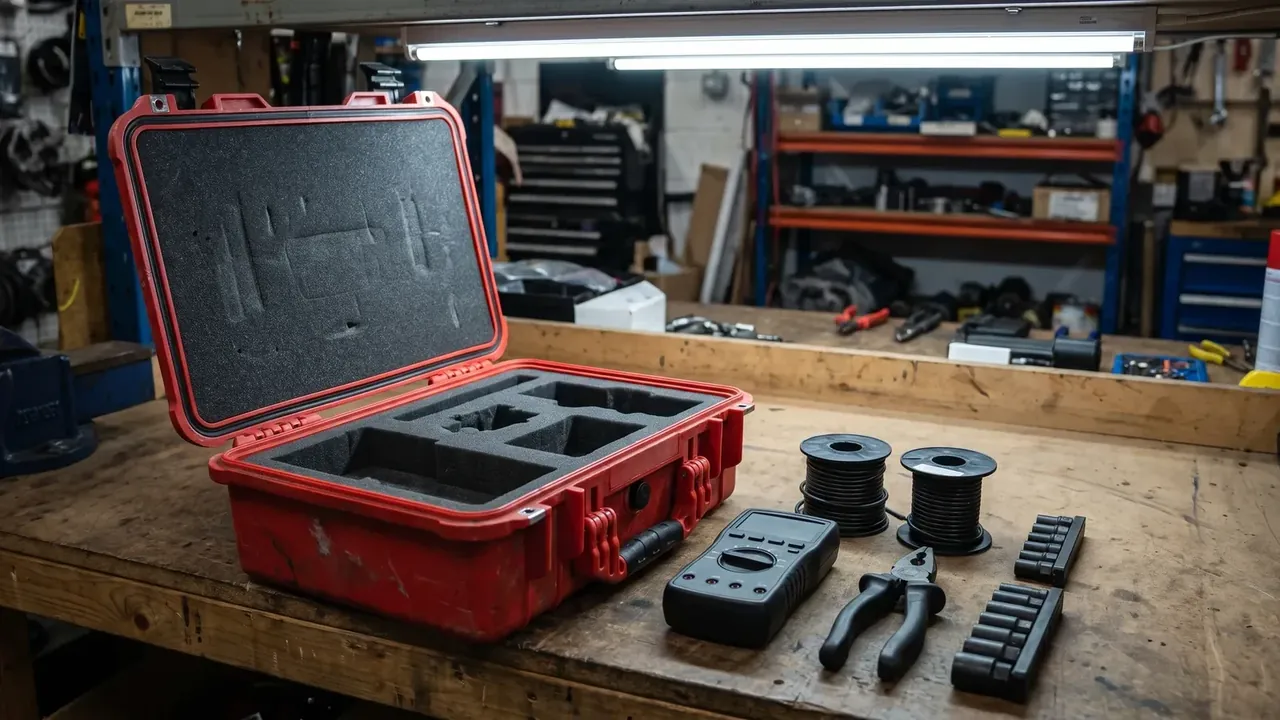
The test is whether the case ever leaves your hand. A hand box can be set down at a threshold; a rolling tool case is pushed or carried, with nothing between. Under 20 m the 2.4 kg is a loss, past 50 m on flat ground it pays back, and the crossover sits near 30 m, further out with every corner and threshold. That calculation needs one site measurement: the walked distance from bay to bench.
A hand box tops out near 18 kg; beyond that people pair up to lift it and lose to one person pushing a case.
3. Against a tool chest: capacity traded for retrieval time
A chest spreads tools out and retrieval means walking; a case gathers them in and retrieval means opening a lid. The difference is the path to each part.
- A six-drawer chest holds about 220 litres; a case of equal footprint holds 60.
- One retrieval from a chest takes 6 seconds; opening and searching a case takes 20.
- A chest never moves, so each walk is 12 m, and 30 walks a day is 360 m.
- A case parks at the bench, cutting the retrieval radius below 2 m.
- A chest occupies 0.6 square metres; a case folds to 0.25.
Under ten retrievals a day at a fixed bench favours the chest; a bay that changes daily favours the case. Between them, the count of benches per unit decides.
4. Against a tool bag: the line between soft and hard
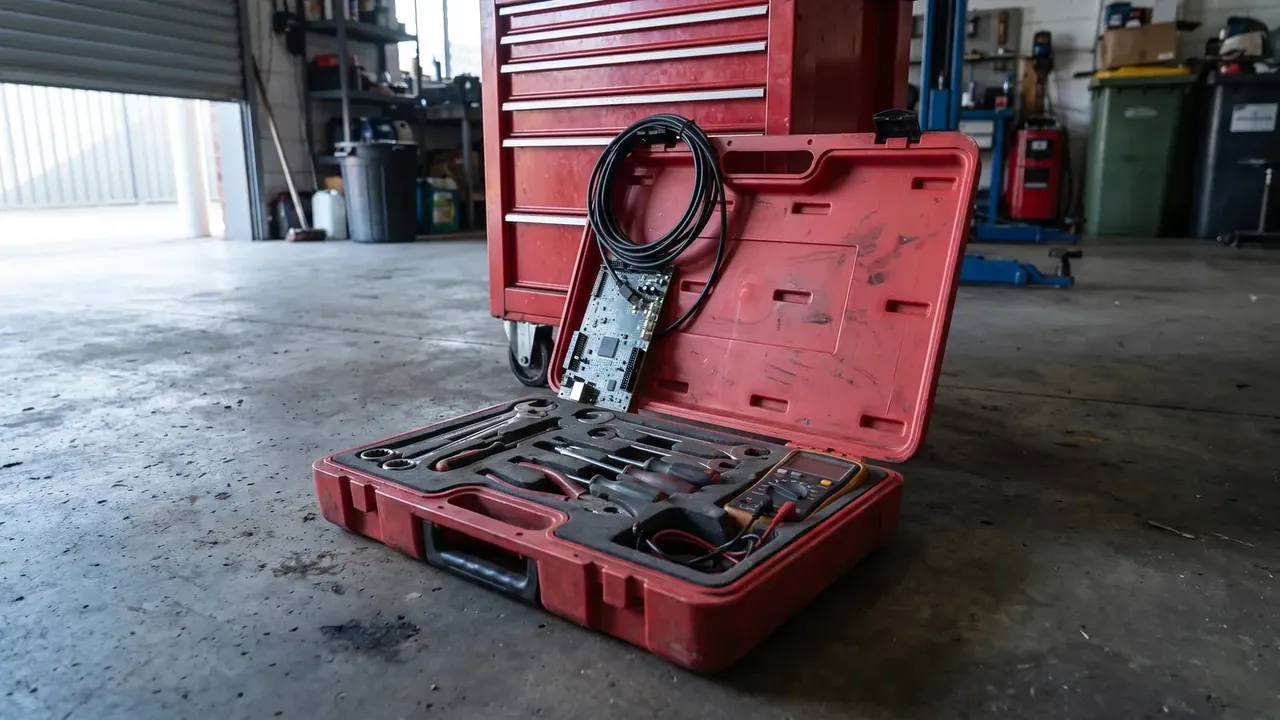
A tool bag is soft, stuffable and hangable, and pays for it with no protection and no stacking. A hard shell covers both, at twice the weight.
| Point | Tool bag | Hard case |
|---|---|---|
| Empty weight | 0.8 kg | 6.2 kg |
| Protection | Fabric cushion, crush-sensitive | 2.8 mm shell, resists side load |
| Stacking | None | Three high |
| Obstacles | Slung or carried | 100 mm wheels, 25 mm threshold |
| Odd shapes | Fit easily | Limited by foam cavities |
The line is whether anything inside can be crushed. Measuring tools, optics and instruments with screens stay unprotected in any fabric; spanners, pliers and tapes travel lighter in a soft bag. Power tools sit between: they fear drops more than crush, so corner bumpers matter more than wall thickness.
5. When a rolling tool case still wins
Read the same conditions the other way: over 25 kg per trip, over 50 m one way, and a flat floor. Drop one and the arithmetic changes.
- Load: 25 to 40 kg packed, beyond a single-handed lift.
- Distance: 50 m one way, or six round trips a day.
- Floor: concrete, epoxy or tile, with no gravel.
- Loading: a van floor below 800 mm, so the case rolls in.
- Access: a ramp or goods lift, so it is never lifted whole.
Two hidden conditions also decide it. The aisle must leave 900 mm for one person to turn the case, and the 0.25 square metre parking spot has to fit beside the bench.
Conclusion
A rolling tool case is not an upgrade but a trade: 2.4 kg of hardware for walking 50 m without stopping. On stairs, gravel and tight corners it loses money; only heavy, long and flat together make a rolling tool case pay back.
This article discusses only the container (case body) side of specifications and design intent, and does not cover any handling, loading or use of the contents.
Related Reading
- Tool bag materials and abrasion trade-offs
- Portable plastic tool box materials compared
- Case configurations by job site
- How to compare lid materials
Related Products
- 8 Series — Gun Cases; Military Equipment Cases; Camera Equipment Cases; Drone Cases; Watch Cases; Knife Cases; First Aid Cases; Electronics Equipment Cases
- WL8-2812 PP Gun Case — model WL8-2812
- All protective cases and toolboxes: 7 series, 158 models