

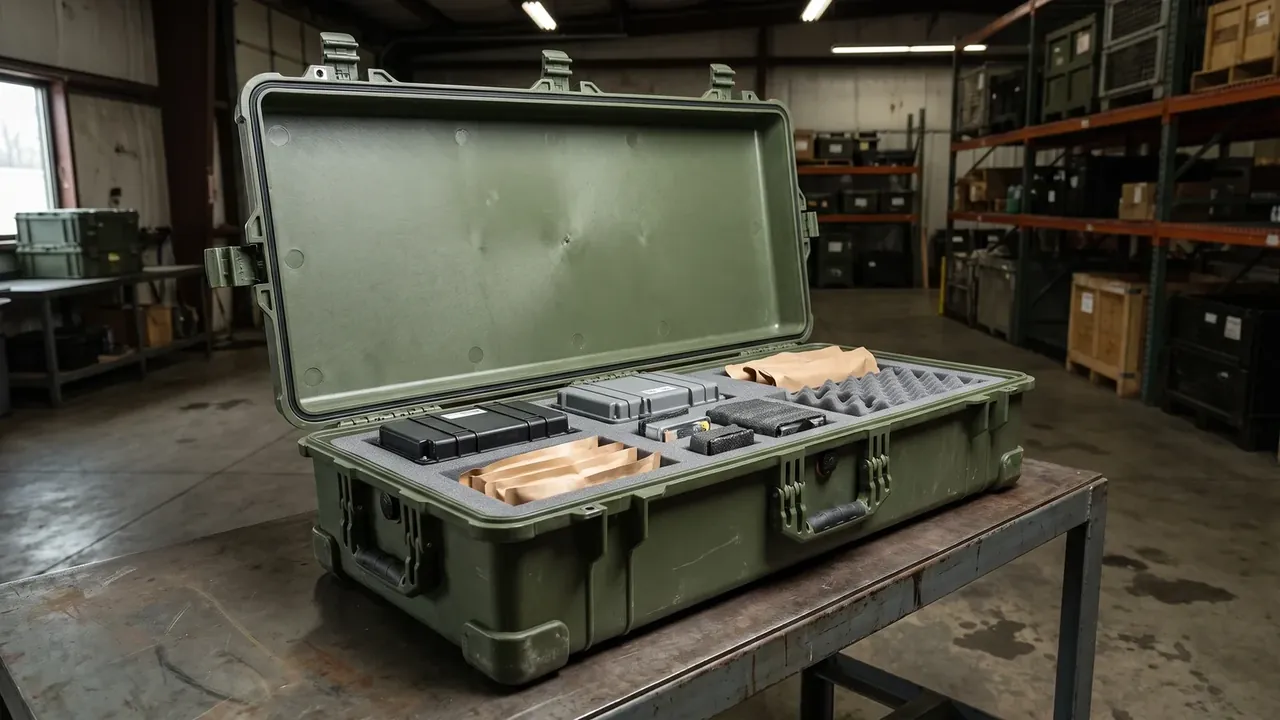
Quick answer: A rotomolded case is configured backwards from the job: transport mode sets the mounting interface, dwell time sets the seal grade, access frequency sets the lid and insert layout. Most of the difference between deployments lands in four places: mounts, latch backup, gasket compound and foam.
Table of contents
- Six Typical Rotomolded Case Applications
- Field and Vehicle Configurations
- Air and Sea Transit Reinforcement
- Medical and Emergency Access Design
- A Configuration Checklist in Order
- FAQ
1. Six Typical Rotomolded Case Applications
Field communications rotation, vehicle carriage, air freight, sea shipment, medical response and cold chain transfer are the six settings where a rotomolded case earns its cost. All six need a body that can be carried, stacked and opened repeatedly without losing its seal.
Write the scenario down first and configuration follows. Once the mould is cut, shell shape and ribs are fixed; what stays adjustable is the mount, latch, gasket and foam.
| Scenario | Duty pattern | Configuration focus |
|---|---|---|
| Field communications | About 90 days per site, manual handling | Handle height, stacking ribs |
| Vehicle carriage | 200 km of gravel road, continuous vibration | Base mounts, anti-slip pads |
| Air freight | Hold pressure near 75 kPa, six handlings | Secondary latch backup |
| Sea shipment | 95%RH humidity, 55 C deck surface | Seal grade, 480 hour salt spray |
| Medical response | Access within 15 seconds on scene | Compartment layout, labels |
| Cold chain transfer | 72 hours at -25 C | Cold gasket, hinges |
2. Field and Vehicle Configurations
A case left in the field fights condensation. Daily cycles swing from -5 C to 45 C, the air inside expands and contracts, and the gasket moves with every breath, so compression set matters more than thickness: keep it under 20 percent. Colour matters too: a dark shell in midday sun runs about 12 C hotter at the surface than a light one.
Vehicle work is about restraint, not cushioning. On 200 km of gravel the rotomolded case bounces continuously, and four base mounts with M8 bolts rated to 2 kN pull-out, over 6 mm of anti-slip rubber, do more than extra foam inside.
3. Air and Sea Transit Reinforcement
Air freight brings pressure and handling count together. With the hold near 75 kPa the pressure difference loads the latches, so a secondary backup becomes necessary: a nylon strap or a spring pin, releasable within five seconds. Six handlings per leg is normal, so latches should be designed against 2000 open-close cycles.
Sea transit stretches time. Decks reach 55 C, humidity holds at 95%RH and salt spray is judged over 480 hours, with hinge pins, latch springs and caster axles failing first. The shell must resist distortion that would take the rim out of flat, and with four high stacking the lid centre should show no sag.
4. Medical and Emergency Access Design
Medical response cares less about resin than whether the right item comes out within 15 seconds. That decides the opening: a top lid exposes every compartment at once, while a front drawer suits a fixed pick order but slides open under vibration unless a detent is fitted.
Compartment count should follow the item list, not the volume. Twelve compartments at 2.5 kg per cell with a 3 mm EVA pad at each base is common. Labels go where the eye lands when the lid opens, at least 40 mm high, with a reflective marker for low light.
5. A Configuration Checklist in Order
Transport mode comes first because it fixes the mounting interface, then dwell time for the seal, access frequency for the lid, temperature for the gasket compound, stack height for ribs. Emergency kits also carry a 28 kg ceiling so two people can move one 50 m.
| Order | Question | Configuration it fixes |
|---|---|---|
| 1 | How does it travel | Mounts, tie-down rings, pads |
| 2 | How long does it stay | Compression set target, seal grade |
| 3 | How often does it open | Latch type, hinge pin material |
| 4 | What temperature range | Resin grade, cold silicone gasket |
| 5 | How high does it stack | Rib density, base |
The order avoids rework: choose the case before the scenario and the first mounting interface blocks the design.
Conclusion
Fitting a rotomolded case to a job means fixing five variables in order: transport mode, dwell time, access frequency, temperature range and stack height, then letting mounts, latches, gasket and foam follow. The more specific the scenario, the less rework; choosing the box first usually stalls at the mounting interface. Bring this checklist to the meeting and a rotomolded case deployment is settled in one pass.
This article discusses only the container (case body) side of specifications and design intent, and does not cover any handling, loading or use of the contents.
Related Reading
- How rotomolding shapes a case body
- Rotomolded case versus alternatives
- Field configurations for military rotomolded cases
- Selection checks for rotationally molded cases
Related Products
- 8 Series — Gun Cases; Military Equipment Cases; Camera Equipment Cases; Drone Cases; Watch Cases; Knife Cases; First Aid Cases; Electronics Equipment Cases
- WL8-2812 PP Gun Case — model WL8-2812
- All protective cases and toolboxes: 7 series, 158 models