

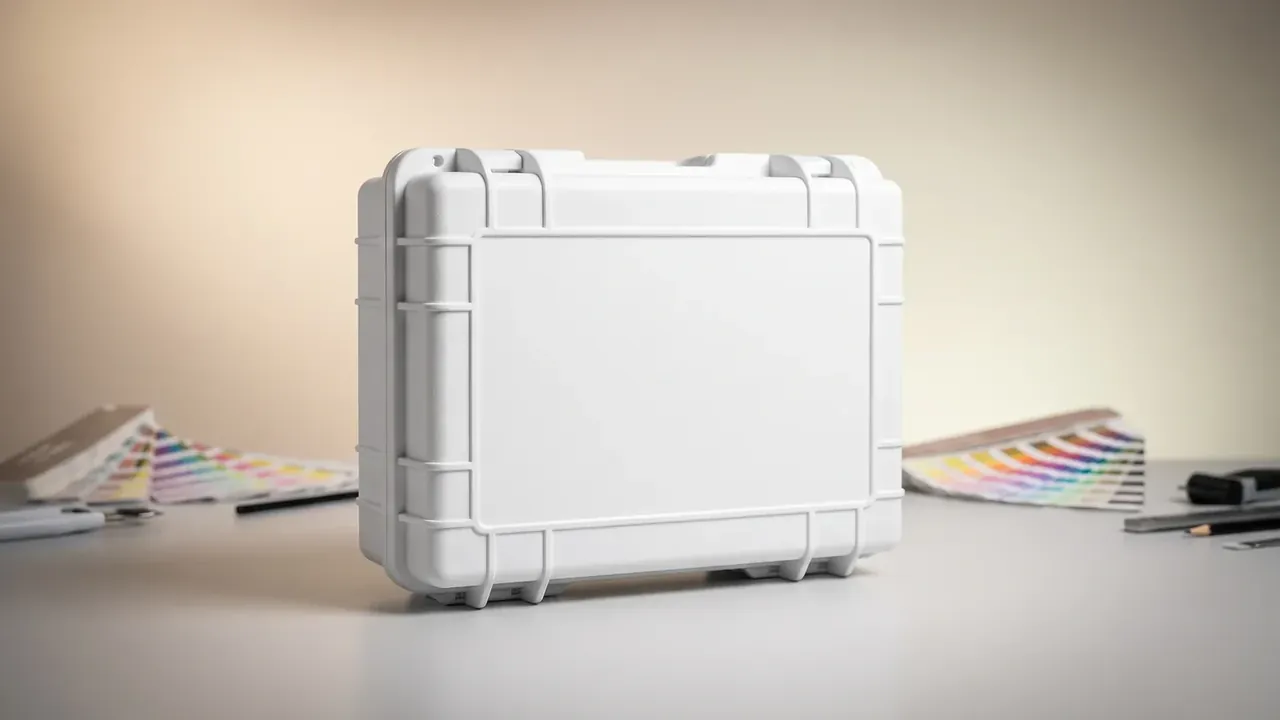
Quick answer: Split a rotomolded case quote into tooling, material, machine time, hardware and packing, treat MOQ as a function of colour change cleaning and tooling amortisation, and schedule lead time node by node. Fixing all three in the RFQ beats chasing the lowest unit price.
Table of contents
- What a Rotomolded Case Quote Is Made Of
- How MOQ and Tooling Cost Spread Across Units
- Scheduling the Lead Time of a Rotomolded Case
- Parameters That Must Be Fixed in the RFQ
- Reading Price Gaps During Comparison
- FAQ
1. What a Rotomolded Case Quote Is Made Of
A quote carrying one number invites dispute. Split it into tooling, material, machine time, hardware, packing and freight. Material follows the powder index, machine time follows cycle length, so a merged figure hides which block has room.
A 60 litre rotomolded case shot at 11.5 kg net, powder at 10.5 to 12 CNY per kilogram, holds 120 to 138 CNY of material. A 32 minute two cavity cycle adds about 95 CNY, six latches and two handles with a relief valve 25 CNY, a five ply carton 30 CNY. Ex-works price lands at 300 to 330 CNY before tooling.
| Cost block | 60 L reference |
|---|---|
| Tooling | 18,000 to 35,000 CNY |
| Material | 120 to 138 CNY |
| Machine time | About 95 CNY |
| Hardware | About 25 CNY |
| Packing and freight | About 30 CNY |
An aluminium plate mould costs 18,000 to 35,000 CNY, a welded steel mould past 50,000, and a second cavity lifts tooling about 60 percent while cutting machine time per unit about 30. Quotes must name mould material and cavity count.
2. How MOQ and Tooling Cost Spread Across Units
MOQ follows colour change cleaning and tooling amortisation. Clearing the cavity, powder box and recovery line takes 40 minutes light to dark, 90 the other way, and burns 2 to 3 kg of powder, so a 20 unit run carries that on every unit.
| Order size | Tooling per unit | Unit price |
|---|---|---|
| 50 units | 480 CNY | About 800 CNY |
| 200 units | 120 CNY | About 440 CNY |
| 500 units | 48 CNY | About 368 CNY |
Between 50 and 500 units the price more than halves; past that the gain is single digits. Hold a first order at 200 to 500 units and fix no tooling fee on repeats in writing.
3. Scheduling the Lead Time of a Rotomolded Case
Lead time is a chain of nodes, and a skipped node returns later as a stockout.
| Stage | Days |
|---|---|
| Mould design | 3 to 5 |
| Mould making | 18 to 25 |
| Trial shot and approval | 3 to 5 |
| Production run | 25 to 35 |
New tooling needs 50 to 70 days to first shipment and a steel mould adds two weeks; repeats that change only colour or liner fall to 25 to 30 days. Only moulding compresses: a second cavity takes daily output from 30 to 55 units and a 500 unit run from 17 days to 9.
4. Parameters That Must Be Fixed in the RFQ
Write dimensions with plus or minus 2 mm, wall thickness as 5 mm nominal with no more than 0.8 mm spread, and empty weight capped at 13.5 kg for a 60 litre body.
Add liner density, five units sampled per lot, latch spacing of two per long side under 260 mm, and sealing as a 30 kPa hold for 60 seconds. Close with quote validity and a powder clause, since an 800 CNY per tonne swing is about 9 CNY per case.
5. Reading Price Gaps During Comparison
A 40 CNY gap has four sources: wall down from 5 mm to 4.5 mm, saving 1.2 kg of powder worth 13 CNY; latches from six to four, saving 6 CNY; cartons from five ply to three, saving 5 CNY; or tooling folded into the unit price.
Compare total cost instead. At 500 units, supplier A quotes 320 CNY with tooling; B quotes 280 CNY plus 24,000 CNY of tooling, adding 48 CNY per unit for 328 CNY, and a failure rate rising from 2 to 5 percent adds 30 CNY over three years. Load rate counts too: 15 mm more rib height drops a 40 foot high cube from 320 to 290 units.
Conclusion
Procurement of a rotomolded case is a scheduling exercise: split the quote, find where the tooling curve flattens, and tie each node to the document that starts it. A written RFQ protects long term cost better than another 20 CNY of pressure, which is the discipline of rotomolded case buying.
This article discusses only the container (case body) side of specifications and design intent, and does not cover any handling, loading or use of the contents.
Related Reading
- How the body is moulded
- Dimensions, wall thickness and load ratings
- How it differs from alternatives
- Five criteria for choosing a case
Related Products
- 8 Series — Gun Cases; Military Equipment Cases; Camera Equipment Cases; Drone Cases; Watch Cases; Knife Cases; First Aid Cases; Electronics Equipment Cases
- WL8-2812 PP Gun Case — model WL8-2812
- All protective cases and toolboxes: 7 series, 158 models