

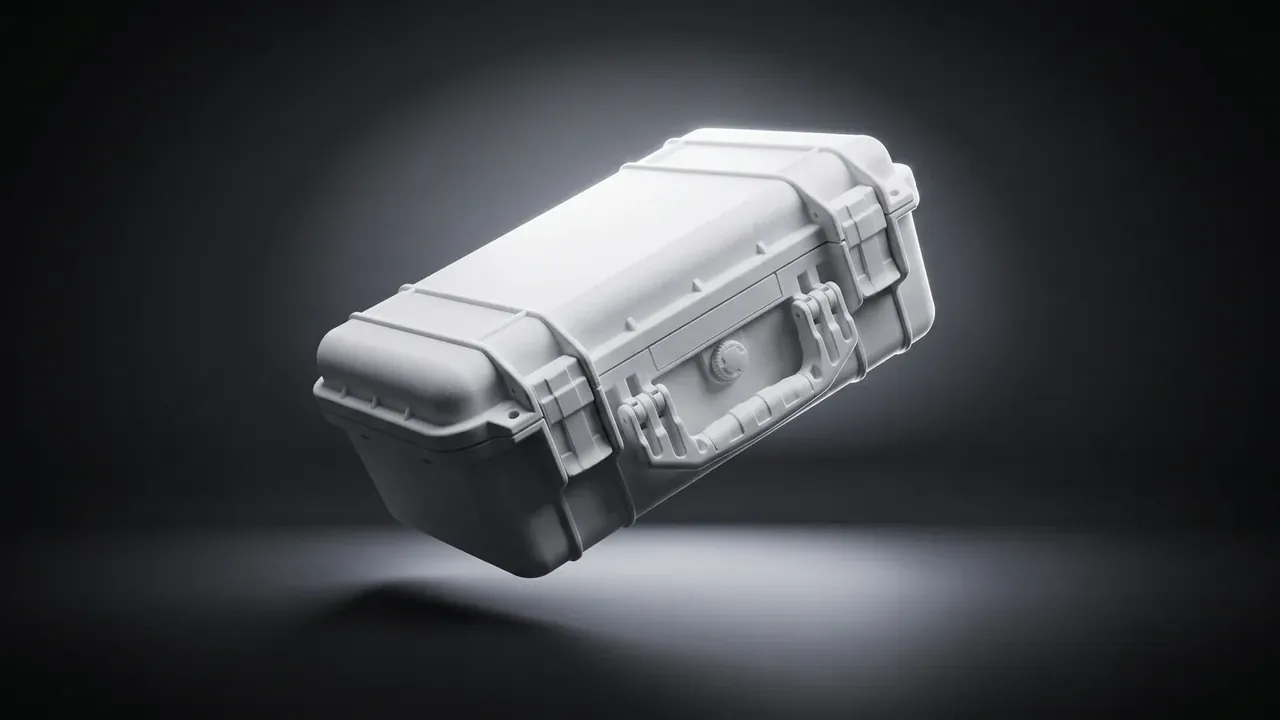
Quick answer: A rotomolded case spec is written backwards from logistics: the pallet module fixes the envelope, the envelope minus wall fixes the cavity, and only then do thickness, tolerance and rated load become measurable.
Table of contents
- Why a Rotomolded Case Spec Starts with the Load Module
- Writing Wall Thickness and Tolerances
- Turning Strength into a Rated Load
- Sea Freight Loading versus Stack Height
- Six Spec Lines a Supplier Cannot Guess
- FAQ
1. Why a Rotomolded Case Spec Starts with the Load Module
Spec sheets usually start with capacity, which produces a shell 850 mm wide that ships two abreast. A rotomolded case should obey the logistics module first: a 1200 x 800 mm pallet and a 40-foot high-cube with 2352 mm internal width, 2690 mm height and a 2340 mm door.
Three abreast at 780 mm allows an envelope of 1150 x 780 x 620 mm. Subtract a 5 mm wall, the lid flange and a 45 mm foot, and the cavity lands at 1080 x 710 x 540 mm, about 414 L.
| Step | Example | What sets it |
|---|---|---|
| Outer envelope | 1150 x 780 x 620 mm | 2352 mm width, three abreast |
| Cavity | 1080 x 710 x 540 mm | Envelope minus wall and foot |
Tolerance follows the chain: plus or minus 3 mm outside, 2 mm inside.
2. Writing Wall Thickness and Tolerances
One thickness number cannot be inspected. The drawing needs nominal thickness, zone and one-sided tolerance: wall 5.0 mm with 0.6 mm, base 6.0 mm with 0.7 mm, corners 7.5 mm with 1.0 mm, lid flange 8.0 mm, hinge bosses 9.0 mm.
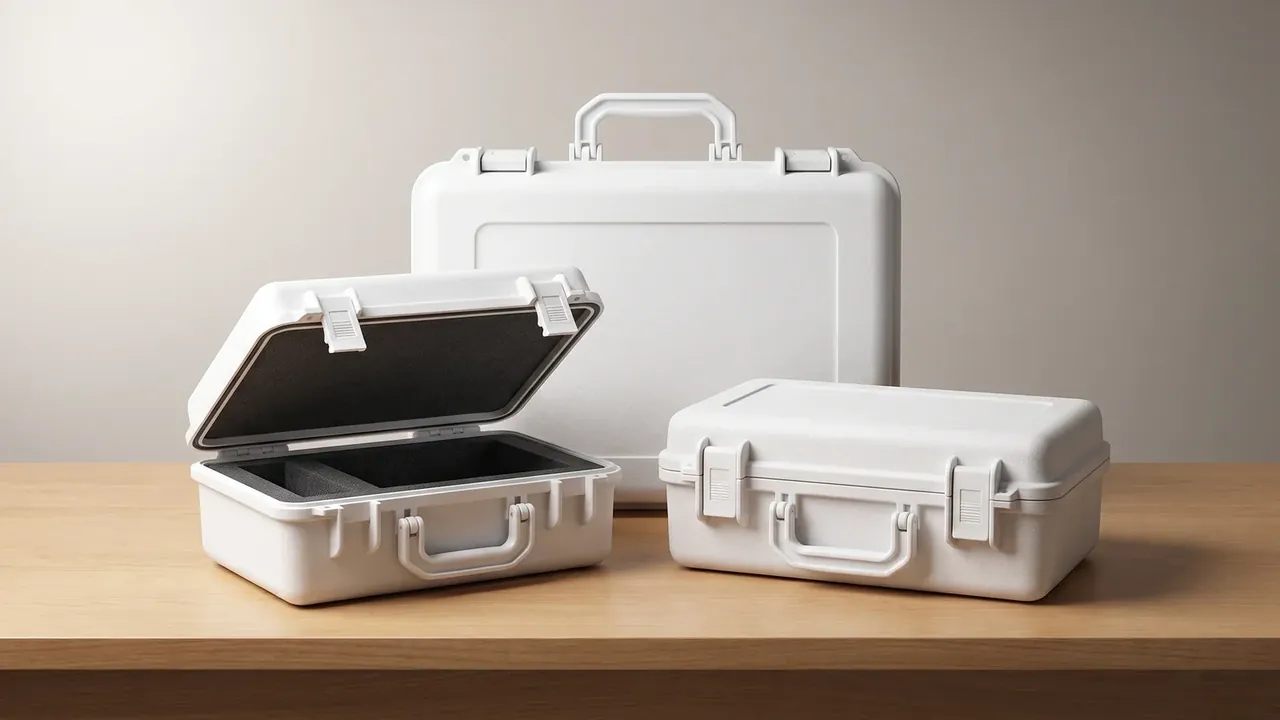
Mould temperature runs 230 to 280 C with dwell near 3 minutes per millimetre. Linear low-density polyethylene shrinks 1.8 to 2.2 percent, so a 1080 mm cavity at 2.0 percent compensation becomes 1102 mm in steel.
| Zone | Nominal | Tolerance |
|---|---|---|
| Side wall | 5.0 mm | plus or minus 0.6 mm |
| Corner and caster pad | 7.5 mm | plus or minus 1.0 mm |
Draft is 1.5 to 2 degrees, corner radii R15, ribs at 110 mm pitch and 6 mm deep, so a 5.0 mm ribbed wall matches a 6.5 mm plain wall.
3. Turning Strength into a Rated Load
Load is usually written as an adjective; the usable form is three figures with a safety factor of 1.5: rated load 120 kg, top load 800 kg held 24 hours with no more than 2 mm permanent set, and permitted stacking.
The formula gives 800 divided by (42 x 1.5), about 12.7, so 12 layers. A 2.7 m ceiling with a 620 mm case allows only 4, so space binds before strength. Lifting is separate: a four-leg sling at 60 degrees is proof loaded at twice the rating, and optional forklift pockets are 120 x 60 mm clear.
4. Sea Freight Loading versus Stack Height
A 40HQ gives 12030 mm of length, 2352 mm of width and 2690 mm of height: 10 rows x 3 columns x 4 tiers, or 120 units. A 20GP gives 5 x 3 x 3, or 45 units.
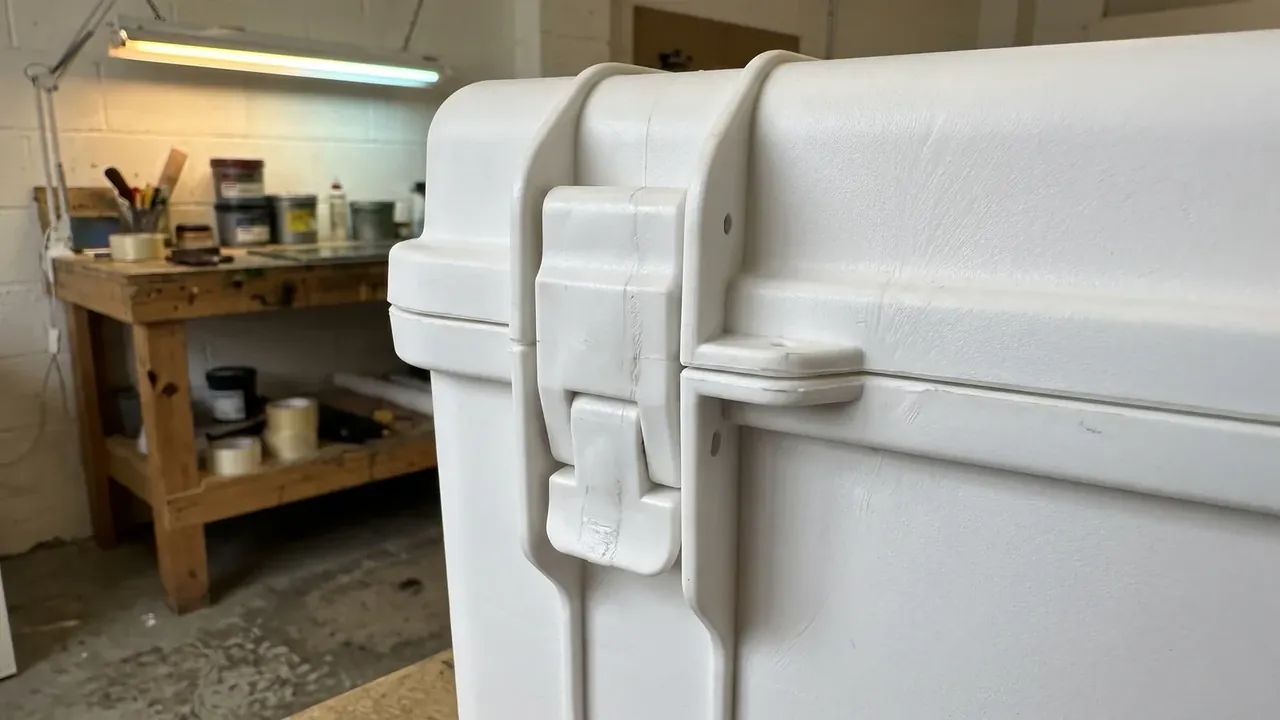
Each extra 50 mm of height can drop a 40HQ from four tiers to three, losing 30 units at once. At 24 kg empty and 42 kg loaded, 120 units weigh about 5.0 t; a steel inner frame at 38 kg shifts the limit from volume to weight.
5. Six Spec Lines a Supplier Cannot Guess
A purchase-ready spec has six lines, and each omission returns as rework.
| Line | How to write it | Cost of omitting |
|---|---|---|
| Dimensions | 1150 x 780 x 620 mm, plus or minus 3 mm | Wrong unit count |
| Wall zones | Five zones with tolerances | No gauge reference |
| Load | 120 kg rated, 800 kg top, 4 high | Collapse in the field |
| Hardware | 304 stainless, M6, 3.5 N·m | Loose hinges |
| Seal | Gasket, compression, test | Leaks with no trail |
| Colour | Chip plus texture | Batch mismatch |
Torque is the line people skip. An M6 screw into a moulded insert seals at 3.5 N·m; hand-tightened to 6 N·m it splits the insert.
Conclusion
Specifications for a rotomolded case are a chain of constraints, not a list of wishes: envelope follows ship width, cavity follows wall, wall follows load, stacking follows ceiling. Written as tolerances and test conditions, they make quotations comparable and put every millimetre where the load travels, which is the discipline behind a rotomolded case specification.
This article discusses only the container (case body) side of specifications and design intent, and does not cover any handling, loading or use of the contents.
Related Reading
- How the structure and process work
- Rotomolded case versus alternative builds
- Selection criteria for comparable cases
- Field configurations for the same family
Related Products
- 8 Series — Gun Cases; Military Equipment Cases; Camera Equipment Cases; Drone Cases; Watch Cases; Knife Cases; First Aid Cases; Electronics Equipment Cases
- WL8-2812 PP Gun Case — model WL8-2812
- All protective cases and toolboxes: 7 series, 158 models