

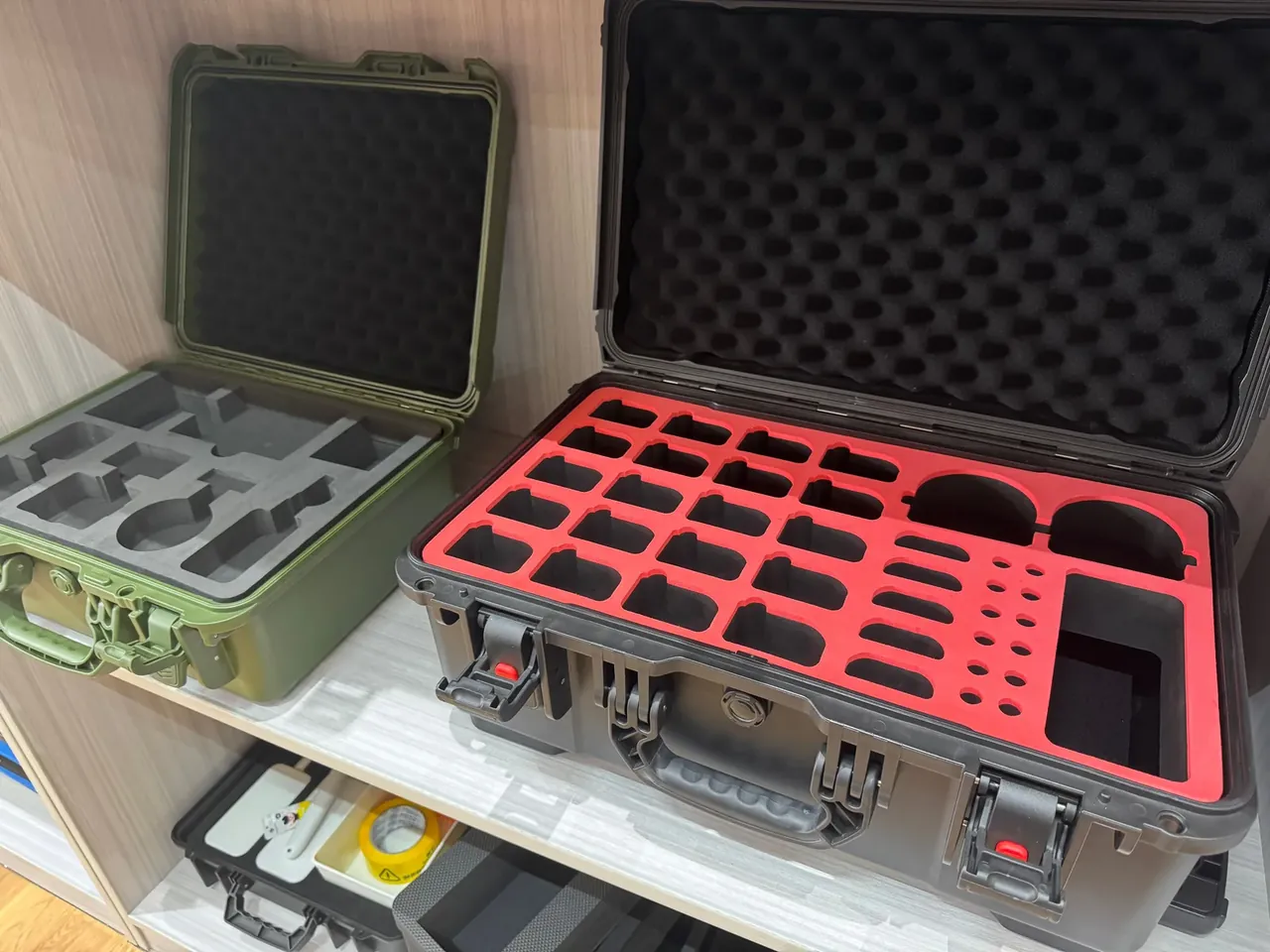
Quick answer: A Sample Display Case needs 12 to 24 slots, 35 kg/m³ foam, slot depth 3 mm under part height and a 95 to 105 degree lid stop.
Table of contents
- Slot Density versus Sample Count
- Foam at 25 and 45 kg/m³ Feels Different
- Lid Angle and Standing Sightline
- One-Handed Handling on Visits
- Reset Speed at Setup and Tear-Down
- Sample Numbers and Slot Mapping
- FAQ
1. Slot Density versus Sample Count
A buyer gives you ninety seconds on the aisle, and if the lid comes up with the part still buried, the conversation moves on. A Sample Display Case laid out in catalogue order makes the seller dig while the buyer asks about the second model. Put the three fastest-moving parts in the right-hand front row.
More slots is not more capacity. Twelve slots allow an 80 mm square cavity; eighteen drop to 60 mm; twenty-four leave 45 mm. Density thins the foam ribs, and below 8 mm the walls lean over within months.
| Slot count | Cavity size | Parts it suits | Pull-out per part |
|---|---|---|---|
| 12 | 80 mm square | 8 to 12 | about 8 s |
| 18 | 60 mm square | 14 to 18 | about 6 s |
| 24 | 45 mm square | 20 to 24 | about 4 s |
Thirty parts usually travel in two cases: an 18-slot main unit, a 24-slot companion for accessories and colour cards. For a Sample Display Case the pair weighs about 1.8 kg more than one 24-slot unit, and buys a main case that opens with one hand.
2. Foam at 25 and 45 kg/m³ Feels Different
Density is quoted in kilograms per cubic metre, and 25, 35 and 45 behave as three materials. A 25 kg/m³ sheet gives no pushback, so a part must be pressed in. 35 kg/m³ is the display default: springy, the wall closing lightly. 45 kg/m³ stands semi-rigid, ribs holding their line.
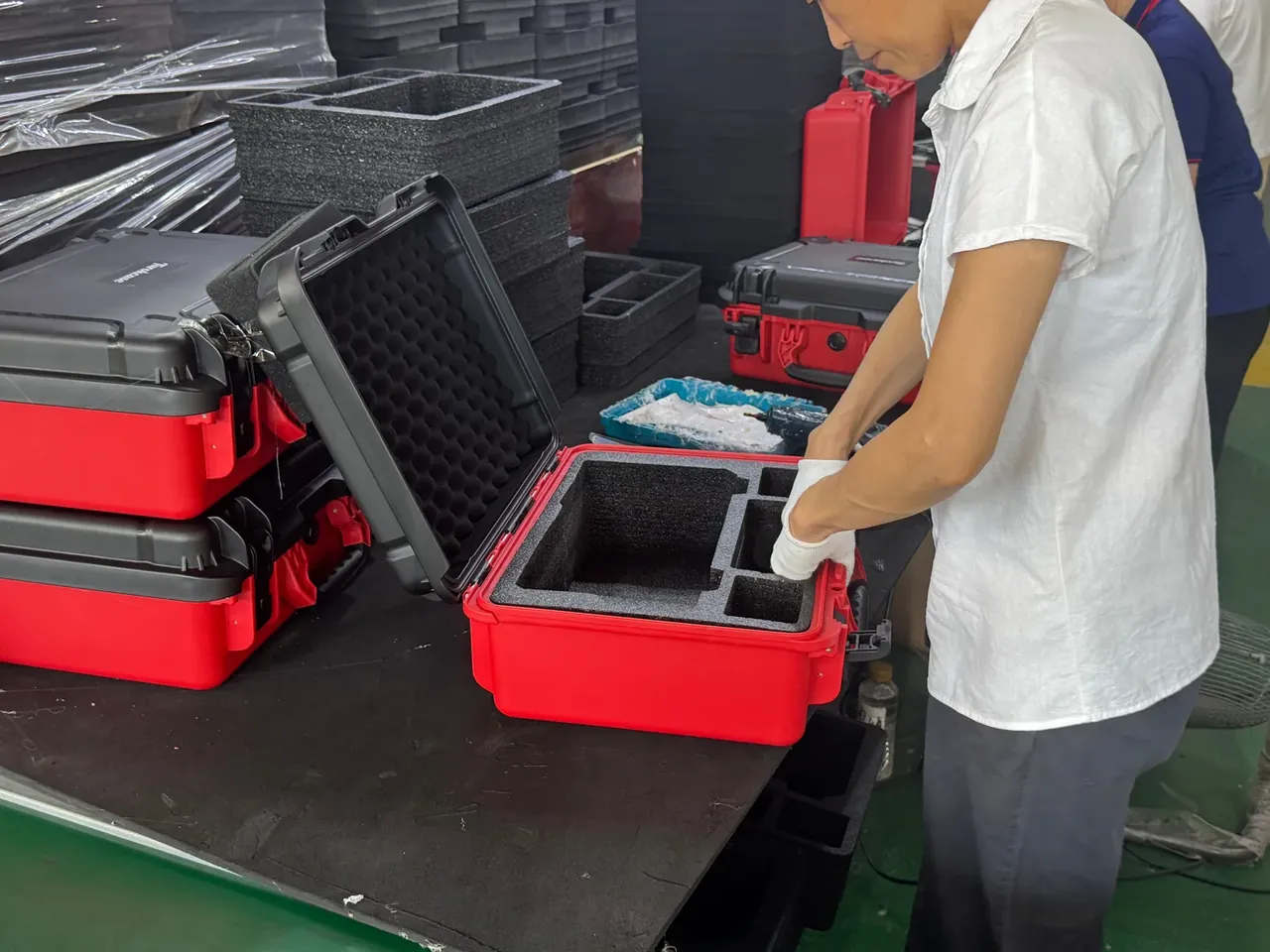
Density forces the slot depth to be recalculated. A 60 mm part sits in a 57 mm slot in 25 kg/m³ foam but needs 55 mm in 45 kg/m³, because hard foam bottoms out. Depth at part height minus 3 mm is the starting point; harder foam tightens it.
A part moving more than 2 mm means the slot is oversized, and the foam gets recut, not shimmed.
| Grade | Thumb rebound | Rib stand-up | Typical parts |
|---|---|---|---|
| 25 kg/m³ | fast, barely felt | weak, needs adhesive | light parts, swatches |
| 35 kg/m³ | medium, springs back | fair, 8 mm ribs hold | general display |
| 45 kg/m³ | slow, print lasts 2 s | strong, 5 mm ribs hold | metal and heavy parts |
Low-density ribs need adhesive backing: an 8 mm rib in 25 kg/m³ foam leans 15 degrees in a month. Choosing 35 or 45 on a Sample Display Case deletes that rework.
3. Lid Angle and Standing Sightline
The lid stop sits between 95 and 105 degrees. Under 90 the lid falls back on its own weight and one hand stays pinned; over 110 it leans past the rear edge, the centre of gravity moves outside the case, and on a 750 mm counter the unit slides backwards.
Sightline matters as much. A standing buyer's eye sits around 1200 to 1400 mm, so a Sample Display Case on a 750 mm counter puts the part face at 900 to 1000 mm once the lid comes up, with no stooping. A case on a 600 mm table needs a 100 mm riser to reach that band.
Inside the lid, a 210 mm × 297 mm slot map laminated at 0.3 mm matte lets the buyer match numbers without the seller reaching into the case.
Settle the stay early: rear edge, not sides. Side stays catch the wrist on the rim; a rear stay stops the lid at 105 degrees and keeps the return stroke from snapping.
4. One-Handed Handling on Visits
A visit has no booth, only a reception desk, a meeting table or a corner of the customer's shop floor. Often 400 mm of table is all that gets cleared. On a Sample Display Case the difference is the latch: a catch that flips with one finger leaves the other hand free to hold the lid.
Handles are reinforced for 15 kg. Loaded with 24 metal parts the case runs close to 9 kg, and the snatch load on lifting is 1.6 times that, so roughly 14 kg lands on the roots. Without a doubler plate the root splits in three months.
The sequence is three moves: thumb flips the catch, index finger braces the lid edge, the free hand lifts the part. Openings canted 15 degrees off vertical save the wrist; a straight cut adds about 3 seconds per pull. One visit opens the case four to six times, and the time piles up.
5. Reset Speed at Setup and Tear-Down
Reset means every part back in its own slot. Three minutes is the single-person ceiling for one Sample Display Case; past that the crew forces parts into any gap, and the next morning costs twenty minutes of re-sorting.
| Reset step | One person | Two people | Common mistake |
|---|---|---|---|
| Back row back in | 70 s | 35 s | front row first, back row blocked |
| Front row back in | 90 s | 45 s | long parts laid across a rib |
Tear-down runs in reverse: back row out first, lid last. Before closing, tilt the case 20 degrees and look along the seam; a part standing proud never seated, and lifting the lid again is cheaper than prying later.
Number labels run 25 mm × 15 mm on the slot floor toward the outer edge, so the tail stays visible under the part. Centre placement hides it; inner placement means peeling foam back.
6. Sample Numbers and Slot Mapping
The number carries a series letter and a two-digit slot, so A-03 means series A, third slot. As these cases converge in appearance, the number is the only reliable locator, which is why a Sample Display Case ships with the map rather than a printed list.
The map goes inside the lid, never outside, where it disappears the moment cases stack.
Audit the list against the map once a quarter. Slot depths survive a model change and the buyer's memory of where a part lives still works. Renumber once and the buyer hunts at the open case, which costs half of the ninety seconds you had.
Related Reading
- How slot layout shapes a sample display case
- Sample display work in testing and sales
- Dividers and load paths in core sample boxes
- Usable volume and cavity ratio
This article covers the container (case) side of specifications and design intent only; it does not address any handling, loading or use of the contents.
JUNZHIJIA
Related Products
- 8 Series — Gun Cases; Military Equipment Cases; Camera Equipment Cases; Drone Cases; Watch Cases; Knife Cases; First Aid Cases; Electronics Equipment Cases
- WL8-2812 PP Gun Case — model WL8-2812
- All protective cases and toolboxes: 7 series, 158 models