

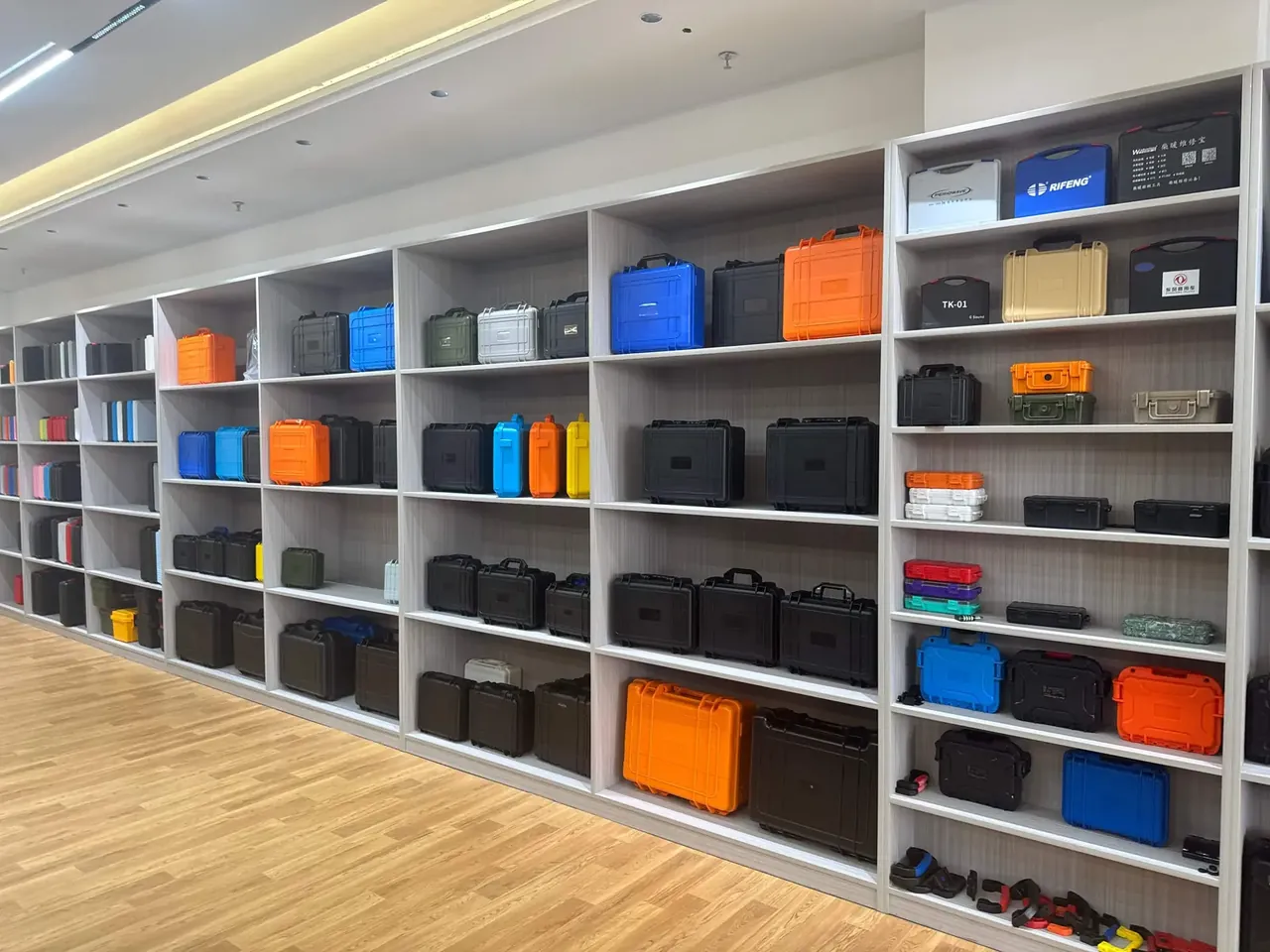
Quick answer: Four settings, four kit lists. A store needs fixed shelving plus four loose samples, a trade show eighteen pieces behind a 240 cm backboard, a visit six cases in the boot, and online eight hero images with a 24-page catalogue.
Table of contents
- How the Four Settings Split the Work
- Store Case Sample Display: Fixed Shelving and Loose Samples
- Trade Show Case Sample Display: Eighteen Pieces
- Case Sample Display on a Customer Visit
- Online: Shooting Table, Catalogue and Page
- FAQ
1. How the Four Settings Split the Work
The same cases in four places need four kits: a store is resident, a show is a filter, a visit is portable, and online replaces presence altogether.
Dwell time sets the order: 40 minutes in a store, 15 at a show, 30 on a visit, 90 seconds on a phone. The shorter the stay, the earlier the conclusion, so a Case Sample Display opens a case before quoting.
| Setting | Dwell | Samples | Core kit | Success signal |
|---|---|---|---|---|
| Store | 40 min | 32 fixed, 4 loose | Shelving, labels, foam | Customer opens a lid |
| Trade show | 15 min | 18 pieces | Backboard, numbers, catalogue | Contact logged |
| Visit | 30 min | 6 carried, 3 by hand | Tape, foam, catalogue | Size confirmed |
| Online | 90 s | 8 hero, 12 detail | Table, catalogue, page | Second image opened |
2. Store Case Sample Display: Fixed Shelving and Loose Samples
A store Case Sample Display of six metres holds 32 cases: 28 fixed to the shelves and four kept loose. The fixed ones show the series; the loose ones let a customer open a lid, drop in a foam set and run a tape across the cavity.
Pick one loose sample per band, handheld through long, label all four at 50 by 30 mm on the lower left corner, and place them at 100 cm so an adult reaches unaided. Numbers must match the price tag and catalogue, because customers remember digits, not model names.
Rotate monthly: a case opened a dozen times a week loosens at the latches and scuffs at the corners.
3. Trade Show Case Sample Display: Eighteen Pieces
Take 18 square metres, three by six, open on two sides behind a 240 cm backboard. Eighteen pieces fit: eight hero models on the open face, six spanning the size range down one side, four finish samples at the entrance corner.
The split matters more than the total: eight hero volume sellers closed and facing the aisle, six span pieces answering size questions, four finishes that photograph badly and must be touched.
Build in six hours: two for backboard and plinth, three for samples and numbering, one to adjust; pack out in two and a half.
| When | Action | Kit | Crew |
|---|---|---|---|
| Build day, 14:00 | Backboard, samples, numbers | Board, 18 cases, labels | 2 |
| Day one, 09:00 | Unpack check, wipe faces | Cloth, spare color cards | 1 |
| Day two | Stand, log leads, hand catalogues | Log sheet, 24-page catalogue | 2 |
| Pack-out, 16:00 | Wrap, count, load | Film, totes | 2 |
4. Case Sample Display on a Customer Visit
What you carry depends on the car. A sedan boot takes two mid-size cases per layer and three layers, so six; a seventh pushes into the back seat.
Thirty minutes runs in order: lay out the size sheet, let the customer point, fetch the case, open it, fit foam, measure the cavity, leave the catalogue with the model circled. Opening before quoting reads as problem solving; quoting first reads as a spec sheet.
5. Online: Shooting Table, Catalogue and Page
Online has no object to hand over, so a Case Sample Display becomes a set of assets. A 150 by 90 cm table with a pale grey sweep takes three frames per case: 45 degrees from above, straight on, and open from above. Three angles of one case beat one angle of three.
Eight hero images cover exterior, open lid, foam, latch, hinge, handle, wheels and a dimension overlay; twelve detail frames shoot latch teeth, hinge pin, gasket and wall section; one 45-second clip shows opening and fitting foam, muted by default.
The catalogue runs 24 pages on 200 gsm art paper: four of series overview, sixteen by size band, four for accessories and ordering, page numbers aligned to the web sections.
Conclusion
The four settings differ in the kit, not the case: four loose samples for the store, eighteen pieces and a backboard for the show, six cases in the boot, eight hero images and 24 pages online. Order each list by dwell time, and a Case Sample Display says the same thing in four places.
This article discusses only the container (case body) side of specifications and design intent, and does not cover any handling, loading or use of the contents.
Related Reading
- How to review supplier samples
- Where custom logo cases are used
- Typical OEM protective case applications
- Choosing a custom logo case
Related Products
- 8 Series — Gun Cases; Military Equipment Cases; Camera Equipment Cases; Drone Cases; Watch Cases; Knife Cases; First Aid Cases; Electronics Equipment Cases
- WL8-2812 PP Gun Case — model WL8-2812
- All protective cases and toolboxes: 7 series, 158 models