

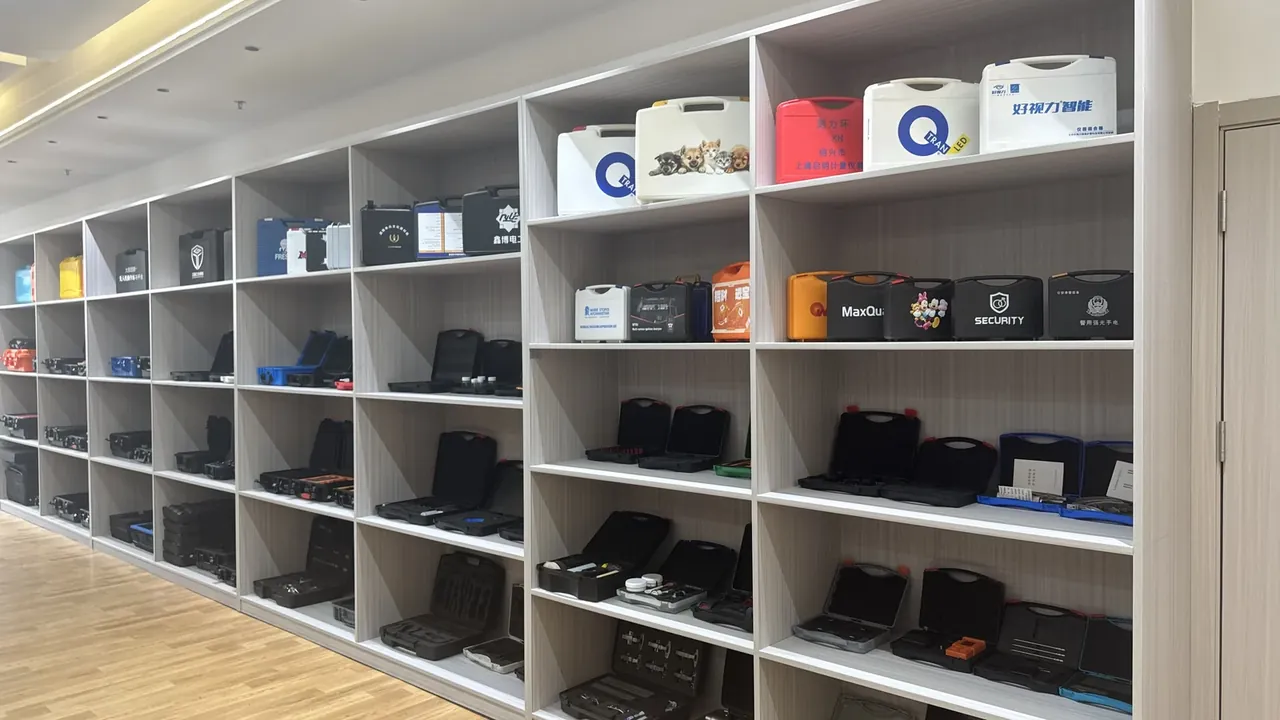
Quick answer: A Case Showroom sample is one hand-finished part; a production part comes off a settled mould and a material lot. Four gaps follow: tooling, masterbatch, bought-in hardware, liner cutting. Lock them as numbers: three trial rounds, colour within ΔE 1.2, die-cut liners, AQL 2.5. The sample defines the standard; production defines delivery.
Table of contents
- Where Case Showroom Samples and Production Parts Diverge
- Tooling and Trial Shots: Hand-Finished First Parts
- Masterbatch and Batch Colour Drift
- Hardware, Gasket and Liner: Supplier Lots and Dies
- Approval List, Sealed Samples and AQL
- FAQ
1. Where Case Showroom Samples and Production Parts Diverge
Every case in a Case Showroom was built one at a time: a mould on trial, an engineer dressing each shot, a small masterbatch blend, a knife-cut liner. Production runs a settled tool, continuous mixing and a die. At two thousand pieces the gaps show as harder lids, darker colour, looser latches.
| Gap | Sample | Production | Fix at approval |
|---|---|---|---|
| Tooling | First shot, dressed by hand | Settled tool holds flash | Log rounds and repairs |
| Colour | Small blend, weighed by hand | Continuous mixing, drift | Set ΔE limit |
| Hardware | One purchase, one lot | Split lots, plating drift | Lock grade and supplier |
| Liner | Hand cut to fit | Die cut to drawing | Issue die drawing |
2. Tooling and Trial Shots: Hand-Finished First Parts
A first shot carries 0.15 to 0.25 mm of stock on the parting line, taken down with P400 paper before the part reaches the Case Showroom. The drawing says 3.2 mm; the dressed sample reads 3.1 mm, the settled tool 3.35 mm, enough to demand a new liner fit.
Hardening moves the cavity 0.2 to 0.4 percent: on a 600 mm case that is 1.2 to 2.4 mm no fitting removes. Run three rounds of 25 shots and ban hand work on parting lines.
3. Masterbatch and Batch Colour Drift
Sample colour is a small blend at 2 percent masterbatch. Production mixes continuously, and a change of carrier grade or pigment source moves ΔE by 0.5 to 1.0 between lots. An unpurged barrel leaves the first fifteen shots dark; a white case that looked neutral in the Case Showroom reads yellow under plant light.
Judge against the sealed sample, not a chip, at 4000 K and 500 mm. Hold ΔE at 1.2; between 1.2 and 2.0 is a concession, above 2.0 the lot returns. Keep three 80 mm plaques per lot for twelve months.
4. Hardware, Gasket and Liner: Supplier Lots and Dies
The latch on the Case Showroom sample: 12 microns plating, 96 hours salt spray, 45 N. Production plating can fall to 8 microns and rust at 48 hours, force swinging 38 to 52 N.
The gasket is judged on hardness and set: Shore A 65, within three points. A die holds 0.3 mm where hand cutting holds 1.5 mm, but the die dulls after 5,000 strikes.
| Item | Sample | Drift source | Control |
|---|---|---|---|
| Latch | 12 microns, 45 N | Die revision, plating bath | 10 microns, 45 ± 5 N |
| Hinge pin | 304, 0.05 mm gap | Material swap, heat lot | 0.1 mm max |
| Gasket | Shore A 65, 25% set | Compound lot, cure | 65 ± 3, 30% max |
| Liner | Hand cut, ± 1.5 mm | Die wear, density | ± 0.5 mm, 45 ± 3 |
5. Approval List, Sealed Samples and AQL
What was approved in the Case Showroom needs eight values: dimensions, wall spread at six points, ΔE, plating and opening force, gasket hardness, liner density, cut tolerance, print, packing. Each needs a method; as sample means nothing.
Seal three samples for file, customer and line, labelled with date, tool, masterbatch and die. Inspect to ISO 2859-1, level II, AQL 2.5.
| Lot size | Code | Sample | Accept / reject |
|---|---|---|---|
| 151 to 280 | G | 32 | 2 / 3 |
| 281 to 500 | H | 50 | 3 / 4 |
| 501 to 1,200 | J | 80 | 5 / 6 |
| 1,201 to 3,200 | K | 125 | 7 / 8 |
Sharp edges, latch failure, hinge fracture and gasket release reject a lot on one find; a wall range above 0.15 mm across twenty cases stops the line.
Conclusion
Approval builds a standard that repeats, not a handsome case. Record the trial rounds, lock the masterbatch and ΔE, lock hardware grades and the liner die, and let AQL and sealed samples carry the judgement. Convert all four gaps into numbers, and the case seen in the Case Showroom arrives two thousand times.
This article discusses only the container (case body) side of specifications and design intent, and does not cover any handling, loading or use of the contents.
Related Reading
- How sampling approval works for protective cases
- Setting AQL sampling for custom case acceptance
- Telling a genuine case from a copy
- Reading supplier sample evaluation cases
Related Products
- 8 Series — Gun Cases; Military Equipment Cases; Camera Equipment Cases; Drone Cases; Watch Cases; Knife Cases; First Aid Cases; Electronics Equipment Cases
- WL8-2812 PP Gun Case — model WL8-2812
- All protective cases and toolboxes: 7 series, 158 models