

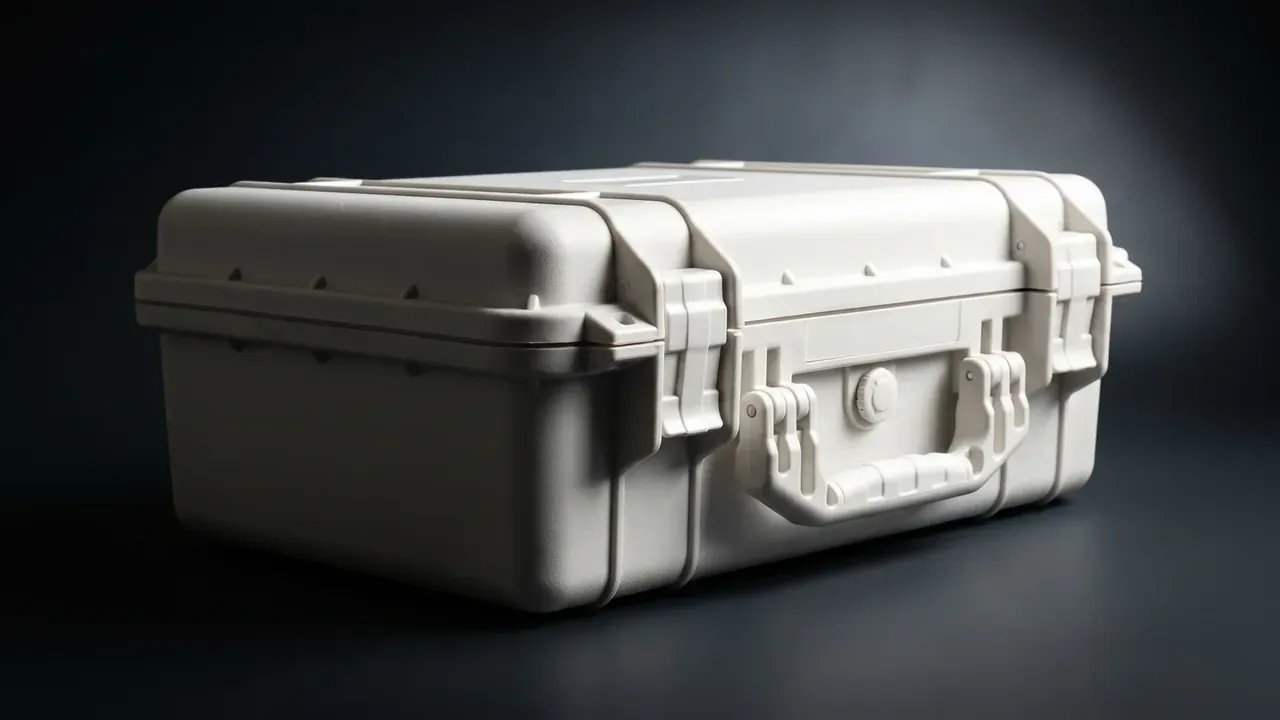
Quick answer: A sampling equipment transport case holds its margin with 20 mm of EPS at 0.038 W/(m·K), four legs of 25 min and a 1.2 ℃ rise after 30 s of open lid.
Table of contents
- Short-Haul Route Profile of a Sampling Equipment Transport Case
- Wall Conduction and Insulation Thickness
- Recorder Pocket Mounting and Hole Layout
- What a 30-Second Lid Opening Does
- Record Retention Across Four Handovers
- FAQ
1. Short-Haul Route Profile of a Sampling Equipment Transport Case
A sampling van stops four times a day, and every lid lift makes the temperature line inside jump. No leg is long — 25 min each — yet the heat load counts lid cycles, not kilometres.
A sampling equipment transport case does not face one long haul but four starts and four stops. The van parks, the door opens, the case comes off, the lid goes up, a figure is written, the lid closes. Each round throws the outer wall through one jump from cabin to ambient, and each 30 s opening tears a hole in the inner boundary.
| Legs | Time per leg | Boundary event | Net effect |
|---|---|---|---|
| 1 | 25 min | One lid | Rise sits in the opening |
| 2 | 50 min | Two lids | Openings add up |
| 4 | 100 min | Four lids | Openings dominate |
Heat load scales with area: outside surface runs to 0.6 m², the sides take 0.3 m², and the lid covers 0.15 m² while admitting heat quickest.
2. Wall Conduction and Insulation Thickness
A sampling equipment transport case measures 440×340×190 mm outside against a 400×300×155 mm cavity, giving 20 mm per side and 35 mm top to bottom. That 35 mm splits into 4.4 mm lid and base shells, a full 20 mm layer of EPS, and 6 mm for the closing step and gasket groove.
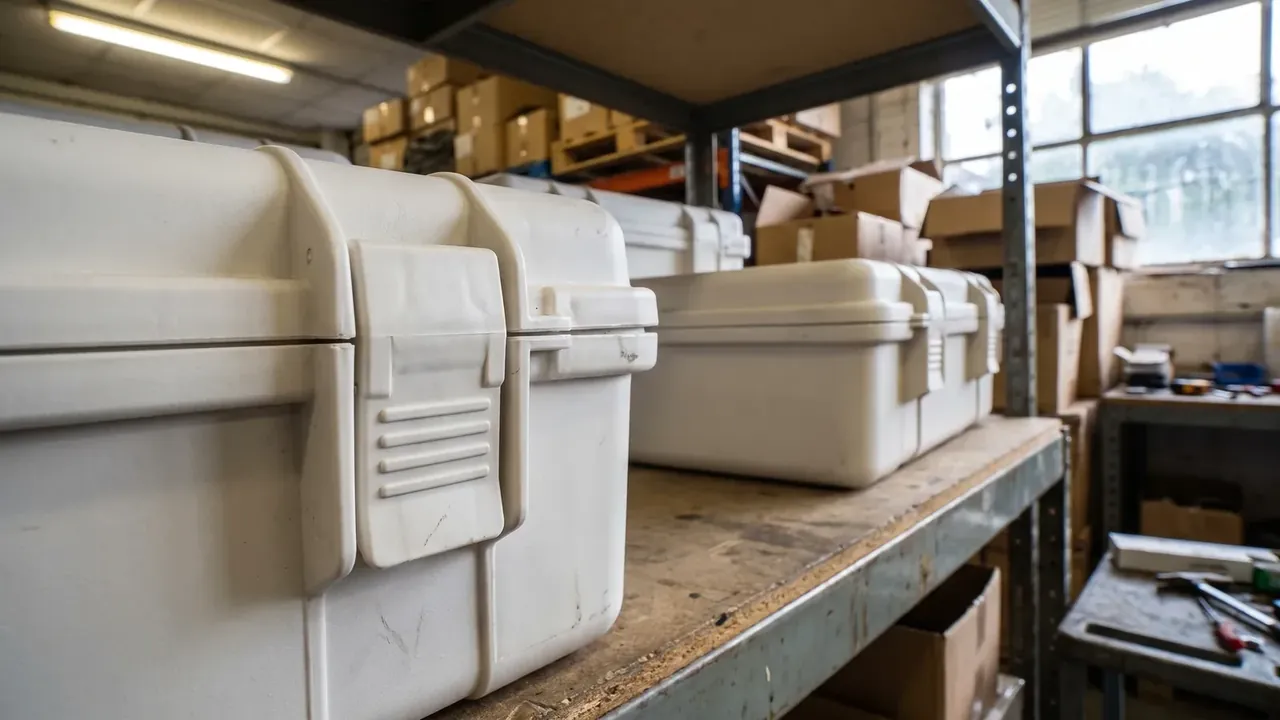
Resistance is thickness over conductivity, flux is difference over resistance. With EPS at 0.038 W/(m·K), a 20 mm layer reaches 0.53 m²·K/W and passes 38 W/m² across 20 K. At 25 mm resistance rises to 0.66 and flux drops to 30 W/m².
| Conduction path | Layer | Resistance | Flux at 20 K |
|---|---|---|---|
| Lid EPS | 20 mm | 0.53 m²·K/W | 38 W/m² |
| Lid EPS, thicker | 25 mm | 0.66 m²·K/W | 30 W/m² |
| Side insulation | 15 mm | 0.39 m²·K/W | 51 W/m² |
The weak face is the side: a sampling equipment transport case carries only 15 mm there, so flux runs a third above the lid and the inner curve is dragged by the sides first.
The 15 mm comes from fixing outline and cavity together: 440 mm minus 400 mm leaves 20 mm a side, and 4.4 mm of shell leaves 15.6 mm.
3. Recorder Pocket Mounting and Hole Layout
The recorder pocket on a sampling equipment transport case is a 60×40 mm recess at the geometric centre of the inner lid. That centre sits furthest from all four edges and feels least from the frame thermal bridge, so its reading comes closest to the mean.
| Face | Holes | Reading | |
|---|---|---|---|
| Lid centre | Inner lid | 2 × φ4 mm | Close to mean |
| Lid edge | Near long side | 2 × φ4 mm | Bridge bias |
| Base corner | Inner base | None | Extreme only |
Two φ4 mm holes flank the pocket on a sampling equipment transport case, for probe leads or screws. Smaller is better: φ4 mm with a tapered plug and O-ring keeps enough radial squeeze for IP67 through 1 m of immersion. At 6 mm the same plug loses compression and water arrives at the edge first.
Pocket and holes constrain each other. Enlarge the pocket past 60×40 mm and more material leaves the lid, so the panel arches as two latches rated 280 N pull it down.
The recess is 8 mm deep, trapping the card on four edges. Behind it sits 3 mm of solid material rather than a void, because still air does not follow internal temperature.
4. What a 30-Second Lid Opening Does
Thirty seconds of open lid raises the interior of a sampling equipment transport case by 1.2 ℃. That figure belongs to a 20 K difference, still air, and a probe 50 mm below the lid centre; hold the lid for 60 s and the rise reaches 2.6 ℃, so the first half is not half.
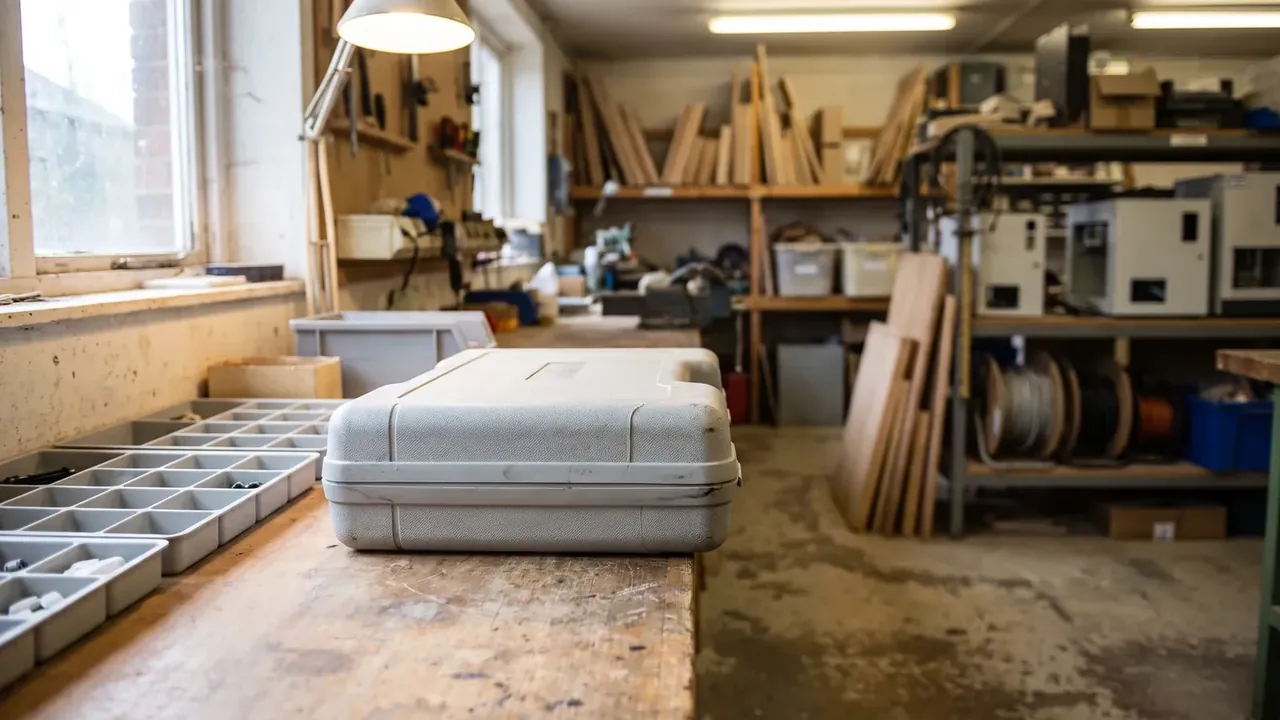
A second opening costs more: the interior has exchanged air once and holds less reserve, so the next 30 s takes the rise to about 1.6 ℃ and the four-leg total toward 5 ℃.
Cutting it is a shell job. A sampling equipment transport case can carry a second inner lid: only the outer one lifts, exposure shrinks from a whole panel to a 60 mm window, and the inner lid overlaps the rim by 8 mm, settling under its own weight after 5 000 cycles.
5. Record Retention Across Four Handovers
Four legs of a sampling equipment transport case add to 100 min and four handovers, each needing a signature and a copied reading; a broken chain leaves no way to tell which leg carried the rise.
Retention hangs on hardware in the shell. Beside the recorder pocket of a sampling equipment transport case sits a 60×40 mm slot matched to the card, held by a pressure strip, with a 1 mm vent to stop condensation gluing it down.
The scrap line combines time and rise: once a single leg runs past 25 min and the interior has climbed 1.2 ℃, the insulation should move from 20 mm to 25 mm. Two figures travel with it — a 6.9 kg case changing dimension by under 1.5 mm across −20 ℃ to +55 ℃, and a base lid carrying about 20.7 kg when four are stacked.
Conclusion
The thermal capability of a sampling equipment transport case rests on three structures: a 4.4 mm shell with 20 mm of EPS holding flux at 38 W/m², a 60×40 mm pocket placing the reading at the lid centre, and two φ4 mm holes sealed to keep IP67. The 15 mm sides are the weak face at 51 W/m². Judgement belongs to the pattern across four legs.
Related Reading
Related Products
- 8 Series — Gun Cases; Military Equipment Cases; Camera Equipment Cases; Drone Cases; Watch Cases; Knife Cases; First Aid Cases; Electronics Equipment Cases
- WL8-2812 PP Gun Case — model WL8-2812
- All protective cases and toolboxes: 7 series, 158 models