

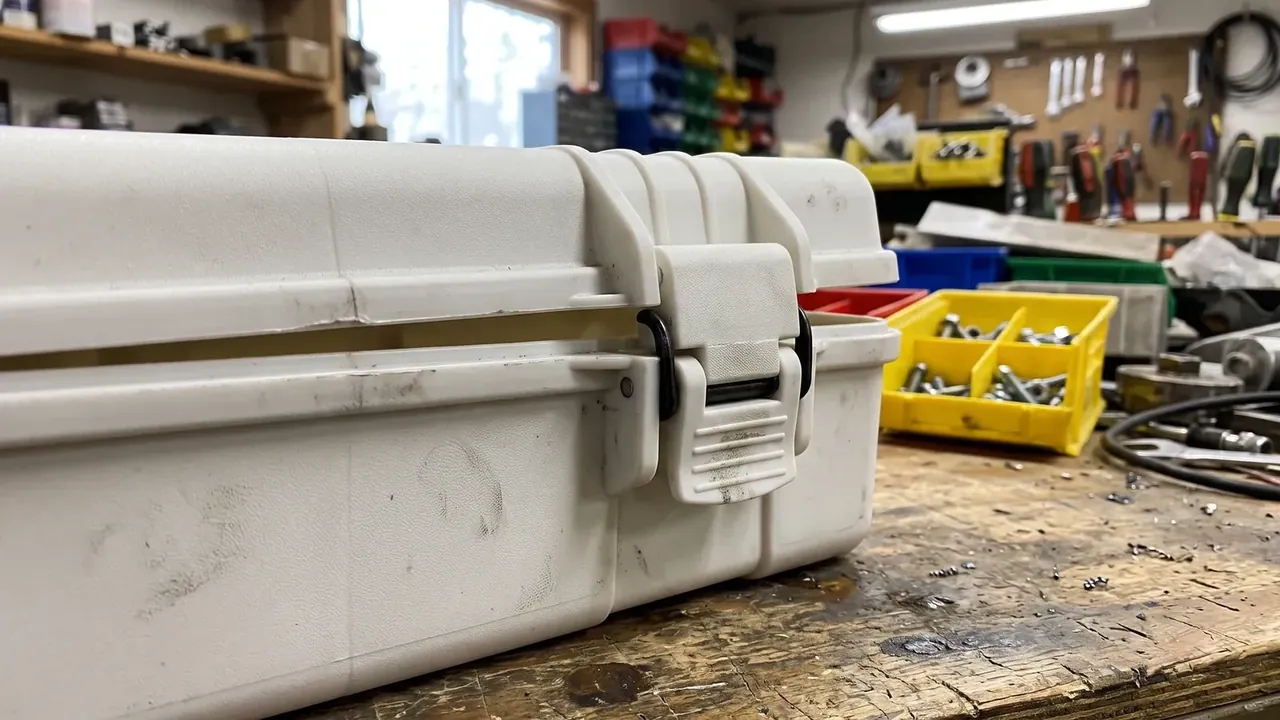
Quick answer: A shipping case rests on five structural decisions: shell forming and wall thickness, rib and corner cushioning, seal groove and relief valve, latches and hinges, and the liner that fixes the load. Each has a workable numeric range and a reason.
Table of contents
- How a Shipping Case Shell Is Formed and Where Wall Thickness Goes
- Ribs and Corner Cushioning: Where the Load Travels
- Seal Groove and Pressure Relief: One Gasket, One Valve
- Latches and Hinges: The Source of Closing Force
- Liner and Fixing Methods: Holding the Load in Place
- FAQ
1. How a Shipping Case Shell Is Formed and Where Wall Thickness Goes
A shipping case shell comes from one of two processes. Injection moulding fills a steel tool in one shot, and a 1,250 tonne press runs bodies around 1.2 m across. Rotational moulding skins powder over the cavity for 6 to 10 mm walls.
Wall thickness is never one number. Side walls run 3.0 to 3.5 mm at mid height, while corners, wheel mounts and hinge pads carry point loads and are built to 1.4 or 1.6 times that.
| Zone | Typical wall | Why |
|---|---|---|
| Mid side wall | 3.0–3.5 mm | Largest area, where weight is saved |
| Corners and wheel mounts | 4.5–5.0 mm | Drop points under point load |
| Rim | 3.8–4.2 mm | Bends first when the lid closes |
2. Ribs and Corner Cushioning: Where the Load Travels
A shipping case cannot be stiffened by adding wall, because weight rises faster than stiffness. Ribs on the inside face cut one long span into several short ones. Keep rib height within three times the wall, such as a 9 mm rib on a 2.2 mm wall, or the rib shrinks at its root and stops carrying load.
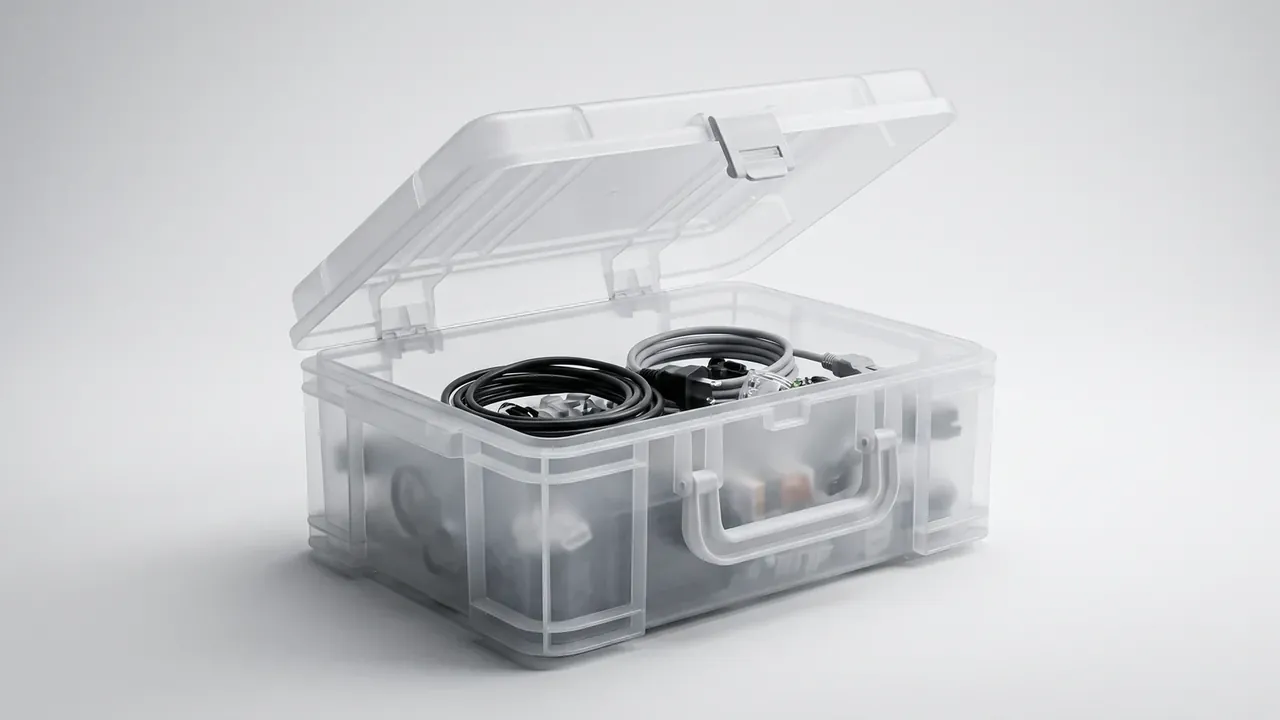
Cushioning comes from steering force around the wall, not from soft material. An outside radius of 20 to 25 mm spreads a drop across a larger patch, and a corner gusset feeds that force into two side walls. A 1.2 m drop on six faces, three edges and one corner is the check; whitening means the polymer has yielded.
3. Seal Groove and Pressure Relief: One Gasket, One Valve
Whether a shipping case keeps water out is decided at the groove. A groove 6.5 mm wide and 5.2 mm deep takes a 7 mm solid gasket and compresses it 25 to 30 percent: below that the seal never seats, above 35 percent it takes a set and stops springing back.
Pressure relief is the part most often dropped. Load at minus 20 °C, unload from a 50 °C trailer, and trapped air can hold roughly 0.3 bar of differential, more in an aircraft hold. Without a valve that differential pulls the lid down onto the gasket.
| Item | Value |
|---|---|
| Groove width and depth | 6.5 / 5.2 mm, for a 7 mm gasket |
| Gasket compression | 25%–30% |
| Cracking pressure | 0.2–0.4 bar |
4. Latches and Hinges: The Source of Closing Force
Latches decide whether the rim closes evenly. A shipping case usually runs over-centre latches with about 6 mm of take-up and 180 to 220 N of pull each. A four-latch body is rated on three, because one latch popping open in transit is normal.
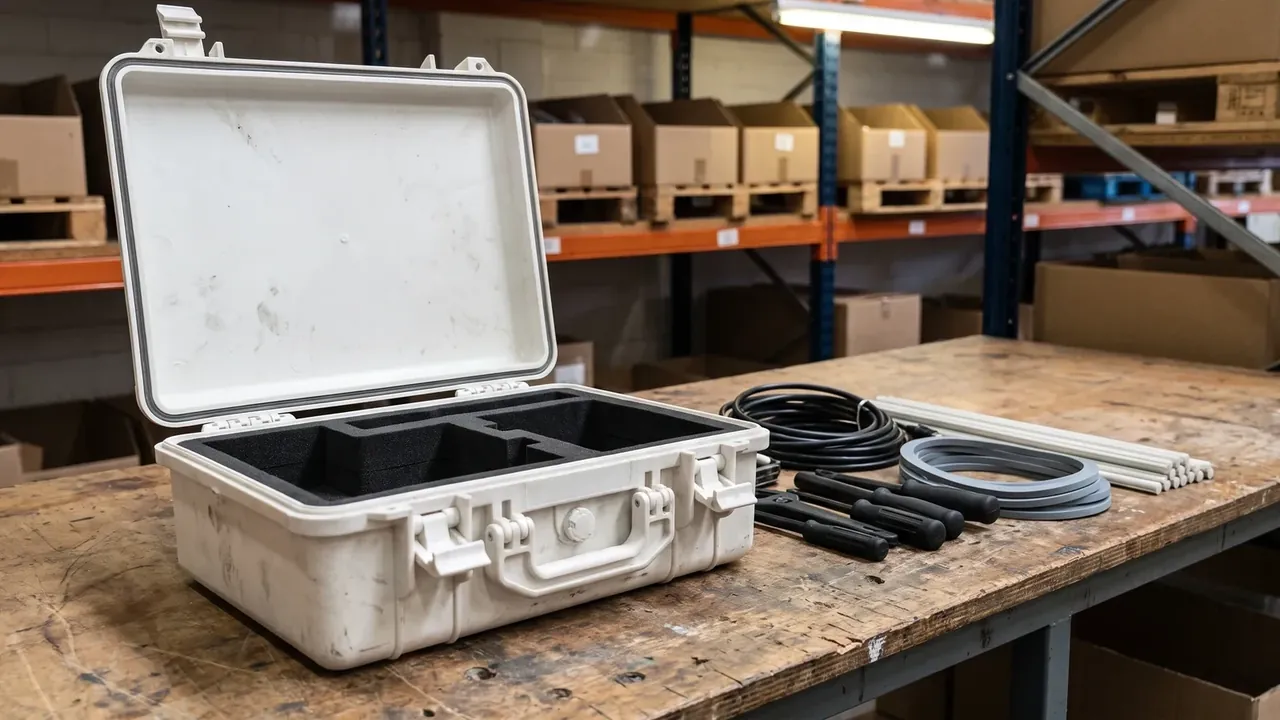
Hinges are the other half. A living hinge is a thin web designed for 10,000 flex cycles, though whitening starts near 3,000. Where the lid opens daily, use a stainless 5 mm pin hinge with bushings and a thickened pad.
5. Liner and Fixing Methods: Holding the Load in Place
A liner is a locating device, not padding. Foam cavities are cut 2 to 3 mm smaller than the item so compression grips it, and lid foam stands 5 mm proud so it presses down on closing. Polyethylene at 38 kg/m³ suits repeated compression; EVA at 45 kg/m³ suits sharp edges.
Fixing follows weight. Light items sit on a full foam face. Anything over 5 kg gets a 9 mm plywood base screwed into moulded inserts, with foam demoted to a cushion. Slotted dividers need 6 mm or they work loose.
| Liner type | Fixing | Best for |
|---|---|---|
| Full-face foam | Adhesive | Regular, light items |
| Cut foam, 38 kg/m³ | Compression grip | Instruments, handheld sets |
Conclusion
The five decisions behind a shipping case are forced by service conditions: wall thickness follows load points, rib height follows span, groove depth follows compression, liner follows weight. Ask where those numbers sit before ordering a shipping case.
This article discusses only the container (case body) side of specifications and design intent, and does not cover any handling, loading or use of the contents.
Related Reading
- How an injection moulded case body is shot
- Rotomoulding and how wall thickness is controlled
- Cutting and bonding foam inserts
- Which parameters matter when choosing a shipping case
Related Products
- 8 Series — Gun Cases; Military Equipment Cases; Camera Equipment Cases; Drone Cases; Watch Cases; Knife Cases; First Aid Cases; Electronics Equipment Cases
- WL8-2812 PP Gun Case — model WL8-2812
- All protective cases and toolboxes: 7 series, 158 models