

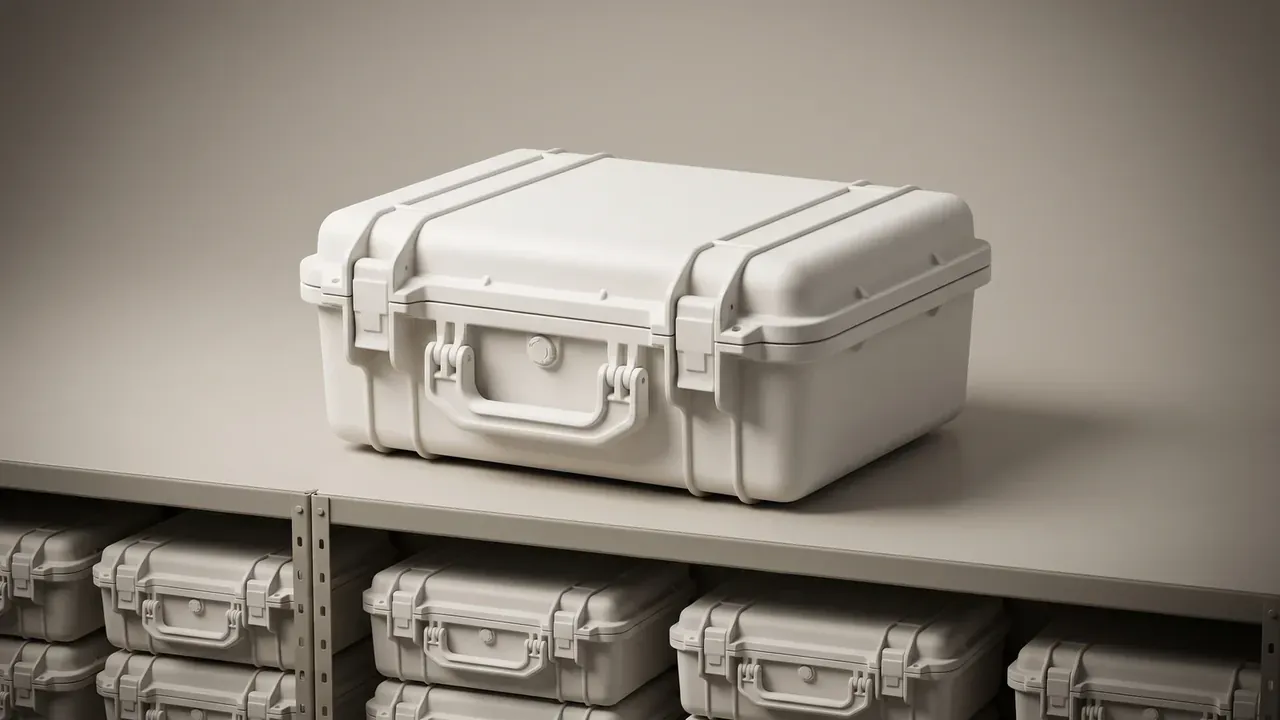
Quick answer: Run a Shipping Case acceptance in three gates: first article, lot sampling and release. Measure wall thickness at five points, immerse at 1 m for 30 minutes, stack at 1.8 times rated load for 24 hours, drop from 1.2 m and cycle the latches 5,000 times. Any result outside those limits rejects the lot.
Table of contents
- The Three Gates of a Shipping Case Acceptance Standard
- First Article and Lot Sampling
- Measuring Dimensions and Wall Thickness
- Immersion, Stacking and Drop Tests
- Latch Cycling, Defect Classes and Records
- FAQ
1. The Three Gates of a Shipping Case Acceptance Standard
Acceptance runs three gates, not one final inspection. The first article asks whether this mould and resin can start production, lot sampling asks whether the batch still matches it, and release asks whether every pallet was checked. Skip a gate and thin walls reach the customer.
The first article triggers on a new tool, a colour or resin change and after every mould repair: three units, two tested, one kept. Lot sampling at AQL 1.0 covers five units for appearance and dimensions plus two for immersion and stacking; release checks label and count on one unit per pallet.
2. First Article and Lot Sampling
Sample by cavity, shift and resin lot. A four-cavity tool needs one unit per cavity, because drawing only from cavity one never exposes sink on the other three. Take body and lid as a pair; the seam decides whether the case seals.
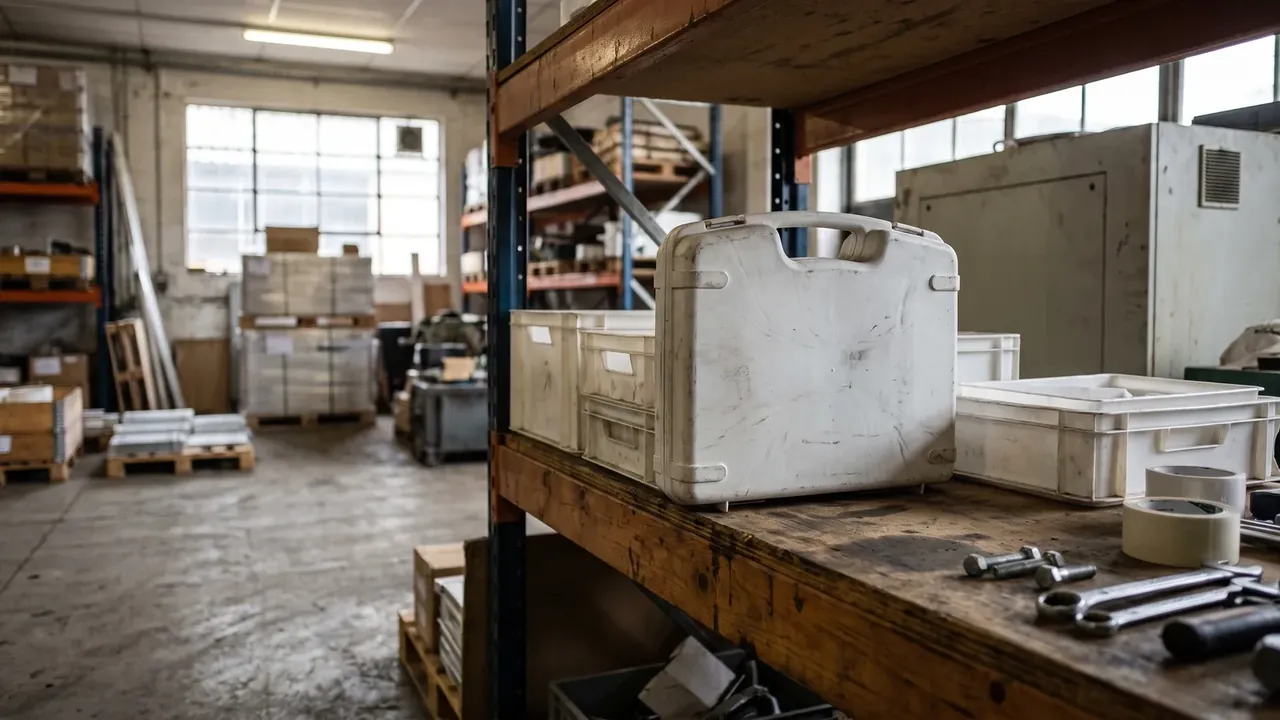
Condition samples at 23 degrees Celsius plus or minus 2 for four hours. A fresh unit holds 40 to 50 degrees and reads 1 to 2 mm larger, so warm measurement passes dimensions that fail later.
3. Measuring Dimensions and Wall Thickness
Dimensions split into three groups: envelope, cavity and mating faces. Read the envelope 20 mm below the rim, the cavity 30 mm above the base, and the seam with a 0.2 mm feeler that must not enter.
| Item | Tool | Point | Limit |
|---|---|---|---|
| Envelope | Tape and calliper | 20 mm below rim | Plus or minus 3 mm |
| Cavity | Inside micrometer | 30 mm above base | Plus or minus 2 mm |
| Wall | Ultrasonic gauge | Four corners, mid-long side | 4.2 mm minimum |
| Seam gap | Feeler | Two points per side | 0.2 mm will not enter |
Wall thickness needs an ultrasonic gauge rather than a calliper, which only reaches the rim while the thin spot sits mid-wall. Five readings per unit, logged to 0.01 mm; a Shipping Case under 4.2 mm bulges by the third stacked layer.
4. Immersion, Stacking and Drop Tests
Test sealing by immersion, not spray: load 80 percent of rating, add absorbent paper, sink to 1 m for 30 minutes, then dry and open. At 1 m the pressure reaches roughly 10 kPa, enough to push water through a pinhole.
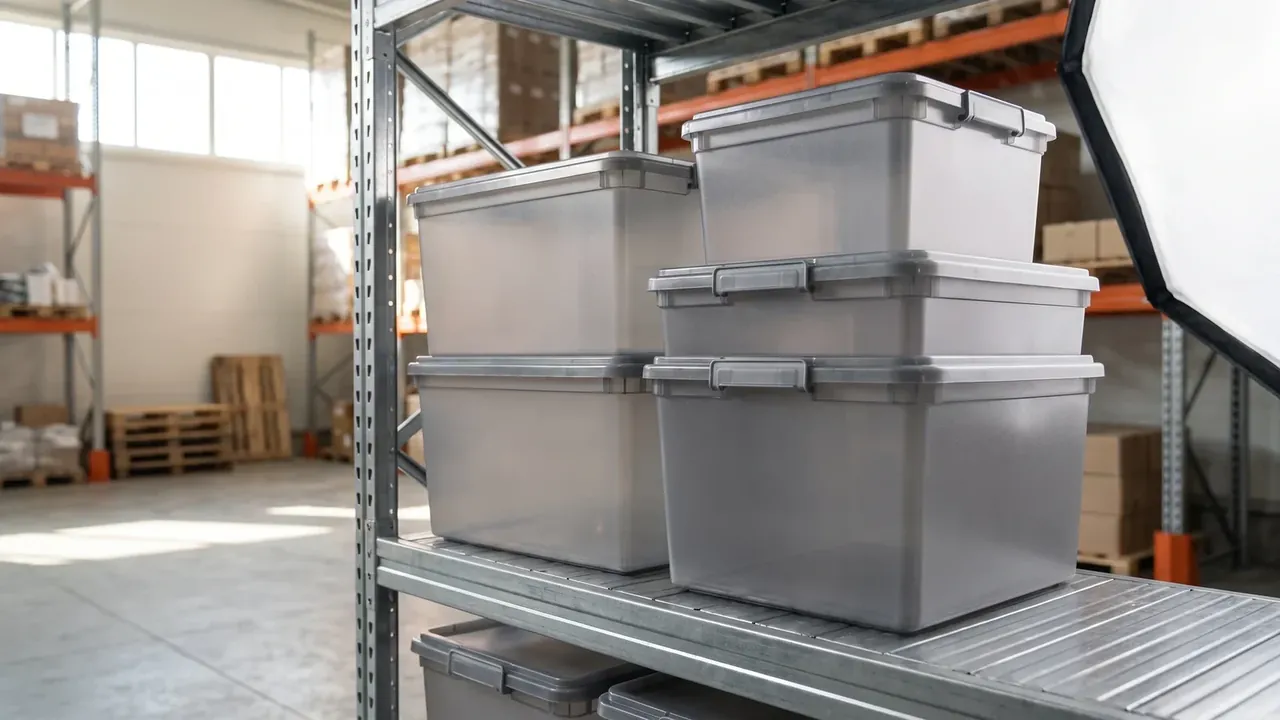
Stack at 1.8 times rated load for 24 hours, then read base deflection one hour after unloading at 5 mm maximum. Drop from 1.2 m onto six faces, three edges and one corner, working the latches after each impact. Stack before dropping, so cracks open where transport puts them.
5. Latch Cycling, Defect Classes and Records
Cycle the latches 5,000 times at no more than 20 per minute, logging force every 500. A loss above 20 percent fails, because internal pressure then pops the latch open.
Sort failures into three classes: A rejects the lot, B doubles the sample, C passes with a note. Keep four records for three years: first article report, resin lot and trial sheet, inspection sheets, raw data.
| Class | Typical defect | Action | Release |
|---|---|---|---|
| A | Leak at 1 m, base set over 5 mm | Reject lot | Retest after 100 percent check |
| B | Wall 4.0 to 4.2 mm, colour drift | Double sampling | Pass on retest |
| C | Label pad offset, flash | Accept with note | Record and fix next lot |
Conclusion
A Shipping Case acceptance standard is not a certificate but a set of repeatable actions: where to sample, how long to cool, how many points to read, how often to drop, and what number forces a rejection. Write each action with its limit beside it, and the Shipping Case argument ends in a figure.
This article discusses only the container (case body) side of specifications and design intent, and does not cover any handling, loading or use of the contents.
Related Reading
- How a first article is approved
- Production SOP and process sign-off
- Resin lot traceability for moulded cases
- Handling damaged Shipping Case units
Related Products
- 8 Series — Gun Cases; Military Equipment Cases; Camera Equipment Cases; Drone Cases; Watch Cases; Knife Cases; First Aid Cases; Electronics Equipment Cases
- WL8-2812 PP Gun Case — model WL8-2812
- All protective cases and toolboxes: 7 series, 158 models