

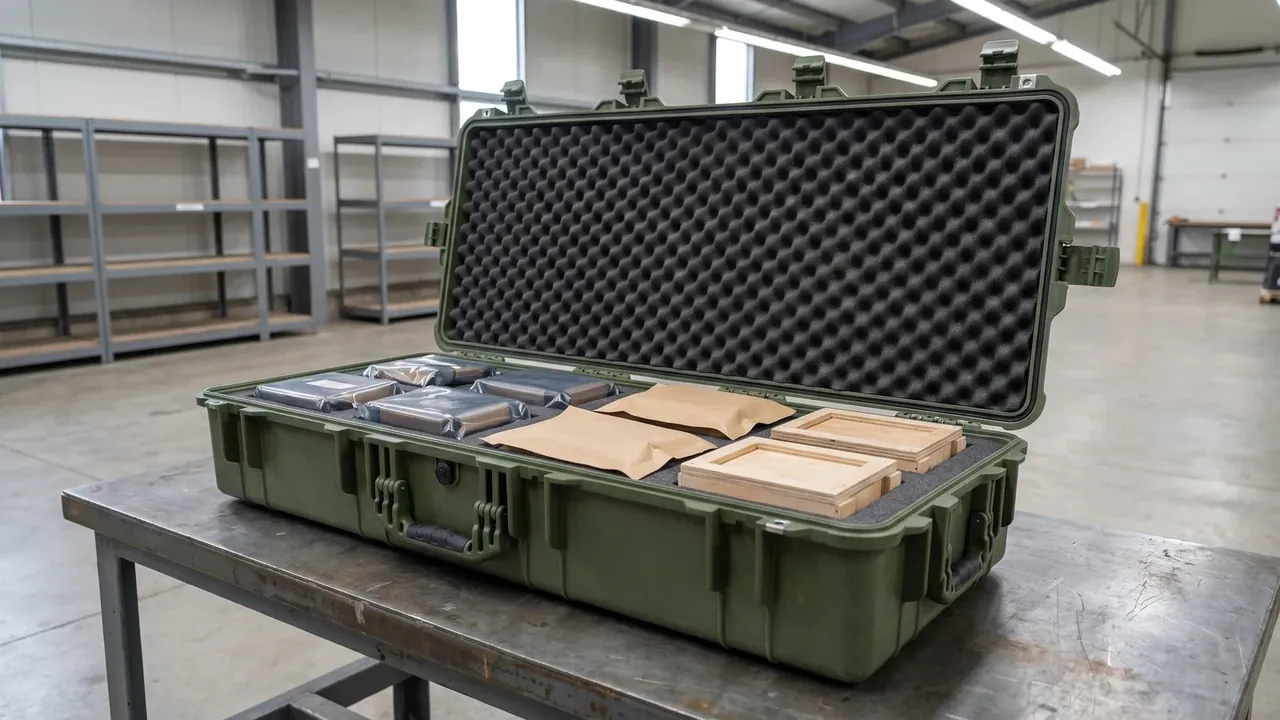
Quick answer: A shockproof case cannot be accepted on the phrase built to take a knock. Split acceptance into type testing, which proves the design, and routine testing, which proves the batch, with every item carrying a threshold and a specimen number.
Table of contents
- Two Inspection Sets Behind a Shockproof Case
- Hardware: Latches, Hinges and Handles
- Impact and Vibration Verdicts
- Foam Insert Checks and Thresholds
- Sampling, Retest and the Report
- FAQ
1. Two Inspection Sets Behind a Shockproof Case
Type testing covers hardware strength, cold drop, random vibration, stacking and foam on three units, and may destroy them. Routine testing covers only what leaves the unit deliverable: latch feel, hinge stroke, insert fit and marking.
| Item | Type test | Routine test | Threshold |
|---|---|---|---|
| Latch retention | 3 units | Feel, every unit | 400 N held for 60 seconds |
| Hinge life | 3 units | 5 open-close cycles | Gap growth after 3000 cycles |
| Cold drop | 3 units | None | Dent no deeper than 2 mm |
| Random vibration | 3 units | None | Insert shift no more than 2 mm |
| Stacking | 3 units | None | Height change after 24 hours |
| Foam | Sampled per lot | Fit, every unit | Recovery no lower than 92% |
A threshold has to be a number: 400 N for 60 seconds with 0.5 mm of permanent set, not the word secure.
2. Hardware: Latches, Hinges and Handles
Hardware is where a shockproof case fails first, and where a quotation gets trimmed. On the same mould a tongue cut from 3.0 mm to 2.4 mm looks identical and loses about thirty percent of its holding force.
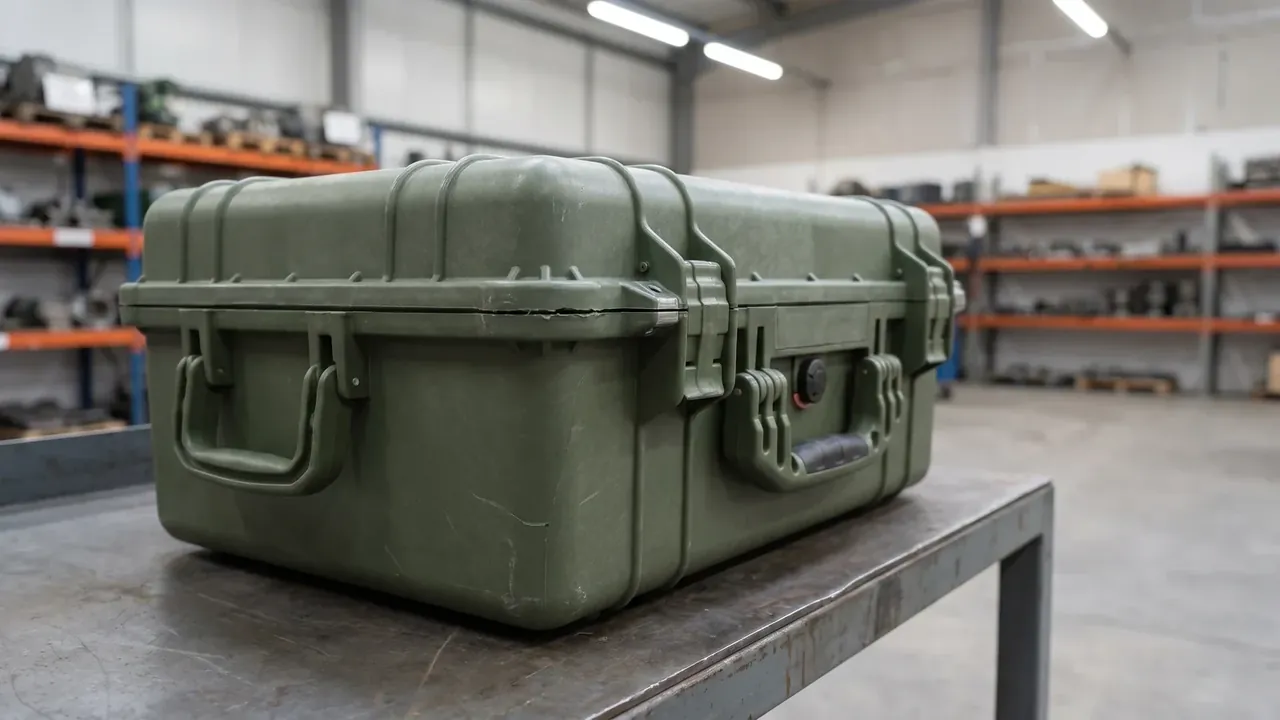
Load the latch to 400 N for 60 seconds, then measure movement between tongue and keeper; over 0.5 mm fails. Run the hinge to 3000 cycles at 15 per minute with pin clearance growth under 0.15 mm, where a 5 mm stainless pin survives and a 4 mm carbon pin turns oval.
Load the handle to twice its rating for 30 minutes with 2 mm of set; breakage starts at the root fillet, so a radius under R3 belongs on the drawing.
3. Impact and Vibration Verdicts
Impact uses a drop weight rather than a whole-case drop: 5 kg from 1.0 m with a 25 mm head, striking the wall centre and one corner. Pass means a dent under 2 mm, no through crack and no white stress band inside.
The cold soak is separate: four hours at minus 25 degrees Celsius, struck within 30 seconds.
Vibration runs at 0.5 g rms from 10 to 500 Hz for 30 minutes per axis; the verdict concerns movement inside.
| Test | Condition | Verdict |
|---|---|---|
| Ambient drop | 5 kg, 1.0 m, R25 head | Dent under 2 mm, no crack |
| Cold drop | Minus 25 degrees, four hours | Same, struck within 30 seconds |
| Random vibration | 0.5 g rms, 30 minutes per axis | Insert shift under 2 mm |
| Stacking | 300 kg for 24 hours | Height change under 3 mm |
4. Foam Insert Checks and Thresholds
Foam is the consumable part of a shockproof case and the easiest to swap. A lower density grade looks and feels the same while flattening the cushioning curve.
Cut a 50 by 50 by 25 mm sample and weigh it; the reading may differ from the declared figure by no more than 5 percent. Compress 25 percent for 24 hours, rest 30 minutes, then require 92 percent rebound.
| Check | Method | Threshold |
|---|---|---|
| Density | 50 by 50 by 25 mm sample weighed | Within 5% of declared |
| Recovery | 25% compression, 24 hours | At least 92% |
| Residual travel | Foam under the part base | At least 8 mm |
| Fit gap | Feeler gauge at the cavity wall | No more than 2 mm |
Residual travel is the forgotten item: a part can sit flush on 3 mm of foam and bottom out on the first drop.
5. Sampling, Retest and the Report
Sample by lot: 8 units from every 200 for non-destructive items, plus 2 for destructive ones. One failure in that pair returns the lot without retest, because it points at design or process rather than at a single unit.
Non-destructive failures may be retested: double the sample to 16, and a second failure returns the lot. A report lists conditions, specimen numbers, measured values per unit, verdicts and photographs. Averages are not accepted.
Conclusion
Acceptance translates built to take a knock into numbers: 400 N of retention, 3000 hinge cycles, a drop at minus 25 degrees, 92 percent recovery. Type testing governs the design and routine testing governs consistency, and both leave records. Put the thresholds in the contract, and a shockproof case earns its name instead of borrowing it.
This article discusses only the container (case body) side of specifications and design intent, and does not cover any handling, loading or use of the contents.
Related Reading
- Shockproof case specifications: drop height and foam margin
- How a shockproof case moves and absorbs load
- Fitting and bonding foam inserts
- Production SOP checkpoints on the line
Related Products
- 8 Series — Gun Cases; Military Equipment Cases; Camera Equipment Cases; Drone Cases; Watch Cases; Knife Cases; First Aid Cases; Electronics Equipment Cases
- WL8-2812 PP Gun Case — model WL8-2812
- All protective cases and toolboxes: 7 series, 158 models