

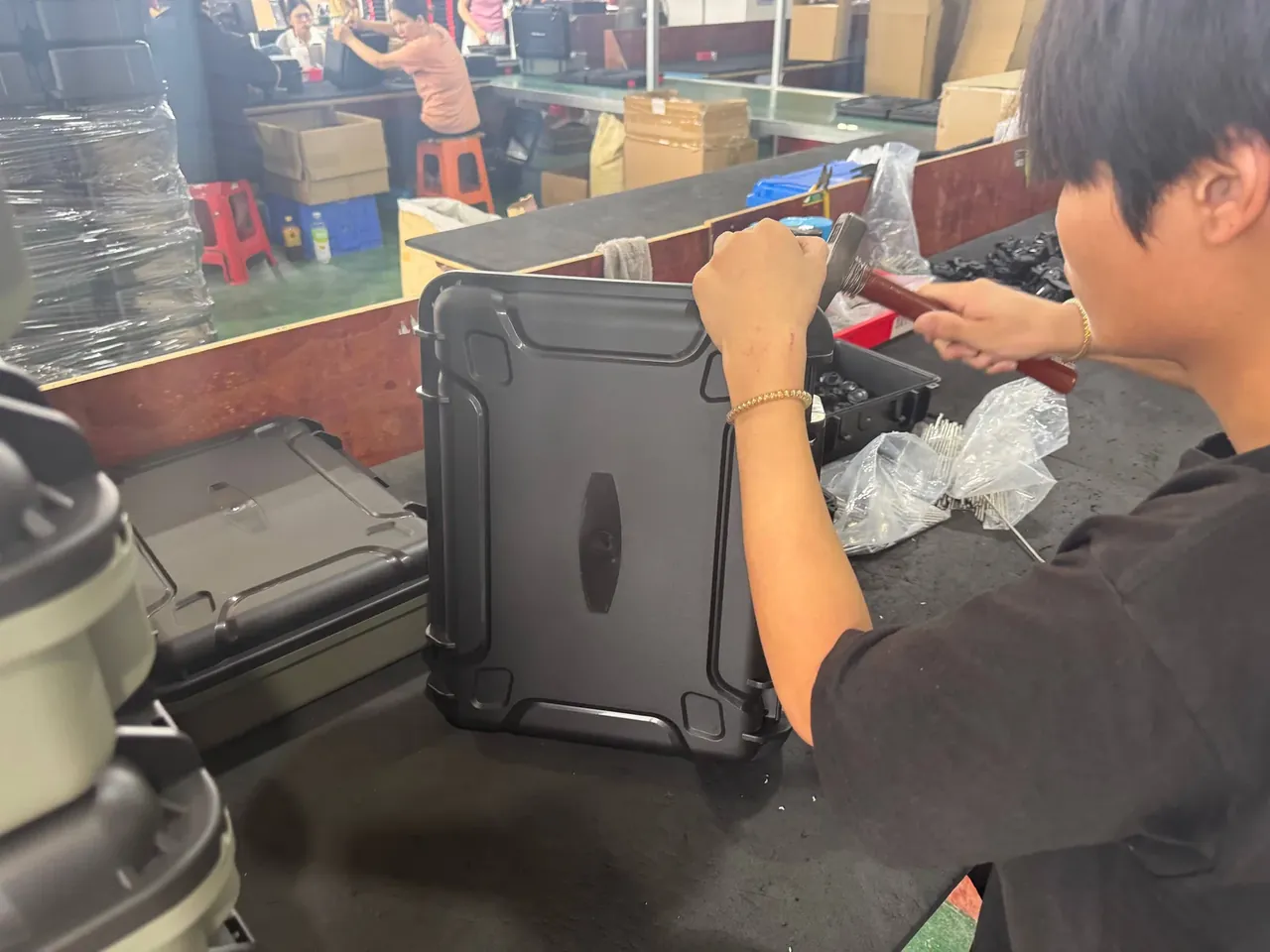
Quick answer: A Shockproof Military Equipment Case keeps transmitted acceleration under 3.8 g at 14 kg over 5-200 Hz, with liner shift within 1.0 mm after a 1.2 m drop.
Table of contents
- Base Pad Density Layering for a Shockproof Military Equipment Case
- Wall Rib Spacing and Stiffness Allocation
- Transmitted Acceleration Readings Across the Sweep Band
- Measuring Liner Shift After a Drop
- Pad Rebound Recheck After Lid Cycling
- FAQ
1. Base Pad Density Layering for a Shockproof Military Equipment Case
A Shockproof Military Equipment Case measures 610×440×270 mm outside and 545×375×205 mm inside, with a 4.4 mm wall, a 6.8 kg empty shell and a 14 kg rated load. Those figures set the cushioning budget: the 205 mm internal height loses clearance to the lid pad, so the base cannot be one uniform slab.
Each density takes a different part of the travel. The bottom ply against the shell uses 45 kg/m³ EVA for the static load, the upper ply a softer blend for small bumps, and the 20 mm lid foam only holds the top face. The main pad is 42 mm thick with compression set capped at 3.0%, which decides whether the pad still returns the mass to position after thousands of lid cycles.
| Liner zone | Density and thickness | Compression set | Role |
|---|---|---|---|
| Base lower ply | 45 kg/m³, lower half of 42 mm | ≤3.0% | carry 14 kg static |
| Base upper ply | softer blend, upper half of 42 mm | ≤3.0% | absorb small bumps |
| Lid foam | 20 mm | ≤3.0% | hold top face |
| Wall root strip | follows the ribs | ≤3.0% | block sideways creep |
A ply cut with recycled content shows up first on the scale, then on the sweep curve, which is why a Shockproof Military Equipment Case is weighed before it is shaken.
2. Wall Rib Spacing and Stiffness Allocation
The wall of a Shockproof Military Equipment Case is not a flat panel. Longitudinal ribs divide the shell into short spans at 68 mm pitch; with the 4.4 mm wall they move the natural frequency away from the busiest part of the 5-200 Hz band. Too few ribs and the wall follows the table like a drum head, too many and weld lines multiply.
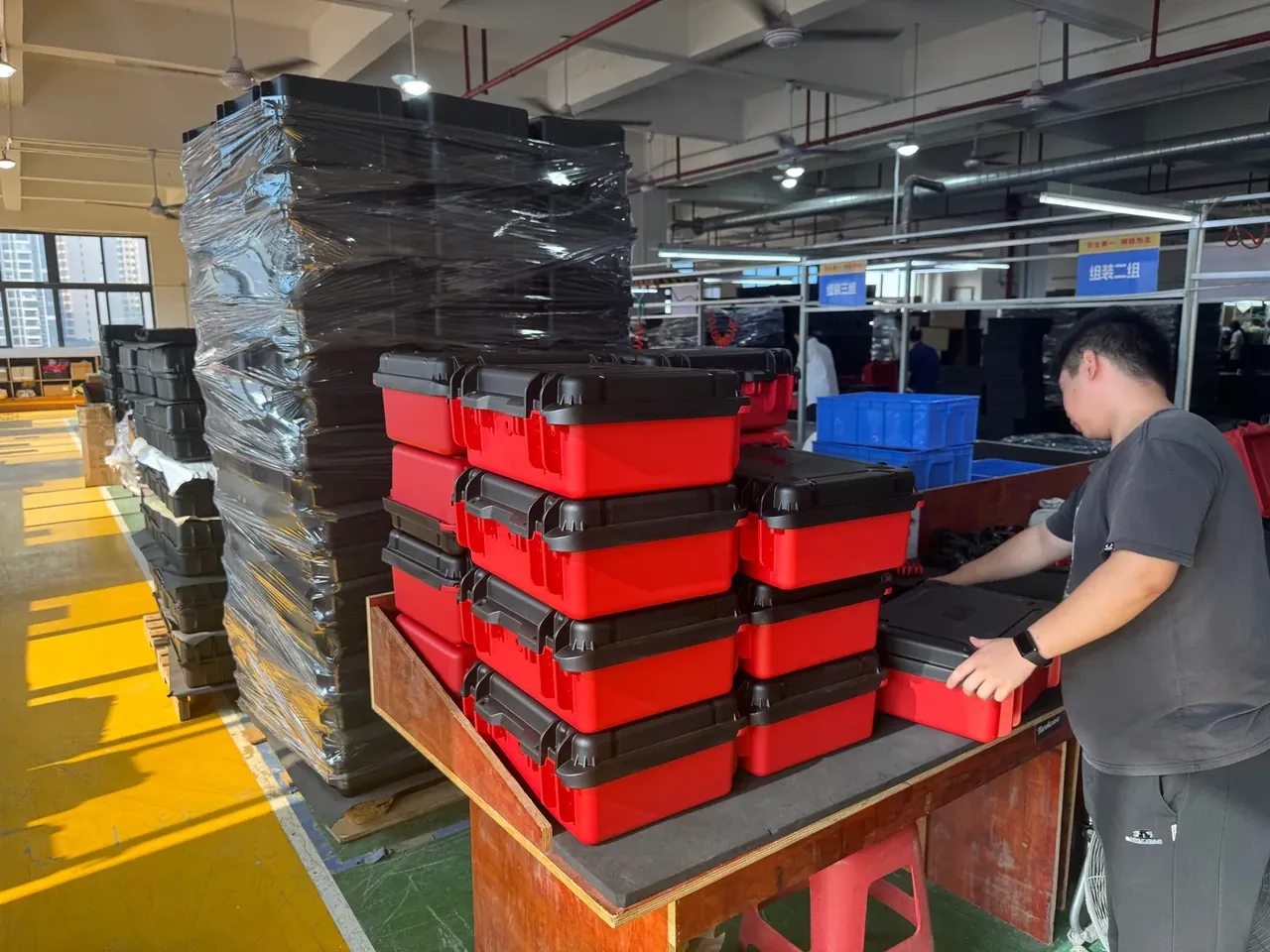
Four latches ring the mouth at 430 N each, so the lid seats on the shell step and cannot bounce during a sweep. The assembled Shockproof Military Equipment Case reaches IP66, with the gasket pressed to a fixed squeeze that seals without lifting the lid.
3. Transmitted Acceleration Readings Across the Sweep Band
To read transmitted acceleration, a 14 kg mass goes into a Shockproof Military Equipment Case clamped to a shaker, and a 5-200 Hz sweep runs with one accelerometer on the table and another above the liner. The ratio shows whether isolation works. The ≤3.8 g limit is the peak reaching the liner at resonance, not a band average.
| Sweep segment | Drive level | Transmissibility | Peak reading |
|---|---|---|---|
| 5-40 Hz | low frequency, large displacement | near 1 | ≤2.6 g |
| 40-120 Hz | resonance dense | highest | ≤3.8 g |
| 120-200 Hz | high frequency, small displacement | falling fast | ≤1.9 g |
Readings are split by segment. At low frequency the shell tracks the table, transmissibility sits near 1, and acceleration stays within 2.6 g because the pad is barely working. In the 40-120 Hz window the pad-and-mass system hits resonance and the peak presses hardest against the 3.8 g line; this is where density layering proves itself. Above 120 Hz inertia shrinks relative motion and the reading falls to about 1.9 g. Cut the load from 14 kg to 8 kg and resonance shifts upward, so every Shockproof Military Equipment Case report states its measured load. One forward-and-back pass is a single set; an up-sweep versus down-sweep peak gap beyond 0.3 g means the pad is loose and must be refitted.
4. Measuring Liner Shift After a Drop
Drop testing on a Shockproof Military Equipment Case runs at 1.2 m, one drop per face across six faces. With the lid still shut, liner shift against the shell datum is measured to a ≤1.0 mm limit: mark pairs at the four pad corners and inner wall, read the difference with a depth gauge, report the largest.
| Acceleration reading | Load | Recheck segment | Drop height | Liner shift |
|---|---|---|---|---|
| 3.8 g | 14 kg | 40-120 Hz | 1.2 m | ≤1.0 mm |
| 3.2 g | 14 kg | 40-120 Hz | 1.2 m | ≤0.8 mm |
| 2.6 g | 14 kg | 5-40 Hz | 1.2 m | ≤0.6 mm |
A higher resonance peak means more liner shear on impact, so the two columns are read together. A Shockproof Military Equipment Case fails the liner once shift passes 1.0 mm; checking the lid gap by eye is not a measurement.
5. Pad Rebound Recheck After Lid Cycling
A cycling rig opens and closes the lid at a fixed rate, then the pad is measured again. The 3.0% compression set limit is only truly tested after that run: lay the pad flat, read recovered thickness against a new part. A loss beyond 3.0% means the foam has packed down and the sweep peak will climb.
Rebound and layering pull against each other. A dense lower ply recovers slowly, a soft upper ply quickly; a wide gap points to mixed batches, and even passing single readings then call for re-sorting by density. JUNZHIJIA ships the new, post-sweep and post-cycling thickness sets with each Shockproof Military Equipment Case, so a buyer can recheck the trend with the same gauge.
Conclusion
Two limits define a Shockproof Military Equipment Case: ≤3.8 g under 14 kg and ≤1.0 mm after a 1.2 m drop. Density layering, rib pitch and gasket fit carry them together, and relaxing any one lifts the sweep curve. Ask for the sweep and drop-shift records before pad thickness and rebound; those say more than wall thickness alone. JUNZHIJIA attaches the three thickness sets to each shell, so a buyer remeasures with the same gauge and settles the spec on data.
Related Reading
- How to read shockproof case specifications
- Random vibration versus sine sweep
- Measurement clauses in shockproof case standards
- Sealing and stiffness of high-grade waterproof shockproof cases
Related Products
- 8 Series — Gun Cases; Military Equipment Cases; Camera Equipment Cases; Drone Cases; Watch Cases; Knife Cases; First Aid Cases; Electronics Equipment Cases
- WL8-2812 PP Gun Case — model WL8-2812
- All protective cases and toolboxes: 7 series, 158 models