

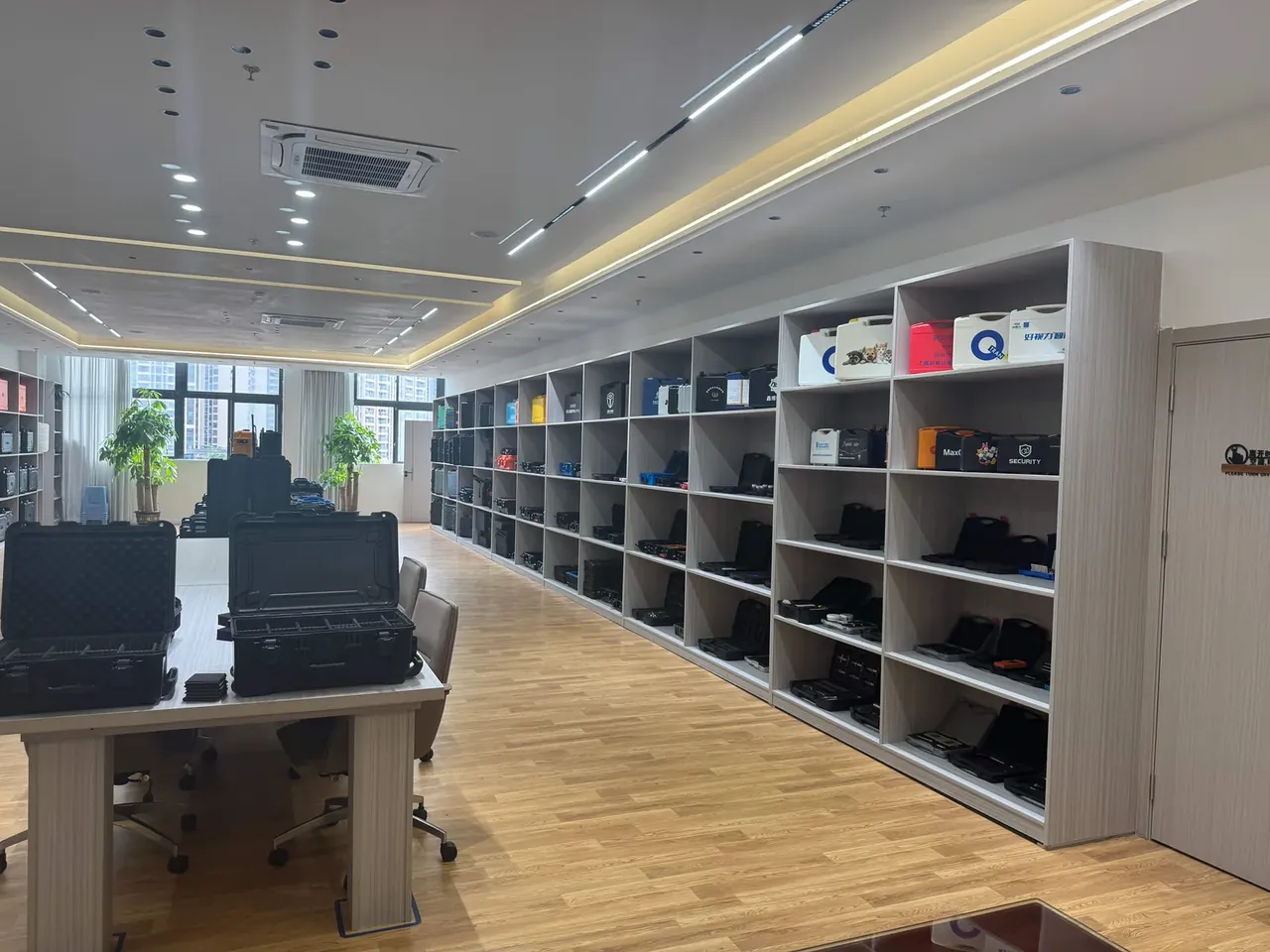
Quick answer: Two shells, one 0.8 kg gap: a single vs double wall case weighs 2.1 kg against 2.9 kg, and the 12 mm cavity holds only 4 g of air.
Table of contents
- Where the 0.8 kg comes from
- Thirty minutes in a cold chamber
- A 1.2 m drop, 68 G against 55 G
- What the second wall costs
- Where single stops and double starts
- FAQ
1. Where the 0.8 kg comes from
Two shells of 400 mm × 300 mm × 200 mm go on the scale: 2.1 kg single, 2.9 kg double. The single wall is one 3.0 mm skin. The double is a 3.0 mm outer skin plus a 2.0 mm inner skin, held 12 mm apart by 24 ribs.
Air is 4 g of that 0.8 kg. A 12 mm gap over the whole shell holds about 3.2 L, and at 1.2 kg/m³ it weighs nothing. The mass sits in the inner skin: 0.31 m² at 0.91 g/cm³ for PP gives 0.56 kg, the ribs add 0.2 kg, and 0.04 kg is hardware.
| Item | Single wall | Double wall |
|---|---|---|
| Wall build | one 3.0 mm skin | 3.0 mm outer + 2.0 mm inner |
| Cavity | none | 12 mm |
| Ribs | 16 | 24 |
| Weight per case | 2.1 kg | 2.9 kg |
| Moulding cycle | 69 s | 78 s |
| Tooling | one two-plate tool | three-plate tool with 2 slides |
The gap buys thermal resistance and crush travel. It adds almost nothing on the scale.
2. Thirty minutes in a cold chamber
Both cases enter a chamber at −10 ℃ with a logger inside, starting at 20 ℃. After 30 min the single reads −5.8 ℃, 4.2 ℃ above ambient; the double reads −8.4 ℃, 1.6 ℃ above. Half an hour buys 2.6 ℃ of hold.

Still air conducts at 0.026 W/(m·K), which would give 0.46 m²·K/W across 12 mm. Convection and radiation inside the cavity cut the effective value to about 0.18 m²·K/W. Widening the gap from 12 mm to 20 mm adds only 0.03, because past 15 mm convection takes over.
The cavity is vented, not sealed. Two Ø3 mm holes sit between the skins, or a temperature swing would bulge the inner wall. Those holes also pass moisture, and a wet cavity falls below 0.05 m²·K/W, worse than a single wall.
Temperature only matters through condensation. At 25 ℃ and 70% RH the dew point is about 19 ℃, so a move into a 5 ℃ cold room puts a single wall under it within 30 min, while the double keeps 1.3 ℃ of margin.
3. A 1.2 m drop, 68 G against 55 G
One rig, one 6 kg ballast, 1.2 m free fall, three corner drops: 68 G single, 55 G double, 19% lower. Pulse width runs 2.4 ms against 3.1 ms.
The peak falls because of the cavity, not a harder wall. The impact compresses the 12 mm gap first, stretching the pulse and cutting the peak. In this role the inner skin is a bumper, not a stiffer plate.
That margin only matters for some loads. A part rated to 100 G passes either way. A part rated to 60 G fails the single and just passes the double, and those 13 G are the argument.
Ballast changes it: at 12 kg the single climbs to 82 G and the double to 64 G, an 18 G gap. Heavier loads bottom out the travel sooner, so the benefit rises then fades, and past 15 kg the two converge.
Read peak with pulse width. Peak alone confuses damping with stiffness, and a median of three drops says more about consistency than the worst single hit.
4. What the second wall costs
The first cost is stacked tolerance. The 3.0 mm skin runs ±0.15 mm, the 2.0 mm skin the same, and the cavity is set by the parting line at ±0.5 mm. Total thickness spreads to ±0.8 mm and seating flatness loosens from 0.3 mm to 0.6 mm, enough to leave one corner hanging on a bench.
The second is a cleaning trap. The joint between skins is a groove 12 mm deep and 2.5 mm wide, too narrow for a brush, so it needs air and a flush. Cleaning goes from 90 s to 130 s, 40 s more, or 5.5 h across 500 pieces.
The third is tooling. A second skin needs 2 slides and 1 lifter, tooling rises 55%, and the cycle stretches from 69 s to 78 s.
| Cost | What it looks like | Measured |
|---|---|---|
| Stacked tolerance | three tolerances add up | ±0.8 mm total, 0.6 mm flatness |
| Cleaning trap | ring groove at the skin joint | 12 mm deep, 2.5 mm wide, 40 s more |
| Tooling complexity | extra slides and a lifter | +55% tooling, +9 s cycle |
Add the three and the double is 38% dearer per case. At USD 300 a unit that is 114, or 114,000 across 1000 pieces. On 100 pieces the tooling premium alone works out at 90 each.
5. Where single stops and double starts
A single wall is enough on four checkable conditions: humidity at or below 60%, round trips under 2 h, a spread of 15 ℃ or less, and no condensation-sensitive load. When all four hold, 2.6 ℃ and 13 G buy nothing.
Double is required on four too: a spread above 15 ℃, cavity dew-point margin under 3 ℃, an overnight outdoors or a long stay in a car boot, and a one-way run over 4 h with a temperature step. Two hits make the cavity necessary; one says try a divider first.
The borderline band is 10 ℃ to 15 ℃. Measure it: a single wall with one 3 mm divider, three round trips, logging the lowest cavity temperature and the dew point. Two breaches and you move up, none and you stay.
Inspection needs no cut-open sample. A 0.5 mm ultrasonic gauge at five points on the base, minimum value taken as cavity thickness, settles it: two points under 11 mm means a thick inner skin or a shifted rib, and that batch's thermal claim is discounted 8%.
The dividing line is not price. It is spread and dew point, both measurable before an order is placed.
Conclusion
The single vs double wall case question usually ends in a hand-feel argument, when three numbers settle it: weight, 30 min spread and 1.2 m drop peak. The 0.8 kg touches handling and freight only, and at USD 6 per kg across 2000 shipments a year that is 12,000, a rounding error against 114,000 on a 1000-piece order. What decides whether a load survives is the 2.6 ℃ and the 13 G, and those map onto dew-point margin and component shock rating, both measurable before an order exists.
| Metric | Single wall | Double wall | Delta | What it decides |
|---|---|---|---|---|
| Weight per case | 2.1 kg | 2.9 kg | +0.8 kg | freight only |
| Spread after 30 min | 4.2 ℃ | 1.6 ℃ | −2.6 ℃ | dew-point margin |
| 1.2 m drop peak | 68 G | 55 G | −13 G | component rating |
| Cost index | 100 | 138 | +38% | order quantity |
One line decides it: go double only when the spread exceeds 15 ℃ or the cavity dew-point margin falls under 3 ℃. When neither holds, a single wall with one 3 mm divider is the cheaper answer.
This article discusses container-side specifications and design implications only, and does not cover any handling, loading or use of the contents.
Related Reading
- Case wall thickness against weight
- Running a thermal cycling test
- IP67 cases through a temperature range
- Cooler hold time versus cold chain cases
Related Products
- 8 Series — Gun Cases; Military Equipment Cases; Camera Equipment Cases; Drone Cases; Watch Cases; Knife Cases; First Aid Cases; Electronics Equipment Cases
- WL8-2812 PP Gun Case — model WL8-2812
- All protective cases and toolboxes: 7 series, 158 models