


Quick answer: This case wall thickness chart sets six grades from 1.8 to 4.0 mm against empty weight and cavity volume on one 500×400×220 mm shell.
Table of contents
- How to read the chart
- Six grades by weight and volume
- Grams of plastic per litre
- Three load paths
- Cost and cycle time
- Checking thickness at sampling
- FAQ
1. How to read the chart
The six grades are 1.8, 2.2, 2.5, 3.0, 3.5 and 4.0 mm. A case wall thickness chart only compares across grades when four definitions are fixed first.
Thickness: the drawing carries a nominal taken from the cavity-to-core gap, while the report needs a mean and a thinnest point. A 2.5 mm shell reading 2.53 mm mean and 2.31 mm thin is normal.
Weight: empty case with hardware, no liner; a pre-cut liner for 30 L weighs 0.35 to 0.6 kg. Volume: net cavity, ribs and lip deducted.
Load: the figures mean a uniform load on the lid at 23 °C for 24 hours with residual deflection under 2 mm. One shell quotes at 800 kg by peak and 450 kg by the 2 mm rule.
2. Six grades by weight and volume
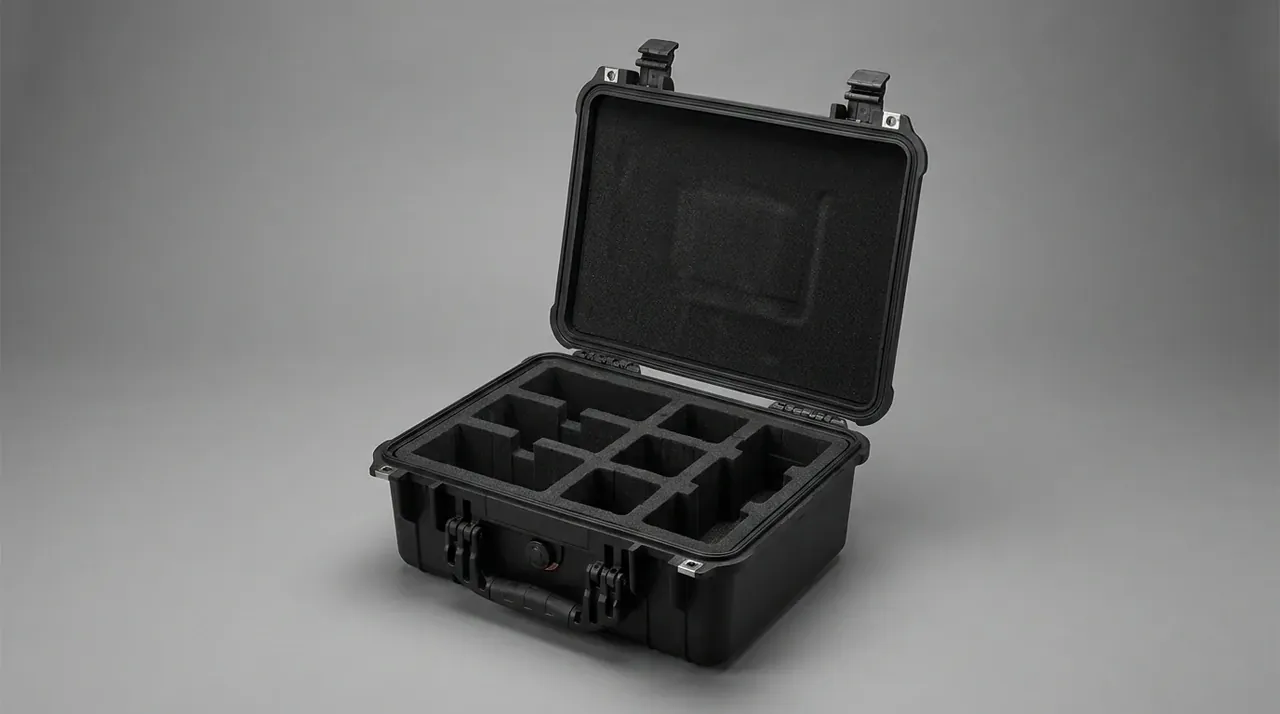
On one 500×400×220 mm shell, 0.4 to 0.6 mm off the core per side moves one grade. Weight is PP at 0.91 g/cm³ over 0.72 m² plus 0.35 kg of hardware.
| Nominal wall mm | Cavity L | Empty weight kg | Weight per litre g/L |
|---|---|---|---|
| 1.8 | 33.4 | 1.53 | 46 |
| 2.2 | 32.7 | 1.79 | 55 |
| 2.5 | 32.1 | 1.99 | 62 |
| 3.0 | 31.3 | 2.32 | 74 |
| 3.5 | 30.6 | 2.64 | 86 |
| 4.0 | 29.8 | 2.97 | 100 |
From 1.8 to 4.0 mm the empty weight gains 94% while the cavity loses only 10.8%. Each step costs 0.6 to 0.8 L and adds 0.20 to 0.33 kg.
3. Grams of plastic per litre
At 1.8 mm a shell carries 46 g per litre; at 4.0 mm, 100 g, a factor of 2.17. The ratio removes size from the comparison, so 30 L and 90 L cases read on one line.
For handling, 60 g/L divides the field. Below it a 30 L case loaded to 8 kg travels 200 m in one hand; past 100 g/L the same volume starts at 3 kg empty and 11 kg loaded, doubling handle pressure.
Freight converts the ratio to money. Air cargo at 18 CNY per kg on a 1.44 kg gap is 25.9 CNY each way, or 259,000 CNY a year on 5,000 units twice over.
4. Three load paths
Uniform lid load, side pressure and corner drop are separate paths, and thickness carries a different share on each.
Lid load is about 70% of the practical rating, run through the side walls into four base corners, with mid-span sag as the control. A 500×400 mm lid at 2.5 mm with 12 mm ribs on 90 mm pitch holds 450 kg at 1.8 mm of sag; at 150 mm pitch, 260 kg.
Side pressure tests crushing, not bending. A 200 mm indenter at 50 mm per minute whitens a 2.5 mm wall at 1.5 kN; 3.5 mm takes 2.3 kN. Thickness works almost linearly here and ribs contribute little.
Corner drop pairs the corner moulding with the wall, the wall second. Dropped at 1.2 m and 12 kg, two of three 1.8 mm samples split at a base corner, none at 3.0 mm, and at 4.0 mm the latch ear whitened instead.
| Wall mm | Lid load kg | Side pressure kN | After 1.2 m corner drop |
|---|---|---|---|
| 1.8 | 220 | 0.9 | 2 of 3 split at a corner |
| 2.2 | 340 | 1.2 | 1 of 3 split at a corner |
| 2.5 | 450 | 1.5 | No split, corner whitened |
| 3.0 | 620 | 1.9 | No split |
| 3.5 | 810 | 2.3 | No split, latch ear whitened |
| 4.0 | 1000 | 2.7 | Latch ear whitened, hinge sound |
5. Cost and cycle time
Resin at 9.8 CNY per kg puts 2.5 mm at 16.1 CNY and 4.0 mm at 25.7 CNY, with resin at 18% to 22% of unit cost.
Cooling scales with the square of thickness: 20 s at 2.5 mm against 39 s at 3.5 mm, so a single-cavity press drops from 112 parts an hour to 70. At 260 CNY per machine hour the moulding charge rises from 2.31 to 3.68 CNY.
| Wall mm | Resin kg | Resin CNY | Cooling s | Delta vs 2.5 mm |
|---|---|---|---|---|
| 1.8 | 1.18 | 11.6 | 10 | −4.5 |
| 2.2 | 1.44 | 14.1 | 15 | −2.0 |
| 2.5 | 1.64 | 16.1 | 20 | 0 |
| 3.0 | 1.97 | 19.3 | 29 | +3.2 |
| 3.5 | 2.29 | 22.4 | 39 | +6.3 |
| 4.0 | 2.62 | 25.7 | 51 | +9.6 |
One grade up adds 7.7 CNY per unit, so a thousand pieces is 7,700 CNY and ten thousand pays for a core. Going down to 2.2 mm saves 0.20 kg but cuts lid load from 450 to 340 kg, a 24.4% loss.
6. Checking thickness at sampling
Three lines across the lid and two down a side wall at 50 mm spacing give 18 points on a 30 L shell and 32 on a 90 L shell.
A 5 MHz gauge at 0.01 mm resolution, read three times and kept as a median, repeats within 0.05 mm. Readings run 0.4 to 0.6 mm high at rib roots, so mark those points and keep them out of the mean.
Three limits: mean at least 0.97 of nominal, thinnest point at least 0.90, spread within one part no more than 0.35 mm. For 2.5 mm that is 2.43 mm, 2.25 mm and 0.35 mm. Fix packing pressure and mould temperature before touching the core.
Conclusion
Three bands cover most decisions on case wall thickness. Under 300 kg lid load, take 1.8 to 2.2 mm; 300 to 600 kg for routine transit, 2.5 to 3.0 mm; above 600 kg or past a 1.2 m drop, 3.5 to 4.0 mm. The chart is worth less than its definitions: nominal, mean, thinnest point, empty weight with hardware, 23 °C, 24 hours, 2 mm deflection. Put them on the drawing and quotations compare; leave them off and one chart yields three answers. What the cavity gives back matters too: 10 mm of lost length stops more builds than 0.3 kg of weight.
This article discusses container-side specifications and design implications only, and does not cover any handling, loading or use of the contents.
Related Reading
- How wall thickness maps to strength
- Wall thickness in structural design
- Wall control in rotational moulding
- Drop test height set by weight
Related Products
- 8 Series — Gun Cases; Military Equipment Cases; Camera Equipment Cases; Drone Cases; Watch Cases; Knife Cases; First Aid Cases; Electronics Equipment Cases
- WL8-2812 PP Gun Case — model WL8-2812
- All protective cases and toolboxes: 7 series, 158 models