

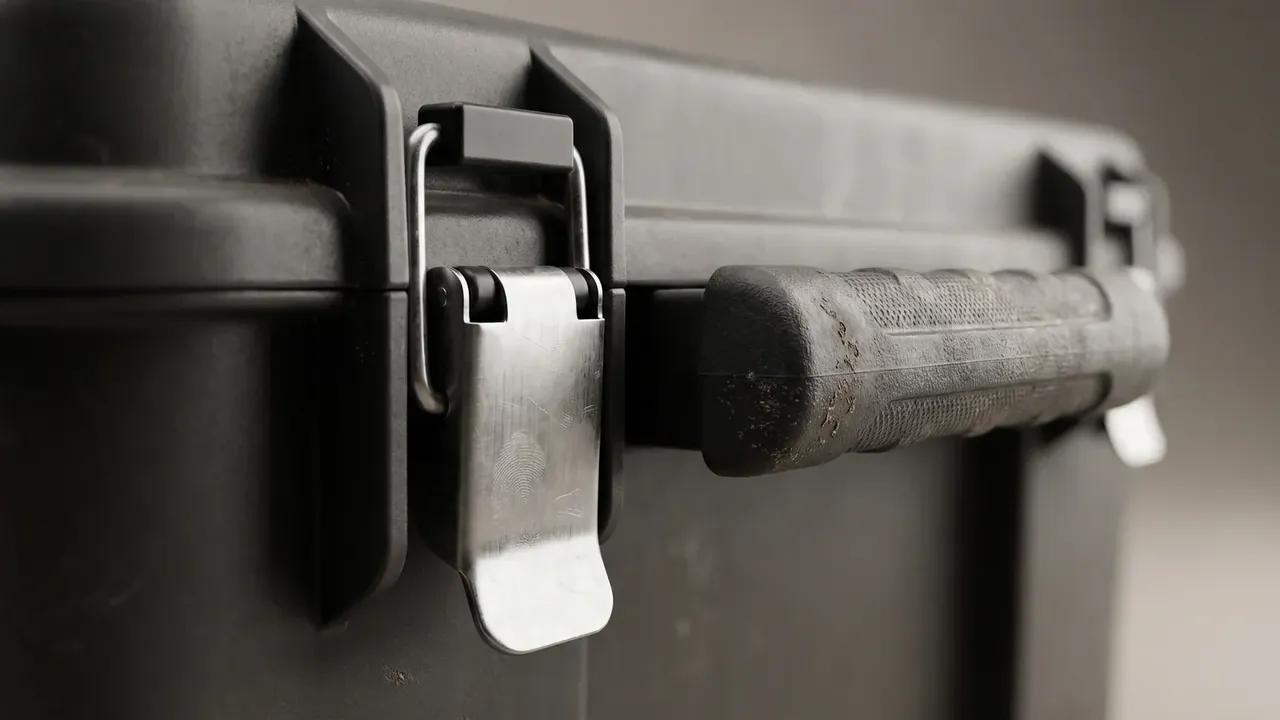
Quick answer: On a small portable box the price is rarely the biggest line; volumetric weight and rework are. Split cavities into 2.2, 4.2, 8.1 and 16 litre tiers, measure the opening that carries the box, and keep 10 mm of outside clearance.
Table of contents
- Four cavity tiers of a small portable box
- Handle height and centre of gravity
- Boot, cabin and backpack
- Grams per litre and payload
- Wall thickness at small sizes
- Mispick cost and a selection table
- FAQ
1. Four cavity tiers of a small portable box
Move the cavity from 4.2 to 8.1 litres and the empty case gains 0.33 kg, while chargeable weight jumps from 1.23 to 2.17 kg. That step never appears on a quotation for a small portable box. Volumetric weight is outside length × width × height divided by 6000, so walls and ribs sit inside it. Pick by the opening rather than the outside length: a car boot has a 720 mm sill and a 950 mm opening, cabin baggage holds a 115 cm three-side sum, a 30 litre pack measures 300 mm across. A small portable box needs 10 mm of clearance there.
| Tier | Cavity (mm) | Volume | Outside (mm) | Empty | Chargeable | Typical carrier |
|---|---|---|---|---|---|---|
| A | 205×145×75 | 2.2 L | 240×185×92 | 0.45 kg | 0.68 kg | Shoulder bag |
| B | 245×180×95 | 4.2 L | 285×225×115 | 0.62 kg | 1.23 kg | Motorcycle box |
| C | 300×225×120 | 8.1 L | 345×270×140 | 0.95 kg | 2.17 kg | Car boot, 30 L pack |
| D | 380×280×150 | 16.0 L | 430×330×175 | 1.45 kg | 4.14 kg | Pickup bed, rack |
A to B doubles the cavity for 0.55 kg; C to D adds 1.97 kg.
2. Handle height and centre of gravity
A handle is a lever arm, not an accessory. Loaded to 6 kg, a small portable box with the handle 42 mm above the lid puts a constant moment on the wrist, and after five hundred metres that becomes a count of hand swaps.
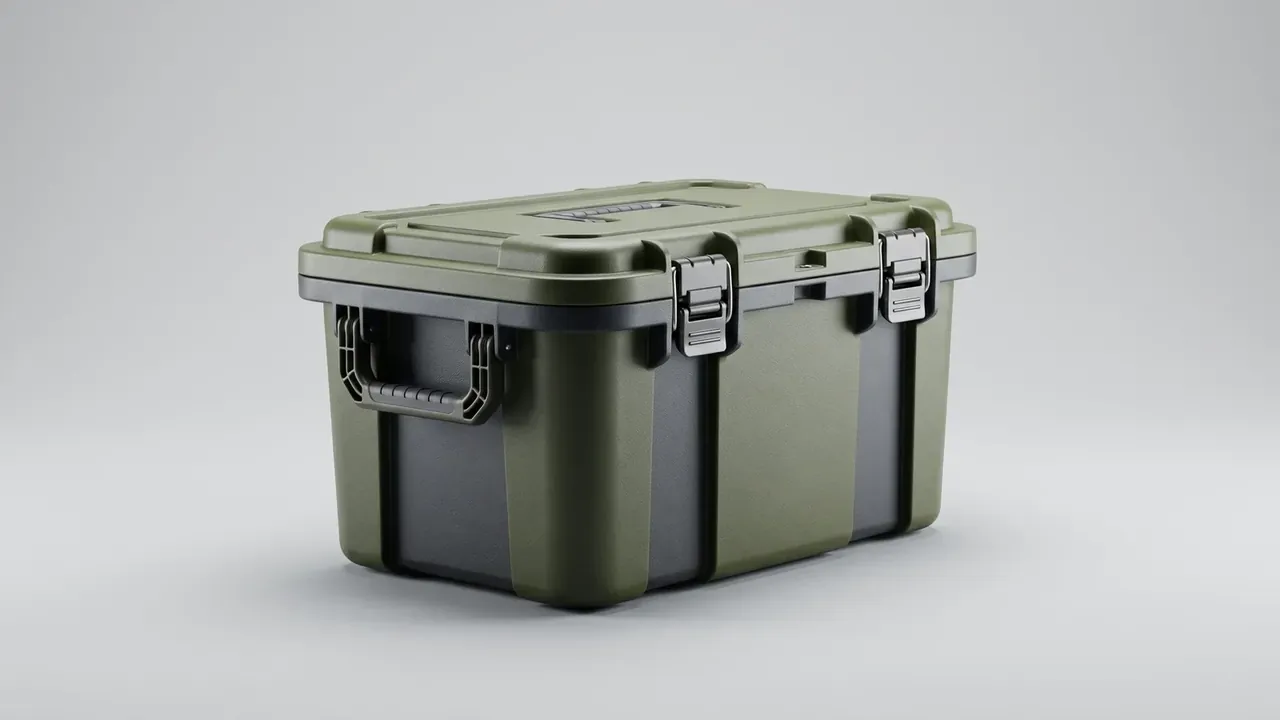
A 105 mm grip on a 28 mm bar is the four-finger minimum; at 90 mm a work glove will not pass. Twin handles cost 6 to 9 percent more and keep tier D level.
Centre of gravity is the quieter problem.
An empty case sits about 18 mm above its geometric centre, since ribs and latches live in the lid. Walk twenty paces at rated load; if the base stops knocking your calf, the balance is right. Handle roots crack first, so the mould needs R8 or more where handle meets wall, with thickness grading from 2.8 mm to 2.0 mm.
3. Boot, cabin and backpack
Where the box travels sets the outside limit harder than volume does.
- Car boot: 720 mm sill, so anything over 300 mm tall lies flat
- Aircraft cabin: 115 cm three-side sum, wheels included
- Backpack: 300 mm main opening; a case over 280 mm jams at the zip corner
- Shelving: 400 mm clear height, so tier D goes one layer only
The most missed constraint is the load cover: leave height for the case but not for the cover, and the box lies flat, costing two positions. A wheeled small portable box quoted at 55 cm often tapes out at 58 cm at the gate.
4. Grams per litre and payload
Grams per litre is the fairer measure than total weight. Across the four tiers it runs 202, 148, 117 and 91 g/L, and small cases are penalised by ratio because latches and hinges do not shrink with the cavity.
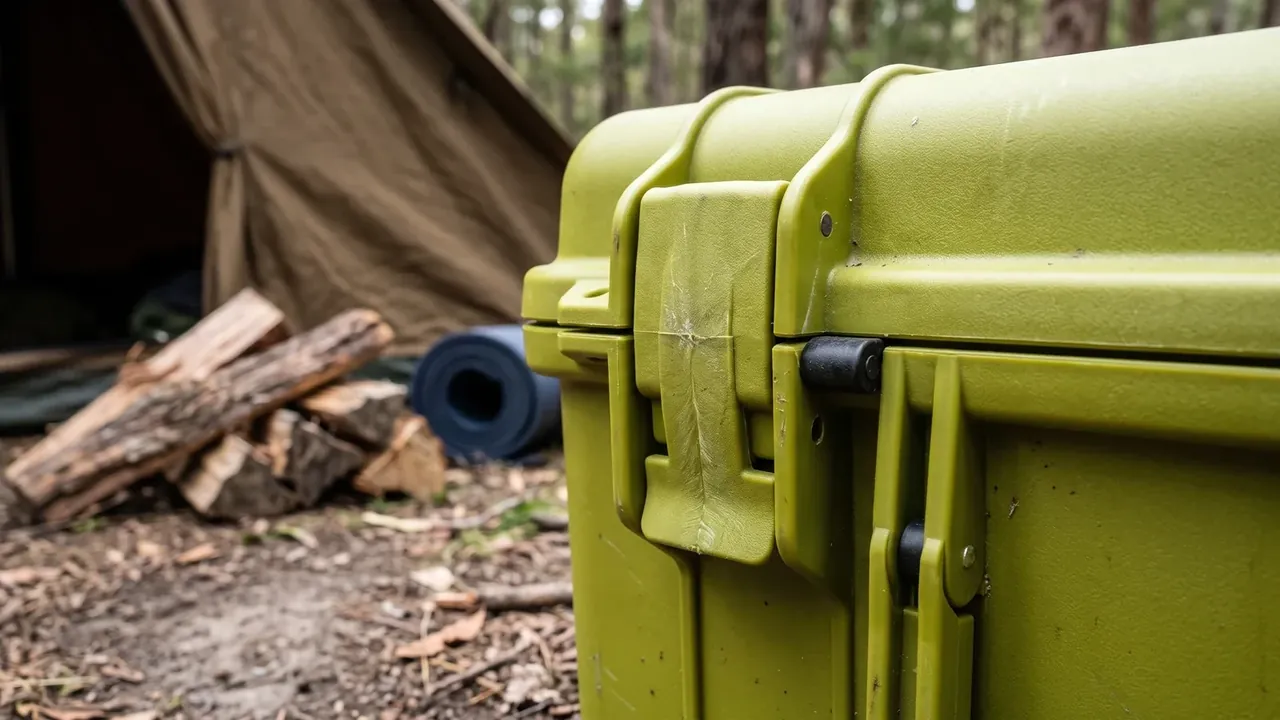
Tier A at 202 g/L loads to 3.2 kg and carries in one hand for twenty minutes without a swap; tier D at 91 g/L loads to 14.5 kg and wants a trolley. Staying under 150 g/L is the practical line for a small portable box carried on the body. Loaded weight excludes straps and pouches, which add 0.5 to 1 kg in the hand.
5. Wall thickness at small sizes
Every 0.8 mm added to the wall takes 1.6 mm off the cavity in each direction. A small portable box starts narrow, so 2.0 to 2.8 mm costs tier C about 0.2 litres while gaining half a drop class.
Stiffness at this size comes from ribs, not walls. Ribs at 60 mm pitch and 4 mm height let a 2.2 mm wall survive a 1.2 m six-face drop; a 3.0 mm wall without ribs splits at the corners.
Shrinkage is the second variable.
A small mould cools fast, and a rib-to-wall ratio beyond 1:2 sinks the surface by 0.3 mm, enough to flatten the sealing land on the lid rim. Hold the ratio within 1:1.5 and warpage stays under 0.4 mm.
6. Mispick cost and a selection table
Five sections of criteria collapse into one table, and the cost of a wrong tier sits in freight and foam rather than in the case price.
| Mistake | Per unit | Per 200-unit lot |
|---|---|---|
| Oversized case | 12 CNY liner | Freight up 2400 CNY |
| Undersized case | 4 CNY tooling | Delivery slips three weeks |
| Handle ignored | 18 CNY strap | Returns reach 3 percent |
| Wall too thick | 6000 CNY rework | Full inspection |
On a 200-unit run, changing the case means re-cutting a mould and re-booking a container. Settle the comparison at sampling: load one real carrier, lift one full load, measure one outside profile, then discuss price on a small portable box.
Conclusion
Cost on a small portable box splits into three parts: the case, the volumetric weight and the rework. Only the first is visible on a quotation, and the other two surface after the container has sailed.
Measure the opening, size wall and ribs by grams per litre, then run a loaded carry test. A small portable box is not won by the thickest shell, but by the one that spends least at the same cavity size.
This article discusses only the container (case body) side of specifications and design intent, and does not cover any handling, loading or use of the contents.
Related Reading
- Specification logic for compact arms cases
- Inspection items for compact arms cases
- Material trade-offs for a portable tool box
- Portable tool box configurations by scene
Related Products
- 8 Series — Gun Cases; Military Equipment Cases; Camera Equipment Cases; Drone Cases; Watch Cases; Knife Cases; First Aid Cases; Electronics Equipment Cases
- WL8-2812 PP Gun Case — model WL8-2812
- All protective cases and toolboxes: 7 series, 158 models