


Quick answer: Mostly, yes. A tape measures the cavity, a palm tests the lid, an ear checks the valve, a finger pulls a latch, and the quote gives up three numbers.
Table of contents
- First Check on a Sniper Rifle Case: Cavity Length
- Wall, Weight and How It Hangs
- Seal and Purge: What a Cup of Water Proves
- Blocks and Support: Press the Middle
- Three Numbers Hidden in the Quote
- FAQ
1. First Check on a Sniper Rifle Case: Cavity Length
Put the case flat and run a tape from one inner end wall to the other. Skip the foam first. A common figure is 1,505 mm: a 1,385 mm rifle, a 95 mm suppressor, 25 mm of clearance.
Measure depth and end-wall thickness next, and only then look at the foam cuts.
| What | How | Range | If it fails |
|---|---|---|---|
| Cavity length | Inner wall to inner wall | Longest set-up plus 20–25 mm | Lid will not close |
| Cavity depth | Base foam to lid foam | 140 mm or more | Lid presses the scope |
| End wall | Outer face to cavity face | 12 mm or more | Wall cracks on a drop |
Too little length is easy to miss, because a bare rifle still fits. Push it to one end, see what is left.
2. Wall, Weight and How It Hangs
An empty weight of 9.8 kg is a useful line for a sniper rifle case. Below it, walls are usually under 3.5 mm and a 1.5 m body sags when carried by one handle. Above 12 kg, carrying becomes a chore.
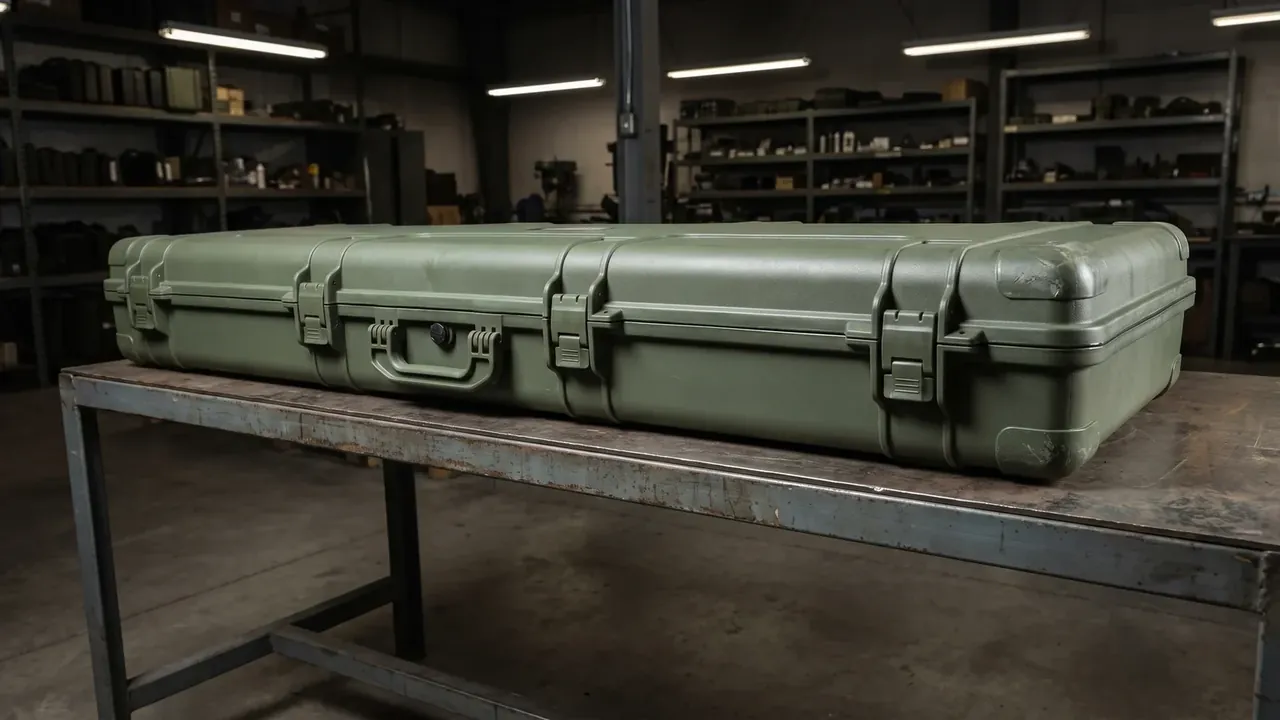
Hang time reads stiffness too. Lift by the middle handle, hold level for thirty seconds, and watch the ends; more than 3 mm of sag means the rib pitch is too wide or the wall too thin.
Wall and stiffness are different things. Wall resists corner cracks; ribs carry bending. Ribs at 105 mm pitch and 11 mm deep save 600 g against 0.8 mm of extra wall, and deflect less. Ask for rib pitch and depth first, wall second.
3. Seal and Purge: What a Cup of Water Proves
Start with the purge valve. Close the lid, press with a palm and listen: a faint hiss means air moves and the cord is compressed. Silence means a blocked valve or a dry seal.
A cup of water is the cheapest field test. Close the lid, pour half a cup along the seam, wait five minutes, then look inside the groove. It will not find a slow leak, but it catches an unseated cord.
The formal criterion is 0.25 bar held for 90 seconds, with 0.015 bar of loss at most. Without a rig, ask for the record and retest one unit.
4. Blocks and Support: Press the Middle
Three blocks should carry the stock, the receiver and the barrel of a sniper rifle case. Press the middle with a palm: a return within two seconds means a buffer layer under the block. A hard, slow push usually means one slab glued to the shell.
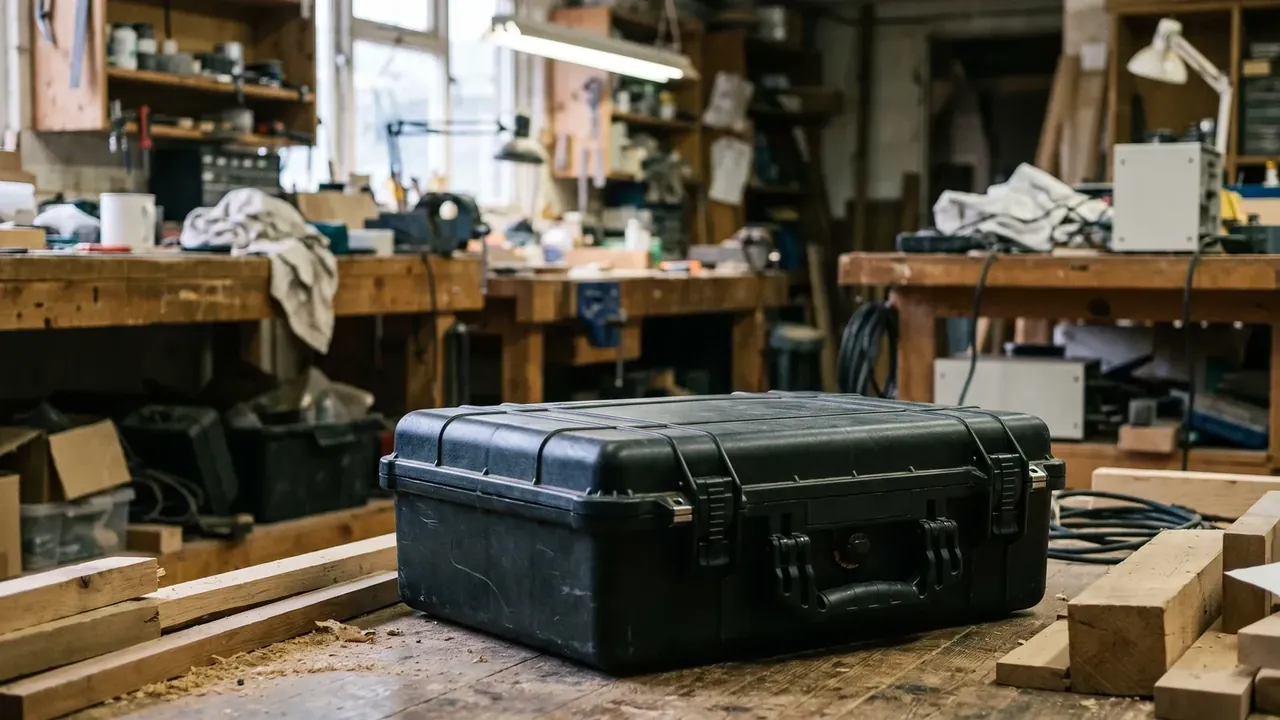
Four hand tests beat reading a datasheet:
- press the middle and time the return
- pinch a block edge, hard or foam
- close and shake, listening for movement
- pull a block, look for a buffer
The fourth is the one buyers skip. A removable block follows a barrel change; a glued one does not.
5. Three Numbers Hidden in the Quote
Two quotes for the same size can differ by thirty percent, and the gap sits in three numbers: cavities per tool, cooling seconds, salt-spray hours. All three show later as warpage or rust.
| Ask | Typical reply | Reply worth having | Why it matters |
|---|---|---|---|
| Tooling | We have a mould | One cavity, revision four | Multi-cavity parts vary |
| Cooling | 60 seconds | 75 seconds or more | Rushed cooling bows the lid |
| Salt spray | We test it | 96 hours, report with goods | Hardware life |
| Sampling | 25 days | 7 days sample, 25 days bulk | Slow means tool changes |
None is hard to ask. What is hard is a specific answer; a supplier who says it is no problem usually has no record.
Conclusion
A sniper rifle case needs no laboratory: a tape, a palm, an ear and a cup cover cavity, stiffness, seal and blocks. Settle those four, then argue price.
This article discusses only the container (case body) side of specifications and design intent, and does not cover any handling, loading or use of the contents.
Related Reading
- Sniper rifle case applications and load-outs
- Sniper rifle case specifications: cavity, blocks, damping
- Judging criteria for rifle cases
- Judging criteria for gun cases
Related Products
- 8 Series — Gun Cases; Military Equipment Cases; Camera Equipment Cases; Drone Cases; Watch Cases; Knife Cases; First Aid Cases; Electronics Equipment Cases
- WL8-2812 PP Gun Case — model WL8-2812
- All protective cases and toolboxes: 7 series, 158 models