

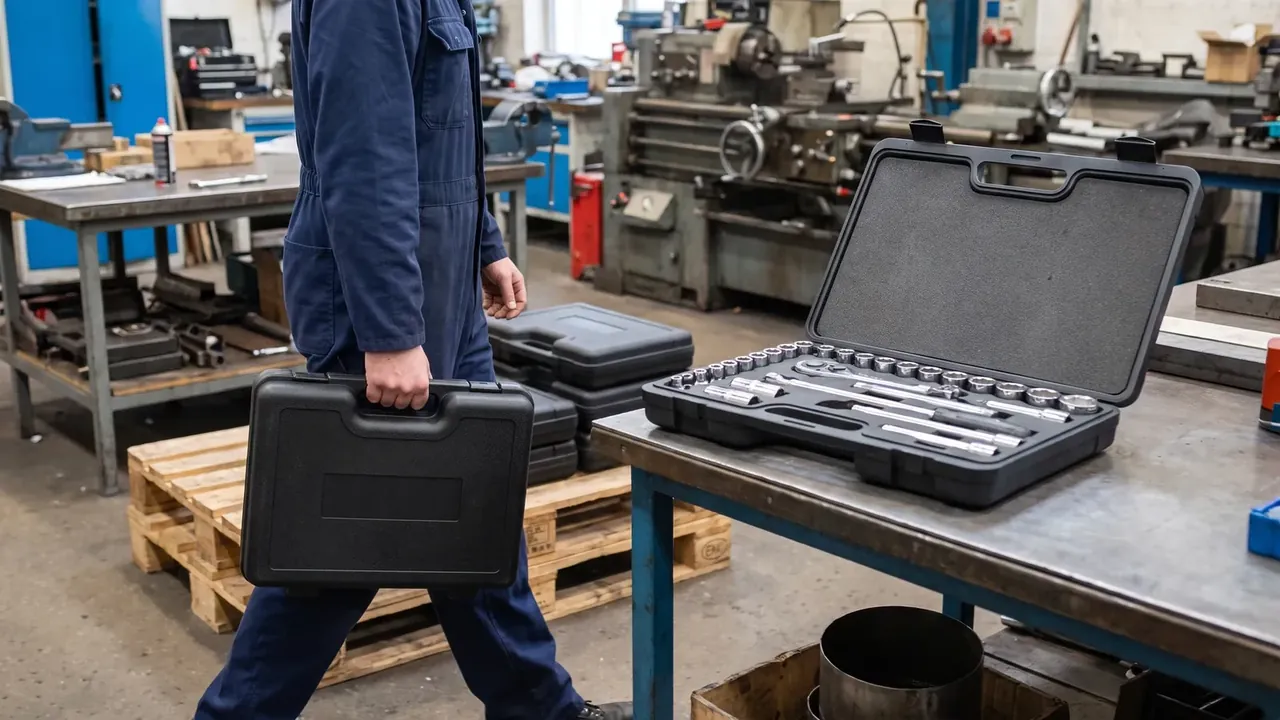
Quick answer: Acceptance of a socket wrench set case runs on seven items: appearance, dimensions, liner fit, latch force, drop, stack and salt spray. Each gets a method and a pass value, then AQL sampling and a defect grade decide release.
Table of contents
- What the socket wrench set case acceptance covers
- Appearance and dimensional measurement
- Liner fit and latch holding force
- Drop and stack tests
- Salt spray and AQL sampling
- FAQ
1. What the socket wrench set case acceptance covers
Acceptance fixes seven items into one sheet for a socket wrench set case, each with a method and a pass value. Appearance and dimensions run on every unit; liner fit and latch force are sampled per batch; drop, stack and salt spray are type tests, run once per structure.
Order matters: appearance precedes dimensions, and type tests sit last, since they measure margin rather than craft.
| Item | Method | Pass |
|---|---|---|
| Appearance | Visual, 500 lux | No cracks or through scratches |
| Dimensions | Caliper, plate, gauge | Outline within 2.0 mm |
| Liner fit | 0.25 mm feeler | No entry past 3 mm |
| Latch force | Pull gauge, 10 seconds | 200 N or more |
| Drop | 15 kg loaded, 1.2 m | No crack, latches shut |
| Stack | 200 kg on top, 72 hours | Set under 2 mm |
| Salt spray | Neutral, 48 hours | No red rust, white rust under 5 percent |
2. Appearance and dimensional measurement
Read appearance at 500 lux from 600 mm, square on and from the side: cracks, through scratches, flow and sink marks. Colour goes to a spectrophotometer on three cases, within delta E 1.5.
Four dimensions decide. Outline sits within 2.0 mm; wall comes from nine readings averaged to 3.8 mm plus or minus 0.15 mm; floor diagonal differs under 2.5 mm; rim warp stays below 2 mm per metre. Condition samples 4 hours at 23 C and 50 percent humidity first.
3. Liner fit and latch holding force
With the liner seated, run a 0.25 mm feeler along each rim; entry past 3 mm fails the unit. Three pockets then get a centre offset check, within 0.4 mm.
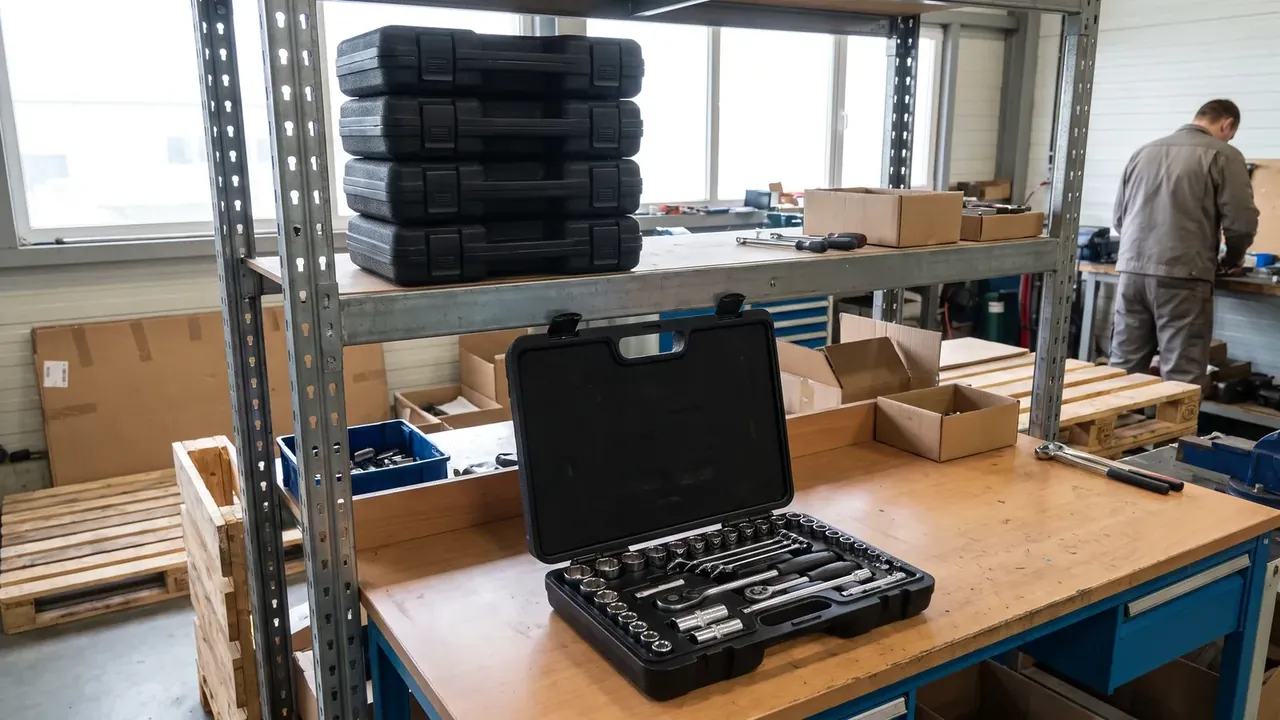
Latch force is a pull gauge job: load to rating, pull at the tongue, hold 10 seconds, no release at 200 N. After 2000 cycles force stays above 170 N, a loss under 15 percent, and both latches sit within 20 N.
4. Drop and stack tests
Drop a case loaded to 15 kg from 1.2 m onto concrete, once on each face, then repeat from a corner after six hours at minus 18 C. No crack, no sprung latch, no lifted liner, and it must still close and latch.
Stack puts 200 kg on the lid for 72 hours at 45 C. Set stays under 2 mm an hour after release, the lid takes no dish and the latches do not shift. Take the warehouse tier count plus one, up to five.
5. Salt spray and AQL sampling
Salt spray covers metal only: latches, pins and rivets. After 48 hours of neutral spray there is no red rust and white rust stays under 5 percent. Inserts come off finished cases, not supplier coupons.
Sampling of a socket wrench set case follows GB/T 2828.1, normal, single, general level II. A lot of 501 to 1200 gives 80 pieces: AQL 1.0 major, accept 2 reject 3; AQL 2.5 minor, accept 5 reject 6. Critical items are not sampled; every unit is checked.
| Lot size | Sample | Major accept and reject | Minor accept and reject |
|---|---|---|---|
| 151 to 280 | 32 | 1 and 2 | 2 and 3 |
| 281 to 500 | 50 | 1 and 2 | 3 and 4 |
| 501 to 1200 | 80 | 2 and 3 | 5 and 6 |
| 1201 to 3200 | 125 | 3 and 4 | 7 and 8 |
| Grade | Examples | Action |
|---|---|---|
| Critical | Latch off, shell cracked | Reject the lot |
| Major | Outline out, low latch force | Double the sample |
| Minor | Faint flow mark, label off centre | Accept with a note |
Records trace batch code, mould, machine and resin lot; the code has twelve digits. Two retention samples per batch sit eighteen months. Miss one layer and the batch is untraceable.
Conclusion
Acceptance for a socket wrench set case is one table tying method, gauge, pass value and record. Full inspection guards appearance, sampling guards latches, type tests guard margin. Draw the boundaries clearly and a socket wrench set case batch stops drifting.
This article discusses only the container (case body) side of specifications and design intent, and does not cover any handling, loading or use of the contents.
Related Reading
- Socket wrench set case in repair work
- Production SOP and judgement
- Waterproof hard case standards
- Resin lot and goods traceability
Related Products
- 8 Series — Gun Cases; Military Equipment Cases; Camera Equipment Cases; Drone Cases; Watch Cases; Knife Cases; First Aid Cases; Electronics Equipment Cases
- WL8-2812 PP Gun Case — model WL8-2812
- All protective cases and toolboxes: 7 series, 158 models