

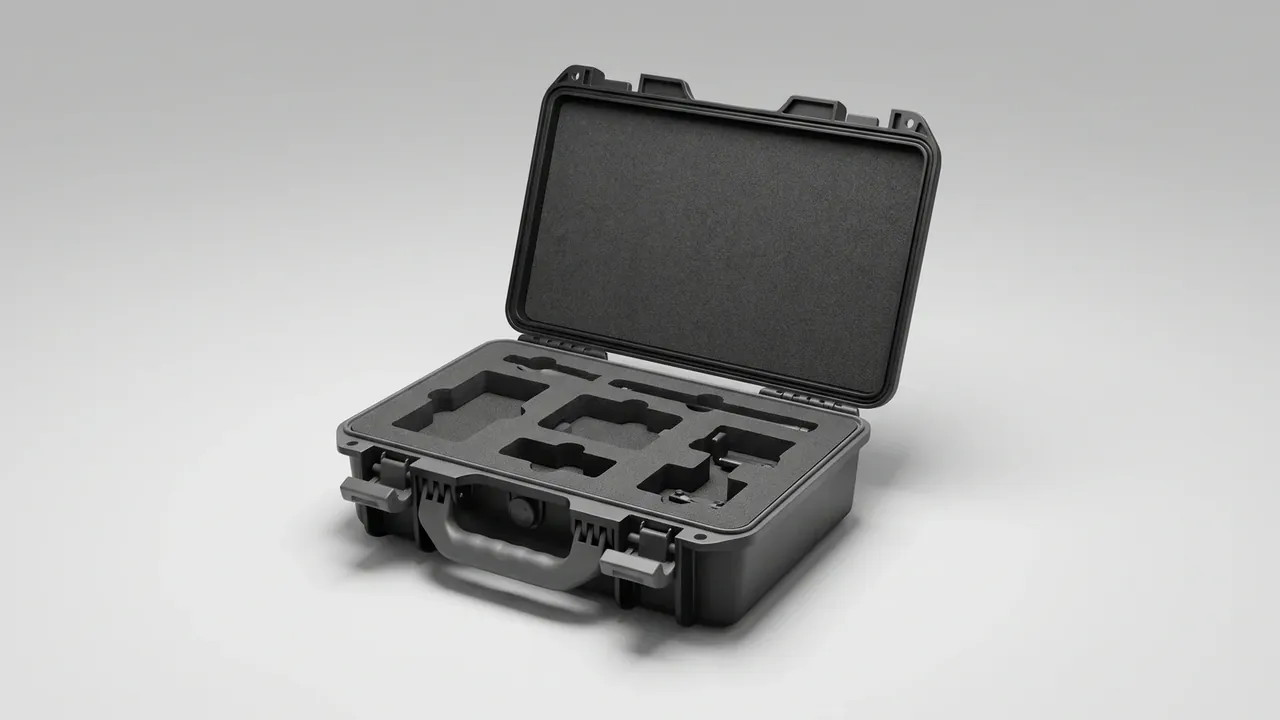
Quick answer: Five build details decide a specialized shipping and storage container: wall thickness, ribs and corners, the seal groove and gasket, hinges and latches, and the foam insert. The first four are fixed in one heating cycle; foam is added at assembly.
Table of contents
- Five Structural Layers of a Specialized Shipping and Storage Container
- Wall Thickness Distribution
- Ribs, Corners and the Seal Groove
- Hinges and Latches
- Foam Inserts and Dividers
- FAQ
1. Five Structural Layers of a Specialized Shipping and Storage Container
A specialized shipping and storage container is five structural surfaces in one shell: wall for stiffness, ribs and corners for local load, groove and gasket for isolation, hinges and latches for closure, foam and dividers for location.
Tolerance is inherited in that order. Rib depth sets where wall thickness lands, wall thickness sets rim flatness, and rim flatness sets how evenly the gasket compresses. A lid that will not sit down usually started three operations earlier.
| Detail | Made by | Measured as |
|---|---|---|
| Wall | Powder charge, biaxial ratio | 6 mm average, ±0.8 mm |
| Ribs | Mould grooves, R25 corners | 12 mm height, R3 root |
| Groove | Moulded with the rim | 70 percent fill |
| Latches | Over-centre catch | 60 N opening force |
2. Wall Thickness Distribution
Powder fuses in layers. Thick zones come from piling, thin zones from poor heat transfer. On a specialized shipping and storage container with a 600 mm internal length, a 4.2 kg charge gives about 6 mm average, yet the corners measure near 9 mm because powder lingers there.
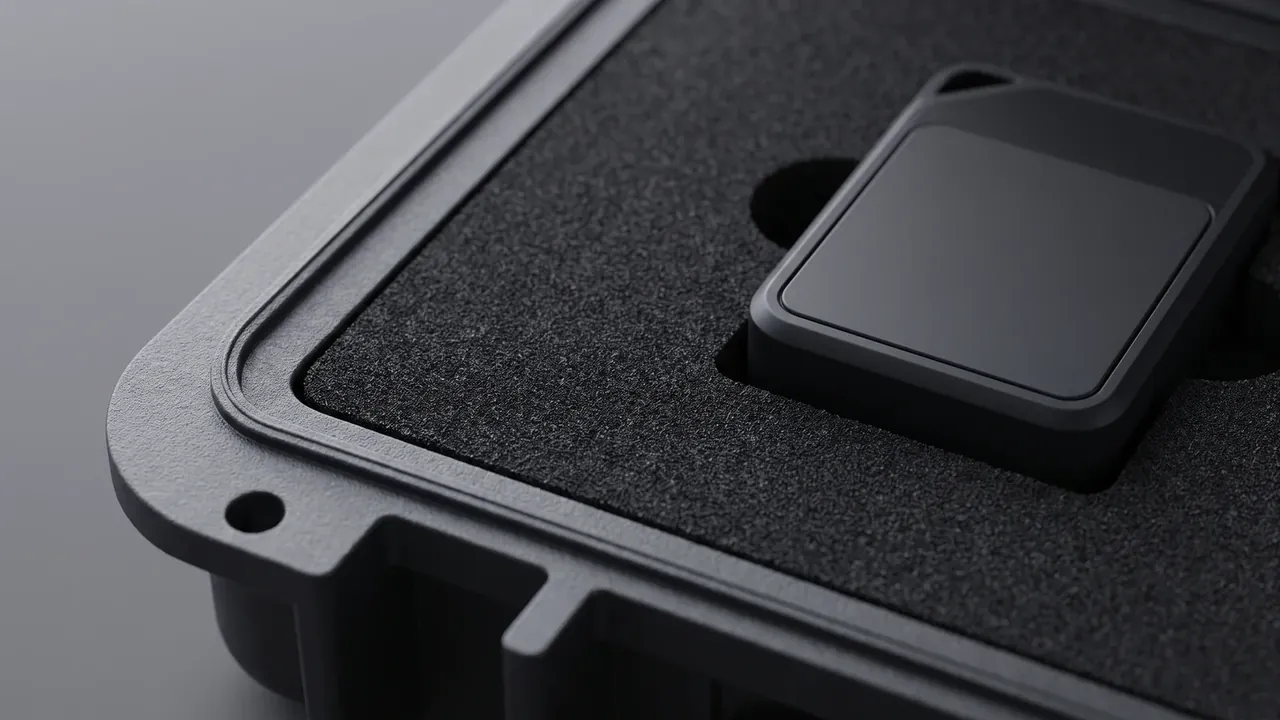
That corner mass is physics, not intent. Trimming it needs insulating pads and local thinning, not a smaller charge, which would thin the side walls too.
Control comes from a gauge map: twelve points per case, base and sides and corners, tolerance ±0.8 mm, anything under 4.0 mm rejected. A 4 to 1 biaxial ratio, 280 °C oven and 22 min cycle is a common starting point.
3. Ribs, Corners and the Seal Groove
A rotomoulded rib is a continuous shoulder, recessed outside and raised inside, normally 12 mm high with an R3 root at 90 mm spacing. Transverse ribs fight side-wall bulge; longitudinal ribs pass stacked load to the base.
Corners absorb impact and anchor the hardware. At R25 or more, with the hinge boss merged into solid material, screw holes stay out of thin wall.
The groove is moulded with the rim: 6.0 mm wide, 4.5 mm deep, holding a 7.0 mm silicone cord. Groove area of 27 mm² against a cord area near 38.5 mm² gives roughly 70 percent fill, leaving void for rubber displacement. Past 85 percent the cord is pushed out as the lid closes.
4. Hinges and Latches
The hinges and latches on a specialized shipping and storage container are the load path. A side impact travels through the hinge into the rear wall, and the two front latches close the loop; one loose link opens the rim.
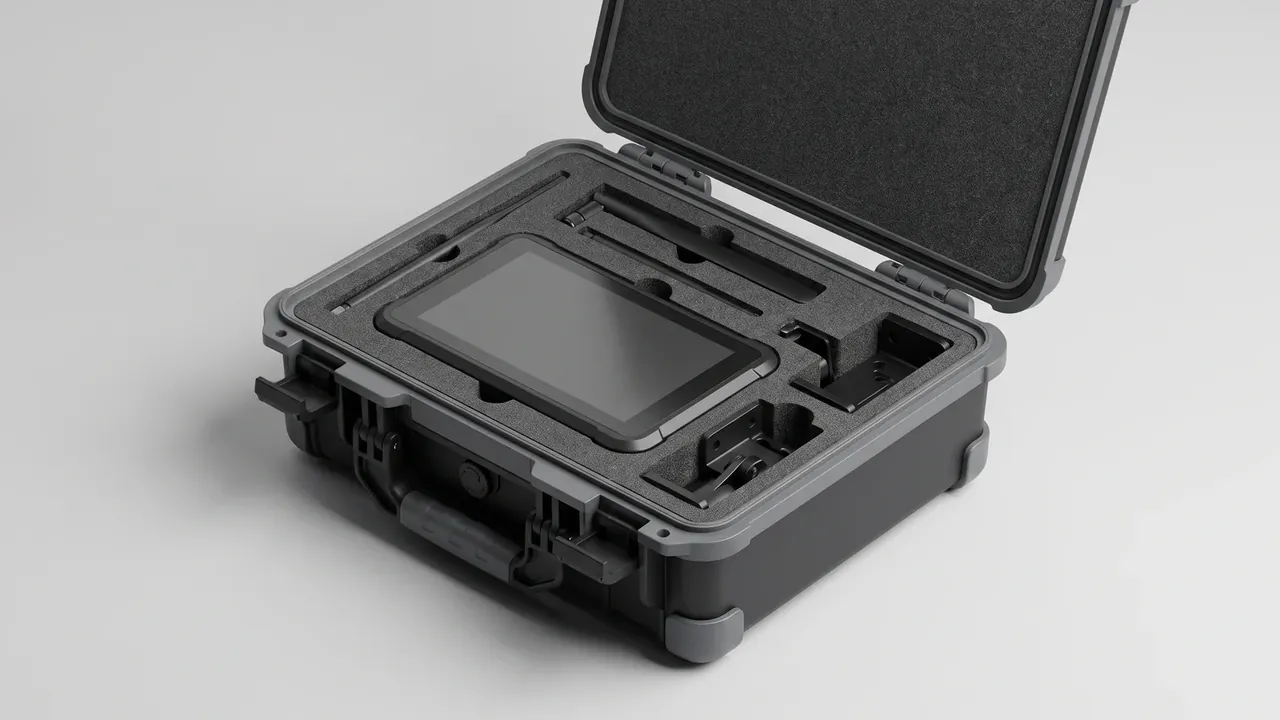
Two 4 mm stainless pins sit in bosses sunk 3 mm into the shell with 0.15 mm clearance per side. More and the lid racks; less and the pin seizes after cold soak and salt spray, usually at six months.
The latch passes 2 mm beyond dead centre and holds preload by spring. Opening force is about 60 N, rising to 75 N at minus 20 °C, so lever length follows a gloved finger, not a bare hand.
5. Foam Inserts and Dividers
Foam turns a point impact into face pressure; a divider cuts interaction between neighbours. The split belongs on the drawing, or the bench lets one replace the other.
| Type | Density | Fixing |
|---|---|---|
| CNC EVA | 45 kg/m³ | Full sheet, edge strips |
| PE foam | 30 kg/m³ | Layered, spot glued |
| PP divider | 8 mm | Slots and clips |
Two clearances are deliberate: 2 mm between pocket and item, 1.5 mm between divider and wall. Replace foam with a permanent set past 10 percent, a cracked slot, or a facing lifted over 5 mm.
Conclusion
Read a specialized shipping and storage container as five surfaces: wall, ribs, groove, latches, foam. One moulding cycle and one assembly step finish them, and tolerance runs from mould to gasket compression. Asking about gauge points and groove forming first keeps a batch out of rework, and that chain is what a specialized shipping and storage container really is.
This article discusses only the container (case body) side of specifications and design intent, and does not cover any handling, loading or use of the contents.
Related Reading
- Custom specifications and acceptance points
- Industrial and defense applications
- How a transport and storage case is defined
- How rotational moulding shapes a case body
Related Products
- 8 Series — Gun Cases; Military Equipment Cases; Camera Equipment Cases; Drone Cases; Watch Cases; Knife Cases; First Aid Cases; Electronics Equipment Cases
- WL8-2812 PP Gun Case — model WL8-2812
- All protective cases and toolboxes: 7 series, 158 models