

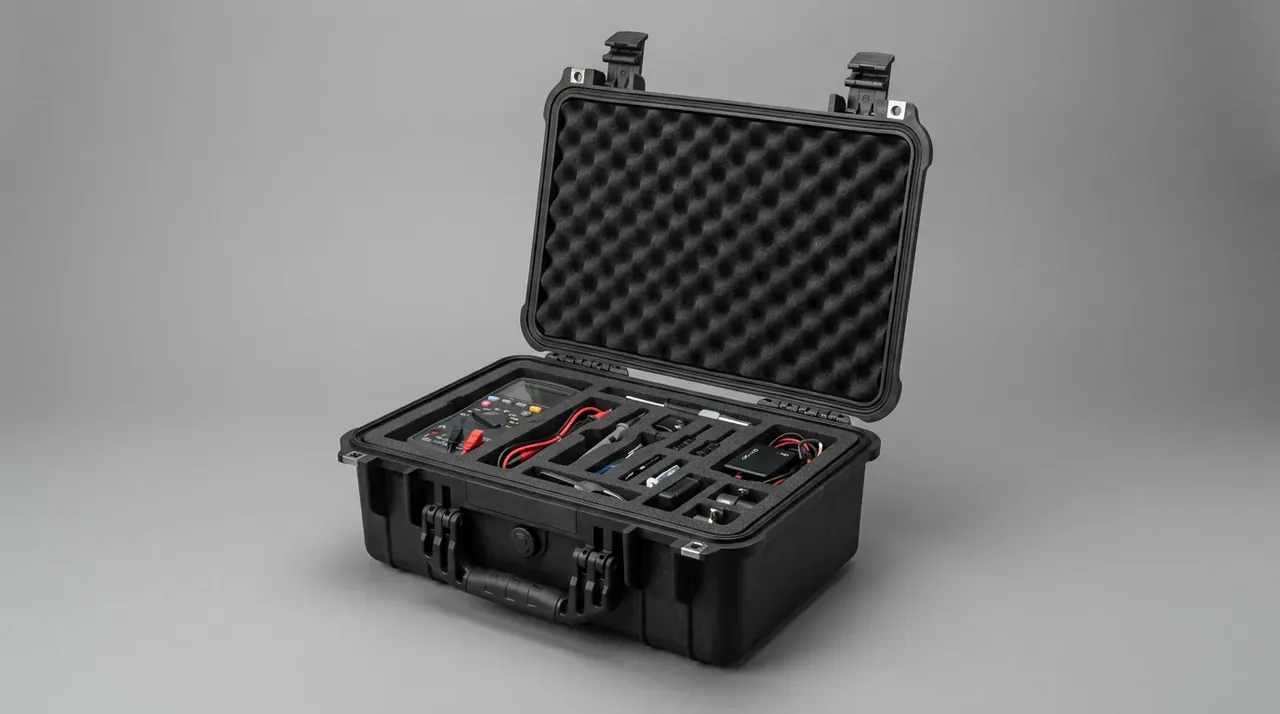
Quick answer: The same case sinks 1.1 mm in 24 hours and 3.4 mm in 7 days, so a case stack test judged at one duration cannot serve the other.
Table of contents
- Why stack duration decides the verdict
- Where the 24-hour and 7-day curves diverge
- Deformation against temperature
- Loading method: real stacks versus weights
- Which time point to judge
- FAQ
1. Why stack duration decides the verdict
A 600×400×220 mm PP case under 300 kg of spread load sinks 1.1 mm at the base centre in 24 hours, 3.4 mm at day 7 and 3.62 mm at day 30. The number keeps moving, so a threshold means nothing without the clock beside it.
Plastic is not a spring. Elastic response covers 12–15 percent of the total; the rest arrives as chains slide, a process measured in days, so a case stack test fixes a stopping point rather than a time.
Twenty-four hours comes from shipping routine: press overnight, load next morning. Seven days matches a sea leg plus customs. A case specified at 24 hours holds with a 3.0 mm wall; the same load at 7 days needs a 3.6 mm base or two ribs 25 mm tall, adding 8–12 percent to material cost.
2. Where the 24-hour and 7-day curves diverge
Creep runs in three stages: a fast 2-hour stage carrying about half the total, a transition to 72 hours at a quarter of that slope, then a steady stage that flattens without reaching zero.
| Time | Sink | Share of total | Daily gain |
|---|---|---|---|
| 1 h | 0.42 mm | 12% | 10.1 mm |
| 8 h | 0.86 mm | 24% | 2.58 mm |
| 24 h | 1.10 mm | 30% | 1.10 mm |
| 72 h | 1.85 mm | 51% | 0.62 mm |
| 168 h | 3.40 mm | 94% | 0.49 mm |
| 720 h | 3.62 mm | 100% | 0.12 mm |
Day one covers 30 percent, day seven covers 94 percent. Testing only the first leaves 70 percent of the deformation outside the report; testing past day 7 adds 6 percent, already inside measurement error.
The knee sits between 60 and 80 hours, where temperature lifts the slope again. A workshop at 26 °C by night and 38 °C by day produces 0.2–0.4 mm steps that read like a second collapse and are thermal expansion stacked on accelerated creep.
3. Deformation against temperature
Holding case and load constant, 7-day sink measures 3.4 mm at 23 °C, 5.1 mm at 40 °C, 7.4 mm at 50 °C and 1.2 mm at -10 °C. The 23 to 40 °C step adds 50 percent, and the next 10 °C adds another 45 percent.
The response is not linear. PP sits well above its glass transition near 0 °C, so warming raises chain mobility exponentially; creep rate runs 1.4–1.6 times faster per 10 °C, and past 45 °C by over 1.8 as the material nears its heat deflection range.
Every case stack test report needs a temperature line. A 3.4 mm result at 23 °C becomes 5.1 mm in a 40 °C warehouse, and quoting the cooler figure assumes the customer air-conditions the building. Summer shipments are the trap: interiors reach 60–65 °C, and cases approved at 23 °C arrive with 6–9 mm of set.
4. Loading method: real stacks versus weights
The loading method sets the stress field, and the approaches differ by over 40 percent, so any duration claim must name the method behind it.
| Method | Contact | 24 h | 7 days | Use |
|---|---|---|---|---|
| Real stack, 3 high | 300×400 mm face | 1.10 mm | 3.40 mm | Pre-shipment |
| Weight, spread | Full steel plate | 1.60 mm | 4.90 mm | Design comparison |
| Weight, single point | 100×100 mm pad | 2.40 mm | 7.20 mm | Limit screening |
Real stacking is closest to service but poorly repeatable: ribs rarely align, load shifts to one side, and three samples differ by 0.6 mm over 7 days. It suits batch release, not design work.
Weights give control. A full plate holds eccentricity under 5 percent and reads 4.90 mm at day 7, 44 percent above real stacking, because steel does not shed load as a deforming upper case does. A 100×100 mm pad raises local stress twelvefold and leaves a dimple, so it finds limits rather than accepting batches.
5. Which time point to judge
The judgement point follows the application, not a standard: 7 days for storage under 30 days, 30 days beyond 45 days at sea, 24 hours for internal transfer.
Thresholds scale between 24 hours and 7 days, and only inside that window. With 1.1 mm against 3.4 mm, a 4.0 mm limit at day 7 corresponds to 1.3 mm at hour 24, not the same 4.0 mm carried across.
Recovery is counted separately. A sample that sinks 3.4 mm returns to 2.9 mm after a day of rest, so the verdict reads the recovered figure; judging the loaded peak overstates deformation by 15 percent.
Measuring points belong in the method: base centre, four edge midpoints and each corner, with the maximum reported, since centre and corner differ by 0.8 mm. Write the purchase clause in three parts: real stack 3 high, 40 °C, 7 days, permanent set under 4.0 mm.
Conclusion
Duration and threshold travel together: 1.3 mm at 24 hours, 4.0 mm at 7 days, 4.2 mm at 30 days. Move a limit across durations and the decision flips, releasing early collapse at one end and scrapping sound designs at the other.
Work in three steps. Fix the application, taking 7 days for storage under 30 days and 30 days beyond 45 days at sea. Fix the method, real stacking for batch release, a spread plate for design comparison. Then write temperature, time, measuring points and limit into one clause. A longer test is not safer; it decides where the curve gets cut, and that cut makes the numbers comparable.
This article discusses container-side specifications and design implications only, and does not cover any handling, loading or use of the contents.
Related Reading
- How to calculate a case load limit
- Wall thickness against compression strength
- Corner loading and reinforcement when stacking
Related Products
- 8 Series — Gun Cases; Military Equipment Cases; Camera Equipment Cases; Drone Cases; Watch Cases; Knife Cases; First Aid Cases; Electronics Equipment Cases
- WL8-2812 PP Gun Case — model WL8-2812
- All protective cases and toolboxes: 7 series, 158 models