

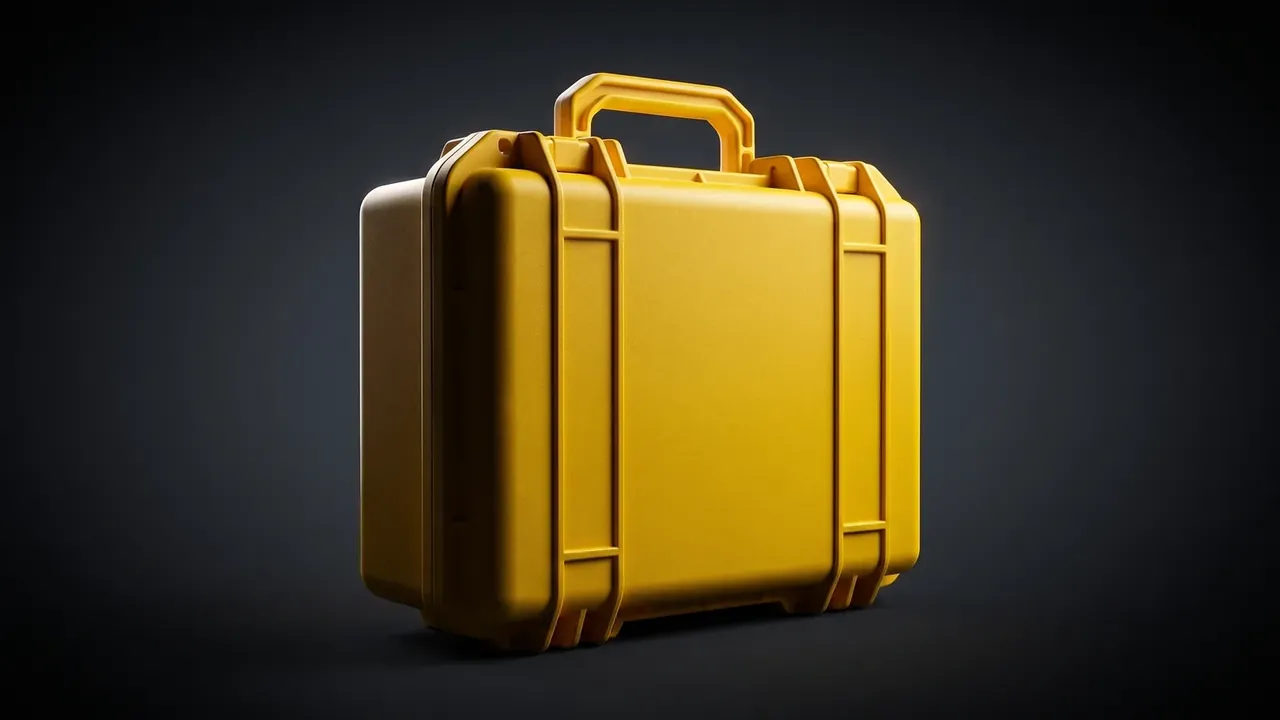
Quick answer: A Stackable Container wins on volume per unit of floor, stack height earned by geometry rather than tape, load-to-weight ratio, and a body that folds for the return leg. It loses on purchase price, which only turnover can dilute.
Table of contents
- Where a Stackable Container Parts Ways with Four Alternatives
- Volumetric Efficiency per Unit
- Stack Height and the Load-to-Weight Ratio
- Return Volume and Service Life
- Five-Year Cost and the Trade-off
- FAQ
1. Where a Stackable Container Parts Ways with Four Alternatives
The alternatives answer different questions: a carton buys one-way protection, a steel bin impact resistance, a moulded box price, a sleeve box an empty return. A Stackable Container buys cycles, so it balances only in a closed loop.
Four measures decide: volume efficiency, stack height, load-to-weight ratio, return volume. They trade against each other: a thicker wall buys height and costs weight.
| Option | Internal, L | Outer, L | Efficiency | Static stack |
|---|---|---|---|---|
| Stackable Container | 68 | 81.6 | 83% | 5 high |
| Corrugated carton | 62 | 72.7 | 85% | 3 high |
| Steel bin | 60 | 78.0 | 77% | 4 high |
| Moulded storage box | 55 | 68.0 | 81% | 2 high |
| Sleeve pallet box | 70 | 84.0 | 83% | 4 high |
On efficiency the carton wins at 85 per cent, because a 7 mm double wall loses little inside. That is an empty-box figure; load it, wet it, and the arithmetic changes.
2. Volumetric Efficiency per Unit
Efficiency is internal litres over outer volume: 83 per cent here on a 3.2 mm wall with a 4 mm floor rib, second behind the carton at 85, ahead of the steel bin at 77.
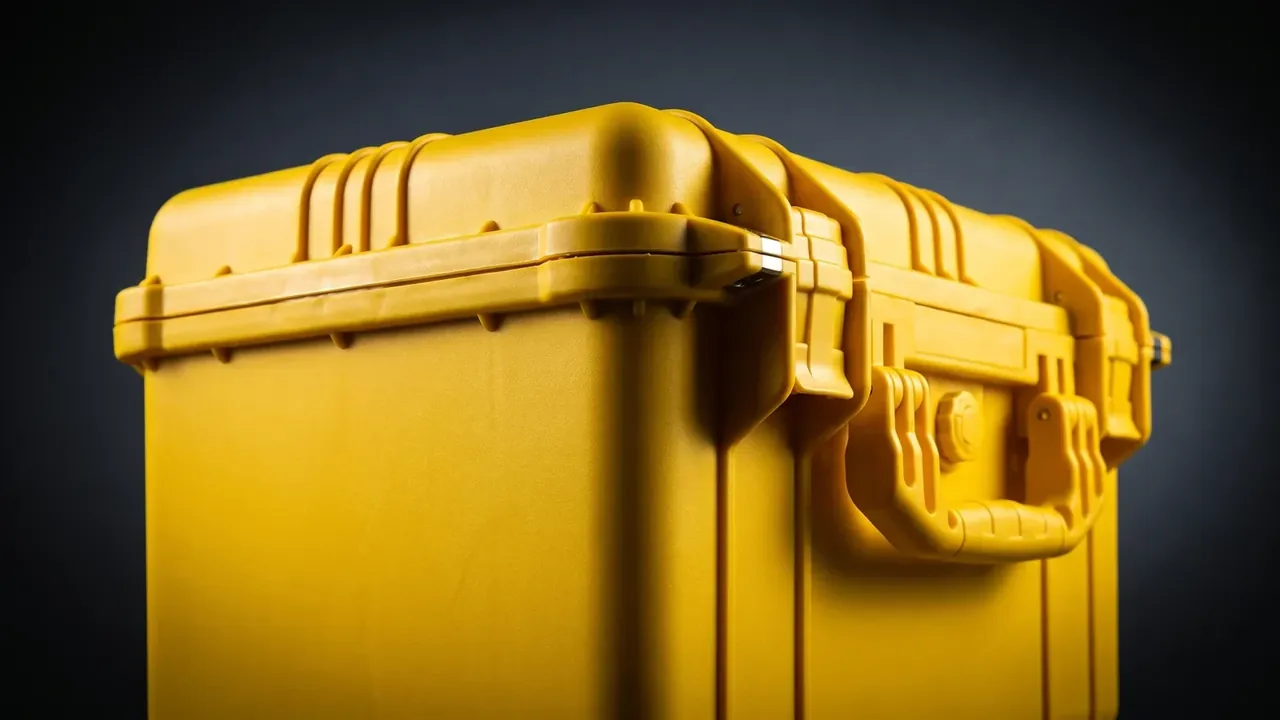
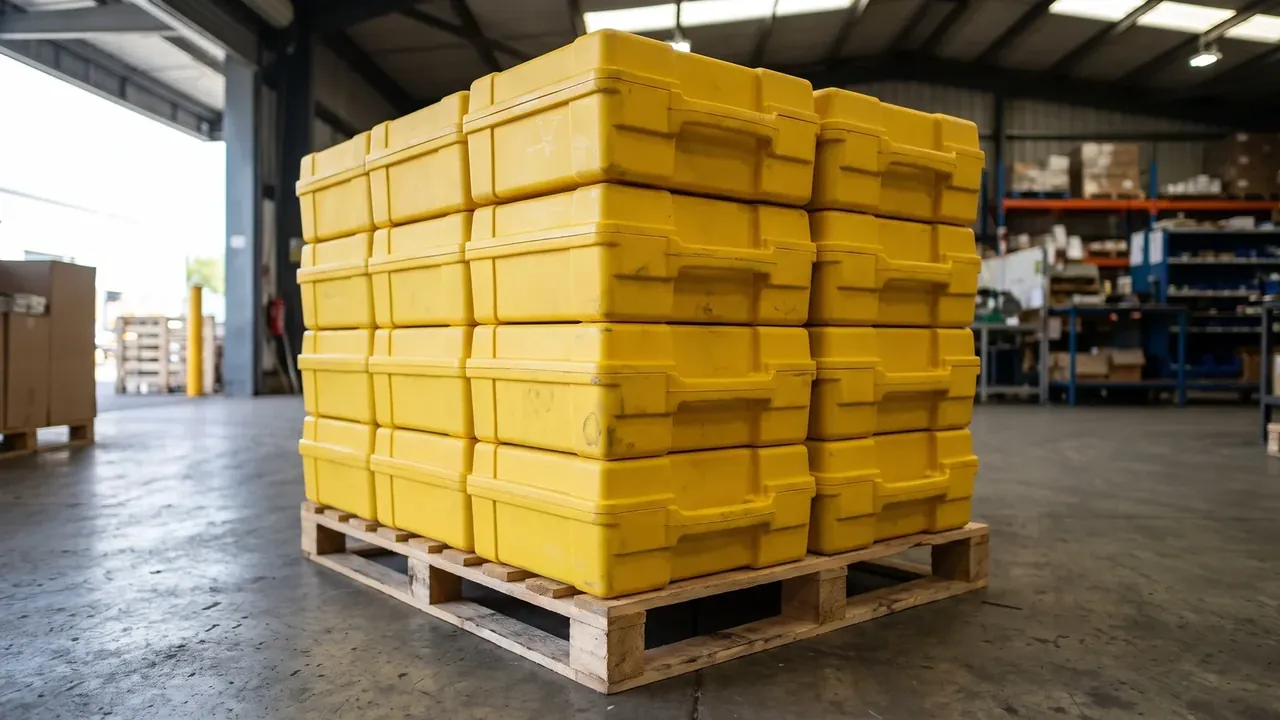
The measure that separates them is litres per square metre. Five high at 340 mm makes a 1.75 m column and 340 L on a 600 × 400 mm footprint; three cartons at 330 mm give 186 L, a factor of 1.8. Rent is charged on area, and steps close the plan area cartons lose to bulge.
3. Stack Height and the Load-to-Weight Ratio
Height is capped by the base lid: 140 kg at five high with 2.5 mm of deflection, and 4.2 mm at six high, where it yields.
| Option | Weight, kg | Load, kg | Load to weight | Base load, kg |
|---|---|---|---|---|
| Stackable Container | 4.6 | 35 | 7.6 | 140 |
| Corrugated carton | 1.1 | 20 | 18.2 | not applicable |
| Steel bin | 26 | 400 | 15.4 | 400 |
| Moulded storage box | 2.4 | 12 | 5.0 | not applicable |
| Sleeve pallet box | 12 | 250 | 20.8 | 250 |
That column flatters the carton at 18.2, yet its mass never meets a tier, while the case spends weight on cones that carry the column. Tare compounds: six units 27.6 kg, six steel bins 156 kg.
4. Return Volume and Service Life
Empty units do not bill as cargo, so the return leg costs more. Folded to 108 mm, the case returns at 32 per cent of its open volume; a sleeve box reaches 22; a steel bin cannot fold and returns at 100.
Life runs in cycles, not years: 1500 rated with steps rounding off near 1200, sleeve hinges failing near 800, moulded boxes at 500, steel bins at 2000 with an annual repaint. Cycles returned per cubic metre justifies the higher price: 1.3 times the sleeve box, 3.1 times the steel bin.
5. Five-Year Cost and the Trade-off
At 78 against 6.5 the case costs twelve times a carton, but the carton is spent once and the case runs 1500 turns, so amortisation falls to 0.06 against 6.50.
| Option | Price | Turns a year | Years | Cost per turn |
|---|---|---|---|---|
| Stackable Container | 78 | 260 | 5 | 0.06 |
| Corrugated carton | 6.5 | 1 | single trip | 6.50 |
| Steel bin | 420 | 260 | 8 | 0.20 |
| Moulded storage box | 32 | 260 | 2 | 0.06 |
| Sleeve pallet box | 260 | 200 | 4 | 0.33 |
Choose by route: one-way despatch takes a carton, impact loads a steel bin, many variants a sleeve box, and a closed loop above 100 turns on racking takes the stackable unit. Below 50 turns the price swallows the gain.
Conclusion
None of the five is better in the abstract, only against a route: the carton wins one-way protection, the steel bin wins load, the moulded box wins price, the sleeve box wins return volume, and the Stackable Container wins by spreading four bills over a thousand turns.
This article discusses only the container (case body) side of specifications and design intent, and does not cover any handling, loading or use of the contents.
Related Reading
- Specifications and stacking parameters for stackable containers
- Reusable shipping and storage boxes against the alternatives
- Transport and storage containers compared
- Portable plastic tool boxes against other materials
Related Products
- 8 Series — Gun Cases; Military Equipment Cases; Camera Equipment Cases; Drone Cases; Watch Cases; Knife Cases; First Aid Cases; Electronics Equipment Cases
- WL8-2812 PP Gun Case — model WL8-2812
- All protective cases and toolboxes: 7 series, 158 models