

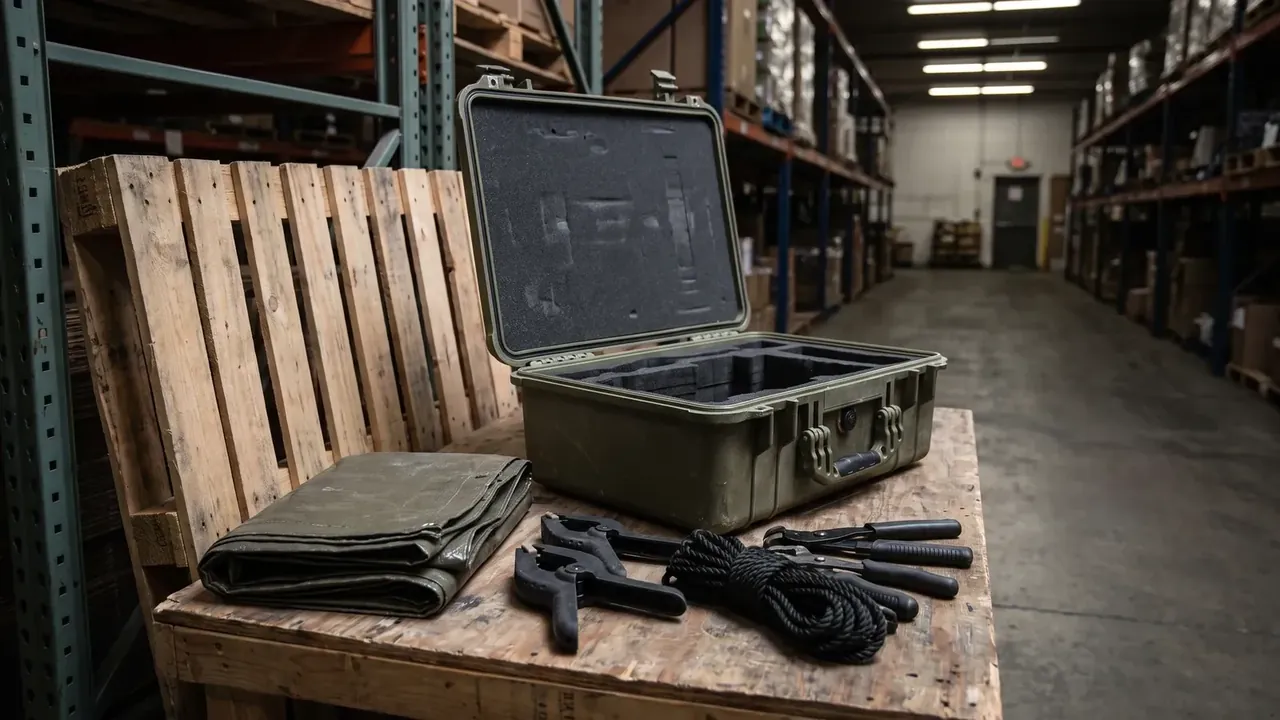
Quick answer: Cleaning is the least useful part of upkeep. Four numbers decide whether a Stackable Container can still go on a stack: lip wear, diagonal skew, rib crack length and latch preload. All four are floor measurements, and the limits below turn them into keep, downgrade or scrap.
Table of contents
- Maintenance Starts at the Stacking Lip
- Compression Set and Diagonal Skew
- Rib Cracks, Hinge Wear and Latch Preload
- Feet, Gaskets and Cleaning Residue
- Inspection Intervals and Scrap Limits
- FAQ
1. Maintenance Starts at the Stacking Lip
The lip is the step where the base boss mates with the lid groove. On a three-high stack the bottom Stackable Container carries the two above plus every jolt in transit; once the lip rounds off, the body walks sideways.
Read boss height with a 0.02 mm caliper at twelve points and groove depth with a gauge. The difference is effective engagement: 8 mm new, watch below 7.5 mm, act below 6.5 mm, where ±4 mm of lateral tolerance has shrunk to ±1.5 mm.
| Engagement | Verdict | Action |
|---|---|---|
| Above 7.5 mm | Normal | Monthly re-check |
| 6.5 to 7.5 mm | Downgrade | Two high, off transport pallets |
| Below 6.5 mm | Scrap | Withdraw |
2. Compression Set and Diagonal Skew
A Stackable Container that has carried full loads goes from square to rhomboid, and the giveaway is two base diagonals of unequal length. On a 1200 × 800 × 600 mm case, 3 mm is new, 5 mm is out of service.

Skew accumulates: one drop will not move it 5 mm, twenty off-centre stacks will. Measure empty without a liner, three times, and use the middle reading.
Rim flatness is the second figure. A 1000 mm rule on edge plus a feeler gauge; 2.5 mm means the lid no longer presses the gasket and load lands on one or two corners.
3. Rib Cracks, Hinge Wear and Latch Preload
Cracks start at rib roots, where stiffness is bought with stress concentration. Sweep the roots of each Stackable Container with a 5x magnifier under raking light for a pale hairline.
| Part | Method | Replace at |
|---|---|---|
| Rib | 5x lens, raking light | Crack over 15 mm or through the wall |
| Hinge | Pin gap check | Over 1.2 mm, or slack at 3000 cycles |
| Latch | 200 N spring scale | Under 120 N after seat adjustment |
| Corner | Visual check | Any crack through the wall |
Hinge life is counted in cycles: 3000 openings, about two and a half years at four a day, by which time the 0.3 mm pin gap is over 1 mm and the lid rocks. Latch fatigue hides better; a 200 N scale on the nose reads 180 N when new and 120 N at the floor.
4. Feet, Gaskets and Cleaning Residue
Four feet lift the body 8 mm so tines can enter and the base never grinds the floor. Lose one and the case stands on three points, the empty corner sinks, and the lip takes the load on one side; one missing foot means off hire, 3 mm of set means a full set.
A 65 Shore A gasket hardens past 75 within three years and lets IP65 slip to IP54. Cleaning is where procedure turns into theatre: a caustic or chlorinated wash looks clean while residue soaks into the pores, so use pH 6 to 8, chloride under 50 mg/L and 20 minutes at 60 °C.
5. Inspection Intervals and Scrap Limits
Rank intervals by failure speed: latches and feet every shift, lip and rim flatness monthly, diagonals quarterly, the static test twice a year.
| Interval | Check | Record |
|---|---|---|
| Each shift | Latches, feet, damage | Shift checklist |
| Monthly | Lip, rim flatness | Inspection card |
| Quarterly | Diagonals, gasket hardness | Asset log |
| Half-yearly | Static stack re-test | Re-test report |
Load to four times rated, hold 24 hours, release and measure after 30 minutes; beyond 2% set the rib roots are already micro-cracked while the outside looks sound. A 500 kg rated Stackable Container is tested at 2000 kg, and engagement under 6.5 mm, a crack through a wall or 2% set scraps it.
Conclusion
Upkeep rests on four figures anyone can take with a caliper, a tape and a spring scale: lip engagement, diagonal skew, crack length and latch preload. Spread them across shift, month, quarter and half-year, and remaining life becomes a calculation instead of a post-mortem. That discipline is what maintenance of a Stackable Container really means.
This article discusses only the container (case body) side of specifications and design intent, and does not cover any handling, loading or use of the contents.
Related Reading
- Stacking design of stackable containers: load, interlock and stability
- Why stackable containers collapse and how to stop it
- Maintenance intervals for reusable shipping and storage containers
- Pallet and case marking rules
Related Products
- 8 Series — Gun Cases; Military Equipment Cases; Camera Equipment Cases; Drone Cases; Watch Cases; Knife Cases; First Aid Cases; Electronics Equipment Cases
- WL8-2812 PP Gun Case — model WL8-2812
- All protective cases and toolboxes: 7 series, 158 models