

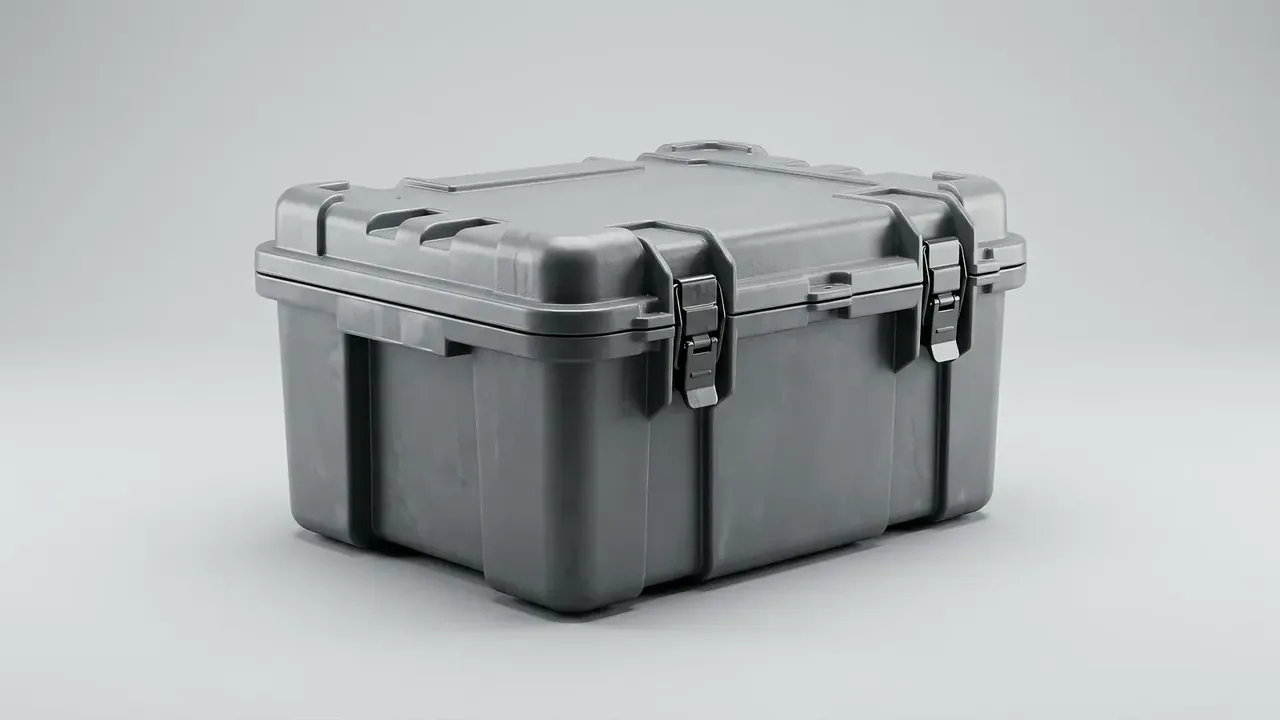
Quick answer: A stack rarely collapses because the case is too weak. One of four links breaks first: layers that never interlock; a bottom layer beyond its allowable value for that temperature and duration; a pallet or floor turning vertical load into an overturning moment; a centre of gravity outside the base. Fix them in that order.
Table of contents
- Four signs that a stackable container stack is failing
- Top geometry and interlocking
- Overload and long-term creep
- Pallets, floors and centre of gravity
- Diagnosis order and reinforcement
- FAQ
1. Four signs that a stackable container stack is failing
A failing stack seldom falls without warning.
| Sign | What you see | Likely cause |
|---|---|---|
| Layer offset | Upper case shifted | No geometric constraint |
| Local collapse | One corner sinks, lid dished | Bottom layer overloaded |
| Corner gaping | Latch open, seam apart | Off-centre load at a corner |
| Whole-stack lean | Stack tilts, wall bulges | Centre of gravity outside the base |
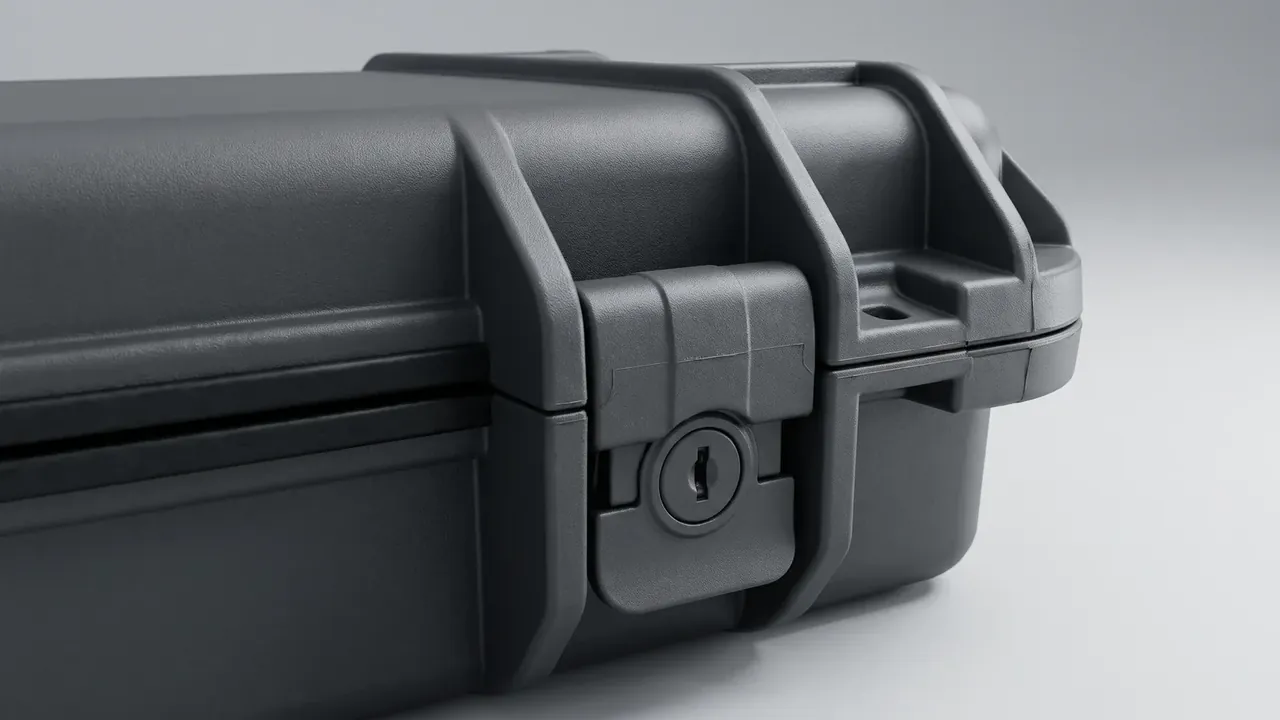
The corner shows trouble first: latch grip and band width decide whether an off-centre load spreads or tears the lid seam. The latch ties the lid to the rim, not case to case. One sign across a layer means geometry; one case means itself.
2. Top geometry and interlocking
Two cases hold because the top of one and the base of the next form a constraint. Flat contact relies on friction alone, near 0.3, too little once an overturning moment appears. Usual forms: a recess with a matching foot, cut wider for moulding tolerance; a stepped rim; corner blocks.
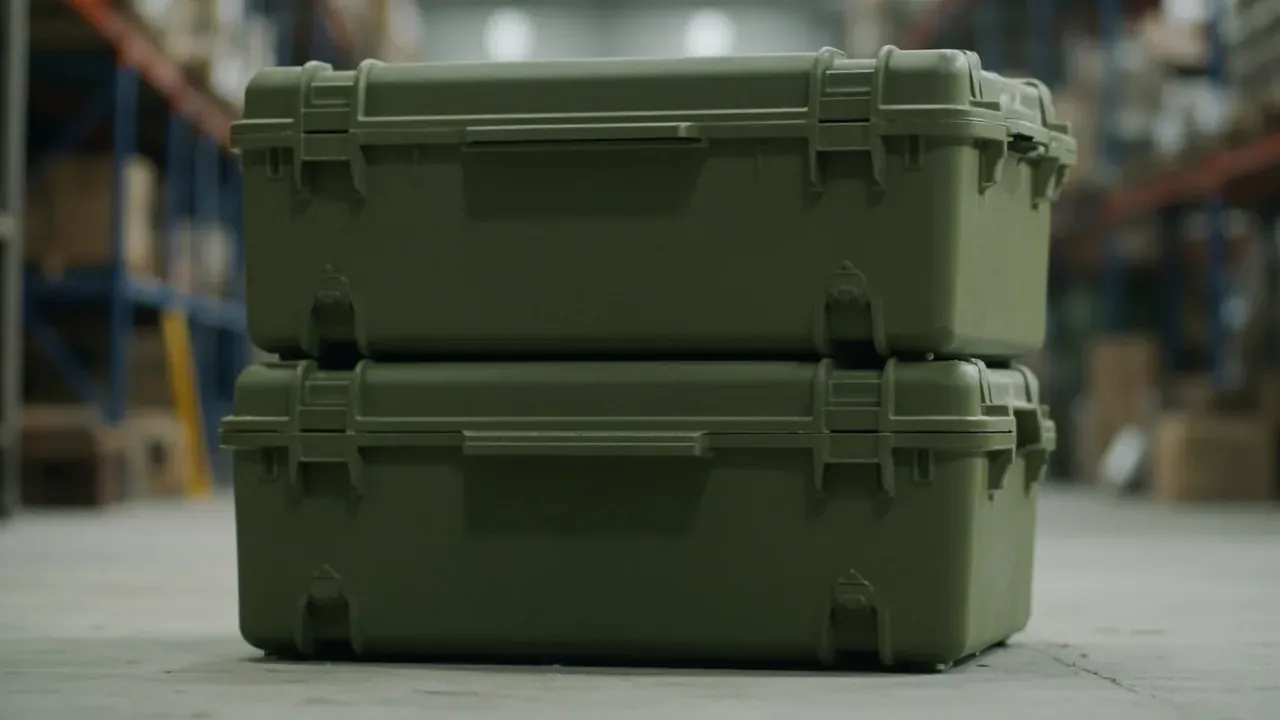
Interlocking handles the horizontal; vertically, the lid needs continuous support. With an empty cavity it bends as a plate supported only at its edges and creeps down, so the case above loses its reference.
3. Overload and long-term creep
A plastic case has a short-term rating and a long-term one. Failure usually arrives three or four weeks after loading.
Load is the weight above divided by the contact area, the projected wall section. Time matters: a thermoplastic deforms slowly under standing load. Temperature matters: one stack allows a different layer count at 20 °C and 40 °C.
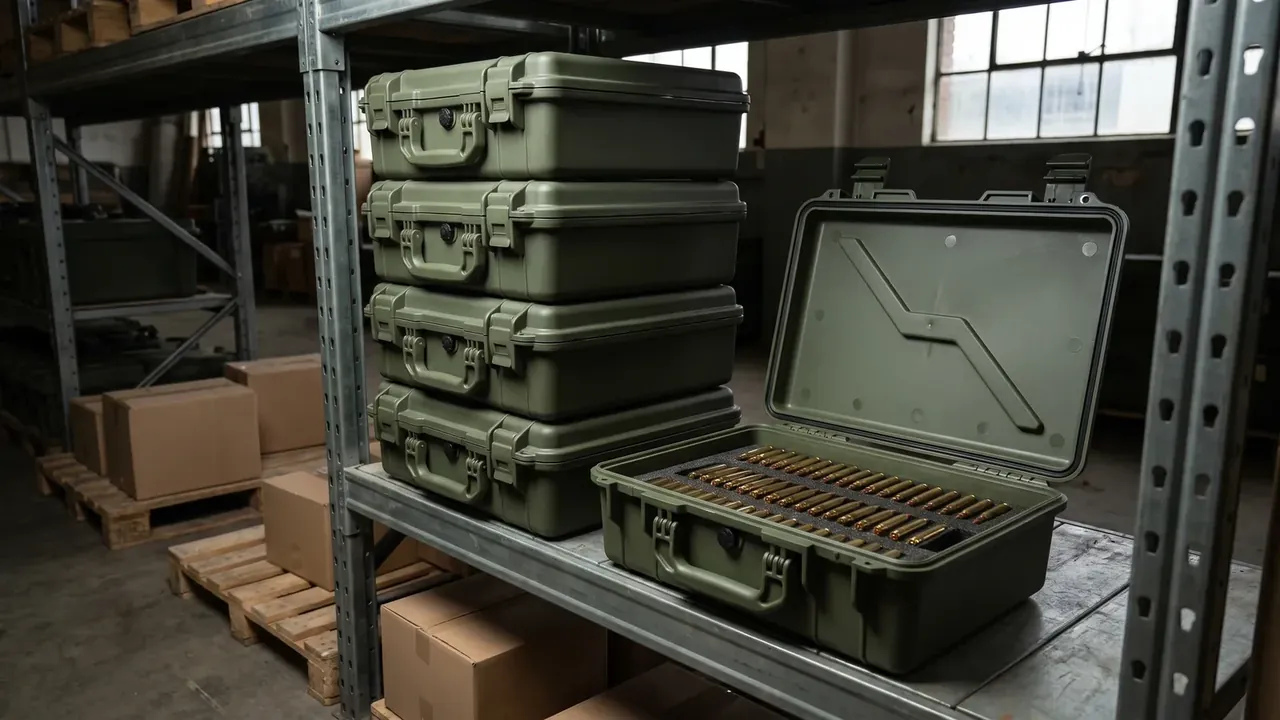
These four sit base against lid, the widest bearing area and most even path. In a taller stack, ribs over the walls carry load down them; ribs over an open span leave the lid bending alone. Check wall alignment, read values at the longest period and highest temperature, then drop a layer.
4. Pallets, floors and centre of gravity
Stability is decided by contact between the bottom layer and its support. Pallet deflection, floor slope and shelf span turn vertical load into an overturning moment.
A damp pallet sags in the middle, so the base hangs free and the case is carried at its ends. Joints, hollows and a drainage fall exceed three millimetres over one metre, enough to shift a tall stack.
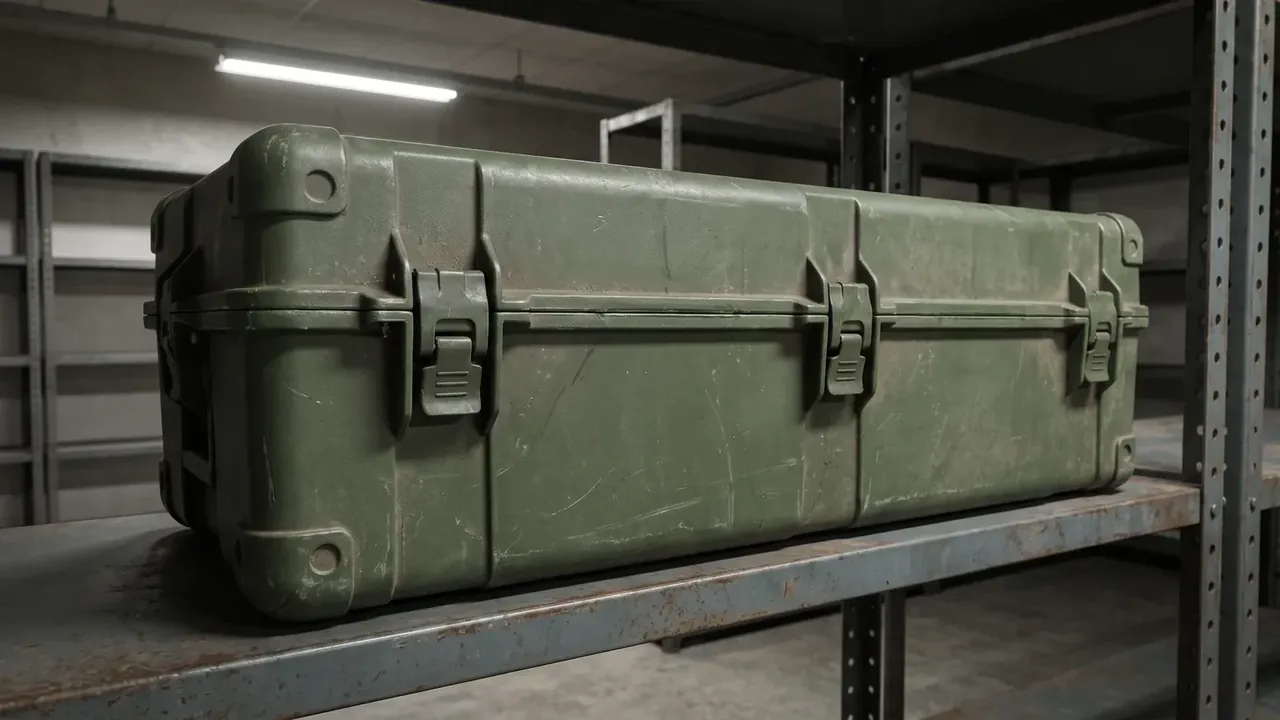
That case spans a shelf with a long middle unsupported. Corner guards take the knocks and lead upper loads into the posts. Keep the height-to-base ratio within three to one.
5. Diagnosis order and reinforcement
Work through geometry, load, support and centre of gravity.
| Step | Check | Pass condition | If it fails |
|---|---|---|---|
| 1 | Layer engagement | Depth exceeds displacement | Change interlock |
| 2 | Lid flatness | No gap under a straight edge | Add a support pad |
| 3 | Wall alignment | Ribs over lower walls | Turn cases or add a board |
| 4 | Bottom pressure | Below the allowable value | Fewer layers |
| 5 | Support surface | Under 3 mm over 1 m | Replace the pallet |
| 6 | Stack centre | Projection inside the base | Move heavy cases down |
Reinforcement rises in three tiers: re-lay the pattern with a spreader board; add a locating pallet or recessed lid; specify a thicker lid, denser ribs or a stepped rim.
- Stacking period and store temperature recorded
- Upper base ribs checked against lower walls
- Support surface measured over one metre
- Height-to-base ratio confirmed
Conclusion
Inspection order beats experience: layers must engage, the lid must stay flat under load, walls must align, bottom pressure must stay below the allowable value; then check pallet, floor and shelf, and finish with centre of gravity.
This article covers container-side specifications and design implications only.
Related Reading
- Layer counts and stacking criteria for stackable containers
- How a stacking load test is run
- Planning pallets and stacking layers
- Stacking structure and interlayer support
Related Products
- 8 Series — Gun Cases; Military Equipment Cases; Camera Equipment Cases; Drone Cases; Watch Cases; Knife Cases; First Aid Cases; Electronics Equipment Cases
- WL8-2812 PP Gun Case — model WL8-2812
- All protective cases and toolboxes: 7 series, 158 models