

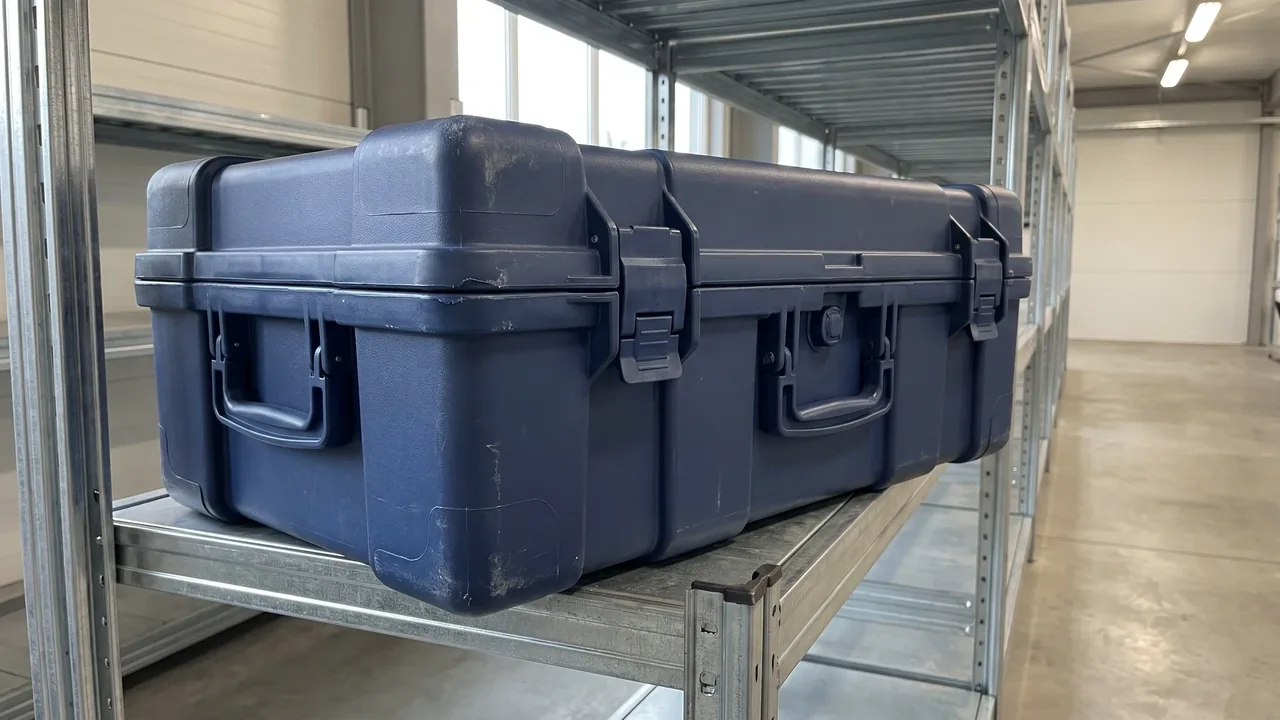
Floor space in any warehouse is fixed, while the volume of goods keeps growing. Whether cargo can be stacked, how high, and for how long without collapsing determines the true capacity of a storage system. The Stackable Container exists precisely to answer that question: it is not merely "a box that can be piled up," but a piece of logistics equipment validated through load calculations, interlock design, and physical testing. As a protective case manufacturer, JUNZHIJIA has observed, while working with warehousing, military logistics, and defense trade customers, a common pattern: most stack-collapse incidents are not caused by poor box quality alone, but by a mismatch between box structure, stacking method, and actual load. From a manufacturer's perspective, this article breaks down the engineering logic behind stacking strength and space efficiency in the stackable container, so that buyers can keep the risk out of their projects at the selection stage.
Stacking Strength: The First Design Constraint for a Stackable Container
Every stackable container design must first answer three questions: at what height will it be stacked, carrying what weight, and for how long. These variables together define the stacking strength specification. Take a common 400-by-300 millimeter logistics tote as an example: a single box loaded to twenty kilograms and stacked four tiers high means the bottom box carries roughly sixty kilograms of sustained compression. Switch to a large rotomolded bulk container loaded to two hundred kilograms and stacked three tiers, and the bottom unit faces more than four hundred kilograms. The two scenarios impose completely different demands on the box.
When manufacturers quote stacking capability, they usually say "full load stackable to X tiers," but that sentence carries hidden assumptions about temperature, duration, and alignment. Plastic loses stiffness at elevated temperature, deforms slowly under sustained pressure, and drifts off its designed load path when tiers are misaligned. A rigorous specification should therefore read "stackable to X tiers when fully loaded, aligned, and stored below twenty-three degrees Celsius." Buyers comparing supplier datasheets must confirm that these premises match, because two seemingly identical figures can represent a twofold difference in real capability. The comparison should also extend to how the rating was verified: a figure backed by a witnessed test with raw data, and one asserted in a sales brochure, may share a number while sharing nothing else.
From an engineering standpoint, stacking strength cannot be solved simply by thickening the walls. Extra wall thickness raises both weight and cost, and increases sink-mark risk in injection molding. The effective approach is structural: guide the pressure along a designed load path, from the top-tier box base down through the rib network of the box below, rather than letting a flat wall panel carry the load. This is the essential difference between a professional stacking container and an ordinary turnover tote: every rib in the former has a mechanical purpose.
One further perspective is often missed: the behavior of a whole stack is not the simple sum of individual box capabilities. By the fifth tier, a slight lean in any single tier is amplified into centimeters of offset at the top; the taller the stack, the harsher the demands on inter-tier restraint and floor flatness. Selection logic for tall stacks therefore differs fundamentally from low stacks: low stacks are judged by single-box compression, tall stacks by system stability. This also explains why the same box model can perform flawlessly in one facility and disappoint in another: floor tolerance, forklift behavior, and load mix all feed the system, not just the molding. For readers planning to combine stacking with pallet planning, the companion discussion of stackable cases and pallet load planning offers a complete calculation framework from stack pattern to pallet face.
Bearing Surfaces, Ribs, and Columns
Open a well-designed Stackable Container and you will find a force system with three components: bearing surfaces, reinforcing ribs, and columns. The bearing surface usually sits on the perimeter flange or top reinforcement ring, and it is the zone where the upper box base actually makes contact. A good design forms a continuous ring so that upper weight spreads evenly; cheaper products contact only at four corners or two long edges, concentrating pressure locally, so those contact zones whiten and crack first after prolonged service.
Ribs form the internal skeleton. Crossing ribs divide large wall panels into small grids, each grid bounded within a safe span against buckling. For injection-molded boxes, rib thickness typically runs between fifty and seventy percent of wall thickness: too thick produces sink marks on the opposite face, too thin offers no support. For rotomolded boxes, the process favors hollow double-wall ribs, which deliver a section modulus far higher than a solid wall for a modest weight increase.
Columns are the vertical force carriers. Heavy-duty containers place column-style ribs at the four corners or around the interior perimeter, so that the weight of upper tiers passes directly from column to column socket through the stack. Under this architecture the wall panels barely participate in compression; they only enclose the cavity. JUNZHIJIA applies this column-transfer architecture to its heavy rotomolded containers, pairing it with thickened column sockets in the base, so that residual deflection of the bottom tier stays within a few millimeters under a three-tier full load. The same philosophy extends across the load spectrum: lighter injection-molded totes borrow the corner-column idea in miniature, while heavy-duty protective cases scale it up for equipment that must survive both the stack above and the road below. When evaluating the stacking potential of any box, first check whether it has an explicit column structure with matching sockets. If yes, the designer has done the force calculations; if no, and the walls carry the load bare, the stacking capability will rarely survive the test of time.

Locating Pins and Interlocks Against Slippage
The most dangerous stacking failure is not crushing but slippage: an entire upper tier slides off the tier below and topples the whole stack. Even when every box is strong enough, the absence of horizontal restraint between tiers lets centrifugal force from a turning forklift, floor vibration, or a collision during manual handling accumulate misalignment until the stack walks apart. Locating pins and interlock structures exist to break this failure chain.
Several restraint families are common. The first is pins and sockets: conical or cylindrical pins rise from the four top corners and engage matching sockets in the base above, centering the upper box automatically and locking horizontal movement. The second is skirt-and-groove interlock: a peripheral skirt on the top rim seats into a groove on the underside of the box above, providing circumferential restraint. The third is full nesting, where the upper base sinks entirely into the lower opening; it offers the strongest anti-slip performance but requires larger clearance for empty-box nesting.
Interlock depth is a matter of judgment. Too shallow, and a forklift operator who places a box slightly off cannot engage the lock at all, so crews stop aligning tiers and the feature becomes decorative. Too deep, and extraction becomes laborious while automated depalletizing grippers struggle to intervene. Mature designs add a lead-in taper that pulls the upper box into correct register during lowering, tolerating tens of millimeters of placement error. Heavy-duty applications can add anti-slip pads or lashing straps as redundant restraint between tiers. Military logistics users face a harsher variant of the problem: stacks ride inside vehicles under sustained vibration and shock. Field experience with ammunition box stacking and storage shows that in-transit inter-tier locking requirements far exceed static warehousing needs, and that requirement belongs in the design brief from day one.
Dynamic versus Static Loads
Any serious discussion of stacking strength must separate static and dynamic loads, because their safety logic differs completely. Static load is the sustained compression the bottom box experiences while the stack rests in storage; it tests long-term compression and creep behavior. Dynamic load appears in transport: road shock makes the entire stack's weight strike the bottom tier at several times gravitational acceleration, while braking and cornering add horizontal shear. A container rated for four static tiers may be limited to two tiers, or to no stacking at all, once the stack is moving.
Packaging test standards draw this line clearly. Static stacking tests apply a load derived from the target stack height, hold it for twenty-four hours or longer, measure deformation, and inspect for cracks. Dynamic tests mount the loaded stack on a vibration table or an actual vehicle and run hours of road-transport spectra. When a manufacturer's stacking figure does not state whether it refers to static or dynamic conditions, buyers should ask. A prudent working rule: warehouse stacking applies the static rating with a safety factor of at least one and a half, transport stacking is evaluated separately under dynamic conditions, or policy simply forbids stacking in transit and defers it to the warehouse. Some operations also distinguish a third condition, handling dynamics, covering the drops, pushes, and drag forces of daily movement that never appear on a test machine but account for a surprising share of field damage; padding the door frames of high-traffic aisles and marking no-drag zones on the floor addresses that condition more cheaply than any structural upgrade.
A middle state is easily overlooked: after months at rest, the bottom box has already crept under load, and if the whole stack is then lifted and moved by forklift, the weakened bottom tier simultaneously carries static pressure and handling dynamics. The disciplined procedure is to dismantle the stack tier by tier before relocation, or to verify that bottom-box deformation remains within limits. Static and dynamic lines teach the same lesson: box capability is conditional, and when conditions change, capability must be reassessed. For teams who want to go deeper into how vibration reshapes the load picture, the article on transport vibration testing of cases explains resonance points and random-vibration spectra in terms that apply equally to a lorry-borne stack of containers.
Nested Empty, Stacked Full
The space efficiency of a stackable container is defined by two figures: stack height when full, and nesting depth when empty. The first answers "how is cargo stored," the second answers "how are containers returned." Selection that looks only at stack tiers while ignoring nesting ratio will pay a steep price in reverse logistics.
The accounting for full stacking is intuitive: three tiers on the same floor area multiply land utilization by three. But stack height faces two limits: the compression capacity of the bottom box, and fire and operation codes that cap manual picking stacks around two meters in most warehouses, above which high-bay racking with mechanical handling takes over. Local rules vary widely, and sprinkler design, insurance surveys, and even the warehouse's own historical incident record can pull the practical ceiling lower than the code minimum, so the ceiling should be confirmed with the facility operator rather than assumed from a handbook. A sound stacking plan fixes the working height first, derives tier count second, and verifies bottom-tier load last; the order cannot be reversed.
The accounting for empty nesting is subtler. Straight-wall boxes save almost nothing when empty: five nested empty boxes occupy the shipping volume of five loaded ones, making return transport expensive. Hence many stackable containers adopt collapsible bases or flexible walls: the base flips up and walls fold inward, achieving nesting depths above seventy percent of box height, so one truck can return several times the container count. JUNZHIJIA's nestable rotomolded containers restore rigid compression capability through a locking mechanism when loaded, and release the lock to collapse when empty; one mechanism serves both states. Evaluating such designs demands focus on lock reliability, because an unintended release under full load is far more dangerous than the failure of an ordinary straight-wall box. The companion analysis of height limits in stackable toolboxes discusses the same trade in smaller format, and its conclusion transfers directly to large containers: stacking and nesting compete for the same structural budget, so the primary use case must be declared before selection.
Creep and Aging Under Long-Term Stacking
Plastic Stackable Containers cannot escape creep. Creep is the continued deformation of a material under constant stress: even when stress sits far below yield strength, a bottom box under sustained pressure slowly bulges outward, and after several months the deformation may reach several times its initial value. As creep advances, effective compression capacity declines in step, and a container designed for four tiers may retain only three tiers of safety margin in its second year.
Creep depends on three variables: stress level, temperature, and the material itself. Higher stress and higher temperature accelerate it. Within the polyolefin family, grades reinforced with glass beads or fibers resist creep markedly better, and cross-linked polyethylene outperforms ordinary linear grades in sustained-load service. Manufacturers should run creep tests on the actual stacking condition: hold the design load for a thousand hours or more, plot deformation against time, and extrapolate to the intended service life. Buyers, in turn, should ask how long the test behind "stackable to X tiers" actually ran; a claim of long-term stacking supported only by a few hours of short-duration compression is not credible.
Aging operates on a second time axis. Ultraviolet exposure embrittles boxes stacked outdoors, cold reduces toughness, and repeated thermal cycling seeds fatigue micro-cracks at rib roots. None of this damage is visible from a distance, yet any of it can turn the next minor impact into the stroke that breaks the structure. Countermeasures include choosing black or carbon-black compounds for outdoor yards, specifying low-temperature grades for cold regions, and rotating stack positions so bottom boxes periodically rest. Inspection closes the loop: a quarterly walk-around that looks for whitening at rib roots, gloss loss on sun-facing panels, and hairline cracks around sockets catches aging while it is still a scheduling problem rather than a safety one. Creep and aging share one property: both are irreversible. Managing them is not about repair afterward but about reserving decay headroom at the selection and procedure level; design margins should be budgeted against end-of-life performance, not as-delivered performance.
Stacking Test Methods and Acceptance Criteria
Whether a stackable container meets its specification is ultimately settled by test. A complete stacking validation has several layers. First, static compression: an empty box goes into a press under a load derived from the expected tiers (total full-load weight of upper tiers times count minus one, times the safety factor), held for the specified duration, then released, with requirements of no cracking and residual deformation below a set limit. Second, loaded stack simulation: real boxes filled to rated load are stacked and cycled through elevated temperature in an environmental chamber, proving sustained compression under the worst thermal condition. Third, transport consolidation: the loaded stack is fixed to a vibration table and run for hours on road spectra, checking for inter-tier slip and abrasion.
Setting acceptance criteria demands more expertise than running the test. "Did not collapse" is grossly insufficient, because the intermediate states before collapse, such as wall bulging, bent locating pins, and tier offset, trigger their own downstream accidents. Reasonable criteria are quantitative: residual height deformation after unload within two percent; interlocks still engaged at a specified tilt angle without separation; lids opening, closing, and sealing normally after test. Defense and military-standard projects additionally cite stacking and transport clauses from GJB or equivalent military standard systems, where test conditions are fixed by the standard and the manufacturer's task is to build in margin rather than pass on the line. Sampling discipline belongs in the plan as well: testing boxes drawn randomly from a production lot says far more about what a buyer will receive than testing hand-picked showroom samples, and retesting after a mold revision keeps the certificate honest. For export deliveries, one caveat applies: local regulations and export-control requirements govern, and this article discusses the packaging container only.
When auditing a supplier, one question works particularly well: ask for the raw records of the stacking test, including load value, duration, temperature, and deformation data. Suppliers with complete records deserve trust in their datasheets; those offering only "full load stackable five tiers" without process data should be used at conservative values.
Forklifts and Palletized Loading
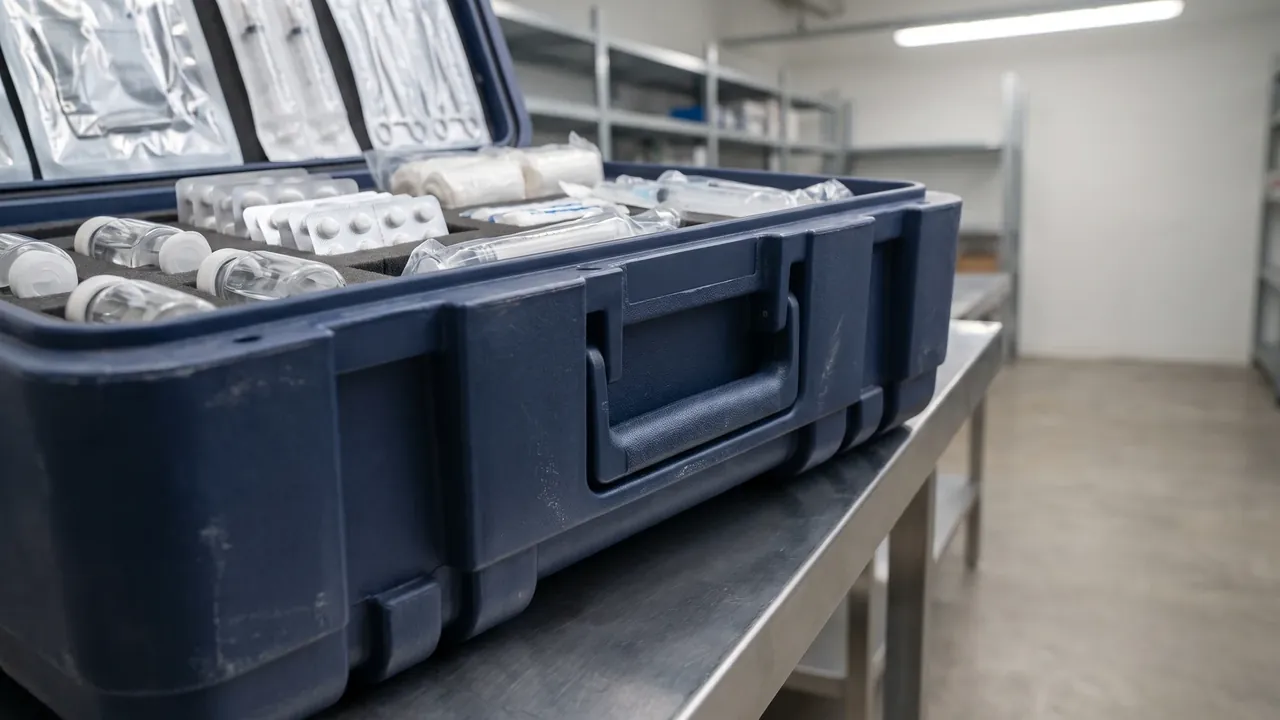
Stacking describes box-to-box relations; containerization describes stack-to-pallet and pallet-to-truck relations. The logistics efficiency of a stackable container is ultimately cashed through forklift and pallet operations, so the base structure must be compatible with standard pallets. Design essentials include: fork pockets or foot spacing matched to standard fork trucks; no overhang when the box sits on the pallet, because any floating corner manufactures a weak point under load; and pallet capacity and stiffness verified against the gross stack weight, since long-term deflection of wooden pallet boards distributes load unevenly onto the tier above.
Full-pallet stacking also has a layout discipline. Containers of a given size should tile a 1200-by-1000 millimeter pallet with integer counts and no dead gaps; where two or more sizes are procured, their mixed arrangement on the pallet face should be validated. Total stack height must clear vehicle headroom: a common enclosed truck offers about 2.4 meters internally, so if pallet plus five loaded tiers exceeds that, unload requires dismantling tiers and the whole-pallet advantage evaporates. Pallet, container, and tier count therefore deserve design as one scheme, never separately.
Forklift handling weighs heavily on stacking life. Fork-entry impact and the skew at box release both impose instantaneous loads far above static values. Adding fork-guide and cushion features to the base, training operators on placement discipline, and fitting locating angles on pallet faces are all cheap, fast measures. When full-pallet stacks are stretch-wrapped, watch the tension: wrap tension presses the top tier downward, effectively loading the bottom tier further. Optimizing box, pallet, forklift, and wrap as one system is the only way to realize theoretical space efficiency; otherwise, compounding losses at each link can leave actual efficiency at half the paper value. In automated dense warehouses, the full-pallet scheme must also interface with shuttles and stacker cranes; the article on pallet-shuttle systems and case adaptation details what those systems demand in base flatness and locating precision, and the article on warehouse storage rules for cases shows how to zone the floor so that whole-pallet lanes, pick faces, and empty-container staging never fight for the same aisle. A layout drawn with both documents open avoids the most expensive class of retrofit: moving racking after the fleet has already been bought.
Measuring Warehouse Space Efficiency
Space efficiency must be calculated, not asserted. Three metrics anchor the warehouse case. First, volumetric utilization: the share of occupied volume that is net cargo, influenced by wall thickness, internal cushioning, and stacking gaps. Second, floor utilization factor: the ratio of effective stack footprint to bay area, eroded by aisles, column spacing, and fire clearances. Third, throughput: the number of put-away and retrieval cycles per unit time on the same bay, which suffers badly if reaching bottom-tier cargo requires dismantling the stack.
For a concrete comparison, build a simple table: for the same goods, scheme A uses straight-wall stackable containers at three tiers, scheme B uses nestable containers at two tiers plus an empty-box compression and return loop; cost out floor rent allocation, dismantling labor, return freight, and container attrition for each. The arithmetic often yields counterintuitive verdicts: the taller scheme is not automatically cheaper overall, because dismantling labor and bottom-cargo access difficulty eat the density advantage. Goods that move as full boxes, such as spares, rations, and military supplies, favor tall straight-wall stacking; goods picked piece by piece favor two tiers with room for manual access. Assign every number in the table an owner and a date, too, because a comparison built on last year's freight rates or a departed manager's guess about labor cost will be argued about forever instead of acted upon.
Warehouse type matters as much. Flat warehouses live on floor stacking, so stacking capability is everything; high-bay warehouses transfer the compression duty to racking, and the box becomes a rack-position vessel, which lowers the weight of interlocks while raising the weight of dimensional consistency and identification marks. Container geometry should be chosen to match: a box that tiles a rack position with millimeters to spare will fight the beams forever, while one designed with the rack module in mind slots in cleanly and keeps clear of sprinkler clearances. Applying the zoning logic from the design of stackable case structures, separating high-stack zones, piece-pick zones, and empty-container staging areas, lets the same container fleet deliver its space advantage across different warehouse types. Revisit the numbers annually: assortment changes, pallet size switches, and facility moves all quietly invalidate yesterday's optimization, and a one-hour recount of the three metrics is cheaper than a year of paying for dead air.
Stacking Management in Military Logistics
Military logistics imposes stacking requirements that differ sharply from commercial warehousing. First, field conditions: stacks may rest on uneven open ground, so bases need generous support area and leveling tolerance, and ground settlement must be caught by interlocks rather than allowed to translate into lean. Second, frequent movement: supplies ride in trucks fixed as whole stacks, under vibration spectra far harsher than civilian freight, making inter-tier locking and stack lashing hard requirements. Third, environmental span: the same containers may deploy from humid coastlines to highland cold zones, so materials must hold stacking performance across a wide temperature band, with low-temperature brittleness and high-temperature softening both eliminated at the material-selection stage.
In reserves of ammunition, rations, and clothing, stacking also connects directly to speed of issue. War-reserve stock sits stacked high in peacetime and must decompose into truckloads quickly in wartime, so the stacking plan should predefine the dismantling sequence, with bay orientation, tier numbering, and forklift lanes folded into the depot floor plan. Drills that actually dismantle a loaded stack and reload it onto a truck turn the paper sequence into muscle memory, and they routinely expose problems no drawing review ever finds, from lanes too narrow for a loaded fork to tier labels invisible from the operating height. Military packaging standards set explicit stacking test requirements; box specifications in the GJB system typically fix full-load stack height and test duration, and manufacturers must design structures to the upper bound of the standard rather than to a customer's current warehouse condition, because reserve goods may sit for years: today's margin is the safety of some future year.
Stacking Compliance in Defense Export Projects
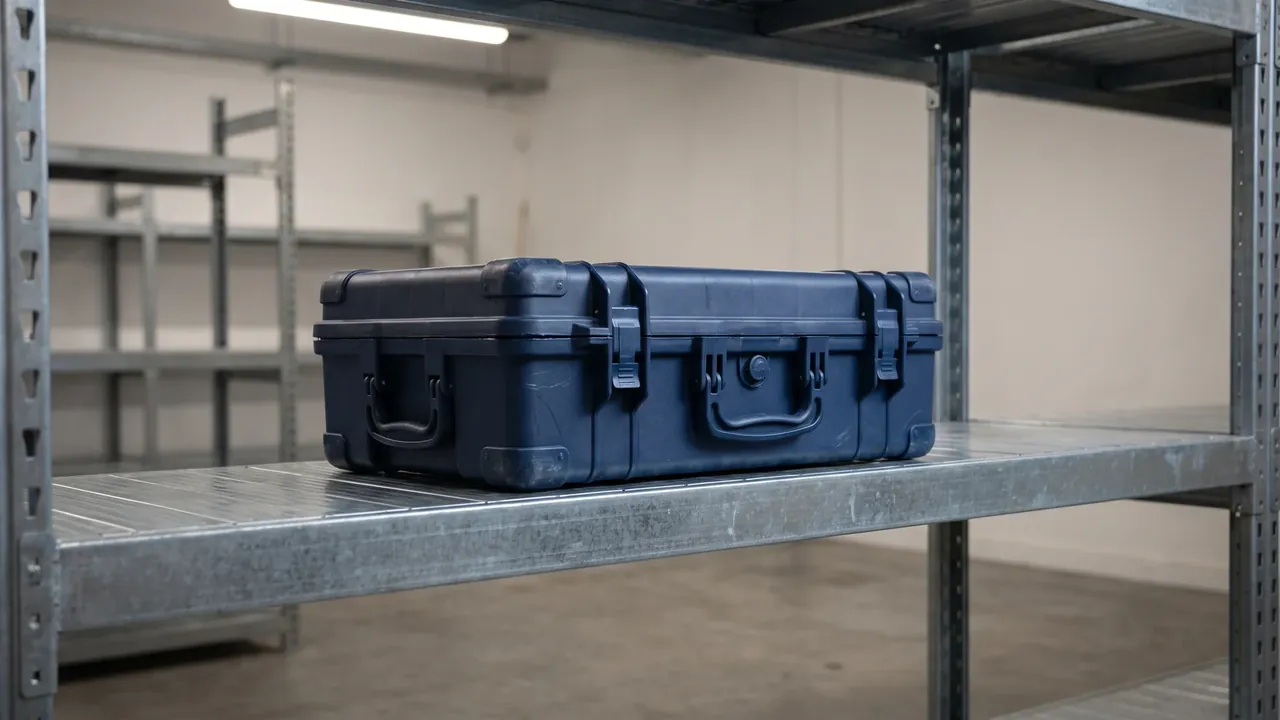
Defense-trade customers usually audit packaging containers more strictly than domestic buyers, and stacking figures are standing items on the review checklist. Export projects often quote stacking requirements directly from buyer-designated or NATO-family packaging standards, where test conditions, criteria, and report formats may all differ from Chinese domestic practice. The manufacturer's first step on such projects is obtaining the buyer's packaging specification and checking stacking tiers, dwell duration, ambient temperature, and test methods line by line, never answering a foreign inquiry from a domestic datasheet.
Beyond stacking, ocean freight adds cabin constraints: in-container stack height is limited by door clearance, rolling at sea loads cargo laterally, and the lashing plan must be submitted together with the packaging plan. Humidity inside a container cycling through day-and-night temperatures also attacks labels and closures, so marking systems for export boxes should survive condensation, not just compression. For packaging boxes carrying linked ammunition or cartridge cases, stacking separation and compartment rules additionally follow the buyer's ordnance storage regulations; as noted, local regulations and export-control requirements govern, and this article confines itself to the packaging container without expanding on contents.
Delivery experience suggests the most common export stacking problem is not insufficient strength but document mismatch: test reports missing the buyer's designated standard number, criteria phrased differently from the specification, or report language and copy counts failing review requirements. Manufacturers serving export projects should maintain test-document templates, preparing verification evidence before bidding. A stacking report that survives technical review wins more buyer trust than a discount on the quotation, because it demonstrates that the supplier understands and respects the customer's equipment management system.
Failure Modes of the Stackable Container and a Selection Checklist
Field feedback clusters stacking failures into a handful of modes. Crushing: bottom walls or top faces cave in, usually from over-stacking or heat-softened material. Slippage: accumulated tier offset topples the stack, usually from missing interlocks or careless placement. Warping: long-term creep twists boxes until lids no longer close and seals fail. Brittle fracture: cold or aged plastic cracks under slight impact, typical of outdoor yards and cold regions. Wear: fork pockets and pallet contact faces thin out through repeated friction until they punch through during handling. The common thread is that failure rarely has a single cause; it emerges where design margin, operating conditions, and management discipline all leak at once.
The resulting selection checklist lets buyers audit quotations item by item. One, confirm the premises behind the rated stack height: temperature, duration, alignment. Two, check for column force-transfer structure and locating interlocks. Three, request static compression and creep data and match test duration to service life. Four, clarify whether stacking in transit is permitted and how dynamic load was verified. Five, decide whether empty containers must nest, and verify nesting depth and lock reliability. Six, check base compatibility with standard pallets and forks. Seven, confirm material grades cover the ambient temperature and ultraviolet exposure. Eight, ask whether the supplier can customize reinforcement, such as thicker columns for a specific stack height. Two habits make the checklist powerful in practice. Score every supplier on the same sheet so that answers are comparable rather than remembered selectively, and record which claims came with evidence, because the pattern of documented versus undocumented claims reveals a supplier's engineering culture faster than any audit visit. A supplier who answers all eight completely belongs on the short list for a stacking project.
Frequently Asked Questions
Q: A stackable container is rated "full load stackable to four tiers." Can that number be applied as written? A: Not unconditionally. Stack height is a conditional figure that usually presumes room temperature, aligned placement, and static storage. In a warehouse that runs hot in summer, plastic stiffness drops and the allowable tiers go down; if the stack will ride in vehicles under vibration, dynamic conditions cut the number far further. The safe procedure is to confirm the test conditions behind the rating, then derate against your own temperature and dwell profile: apply at least a one-and-a-half-fold safety factor for static warehousing, and treat transport stacking as a separate evaluation or simply prohibit it in transit. Also record who placed the rating and when it was last revalidated, because structural revisions of the same box model can change the number between production years. Buyers who keep a one-page summary of these premises beside the storage plan catch most misuse before it happens. The number on the datasheet is the starting point of a design exercise, not an authorization for daily use. Suppliers who can state the premises crisply are showing you they actually ran the tests, which is worth more than an extra tier on paper.
Q: Will a plastic stacking box gradually compress shorter over the years, and how should creep be managed? A: Yes. Creep is intrinsic to thermoplastics under sustained stress, so residual compression and outward wall bulging on the bottom tier after months of storage are normal, as long as deformation stays inside the design envelope. Manufacturers should run long-duration compression tests, plot the deformation curve, and set the design load on the flat region of that curve; users should rotate stacks periodically so bottom boxes recover under zero load, and demote visibly bulged boxes to lighter duty. Keep a simple measurement log: a fixed measuring point on each bottom-tier box, checked quarterly with a straightedge and gauge, turns creep from an invisible process into a trend you can project, and the same log doubles as evidence during warranty discussions. At selection, prefer densely ribbed boxes with column force-transfer structures, and favor glass-bead-reinforced or cross-linked polyethylene grades, both of which resist creep far better than commodity resins. Hot warehouses deserve special caution: a step increase in temperature multiplies creep rate, so tier counts should be reduced accordingly. Management, not repair, is the lever, because creep never reverses once it has run its course through a loaded season.
Q: Among locating pins, skirt interlocks, and full nesting, which inter-tier locking method should be chosen? A: Match the method to slip risk and handling style. Locating pins are inexpensive and self-centering, suited to medium and light loads placed by hand, but their resistance to horizontal shear is limited. Skirt-and-groove interlocks provide circumferential restraint with moderate anti-slip capability while leaving automated depalletizer grippers unobstructed, fitting mechanized warehouses. Full nesting sinks the entire upper base into the lower opening, delivering the strongest anti-slip performance and the best tolerance of transport vibration, at the cost of larger empty-nesting clearance and slightly harder extraction. The deciding question is what the stack will experience: for purely static storage the first two suffice; for stacks that ride in vehicles or rest on vibration-prone ground, choose full nesting or add lashing redundancy. Cost and cycle life belong in the comparison as well, since pins wear fastest under repeated handling and skirts tolerate the most cycles before the edges round off. Whichever family you pick, insist on a lead-in taper, because it automatically corrects tens of millimeters of placement error and keeps the interlock actually engaged in daily practice rather than only on the drawing.
Q: Do collapsible, nestable containers sacrifice reliability for mechanism complexity? A: Early collapsible-base designs did carry a real risk of lock release under full load, but modern designs have closed that gap substantially. Evaluate a nesting mechanism on three points: whether the lock is a hard mechanical connection rather than friction alone, since a locking pin or detent holds even when worn; whether lock state is visibly indicated, so operators can confirm engagement at a glance; and whether the mechanism operates one-handed and permits inspection under load. A qualified nestable container should pass drop and vibration tests in the loaded, locked state, proving the lock does not release under shock. At purchase, request a demonstration of loaded two-tier lock retention and ask for fatigue data on the mechanism, ideally expressed as cycle count at rated load rather than an open-ended promise. Maintenance matters too: hinge pivots and lock tracks should accept cleaning without disassembly, because grit in a collapsible mechanism is the usual seed of failure. Overall, a properly engineered and validated nesting mechanism is reliable enough for routine logistics cycles, provided the operating discipline keeps the lock state verified at every tier.
Q: What should a credible stacking test report contain? A: At minimum it should state: the standard number and version applied; specimen description, including material grade, wall thickness, and structural revision; test conditions, including load value, how it was derived, hold duration, and ambient temperature; measured data, covering the deformation record during loading and residual deformation after unload; and criteria with conclusions, listing each acceptance limit and its pass or fail verdict. If hot-storage or vibration-overlaid variants were run, each deserves its own data set, because the worst case for a warehouse may combine heat and sustained pressure rather than either alone. The report should also identify the test equipment, its calibration status, and the signatures of both the operator and the reviewer, so the evidence chain reaches back to a real bench on a real date. When reviewing, scrutinize the load-derivation logic: upper-tier full-load weight multiplied by tier count minus one, then by a safety factor, is the standard approach, and a conspicuously lower load suggests cosmetic numbers. Reports with revision control and raw-data attachments deserve the highest trust, because they can be traced to the actual test bench rather than to a marketing summary.
Q: Can stackable containers of different sizes be mixed in one stack? A: In principle, no; where mixing is unavoidable, three conditions apply. First, dimensional compatibility: contact surfaces between tiers must overlap, because a small box resting over the hollow region of a large box carries a cantilevered load it was never designed for. Second, continuous load transfer: the bottom tier of a mixed stack carries the weight of every tier above it, not merely the adjacent one, so the rating check must sum the whole stack. Third, interlock effectiveness: different sizes usually mean pin and socket positions no longer register, disabling tier locking, so compensating measures such as tray-style separator sheets every two or three tiers, or anti-slip pads, become mandatory. Record the mixed-stack composition on a placard fixed to the wrap, so that anyone dismantling it later knows the sequence was deliberate rather than arbitrary, and photograph the stack when it is first built so the reference image survives even if the placard is torn. In daily management, stacking by size zone is the recommended practice and mixing should remain a transitional measure only. Mixed stacks should also run lower than uniform ones, preserving margin against the factors that cannot be fully controlled on a working floor.
Q: How does stacking acceptance for defense export projects differ from domestic practice? A: The differences concentrate in standard citation, test conditions, and documentation discipline. Domestic projects typically run on national or industry standards, while export projects may mandate buyer-designated or NATO-family packaging standards, changing load values, durations, temperatures, and criteria all at once. On documentation, buyers usually require reports in a specified language, citing standard versions, issued by qualified institutions, and nonconforming formats directly block review approval. The practical advice is to lock stacking parameters and test methods clause by clause in the technical annex of the contract, complete a standards-gap comparison before bidding, and run supplementary verification to the buyer's standard where needed. Budget for the gap, too: retesting to a foreign standard takes weeks of lead time, and discovering a shortfall after production starts compresses the schedule exactly when flexibility is scarcest. Appoint one engineer to own the document set across languages, because review comments that bounce between translations waste more calendar time than any test ever will. For defense-trade deliveries, note that local regulations and export-control requirements govern, and this article discusses the packaging container only, leaving all matters of controlled contents outside its scope.
Q: High humidity and occasional rodents affect the warehouse. What does that mean for container selection? A: Moisture and pests threaten the contents and the sealing interfaces rather than the compression structure, but selection must address both together. In humid environments, prefer lids with gasket seals and integrate a desiccant compartment to control the micro-climate inside the box; wood and paper auxiliary materials mildew and attract insects in hot-humid conditions, so internal cushioning should use closed-cell foams such as EVA or EPE instead. Against rodents, rigid rotomolded or injection-molded walls resist gnawing far better than paper or wood packaging, but lid lap gaps must be narrower than what a rodent can exploit, and latched closures that pull the gap shut are worth specifying. Vent holes designed for pressure balancing should carry mesh inserts, since an open vent is otherwise a doorway sized for insects. In stacking practice, keep the bottom tier off the floor on pallets for damp-proofing and cleaning access, leave inspection lanes beside every stack, and patrol routinely for gnawing debris near the base, escalating to a full-stack inspection the moment any sign appears, because a breach discovered early costs one box while a breach discovered late costs the tier above it.
Related Reading: /news/case-stackability-pallet-planning/ /news/military-ammo-box-stacking-storage/ /news/case-warehouse-storage-rules/
Closing
Stacking strength and space efficiency rise or fall together. Choose the container as a system, verify with data, and the warehouse pays you back for years.