

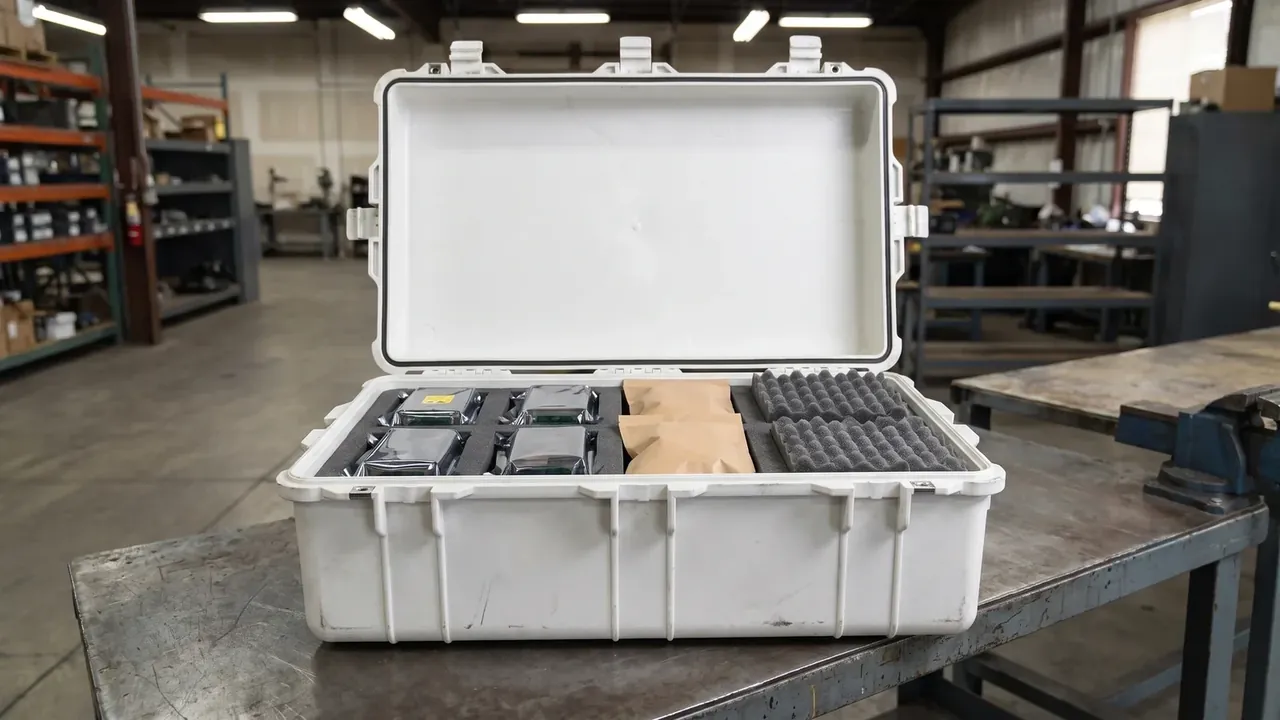
Quick answer: Judge a stackable plastic box on five checks: layers against bottom load, engagement against clearance, tilt and slip margin, rack height against the aisle, and wall against cleaning.
Table of contents
- Layer Count and Load on the Bottom Box
- Interlock Engagement and Side Clearance
- Tilt and Slip Allowance for the Stack
- Rack Height and Picking Aisle
- Wall Thickness, Ribs and Cleaning Trade-offs
- FAQ
1. Layer Count and Load on the Bottom Box
Stacking starts with the layer count, not the footprint. Decide the height, multiply by the loaded weight of one box, and the bottom lid carries that figure for months.
At four layers a 1.8 kg stackable plastic box carrying 15 kg leaves about 50 kg on the bottom unit, concentrated on four rims and the interlocks, so local pressure runs three to four times the average. Work one layer below the calculated maximum, and the spare layer absorbs heat, humidity and overload.
| Layers | Load on bottom | Lid pressure | Sag at 60 °C |
|---|---|---|---|
| 2 | 16.8 kg | 0.011 MPa | 0.3 mm |
| 3 | 33.6 kg | 0.023 MPa | 0.6 mm |
| 4 | 50.4 kg | 0.034 MPa | 1.2 mm |
| 5 | 67.2 kg | 0.045 MPa | 2.1 mm |
2. Interlock Engagement and Side Clearance
Engagement depth sets resistance to sideways movement; side clearance sets how easily a stackable plastic box drops into place. The two pull against each other, so neither can be pushed to a limit.
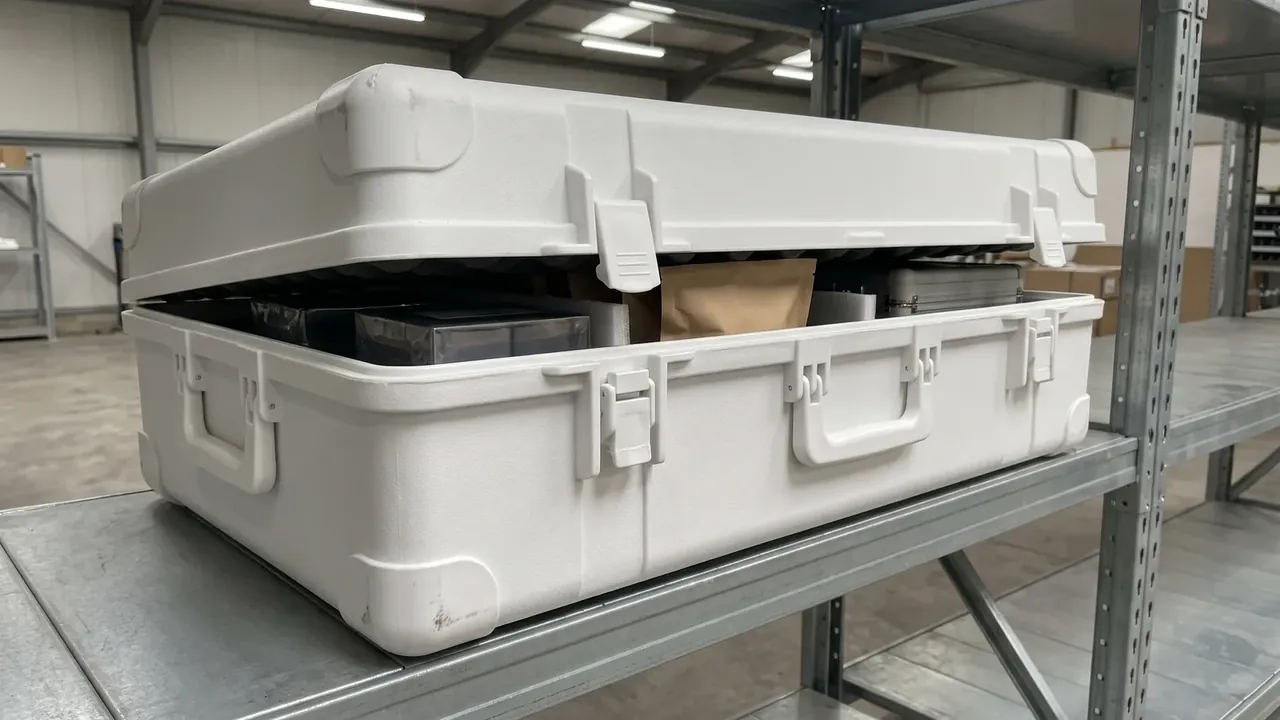
A taper interlock runs 8 mm deep with a 6 degree cone and 2 mm clearance per side. Below 1 mm, a forklift misses the seat three times in ten. Above 3 mm, seating is easy but the stack sways as soon as it moves.
| Interlock | Engagement | Clearance per side | Placement |
|---|---|---|---|
| Taper seat | 8 mm | 2 mm | hand and forklift |
| Corner claws | 10 mm | 2.5 mm | hand, two-handed |
| Locating posts | 12 mm | 1 mm | robot and hoist |
Measure with two empty boxes: a feeler gauge around the gap, then the engagement height. A wide gap with a shallow seat shifts even when each figure looks acceptable.
3. Tilt and Slip Allowance for the Stack
Treat tilt and slip separately. Tilt moves the whole column; slip moves one stackable plastic box against the one below, and the causes are not the same.
In a 2 degree test a four-layer stack should stay within 12 mm of offset from base to top; past 20 mm the interlocks have stopped working. Below a friction coefficient of 0.35, a forklift braking hard shifts the column. Water under the base is the hidden cause: ribbed bases channel liquid away, while a flat base drops below 0.2 on a wet floor.
4. Rack Height and Picking Aisle
Rack height sets the layer count. A 1.35 m beam spacing with 300 mm boxes takes four layers, yet 150 mm stays clear for fingers and fork tines.
| Beam spacing | Layers | Picking |
|---|---|---|
| 1.05 m | 3 | side pull |
| 1.35 m | 4 | side pull |
| 1.65 m | 5 | step or forklift |
Manual picking tops out near 1.6 m, so a 1.65 m beam holding five layers trades floor area for a step stool. A 1.2 m main aisle is the minimum for a 1.5 t forklift turning under load; narrower than 1 m and the stackable plastic box count falls to three layers.
5. Wall Thickness, Ribs and Cleaning Trade-offs
On a stackable plastic box, going from 2.5 mm to 3 mm adds 0.3 kg per unit and 0.9 kg on the bottom of a four-layer stack, and halves lid sag. Ribs buy more: six longitudinal and four transverse ribs spread the pressure of a five-layer stack from 0.06 MPa to 0.045 MPa for 0.1 kg.
Cleaning pushes the other way. Food and pharma work wants no internal corners, a 6 mm radius and open rib channels, which softens the structure by a layer. Fold the handle flat within 3 mm of the lid, or it presses into the box above.
Conclusion
Five checks decide the purchase: layers against bottom load, engagement against clearance, tilt and slip margin, rack height, wall against cleaning. Fixed in this order, they stop the stack sliding at the third layer or collapsing at the fourth. A stackable plastic box specified this way stops being a guess.
This article discusses only the container (case body) side of specifications and design intent, and does not cover any handling, loading or use of the contents.
Related Reading
- Stacking load and interlock geometry
- Why stacked boxes lean and shift
- Storage methods and rack height in a warehouse
- Material and stiffness trade-offs in PP cases
Related Products
- 8 Series — Gun Cases; Military Equipment Cases; Camera Equipment Cases; Drone Cases; Watch Cases; Knife Cases; First Aid Cases; Electronics Equipment Cases
- WL8-2812 PP Gun Case — model WL8-2812
- All protective cases and toolboxes: 7 series, 158 models