

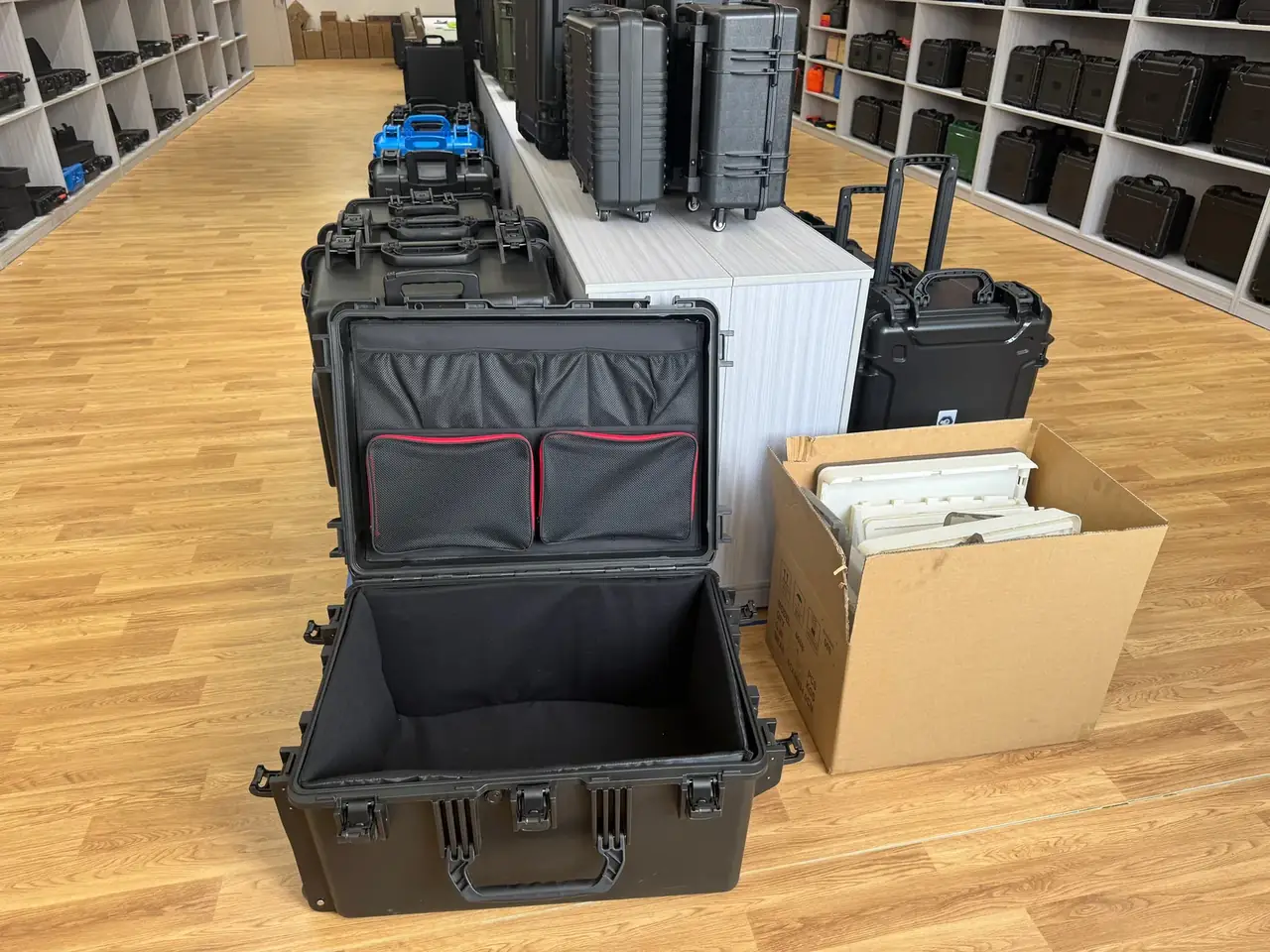
Quick answer: Ribbing and Wall Thickness Design fixes how far a 65 L bin bows: a 2.4 mm wall at 80 mm rib pitch bulges 3.2 mm in 72 h, and the lid will not seal.
Table of contents
- Where the Load Path Runs in Ribbing and Wall Thickness Design
- Matching Rib Height to Rib Spacing
- A 2.4 mm Wall Against a 3.2 mm Wall
- Measuring Bulge Under a Full Load
- Lid Sag and the Weight of Stacked Books
- FAQ
1. Where the Load Path Runs in Ribbing and Wall Thickness Design
A lid that will not catch is usually blamed on the lid, when the fault lies in long-wall ribs. Books spread their mass through the floor, up both long sides, and push the rim outward. The wall acts as a plate held on four edges, and its middle moves first. Ribbing and Wall Thickness Design works on that path.
The floor shares 20 kg across four walls; each bends about the corner posts, peaking at 120 mm above the base; the rim hands the rest to the lid. Ribbing and Wall Thickness Design cuts the long wall into strips, so each strip carries only its own moment. At 580 × 400 × 340 mm the ratio of 1.5 puts the highest moment mid-span, so only the long edges fail.
2. Matching Rib Height to Rib Spacing
Rib height and pitch hold each other in check. At 6 mm the neutral axis sits far enough out to reach 1.8 times the inertia of a plain wall; taller roots cool late and sink. At 80 mm pitch the wall divides into workable strips, while below 60 mm the ribs crowd, melt stalls and weld lines join into a stripe.
| Rib height and pitch | Section inertia | Moulding behaviour | Where it fits |
|---|---|---|---|
| 4 mm high, 60 mm pitch | 1.3 times plain wall | Thin root, clean release | Small formats |
| 6 mm high, 80 mm pitch | 1.8 times plain wall | Even fill, no sink | The 65 L book load |
| 8 mm high, 110 mm pitch | 2.1 times plain wall | Slow cooling, sink | Corner stiffening |
Twelve ribs at 1.2 mm thick, half the wall, freeze through an R1.5 root, and a 1.5° draft leaves 0.9 mm atop a 6 mm rib. The pitch has a floor too: 12 ribs cost 8% more material and 3 s of cycle, 19 ribs 15% and 9 s for under 0.2 times extra inertia. Ribbing and Wall Thickness Design picks its point on that curve.
3. A 2.4 mm Wall Against a 3.2 mm Wall
From 2.4 mm to 3.2 mm, bending capacity rises with the cube of thickness, about 2.4 times, at the cost of a third more material, 18% longer cooling, 28 fewer parts an hour. On the same 65 L shell the ribs win: 2.4 mm plus 6 mm ribs gives 1.8 times the inertia for 8% more material, a plain 3.2 mm wall gives 2.4 times for 33% more. The first buys 75% of the gain with 8% of the mass.

The 3.2 mm wall still belongs at the floor, the rim return and the bearing zone of the bottom bin. Ribs cannot help there; abrasion needs solid section. Stack five high at 30 kg and a 3.2 mm floor sags 0.9 mm after 72 h against 2.2 mm for 2.4 mm. Ribbing and Wall Thickness Design therefore allocates thickness by face.
4. Measuring Bulge Under a Full Load
Bulge is read in a 23 ℃ room: 20 kg of books spines down to 40 mm below the rim, 72 h of rest, a dial gauge at three points along mid-height, empty shell subtracted.
A 2.4 mm wall at 80 mm pitch that bulges past 3 mm in 72 h needs another rib, not another millimetre of wall. At 3.2 mm the rim has widened 1.4 mm and the tongue must shift 1 mm to catch.
| Bulge | Build | Rim widening | Catch after 72 h |
|---|---|---|---|
| 3.2 mm | 2.4 mm wall, no ribs | 1.4 mm | Tongue off-centre, needs a press |
| 2.0 mm | 3.2 mm wall, no ribs | 0.8 mm | Catches, gap at centre |
| 1.1 mm | 2.4 mm wall, 12 ribs at 6 mm | 0.4 mm | Catches first time, lid flat |
Read at one height only. Rim on one bench and mid-wall on another differ by more than 1 mm. Fix the line 120 mm above the base at 1/4, 1/2 and 3/4 of the length; a spread above 0.5 mm points to mould squareness, not to Ribbing and Wall Thickness Design.
5. Lid Sag and the Weight of Stacked Books
The lid is a plate on four edges with nothing underneath. Books stacked to 40 mm below the rim never touch it, so stacking loads it: five high, the bottom lid carries part of four above at a rated 30 kg each, and Ribbing and Wall Thickness Design keeps that panel flat.
A crossed grid divides the lid into 12 cells at 6 mm ribs and 80 mm spacing, dropping span to 80 mm and sag from 1.5 mm to 0.6 mm. Crossings must miss the handle opening.
| Sag limit | Lid load | Lid build | Verdict |
|---|---|---|---|
| 1.5 mm | 30 kg spread | Plain panel | Over the line, gasket slack |
| 0.9 mm | 30 kg spread | 6 ribs one way | Marginal, pass with recheck |
| 0.6 mm | 30 kg spread | 12-cell crossed grid | Pass, catch force stable |
The band runs −10 ℃ to +60 ℃. At 60 ℃ the modulus drops and sag at 30 kg runs 0.2 mm above the 23 ℃ figure; at −10 ℃ cracks start at rib roots. Spines up adds 0.3 mm as a line load, so Ribbing and Wall Thickness Design puts locating ledges inside the lid.
Conclusion
Ribbing and Wall Thickness Design is a division of load, not a thicker shell: mid-wall to twelve ribs at 6 mm and 80 mm pitch, floor and rim to 3.2 mm of section, lid to a crossed grid. Hold 20 kg of books for 72 h with bulge inside 1.1 mm and sag inside 0.6 mm, and the latch closes without force. A 3.2 mm bulge is the signal to add a rib, never to add wall.
Related Reading
Related Products
- 8 Series — Gun Cases; Military Equipment Cases; Camera Equipment Cases; Drone Cases; Watch Cases; Knife Cases; First Aid Cases; Electronics Equipment Cases
- WL8-2812 PP Gun Case — model WL8-2812
- All protective cases and toolboxes: 7 series, 158 models